RSS

Author Archives: George Rogers

Unknown's avatar

About George Rogers

Florida botanist

Pepper-Grass

Pepper-Grass

Lepidium virginicum

Brassicaceae (Cruciferae)

[Three additional species of Lepidium live in Florida, none of them native: two in the Panhandle and “Lesser Swinecress” in our area, not resembling today’s species.]
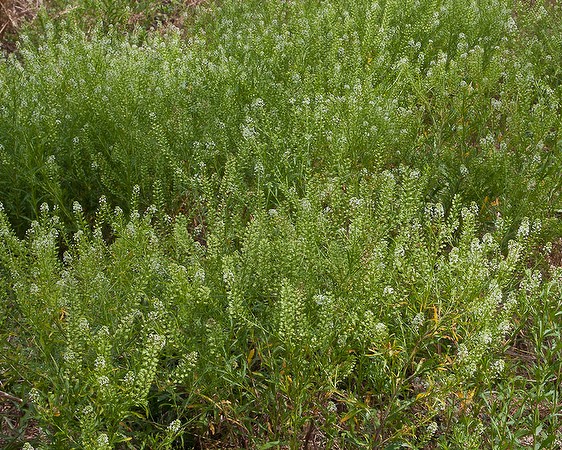
Lepidium at Kiplinger

Yesterday John and George dodged a deluge to enjoy raindrops on the flowers in the Kiplinger Natural Area in Stuart, home of spectacular Loblolly Bays, non flowering in January yet attractive with red winter leaf coloration.

Dominating the disturbed trailside was Pepper-Grass (Lepidium virginicum), which is neither a grass nor related to red or black pepper.  A better name for this coarse native weed might be “Stink Mustard.”  This member of the Mustard Family reeks when crushed a little like its cousin Horseradish.  The Mustard Family is perhaps better known by the older name “Cruciferae,” as in “eat your cruciferous vegetables,”  for instance, cabbage, brussel sprouts, and cauliflower, which are all different cultivars of the same species.  They are called “crucifers,” not because eating them resembles being crucified to kids brought up on pop tarts and Wendys, but rather because the four petals form a cross.  The novel fruits are flat with two covers that fall away to leave a translucent membrane.   Vocabulary lesson:  the fruits are called silicles (SILL–ah-culls, oval) or siliques (a sill-EEK is long and SLEEK).
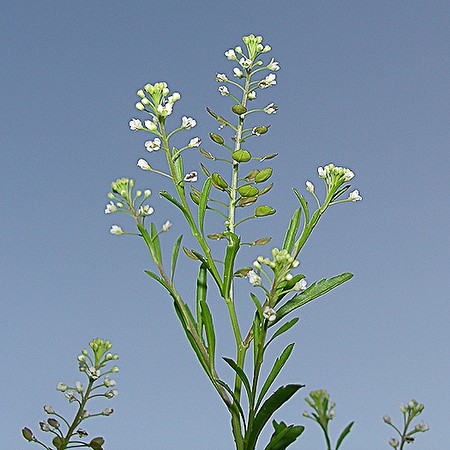
Flowers and silicles (photo by JB)

Different plants poison their pests differently, and Crucifers are regular Nozzle Nolens.  Crush Pepper-Grass, and the sharp mustard vapors penetrate your sinuses like a knife.   The kick comes from sulfur-based “mustard oils” more properly known as glucosinolates.  Until activated, the glucosinolates (glue-coe-SIN-oh-lates) are benign.  They and the activation-enzyme myrosinase reside in separate parts of the plant cells until a lubber grasshopper takes a munch.  Then, like two tubes of epoxy, the glucosinolates and enzyme mingle for hot stinky action in the crushed tissues.  We could linger the chemistry, but that would get boring to the non-chemists (like us), and we’d get in over our heads fast.

Low-dose glucosinolates can be tasty like mustard on a wiener, or cole slaw, or sushi with wasabi.  And the good news is that glucosinolates may inhibit cancer development, although the jury is still out.
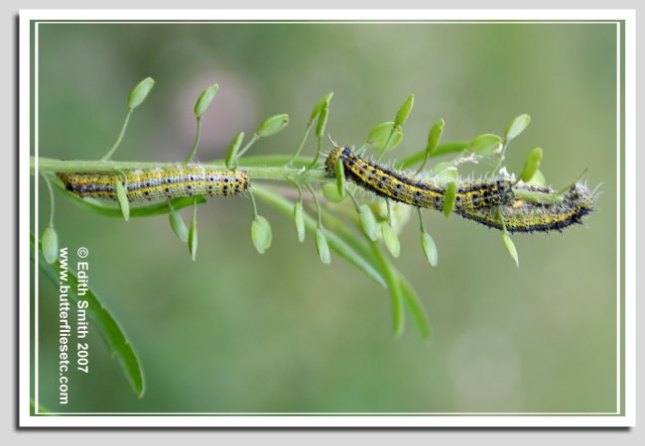
Glucosinolates are wasted on these Great White Southern caterpillars (photo by Edith Smith)

Anti-herbivore toxins deter most vegetarians, but life is one big evolutionary race between the eaters and their victims’ defenses.  Coyotes do catch roadrunners, and creatures do eat Lepidium.  Varied cooties, ranging from aphids to butterflies, have developed enzymes to deactivate the mustard oils, allowing access to those colon-cleansing cole vegetables.  Pepper-Grass supports native and non-native mustard-proof butterflies.   Examples include the Cabbage Butterflies (duh) as well as the Checkered White Butterfly, Great Southern White Butterfly, and the Falcate Orange Tip Butterfly (in northernmost Florida).

In conclusion, eat your vegetables.

(The photo of the Great Southern White Butterfly on the Lepidium is courtesy of Edith Smith at Shady Oak Butterfly Farm.  Visit her remarkable web site CLICK)
 
1 Comment

Posted by on January 28, 2012 in Pepper-Grass


Tags: , ,

Pokeweed

 Pokeweed

Phytolacca americana

Phytolaccaceae

Click for deeper data 

Yesterday John and George explored the natural area adjacent to Bert Winters Park on the Intracoastal in Juno Beach.  This disturbed scrub habitat is in part a scuffed-up area showing signs of invasive exotic removal, and has a small pond surrounded by a sedge-lover’s paradise of wet-mud-plants.  Like any recently disturbed area, the botanizing is fun, and the wildflowers were pretty and plentiful: Coreopsis, Frostweed, Hempvine covered with puffy fruit clusters, Jeweled Blue-Eyed Grass looking like a little blue garden iris, Pineland Scalypink blooming on the sunbaked sand, Procession Flower parading across the dune side, Skyblue Lupine, and striking Beautyberry in full berry.

Image

                                               Photo above: Procession Flower by JB

Image

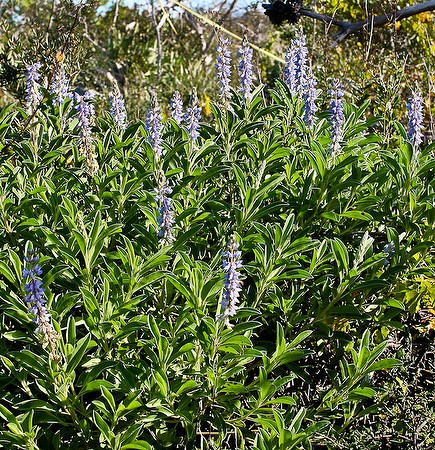
                                                 Photo above: Skyblue Lupine by JB

Such a dandy menu – so hard to select a species to feature.  So how about the most beautiful of all: Pokeweed.

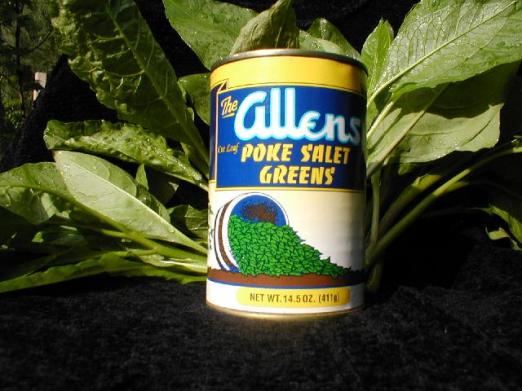
Phytolacca americana is a fascinating species, at least to a die-hard plant enthusiast.  We’ve all heard of Poke Sallet Annie who used to make a mess of it, after careful boiling it to defuse the toxins.  Poke sallet (salad) has had such prominence as an “edible” green they used to can it, a bad idea.  They also used to color wine with the berry juice, another bummer.  As kids we used to smear the berries on as war paint, again, not optimal.  And here is why:

The plant contains kickass bioactive compounds.  The roots or even the berries can kill a person in a jiffy.  But the acute toxicity is not what we’re going to discuss now.  More subtle and insidious are proteins called pokeweed mitogens, abbreviated PWM.   For George these have the distinction of being his first Internet search, back in the 80s when you had to make an appointment with a trained librarian, and received the results on that green-striped perforated computer paper.  The outcome of that primitive search was a huge literature on PWMs.  You can Google pokeweed mitogens on your own now with no help from the librarian.  (That’s a hint—do it.)   These compounds, merely from touching the plant, repeat, from just handling the foliage, stimulate the human immune system to proliferate white blood cells.  PWMs work in ultra-minute concentrations.   No thanks on that sallet, Annie.

Image

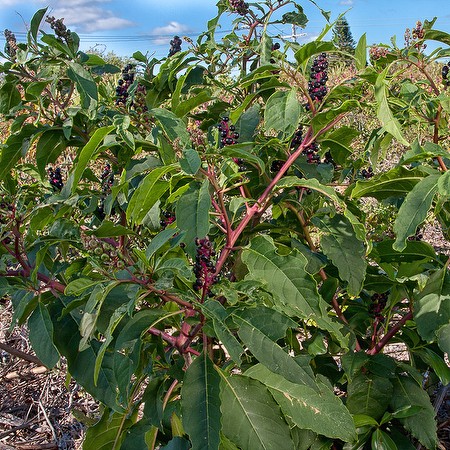
                                                       Photo above: Pokeweed by JB

Why was this not discovered until recently?  The PWM effects don’t seem to cause any known symptoms.  You don’t feel ill, but if you go in for a routine blood test you might raise some eyebrows.  (That is how the effect was discovered.)   These super-charged proteins have taken on a life of their own in immune-cell medical research.  Poke the Pokeweed, it pokes you back.

There is additional interesting Pokeweed biochemistry—antiviral compounds for instance—but let’s move on to bigger things.  This species is a master weed.  It builds up a massive root  that can pose as a parsnip, which is how it has snuffed occasional vegetable gardeners.  The root could survive a nuclear attack and provide poke salad to the mutant post-apocalyptic survivors.  (They will have bigger concerns than proliferating white blood cells.)  Even more interesting are the seeds.

Squash one of those black berries (oh yea, right, don’t touch it).  There are 10 seeds like bullets in a revolver.  Now you might think, “that’s nice, the birds eat the berries and disperse the seeds like any old berry maker plant.”  True, but with an odd twist.  The seeds have varied “wait times” for germination.  If you pluck out the 10 seeds and plant them, some will sprout right away, and others won’t.  Some have a built-in delay documented to last at least 40 years.  This weed is banking for the future!  When a bird drops the seeds from one plant, not only is it being dispersed in space but also in time.  Some of those delay-action seeds get into the soil, then a new forest grows up,  a cyclone blows the forest away, and ta-dah(!) pokeweeds sprout forth after a very patient wait.

This is getting long, but there’s one more important thing, so just keep reading.  Pokeweed has an odd geographic distribution pattern.  The species comes in two varieties.  The “normal” variety, variety americana, with droopy flower clusters is widespread across much of North America.  What’s weird is variety rigida, which, by contrast, holds the inflorescence upright.  Variety rigida is confined to the Atlantic and Gulf coasts, mostly in a razor-thin seaside strip as narrow as a mile or so, stretching from approximately New Jersey to Texas.   The only area where it occurs inland is across all of Florida, which is not exactly inland.   You might think the difference is environmental—maybe those coastal briny breezes influence the angle of the dangle, but life is never so simple.  If you take seeds from perky variety rigida and cultivate them inland where its droopy cousins dwell, the rigida grows up proudly erect, indicating a genetic component to the puzzle.

Now that’s just wacky. Geographically, upright variety rigida is a thin wrapper on the edge of a huge dangly variety americana population.  Along the coast the two grow in close proximity.  I mean, start at the beach, spot the upright rigida on the dunes, walk inland  a mile and the inflorescences droop.  Birds no doubt constantly carry rigida seeds into americana territory and vice versa, yet the two persist as distinct (there are occasional intermediates).  Go figure!

The take-home lessons are these:

1. Do not eat the Pokeweed even if Grandma did, even if Grandma boiled it.  If you are a Grandma, do not serve it.

2. Do not handle the Pokeweed if you are having blood work anytime soon, unless you want to have some fun with the doctors.

3. If you clear the forest, time-delay Pokeweed may rise up and say hello.

4. Because we live in Florida, our Pokeweed has upright flower clusters, but who knows why.

 
4 Comments

Posted by on January 22, 2012 in Pokeweed


Tags: , , , ,

Coffee, Tea, or Gallberry?

Gallberry

Ilex glabra

Aquifoliaceae

John’s been inventorying the Mariposa Cane Slough Preserve in Pt. St. Lucie, for which he produced an engaging slide show with great music.  To keep the ball rolling, John and George sniffed around the preserve yesterday, enjoying nature’s oasis.    CLICK

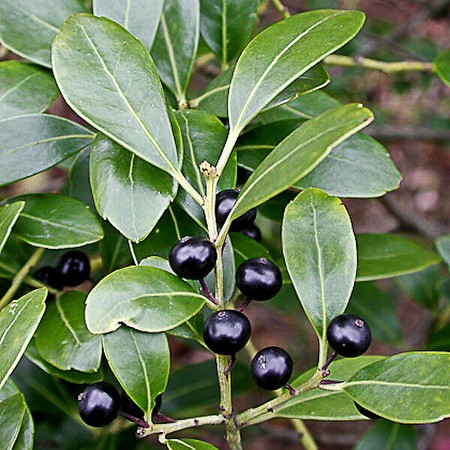
One end of Mariposa suffered a fire not so long ago, and the plant community there is different from the rest.   There is a “lawn” of Gallberry (Ilex glabra).  Gallberry is an example of our feeling that much of the fun of botany comes from getting to know the everyday plants.  Often that’s especially fun because we see the everyday plants, well, every day.  If you have ever tasted the black pea-sized fruits you know why it is called “gall” berry.  They are bitter, although in sort of an interesting way.  Birds and wildlife don’t all find them too bitter.  Maybe the intense flavor discourages the “wrong” fruit-eaters.

Gallberries as they looked yesterday (by JB)

There’s a lot of weird stuff about Gallberry, beginning with the fact that it is a Holly.  If this is not clear at first glance, the flowers are Holly-ish, and leaves look like those of small Asian Hollies used in landscaping.  To steal a 1974 quote from horticulturists Jack Alexander and Michael Dirr, “If Gallberry came from Japan, people would rave about it.”  Of course, the U.S. was especially fascinated with Japan in the 70’s.  Fact is, there are several named horticultural cultivars of this species, more valued up north than in Florida.  Up north?

How many species do you know with a distribution from Florida all the way to Nova Scotia (and westward to Missouri)?  The breadth of the distribution underscores the environmental breadth of Gallberry: hot, cold, sunny, shady, acid, slightly alkaline, clay, sand, or salty.  The species prefers moist  sites, although there is drought tolerance.  The diverse Florida habitats include low pine woods, especially after fire.

Male flowers (not seen this week) (file photo by JB)

The most interesting features of Gallberry have to do with fire.  Here is a hot quiz question.

What do mushrooms, many grasses, icebergs, Gallberries, and spy syndicates have in common? Answer:  Most of the action is hidden below the surface.

Gallberry rhizomes and roots form a massive widespread subterranean network.  The rhizomes can grow to multiple inches in diameter and can run several feet underground connecting bush-with-bush-with-bush like stations along a railroad line.  This helps explain why Gallberry can form a monospecific even-aged “lawn” of thousands of individuals.  As with the Hydra of mythology, cut off one head and is sprouts more.

Cut off one head and you get two more.

Who would cut off the head?   Fire mostly.  Easy to envision here in flammable Florida, although it is fun to wonder if fire is the only leveling force to mow down the Ilex from here to Nova Scotia (or wherever the species evolved originally—see below).  Maybe grazing by herbivores, or extreme cold, or other harsh forces of nature have been factors in the equation too.

Have you ever noticed how a patch of Gallberry can be nearly or entirely berry-forming or not?  As a Holly, Gallberry is dioecious, that is, with separate male (pollen-producing) or female (fruiting) plants.  A big patch, all growing from the same rhizome network can be one big individual genetically speaking, just like a mushroom “fairy ring.”  Such a patch could be all male or all female, although more than one rhizome-individual might establish in one patch, especially given the prolific fruit production and assistance by berry-eating birds and mammals.   If the patches were too unisexual and too separate there’d be no cross-pollination.

This photo tells a story. The blackened stem rising in the upper right is a burn fatality. Hydra-style, at its base are rising two new replacement shoots. A pink new rhizome is extending to the lower right.

While on the theme of Hollies, did you know that Hollies are among the few plant groups with drinkable caffeine?  Hollies serve as teas in scattered regions, including the “Black Drink” consumed by Native Americans in the Southeastern U.S. derived from Dahoon Holly and from Yaupon Holly, and the Yerba Mate sipped at South American tea parties.  What about Gallberry?  Some folks call it “Appalachian Tea,” although its caffeine levels range from zip to bitsy.

One final odd tidbit.  Multiple species of Ilex (Hollies) are native in the U.S.  And you might naturally expect species found together to be most closely related to each other, which is often so but not here.  DNA study shows Gallberry a member of a species cluster otherwise limited to Eurasia and Africa.

Did a migrating bird bring it?   Or with its northern predilection, did the distribution once sprawl from Asia, across a once-dry Bering Strait leading to sunny Florida?   There are many florisitc links between eastern Asia and the eastern U.S.  In any case, the 1974 comment invoking Asian landscaping Hollies was more true than the authors knew.

In short then, here’s a shrub we trip over rushing through the forest looking for the rare or noteworthy, while this humble shrub is notable in its own right as a valued landscape Holly, as a rhizome champ, as a natural shrubby “lawn” after fires, as a native cafeteria for wildlife, as a half-hearted tea, and as an Old World species far from home.  Perhaps it did come from Japan, and it is ok to rave.

 
5 Comments

Posted by on January 14, 2012 in Gallberry


Tags: , ,

Sedges and Grasses on the Move?

Tropical Umbrella Sedge

Fuirena umbellata

Cyperaceae

Yesterday John and George wandered the Danforth Conservation Area in Palm City, a low pine woods with ponds, seasonal pools, and squishy places with mud to your ankles.  Beauty was everywhere, including a natural “botanical garden” of the Aster Family with white, violet, and yellow blooms.

Honeycombheads (Balduina angustifolia) (by JB)

In the squishy zone we encountered a worldwide super-weed seldom seen in Florida, Fuirena umbellata.  We’ll call the species Tropical Umbrella Sedge for lack of a better English name.

Of course invasive exotics are abundant in Florida.  Collectively grass and sedge invaders are remarkably plentiful, and include such conspicuous cases as Guinea Grass, Napier Grass, Natal Grass, and Para Grass.   Many additional less conspicuous species have snuck in.  The problem has a name, even if it is misleading, “The Africanization of American Grasses.”  Not all the invaders are African, but a large number of our invasive grass and sedge species are of Old World origins.  It would be depressing to know what percent of Florida grass and sedge biomass is not indigenous. Given that grasses are the fuel for grass fires, and occupy the bottom rung of the ecological pyramid, the quiet species shift is a little worrisome.

Fuirena umbellata at Danforth (by JB)

Umpteen forces from hurricanes to imported nursery material move grassy weeds to and around Florida.  This complex of forces plus deficiency of historical data make it uncertain that Global Warming is crucial in the grass and sedge invasion.  But to our limited experience here at the latitude where tropics meets frost it seems like the invasive drift might have a northbound tilt. (The biological literature offers many examples of species shifting northward presumably due to Global Warming.)

Even if Global Warming is not directly responsible for northward weed migration, it no doubt warms the reception for tropical invasives, such as Cyperus hyalinus, Cyperus pumilaKyllinga squamulata, to list three sedges now in Florida from points South.  Our favorite example is the grass Steinchisma laxa, a tropical weed unknown in Florida until 2007, then suddenly abundant.  Perhaps Wilma helped.

That brings us back to Fuirena umbellata.  In cases of worldwide tropical weeds, it is tough to pinpoint an exact original distribution, perhaps the Tropical Pacific and Tropical Asia?  In any event, the weed, often associated with rice, is abundant in warm-climate Asia, Pacific Islands, Africa, and tropical America.  Yet  we are aware of only one other collection in Florida, in Broward County, although we have not conducted an exhaustive scientific search.  The abundance south of Florida coupled with scarcity in Florida and a surprise appearance in arctic Martin County is consistent with interpretation as another seemingly northbound weed.

Fuirena umbellata can be so plentiful in other countries as to serve as green manure in rice cultivation.  The species is salt-tolerant, and in places is burned to recover salty ashes; it serves as a (saline?) cleansing bath for babies in Africa.  Reminiscent of Scouring Rushes, the plants contain silica, limiting their utility as livestock fodder.

Fuirena has about four other species in Florida.  Southern Umbrellasedge  (F. scirpoidea) is a common presence along muddy shores, as are a couple smaller species.   Although the flower clusters in today’s species look “just like” a Fuirena, the overall appearance of the plant is out of line with the more familiar species; it stands  up to about six feet tall, making it a giant among Fuirenas, with a distinctive 5-angled stem.    Fuirenas are among the few sedges that have “petals” in the flowers, and those of F. umbellata, as seen with a hand lens, are big, broad to the base, and persistent around the seedlike fruit.

The first species known to us to be documented as migrating (to higher latitudes) due to Global Warming was Edith’s Checkerspot Butterfly in California. This was reported in 1996, just 16 years ago.   The list has grown since then, and we’re hoping that we are wrong about Fuirena umbellata being an “Edith’s Checkerspot” of the Florida grass and sedge world.

 
3 Comments

Posted by on January 7, 2012 in Tropical Umbrella Sedge


Tags: , , ,

What’s the proper side dish for cannibal stew? (Sweet Potato)

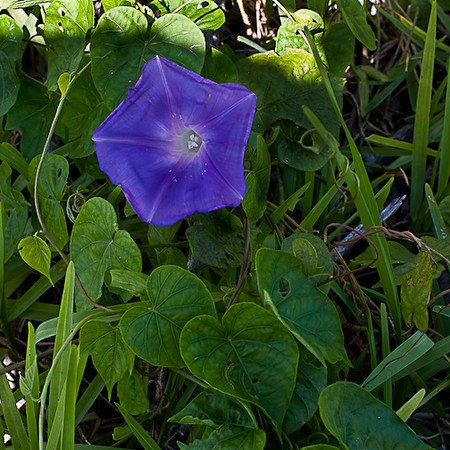
Morning Glories

Ipomoea species

Convolvulaceae

John and George missed getting to the field this week, John with house guests, George with the flu and with adult children home.  So we take a lazy armchair look at a nourishing and photogenic genus.  Ipomoea has around 500 member species, with about 25 in Florida natural areas, wetlands, gardens, and Winn Dixie.  This is the genus of Sweet Potatoes (Ipomoea batatas) and of various species significant in ethnobotany, in gardens,  as invasive exotics and weeds, and at rock concerts.  (Remember Morning Glory seeds?, If not, Google.)

Ipomoea indica (by JB)

Ethnobotany first.  Sweet Patooties originated in the American tropics with their cultivation dating back thousands of years.  They sure have gotten around, making their way westward into the Tropical Pacific in pre-European times.  How exactly that came about remains hidden in the mists of history, despite plenty of discussion and conflicting hypotheses.  Our utterly worthless and 100% non-original guess is that they came back across the Pacific with Polynesians who visited South America and then went back.  And this is our segue into another weird story of Sweet Potato relocation, with a Florida connection.

The Archbold Biological Station near Lake Placid is dedicated to ecological research, especially of scrub. Its 1941 founder Richard Archbold (1907-1976) did not earn his glory studying Red Widow Spiders in Florida scrub, but rather as an adventurer, aviator and jungle explorer, especially in New Guinea.  An Indiana Jones kinda guy, he was the first recorded Western explorer to discover the Baliem Valley in New Guinea, home to an isolated Stone Age population lost to the bigger world until Archbold’s 1938 visit.  What a find.  This was the heyday of aviation-borne, National Geographic feature exploration, and the New Guinea folks were cannibalistic and wore scary tusks to make it totally cool. You may now visit as an eco-tourist.

New Guinea Dani Tribesman (Google Images)

Back then a remarkably large lost population of farmer-warriors occupied a high misty jungle valley surrounded by treacherous mountains.  Today perhaps they wish they had not been found, especially because a member of Archbold’s group shot and killed one.  Not a great  ice-breaker.

Now there are a million fascinating aspects to this, but only one ties in to today’s topic: guess what that lost civilization was growing?  Sweet Potatoes, an American plant.  (They had interesting gourds too, but that is a different story.)  But to return to the amazing point with emphatic redundancy: a species from the New World was the primary crop, cultivated with finesse thank you, in the hands of an isolated mountain tribe with no prior western contact.  Dang.  How that came about is not 100% clear.  Biologist Jared Diamond suspects historical Spanish mariners to have something to do with it.  More intriguing (if less likely) is the possibility that the pre-European movement described above extended as far as New Guinea.  Comparative DNA study will sort all that out soon enough.

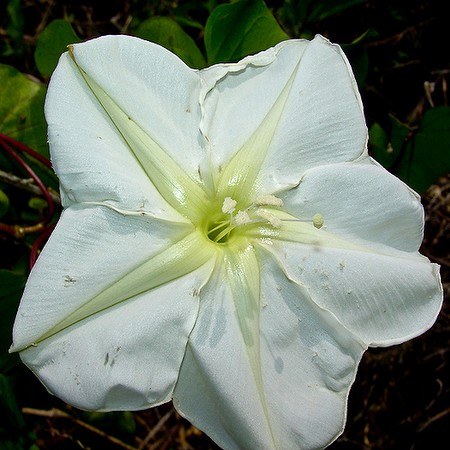
Ipomoea alba (by JB)

And speaking of weird Sweet Potato redistribution, closer to home, floristic super-botanist John Kunkel Small wrote about Giant-Rooted Morning Glory (Ipomoea macrorhiza) persisting from probable ancient cultivation on Florida Native American middens.  If not cultivated, it was clearly at least a sanctioned “camp follower.” Whether or not the species is “native” in Florida seems unclear (and way interesting), placing it in the same native-or-not category of other midden present-day survivors and archaeological remains as  papaya, red peppers, and possibly the “native” agaves.

For a species most definitely not native, we have Water Spinach (Ipomoea aquatica), which came to us from Tropical Asia, where it is an important and prolific staple.  In the U.S. and elsewhere, however, Water Spinach has become a Category I invasive exotic, floating on the water surface and extending its green tentacles by 10 cm per day.  Today’s invasive exotic may feed and fuel the hungry world someday, so no need to be a hater.

Moonvine (Ipomoea alba) is a night-blooming species with big moon shaped lunar-white flowers pollinated by moths in the moonlight.  It once festooned the Pond Apple forest around the southern rim of Lake Okeechobee.   Earlier observers marveled at its abundance, and it remains marvelous in places.  This worthy vine has earned respect in nocturnal gardens worldwide where white blossoms in the breeze dangling from tropical pergolas may tilt the mood to enchantment and romance.

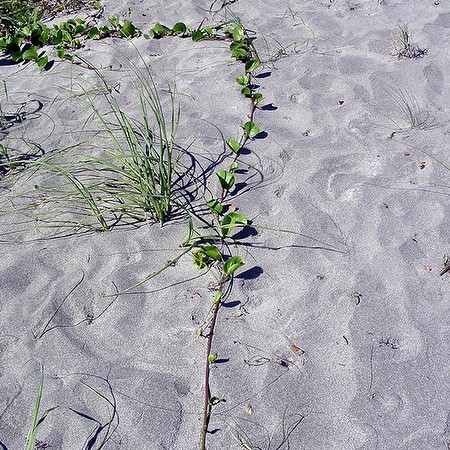
To flip to the other enviro-extreme, Railroad Vine (Ipomoea pes-caprae) is familiar to Florida beach bums.  The purple funnel-shaped flowers rise from the stems stretching across the salty sand like a railroad crossing the Mojave Desert.  The leaves resemble a goat’s foot.  This indestructible vine survives relentless abrasion as well as beach sun and salt, and has an impressive ability to regenerate from severed stem chunks.  This and other Ipomoea species contain anti-inflammatory compounds of interest in a modern pharmacological context.  If you get zapped by a Jellyfish at the beach, here’s a new idea to challenge the famous ol’ weewee therapy.  No thanks, really, on both.

Railroad Vine on the beach (by JB or GR?)

If we were writing a book we could go on into scads more Ipomoea species, but we’re just having fun here, so let’s quit while it is still fun.

 
6 Comments

Posted by on December 30, 2011 in Morning Glory


Tags: , , ,

Bladderworts and Other Bugivores

Drosera capillaris   Droseraceae

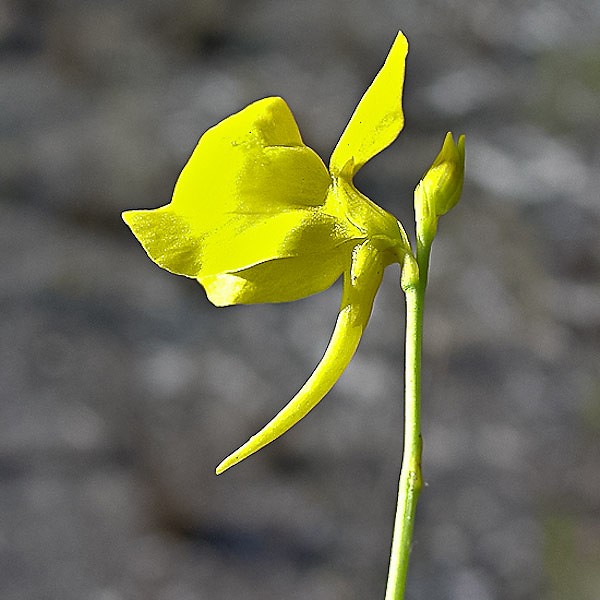
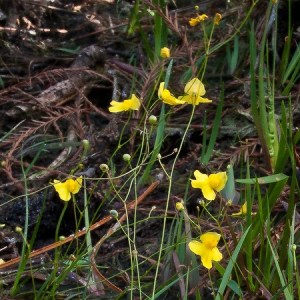
Horned Bladderwort (by JB)

Today John and George  explored  a small pond and adjacent Bald Cypress swamp margin in Jonathan Dickinson State Park near Hobe Sound in preparation for an upcoming educational event.   Carnivorous plants ruled today, so here we go on Bladderworts n’ stuff.   We scored a  Utricularia hat trick, encountered three different species all in flower in a small area.  Generally called Bladderworts,  the  genus contains 214 species altogether.

Zig-Zag Bladderwort (by JB)

Flesh-eating plants represent diverse plant families of Monocots and Dicots, and are not closely related to each other.   They have evolved in situations where the main plant nutrient, nitrogen in its various forms, is in short supply,  or where impaired root functions make it hard to take up, or where roots are absent altogether,  as in Utricularia. Insectivory  captures nitrogen in sterile sandy soils, in acid substrates, on epiphytic perches, in anoxic muds, and sometimes in aquatic habitats.  Utricularias look more like Algae than Flowering Plants—until you spot the beautiful flowers.

Genlisea with trap (Google Images)

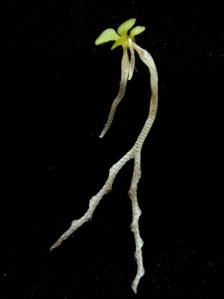
The Genlisea traps are tubes, topped with two weird  long twisted appendages at the open end.   They look a little like those blow-up arm-flapping tube men they use to draw attention to used car lots and furniture sales.  The armlike appendages have inward pointing hairs.   Varmints swim in but can’t back out, because the hairs are a unidirectional valve,  as some fish traps catch fish.  The Genlisea traps are technically rolled leaves, so it is possible they evolved from simpler ancestors having in-curled blades resembling those of Pinguicula, making Genlisea sort of a “missing link” between simple Pinguicula and the complex traps in  Utricularia.   Perhaps relevant to this, Genlisea species have foliage leaves in rosettes  resembling those of Pinguicula.

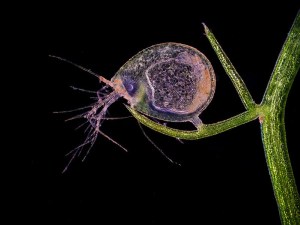
Bladderwort bladder with trigger hairs (Photo by Jose Almodovar)

Utricularia traps are bladder-shaped or look like one of those goatskin wine squirt bottles favored by skiers.    The door leading into the bladder has a trap door.  Near the trap door are microscopic trigger hairs.  When the victim jostles the triggers,  the trap door releases and the bladder expands rapidly, sucking in the meal, as a slurp gun sucks in an aquarium fish. The in-slurp happens in a tiny fraction of a second.

CLICK for video

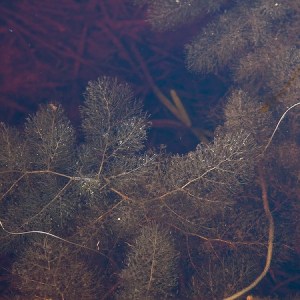
Today’s three Utricularia species are a study of variation within a single genus.   Leafy  Bladderwort  (U. foliosa) lives suspended gracefully in the standing water,  looking at first glance like a green alga waving in the pond.   It builds up huge slippery biomass.   Oddly, the species is distributed in the Americas and in Africa.

Leafy Bladderwort in water (by JB)

The other two, Zig-Zag  Bladderwort (U. subulata) and Horned Bladderwort (U. cornuta), inhabit  moist muds.   They both have fine threadlike leaves hidden in the soil.    They differ in their flower structures:  living up to its name (cornuta = horned), Horned Bladderwort has a long horn-shaped spur on the flower.   Zig-Zag Bladderwort is one of several species in ur area capable of making cleistogamus flowers: tiny flowers that self-pollinate (or somehow develop seed) and never open.

This species has a second quirk.  Where are the photosynthetic leaves?  It has some leaves but not much.  Botanist Wilhelm Barthlott and collaborators, citing earlier research, discuss this species as one of the few “carnivorous” plants that derives energy and not merely minerals from carnivory.

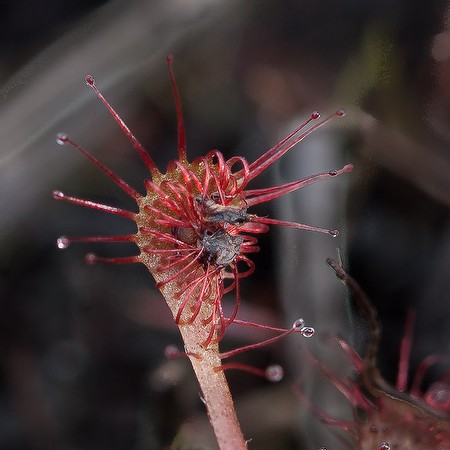
Around our feet, the Bladderworts had competition for the buggy menu.  The wet ground was littered with beautiful tiny Sundews (Drosera capillaris).  The reddish leaves on these are shaped like spoons and are covered topside with long hairs, each hair with a glistening glandular tip.   Insects who touch the tarbaby get in worse and worse as they struggle, until the goo-tipped hairs bend inward and press the corpses to the digestive leaf surface.

Sundew enjoying lunch (Photo by JB)

 
Leave a comment

Posted by on December 21, 2011 in Bladderwort, Sundew


Tags: , , , , , , ,

Dull Leaf Coffee isn’t THAT Dull

Dull Leaf Coffee


Psychotria sulzneri


Rubiaceae


Today John and George continued exploration of Mariposa Cane Slough Preserve in Pt. St. Lucie behind Sam’s Club.  Basing our species choice on beauty, today’s looker was the Dull Leaf Coffee, Psychotria sulzneri in full berry.   This species is one of the four Psychotria species in Florida, three of them native, two indigenous to our area.  The other local native is the Wild Coffee, Psychotria nervosa (the term “nervosa” refers to the leaf veins, not to a mental condition).


Psychotria is one of the largest Dicot genera, with over 1500 species around the world in warm climates.   Some, including Psychotria punctata introduced in southernmost Florida, have symbiotic bacterial translucent dots in the leaves.   Some produce psychoactive alkaloids, although the name “Psychotria,” is apparently not a direct reference to drugs, but rather to an ancient belief that species of this genus propped up the psyche, or soul.   Wild Coffees are related distantly to the coffee we drink, and so far as we know, drinking preparations from Psychotria is dangerous (see comments on drugs above).   Psychotria is in the Coffee Family, the Rubiaceae, an assemblage of many thousand species, including wildflowers (such as Innocence), garden selections (such as Ixora), medicines (such as Quinine), and weeds (such as Mexican “Clover”).


To transition into today’s chosen species, Charles F. and Pearl Sulzner were early Miami real estate investors who supported good causes, including botany, especially for the New York Botanical Garden.  John Kunkel  Small, Florida’s preeminent botanist and namer of P. sulzneri,  represented the New York Botanical Garden and was connected to Miami philanthropy.  He knew how to suck up. Charles Sulzner died tragically at age 85 after being clobbered  by a streetcar in St. Petersburg.


The fruits (photo by JB)

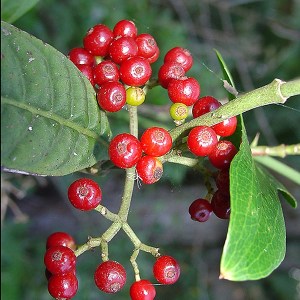
The stunning berries (actually, drupes) on Psychotira sulzneri  pass through a bright yellow phase on the way to scarlet, often resulting in flame-colored fruit displays, no doubt irresistible to birds.   We will come back to the amazing  flowers when the species is in bloom.


The most remarkable feature of Dull Leaf Coffee is not so colorful.    Our two local Psychotria species have starkly different leaf coloration.   Psychotria nervosa features high-gloss bright green.  Psychotria sulzneri , by contrast, has a deep green velvet-matte finish, with a tiny kiss of blue.  But why?  That leaf color is not common in the plant world, although it occurs in other species.  Folks with northern wildflower experience know “Wild-Ginger” (Asarum canadense) with similar coloration.    The leaves are also reminiscent of some Hydrangea foliage, or to a couple of grass buffs like us, a wee hint of Blue Maidencane (Amphicarpum muhlenbergianum).    What do all these have in common?  Shade.


To slide into speculation:     Psychotria nervosa is probably glossy as an adaptation to reflect excess sunbeams, just like a pilot’s mirrored sunglasses.    That would not imply an inability to tolerate shade—it can.   Perhaps delicate shade-tolerant photosynthetic mechanisms need that extra glossy sunscreen, just as the pilot’s delicate retinas need protection.


Rubiaceae stipule (photo by JB)

Psychotria sulzneri  is playing a different game.   Its deep sub-green anti-reflective solar panels  look like they are adapted to drink in every photon, allowing the species to flourish deep in the understory, which it does.  Perhaps P. sulzneri has developed its own sun protection.   When you go to the beach with sunblock it doesn’t show.  So much to research, so few opportunities.  Wouldn’t it be fun to be 22 years old, starting graduate school and looking for research projects with a lab and a grant!?


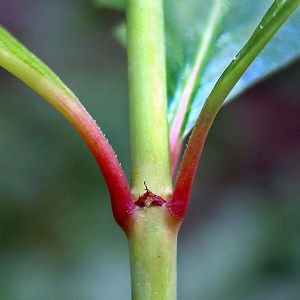
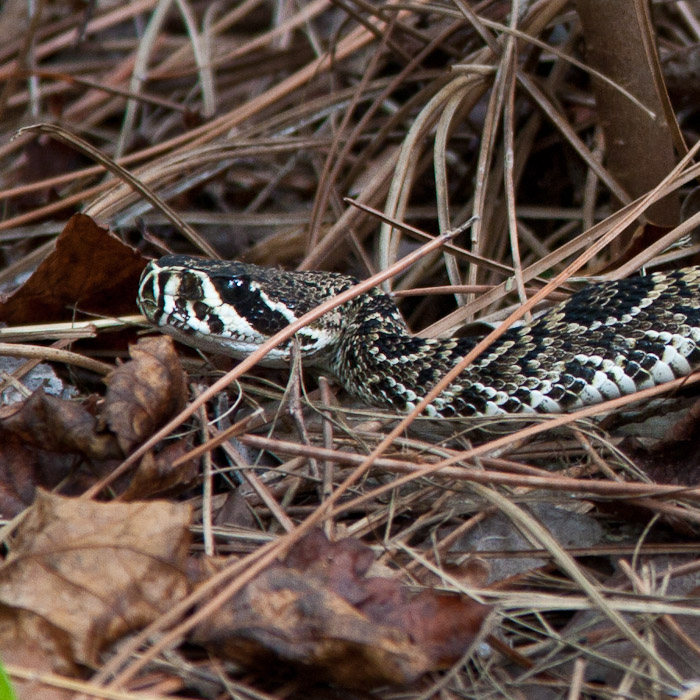
As members of the Coffee Family, psychotrias have a small flap (stipule) between the opposite leaf bases.  The inner surface of the stipule has on it tiny sticky fingers called colleters.  These secrete nectar;  the nectar presumably attracts ants; and the ants presumably defend their botanical sugar-daddy.  Apparently the Mariposa Coffees have escalated their deterrent threat by attracting Eastern Diamondback Rattlesnakes to stand guard.


By the Dull Leaf Coffeee (photo by John “snakes” Bradford)

 
2 Comments

Posted by on December 10, 2011 in Dull Leaf Coffee


Tags: , , , ,

King Eupator, Tom Hanks, and Mrs. Lincoln

Hammock Snakeroot

Ageratina jucunda

Asteraceae

Yesterday, John and George had a good time searching  for Mistletoe in the Mariposa Cane Slough Preserve in Pt. St. Lucie.  This beautiful scrubbish hammock is pure nature joy. And it is in the newspaper,  having its grand opening today (12/3) as this is being typed.  It is an example of the great green things a coalition of green-lovin’ friends of the earth can achieve.  Click for Mariposa

The mystery of MCSP is: “where’s the Mistletoe”?   (Phoradendron leucarpum)   At the southern tip of the Oak Mistletoe range, the species inhabits St. Lucie County, and it is reputed to be in Mariposa.  We looked and hunted, but Christmas kissing in the Preserve  this year must occur without Mistletoe.  Those  big old trees are covered with vines, ferns, Spanish Moss; trying to spot the Mistletoe was  too needle-in-the-haystack for us at the moment, so on to more earthbound plant…

Setting aside an orchid or two, the dominant floral displays yesterday came from the Aster Family, starring Hammock Snakeroot (Ageratina jucunda).   Now we digress a moment, but don’t worry, it all comes together.

A more northern species of Ageratina (White Snakeroot, A. altissima)  is the cause of Milk Sickness which afflicts cattle who eat it and people who drink the tainted moo juice.  The disease was epidemic in the early 1800s in the greater Ohio Valley Region, and killed seven people in Little Pigeon Creek, Indiana in 1818, including Abraham Lincoln’s mother, Nancy Hanks (Lincoln).

Hammock Snakeroot (photo by JB)

Ever notice the resemblance between Nancy Hanks, Tom Hanks, and Honest Abe?  It is not coincidence.

Nancy Hanks (from Google Images)

Also in flower yesterday was Jack-in-the Bush (Chromalaena odorata).  If we turn back the hands of time, this species, Hammock Snakeroot, and White Snakeroot all used to be classified the genus Eupatorium before contemporary taxonomists messed with our minds slicing and dicing the genus.  Geezers like John and George have the older Eupatorium names lodged  in our synapses.

Tom Hanks (from GI)


The easiest way we know to distinguish Ageratina from narrowly defined modern Eupatorium is to look at the phyllaries (the little bracts around the flower head).  In true Eupatorium the phyllaries are conspicuously of two lengths, whereas in Ageratina they are nearly all equal, with a smattering of odd little outliers.

We like Eupatorium, because the name has soul—for  King Tiberius Julius Eupator Philocaesar Philoromaios Eusebes, better known as King Eupator, who reigned over the Bosporus in the late Roman Empire.

Tell the truth

 
4 Comments

Posted by on December 3, 2011 in Hammock Snakeroot


Tags: , , , , , ,

But Rot Might Be Good For You

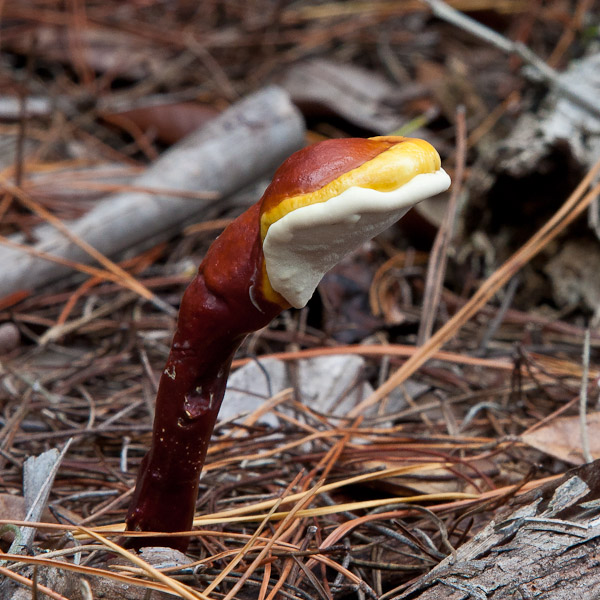
Ganoderma lucidum

[This week, being Thanksgiving, no field trip.  However, John, who is developing his mushroom skills, visited Seabranch State Park near Pt. Salerno where he photographed the fungus Ganoderma lucidum, and researched it.  He’s the brains behind this post, for which George is the typing assistant.]

The word Ganoderma strikes terror into the hearts of South Florida palm gardeners.  Recently Professor Monica Elliott from the University of Florida gave a lecture at Palm Beach State College describing Ganoderma Butt Rot in palms.  The culprit is Ganoderma zonatum.  Many hardwood species suffer Butt Rots too, and today’s Ganoderma can be a hardwood butt rotter.  If you are Asian, however, “Ganoderma“ has a more positive ring to it.  Stay tuned on that.  First, some boring but necessary taxonomy.

Ganoderma lucidum at Seabranch State Park (by JB)

Fungal taxonomy is messy.  Within a species the variation of morphological forms and the environmental influences on shapes and colors can be bewildering:  “those can’t be the same species!”   Butt they are.  Today’s Ganoderma lucidum is an case in point; seen broadly it is the center of a species complex and is understood poorly.  The entire genus has been an historical classification nightmare, with several hundred “species” named around the world, most of them probably belonging in synonymy (that is, redundant).  Part of the nightmare comes from medicinal principles attached to—and patented with—species names.  The nomenclatural mess got so out of hand that a prominent mycologist in 1994 proposed a decade-long moratorium on naming new species in Ganoderma.   So for present purposes, let’s say Ganoderma is a large worldwide genus of wood-decaying fungi best known as “bracket” or “shelf” fungi,  although the shelflike “conk” is not their only form of spore-producing body, which can resemble a mushroom, although the underside will have pores instead of the usual gills.

Ganoderma lucidum production (Google Images)

Ganoderma lucidum is prominent species in Asian medicine, known as Ling Shi in China and as Reishi in Japan.  Its applications are ancient, diverse, highly commercialized, and embraced by modern medical research.  Among the many traditional applications are treatments for high blood pressure, diabetes,  respiratory disorder, cancer, and fatigue.  One of the joys of botany is seeing traditional medicinal applications carry forward into contemporary therapies.  Mainstream cancer-related Ganoderma research focuses largely on diverse effects on the human immune system.

What struck me about John’s findings is how many different threads extend from the same fungus found around the world:  photogenic “mushroom” in a state park, cousin to dreaded tree disease, traditional Asian medicine, and  potential pharmaceutical.   Every living thing has a story,  yet so often we just rush past and say, “oh, look at the pretty mushroom.”

Apply in the event of Butt Rot

 
2 Comments

Posted by on November 25, 2011 in Ganoderma lucidum


Naked Embryos and Dead Man’s Fingers

Black Mangrove

Avicennia germinans

Verbenaceae

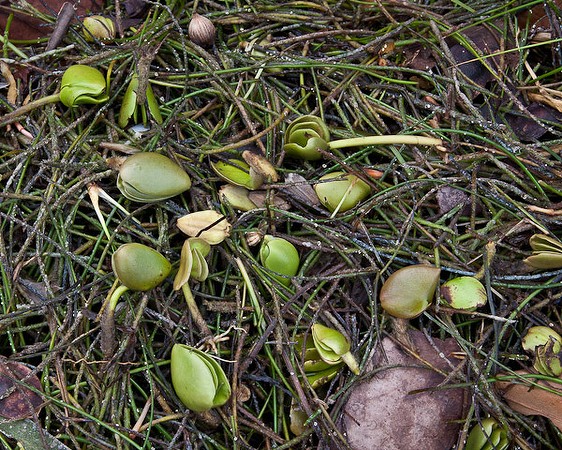
This week’s Friday field trip by John and George got nuked by a combination of work obligations, rain, and car trouble.  With reference to the last-mentioned, this post was written in the commodious Napleton Nissan/Kia Service lounge in Riviera Beach, with complimentary coffee and People Magazine.  So we’ll step back in time just a couple weeks.  Black Mangrove (Avicennia germinans) surprised us by practicing dispersal in massive quantities by bare naked embryos.  We found thousands of them in the tidal wash on the beach at the Hobe Sound Wildlife Refuge across the Intracoastal from Tiger Woods’s spread.  Everybody knows that flowering plants usually disperse as fruits or as seeds, but as exposed embryos?  In saltwater?  Yes.  And some were already rooting on shore, making it clear how you wind up with extensive stands of Black Mangrove.

Black Mangrove embryo castaways on the beach (photo by JB)

Googlization reveals this peculiarity to be old hat to mangrove cognoscenti, even being the basis for the specific epithet “germinans.”  But we’re nobody’s cognoscenti, thus our happy surprise at the little embryonic nudists.  It is also old hat to some plant propagators who soak Avicennia fruits to liberate the embryos for sowin’ and growin’.  By the way, the name Black Mangroves refers to the dark-colored wood.

Embryos from Avicennia species can remain viable over 6 months submerged in sea water and can float alive at least 50 km, although most dispersal is local.  The embryos are large, fleshy, and well provisioned before release.  They look like the innards from a giant lima bean.

Having escaped their fruits and seeds, and having enlarged, they  are in a sense prematurely germinated, and in this way vaguely resemble the precocious seedlings dropping from the unrelated Red Mangroves with a big prematurely sprouted embryonic root sticking out of the persistent fruit covering while still on the mama tree.

Inquiring minds may now ask, well, what about the third Musketeer,  White Mangrove?  Its fruits disperse in the traditional fashion—intact—but they have some “pregermination” going on too, as the seeds can sprout inside the fruits during dispersal.  This shared tendency is an interesting tidbit of convergent evolution where three different and unrelated species have all adopted premature germination, in different forms, to meet the challenge of saltwater-drift dispersal.

Dead man’s fingers (photo by JB)

Anyone with much experience hanging around docks has encountered spooky black gnarly “dead man’s fingers” rising vertically among Black Mangroves.    More convincingly than Bald Cypress “pseudo- pneumatophores,”   Black Mangrove pneumatophores have obvious adaptations as root snorkels.

The fingers are filled with spongy tissue suitable for gas exchange.  The finger lengths adjust to the need for air, and lenticels (breathing pores) on the fingers reportedly open and close in response to environmental conditions.


Leave a comment

Posted by on November 18, 2011 in Black Mangrove


Tags: , , , , ,