RSS

Tag Archives: Avicennia

Naked Embryos and Dead Man’s Fingers

Black Mangrove

Avicennia germinans

Verbenaceae

This week’s Friday field trip by John and George got nuked by a combination of work obligations, rain, and car trouble.  With reference to the last-mentioned, this post was written in the commodious Napleton Nissan/Kia Service lounge in Riviera Beach, with complimentary coffee and People Magazine.  So we’ll step back in time just a couple weeks.  Black Mangrove (Avicennia germinans) surprised us by practicing dispersal in massive quantities by bare naked embryos.  We found thousands of them in the tidal wash on the beach at the Hobe Sound Wildlife Refuge across the Intracoastal from Tiger Woods’s spread.  Everybody knows that flowering plants usually disperse as fruits or as seeds, but as exposed embryos?  In saltwater?  Yes.  And some were already rooting on shore, making it clear how you wind up with extensive stands of Black Mangrove.
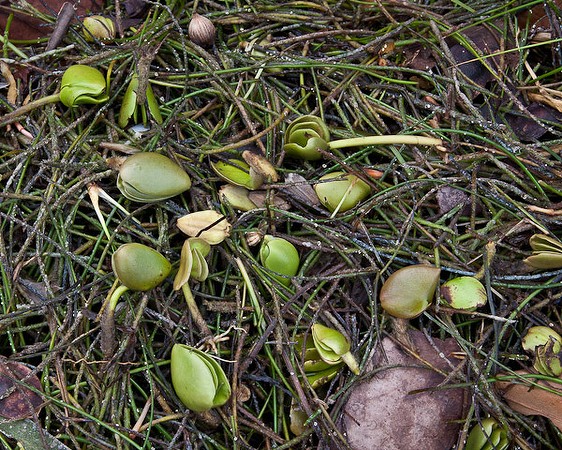
Black Mangrove embryo castaways on the beach (photo by JB)

Googlization reveals this peculiarity to be old hat to mangrove cognoscenti, even being the basis for the specific epithet “germinans.”  But we’re nobody’s cognoscenti, thus our happy surprise at the little embryonic nudists.  It is also old hat to some plant propagators who soak Avicennia fruits to liberate the embryos for sowin’ and growin’.  By the way, the name Black Mangroves refers to the dark-colored wood.

Embryos from Avicennia species can remain viable over 6 months submerged in sea water and can float alive at least 50 km, although most dispersal is local.  The embryos are large, fleshy, and well provisioned before release.  They look like the innards from a giant lima bean.

Having escaped their fruits and seeds, and having enlarged, they  are in a sense prematurely germinated, and in this way vaguely resemble the precocious seedlings dropping from the unrelated Red Mangroves with a big prematurely sprouted embryonic root sticking out of the persistent fruit covering while still on the mama tree.

Inquiring minds may now ask, well, what about the third Musketeer,  White Mangrove?  Its fruits disperse in the traditional fashion—intact—but they have some “pregermination” going on too, as the seeds can sprout inside the fruits during dispersal.  This shared tendency is an interesting tidbit of convergent evolution where three different and unrelated species have all adopted premature germination, in different forms, to meet the challenge of saltwater-drift dispersal.
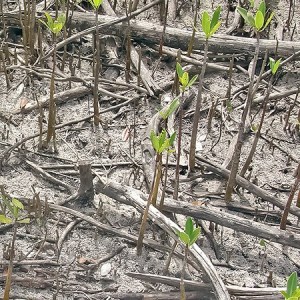
Dead man’s fingers (photo by JB)

Anyone with much experience hanging around docks has encountered spooky black gnarly “dead man’s fingers” rising vertically among Black Mangroves.    More convincingly than Bald Cypress “pseudo- pneumatophores,”   Black Mangrove pneumatophores have obvious adaptations as root snorkels.

The fingers are filled with spongy tissue suitable for gas exchange.  The finger lengths adjust to the need for air, and lenticels (breathing pores) on the fingers reportedly open and close in response to environmental conditions.
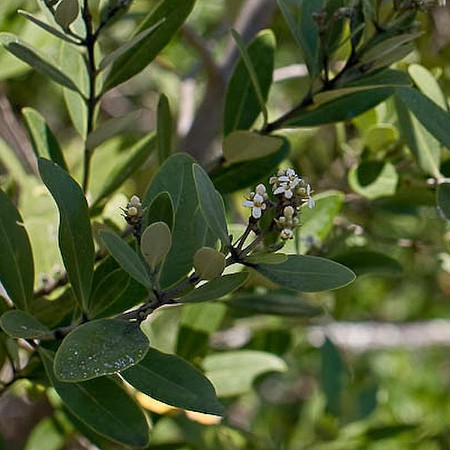


Leave a comment

Posted by on November 18, 2011 in Black Mangrove


Tags: , , , , ,

Love Vine

Love Vine

Cassytha filiformis

Lauraceae

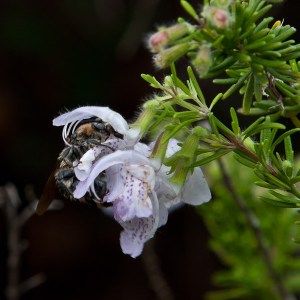
Bee on Conradina (Photo by JB)

John and George explored the Hobe Sound National Wildlife Refuge on the shore of the Intracoastal yesterday, encountering millions of Black Mangrove embryos in the beach debris, some of them taking root.  This was interesting because the dispersal agents are tough, food-laden bare naked embryos without benefit of enclosure in fruit or seed.    We saw Dicerandra immaculata in full bloom left over apparently from a reintroduction effort, enjoyed a bee working over a False-Rosemary (Conradina grandiflora) systematically flower by flower, and encountered a pixieland of mushrooms on the scrubby sugar sand dunes.  

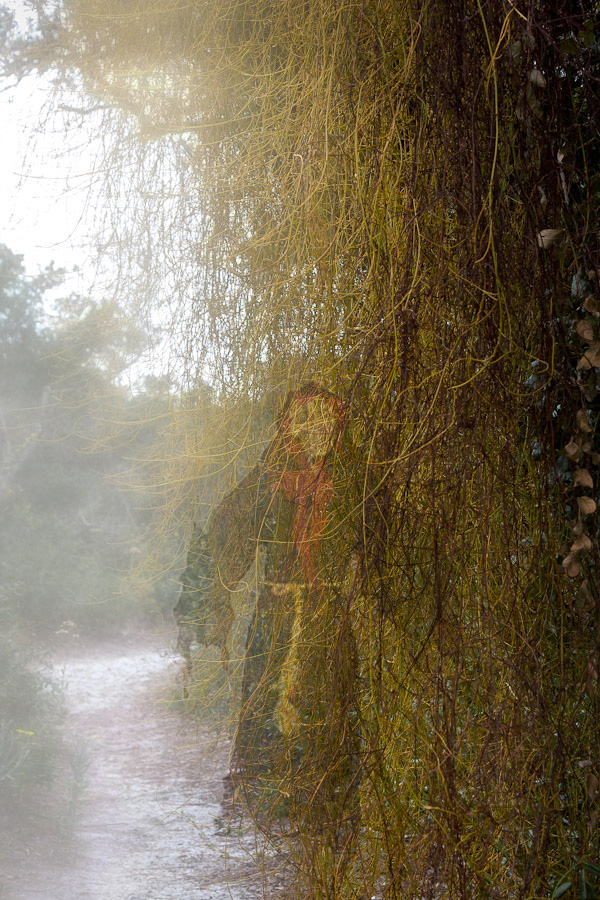
The most imposing and conspicuous (fully) living thing there was the Love Vine draped over trees and shrubs, so we must give it its due.  Love Vine is a nearly leafless scrub-loving parasite resembling orange-tinted spaghetti noodles overwhelming its scrubby shrubby victims.  The botanical name Cassytha comes from Aramaic for “tangled wisp of hair.”  The old name “Woe Vine” fits pretty well too.

To remove a common point of confusion, Love Vine and Dodder look alike but are unrelated examples of convergent evolution.   Dodders are species of the genus Cuscuta in the Morning Glory Family, Convolvulaceae.  Several species live in Florida, with a handful of species in our immediate area.    Although resembling Love Vine, they are far less common and tend to specialize on herbaceous victims as opposed to Love Vine’s preference for bigger prey.

Love Vine (image found on John’s camera after he dropped it fleeing into the woods)

Love Vine (Cassytha filiformis) is a member of the Cinnamon Family, Lauraceae.  Love Vine differs from Dodder by having fleshy drupes (vs. dry capsular) fruits, and by having a feature characteristic of Lauraceae: anthers that open by flaps instead of by the usual slits.   You can see this with a hand lens.   A suggestible observer might sniff the membership of Love Vine in the Lauraceae by a faint spiciness when crushed.   Love Vine has its flower parts in multiples of three, as opposed to multiples of five in Dodder.

Our species, one of about 20 in Cassytha, is worldwide in warm-climate coastal areas.  Apparently the fleshy fruits disperse in part by floating, aided undoubtedly by birds and by storms.

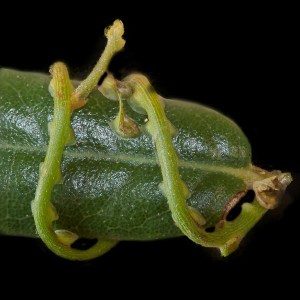
The adaptations of Love Vine for parasitism are profound.  The vine adheres to its host with “suckers” (haustoria) that look like something on a space-alien octopus. 

Love Vine haustoria on oak leaf (photo by JB).

You might think it just sits there and sucks, but the invasion runs deeper.   Tissue from the sucker enters the host and spreads into the hosts cambium (living region just under the bark) and/or phloem (sugar-conducting tissue immediately outside the cambium).  It is never a great idea for a parasite to kills its host.  Although Love Vinosis is sometimes fatal eventually, the attack has a built-in host-sparing restraint.  The parasitic tissue invades the cell walls of its host and draws nutrients out of the host cells across the cell membranes, but the parasitic tissue never actually breaks the host’s cell membranes, thus leaving the host cells alive to keep on feeding.  The recurring idea of harnessing Love Vine as a biocontrol against unwelcome plants may be hobbled by the comparatively nature of Love Vine’s attack. 

On a subcellular level, the xylem (water-conducting) tissues in the parasitic suckers have structures often called “graniferous tracheary elements.”  In plain English, the plumbing at the intake zone has a pressure valve involving tiny granules whose function seems to be to control the stream of incoming stolen sap.    The distribution and roles of these poorly known structures need research.

Around the globe, Love Vine has accumulated numerous uses, ranging from body decoration, to medications, to hair promoter, to potential modern cancer therapy.   As is so often true, the plant contains toxic alkaloids, yet is on the menu in some cultures.    And of course, Love Vine is the active ingredient in love potions.    Happy Halloween.

 
4 Comments

Posted by on October 29, 2011 in Love Vine


Tags: , , , , , ,