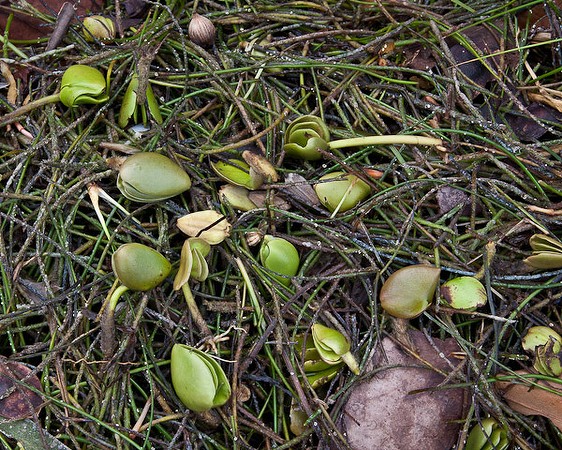
Red Mangrove (Rhizophora mangle) (CLICK for nice Gigapan Red Mangrove by John Bradford added subsequent to posting this blog)
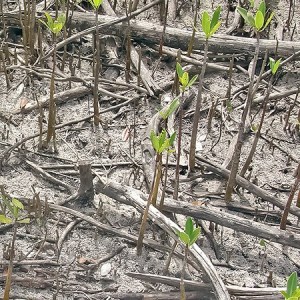
Black Mangrove (Avicennia germinans)
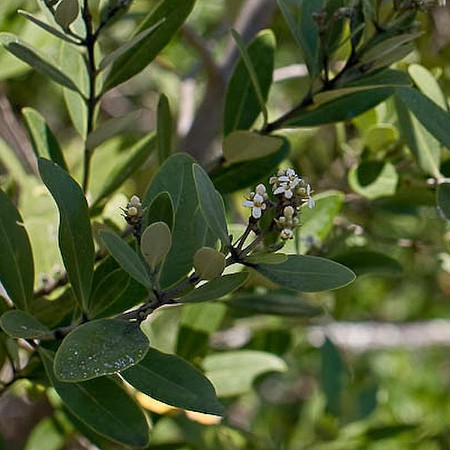
White Mangrove (Laguncularia racemosa)
Toxic “Algae” (Microcystis aeruginosa)
John and George today worked on our tans portaging camera gear around the Kiplinger Natural Area on the St. Lucie River by Stuart. John seized the day to capture Gigapan photos of the river shore.
Gigapan photos allow viewers to pan around and to zoom in on details. Try it after CLICKING HERE to cyber-visit the river.
We had Mangroves on our mind, and they did not look healthy. The shore is lined with a species jumble, including Brazilian Peppers, and many mangroves (especially red mangroves) are dead or visibly unhealthy. (As pointed out in the commentary below, the dead trees in the gigapan seem to be entirely or mostly Brazilian Pepper, although in the vicinity there are miserable mangroves too. The mangroves at this site look decidedly less healthy than those directly on the Intracoastal where I spend a lot of time. I have re-edited this post post-publication to reflect the fact that most of the dead trees are not mangroves. The main point is the water contamination, so read on.)
Now you might say, justifiably, that 10 boat-miles upstream from the St. Lucie Inlet might be marginal mangrove habitat to begin with. (What killed the Brazilian Peppers is interesting too.) A possible reason mangroves to be so far upstream is increased salinity due to reduced freshwater flow from upstream thanks to some mix of water-control activities, dams and spillways, diversion, droughty times, and altered land use patterns. (Or maybe not.) Maybe that pulls the mangrove yo-yo upstream.
Now, if increased salinity crept up the St. Lucie River over some years, or even if it didn’t, the massive summer releases from Lake Okeechobee push the other way. The lakewater this summer reduced salinity to almost zero even near the Inlet. The usually brackish lower river was freshwater.
And that would be freshwater overloaded with nutrients, with nutrient-fed “Algae” (mostly Cyanobacteria), toxins from those Cyanobacteria, sediments, and whatever else enters the Lake and the River from agriculture and suburbia.
Yesterday the river water was dark, opaque, stinky, and lifeless. A boat went by and you could smell its wake splashing on the marly shore where we saw no Fiddler Crabs, despite John photographing their abundance at exactly the same site not long ago in this very blog. CLICK to see missing crabs.
I wonder if the missing crabs used to benefit the mangroves by churning and aerating that watery soil?
(Come to think of it, there weren’t even any mosquitoes.)
Most local readers probably know about the Lake Okeechobee flush disaster this summer and other years. No need to re-beat that dead horse in general terms. But specifically, what about the dominant riverbank woody vegetation—those red, black, and white mangroves?
Known or suspected causes of mangrove decline, in addition to storms and freezes, include salinity changes, excess sediments, excess nutrients, and herbicide contamination. These all arrive in water from Lake O, on top of everyday watershed abuses.
The last culprit in the list is subtle. Herbicides? Studies of mangrove dieback in Australia pinpointed herbicide river contamination as a mangrove-killer, especially the herbicide Diuron, which has an extra- special vengeance for the genus Avicennia (Black Mangroves).
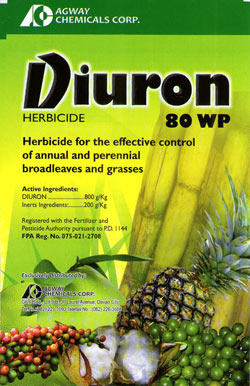
Diuron is toxic false-fertilizer. It kills mangroves, and yep, we have it in local waters.
So then, what about Diuron in the St. Lucie River? Yes, in the notes below is a link to a dated but still-relevant USGS study of pesticides in the St. Lucie River. The top five pesticides detected were all herbicides, including Diuron, as well as our traditional favorite lawn-weedkiller Atrazine and others. Diuron is a Sneaky Pete herbicide. Plants take up natural urea (or the ammonia soil microbes degrade it into). Diuron is a urea mimic, water soluble, a Trojan Horse false-fertilizer similar to urea but with chlorinated timebombs built into the molecule.
The concentrations were “low,” but how low is low enough, especially in light of the gang-attack of several different herbicides, the probability that concentrations are higher in sediments than in the tested water, that there is more development now than in the 90’s, and especially that those pulses of agricultural/suburban-lawn contaminated lake water may have higher pesticide loads than “nice” water on a good day.
Can I say that Diuron killed the mangroves? No. Can I say that the Lake O water did it? No. But there’s something rotten in the State of Denmark. Salinity volatility, crud, N and P in gobs, natural bacterial toxins, and the fruits of modern chemistry all attacking a trio of mangrove species, each with specialized and delicate physiology with respect to salt, nutrients, water transport and the soil ecosystem.
Some time ago in this blog we discussed the reproduction of Black Mangroves. They drop their bare embryos directly from the fruit into the water. CLICK
Yep, right into the Diuron-laced stinkwater sloshing around their snorkel roots jutting up to sustain life through the toxic sediment mud where the crabs ain’t no more.
—————————————————————————————————–
Notes:
USGS report on pesticides in St. Lucie River http://fl.water.usgs.gov/PDF_files/wri02_4304_lietz.pdf
Used the same item for both my blogs this week. Don’t tell anyone.
 John Bradford
 George Rogers
 George Rogers
 Dee Staley
 Treasure Coast Natives