RSS

Saw Palmetto: Silver, Green, and In Between

Saw Palmetto: Silver, Green, and In Between

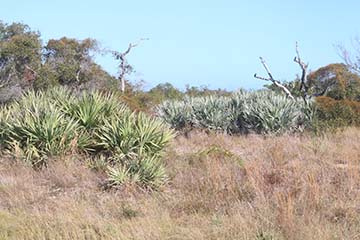
Whether a person’s contact with Saw Palmetto is at a pretentious subdivision entrance or in the itchy scratchy woods, we all know some are green, other silver.  Why?

Before tackling that existential mystery  let’s set the foundation:

  1. Are they two separate species?  No.  Seedlings coming from one seed parent can be both colors,  as a black cat can have a black and white litter. 
  • Are they separated geographically?   No.  Populations are often mixed.  And  it is not as simple as seashore = silver, inland = green. You get both in both settings, although proportions may differ.
  • Is color form determined by environmental cues such as heat or sun?    A qualified mostly no.   With minor exceptions, the plants are fundamentally one or the other,  often side by side, or if transplanted.    There are occasional combo-color individuals.    Some have mostly greenish young leaves and increasingly silver older more-exposed older leaves.  And intermediates are not rare.   Let’s just say,  whatever the underlying “toggle” may be, it seems both simple and imperfect.  For present purposes what matters is that any population can spawn mixtures.

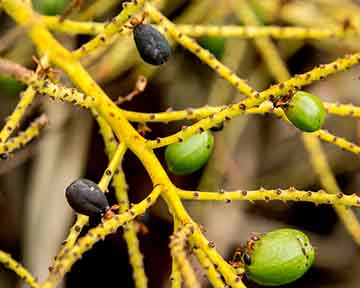
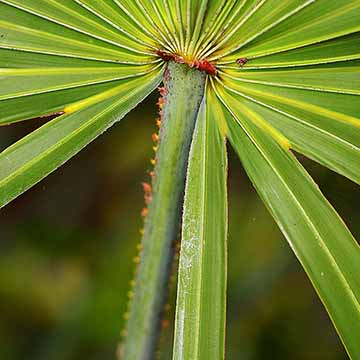
Photos by John Bradford

  • What causes the silver?    Grainy wax coating.
  • What good is that?   I’m not aware of any such research for Saw Palmetto itself.   Common on other palms (Bismarck for example) and on many other plants, botanists generally regard the wax as protection.  Scrub-dwelling, sun-scorched, UV-mutated, wind-blown, sand-blasted, salt-burned, fungal-attacked, bug-eaten  Saw Palmetto is easily imagined as benefiting from a protective coating.   Important to note—the protection is probably not from heat itself.

And that now invites the big questions:

  1. If the a wax job is terrifically protective on Porches and saw palmettos, why aren’t all the saw palmettos silvery waxy? There must be a downside.
  2. What could that be?  Plants use evaporation from the leaves to draw water up from below and for evaporative cooling.   Wax would  probably diminish evaporation.
  3. So then, if  protection is good  but evaporation blockage is bad, why don’t the shrubs  compromise on a single sweet spot with optimal waxiness?  

I think the species makes the two forms to cover all contingencies.   Mother palm says, “if some of my babies are waxy tough while others are better at staying cool, some will prosper, no matter what.”   (For those who like terms,  if allthis blah blah blah is true, a textbook would dub it “balanced polymorphism,”  aka, “hedge your bet.”)

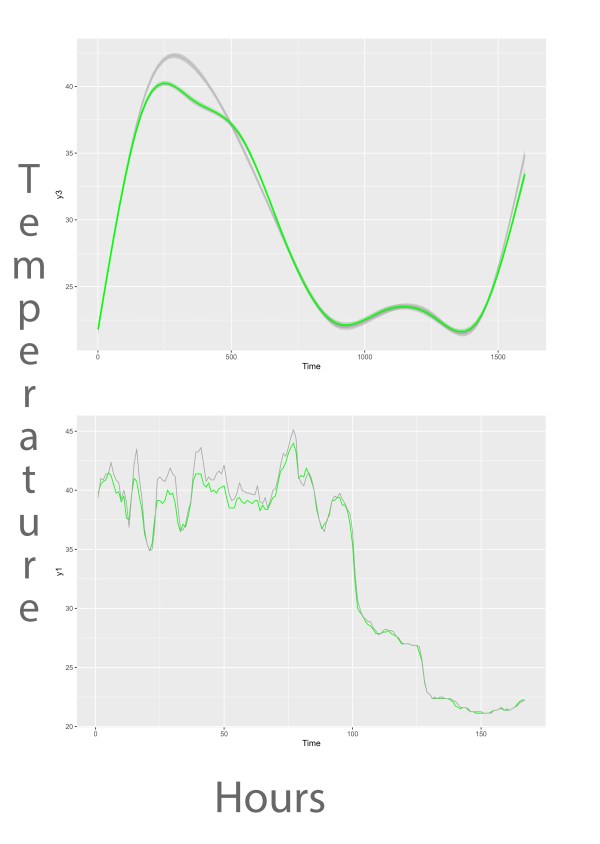
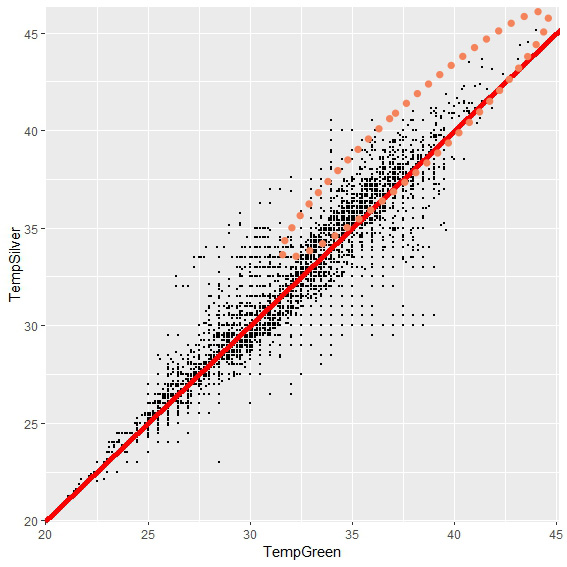
Evidence?    Mighty meagre in the literature, but I’ve been clipping temperature recorders to Saw Palmetto fronds.    My case may not be strong enough for conviction, and messy data are not completely consistent, probably influences by soil water and who knows what.  But look at the three graphs below. The first two show leaf temperatures over spans of hours, silver lines = silver fronds, green for green.   Because the first two graphs were deliberately selected, I added the third graph with all my readings to keep me honest: silver fronds above the red line, green below it.  

The general trend seems to be this:

At lower temperatures the green and silver remain close in temperature, or the green slightly cooler.   In other words, at lower  temperatures the wax seems to offer its general-purpose protection without impairing cooling. Must be worth having!

But, under  hot circumstances silver heats up hotter than green.   When the heat is on,  the wax apparently interferes with cooling.    So green fares better when hot and silver fares better when not.    Maybe.

Silver leaves above the red line. Green below it. Orange ellipse highlights hot silver leaves at hot temperatures.


Link to John Bradford’s web collection. John combined much of his work into this site:   https://tcbradford.wordpress.com/

Link to grass site (which has a couple glitches) www.floridagrassesandsedges.net

 
Leave a comment

Posted by on May 1, 2026 in Uncategorized


Tags: , ,

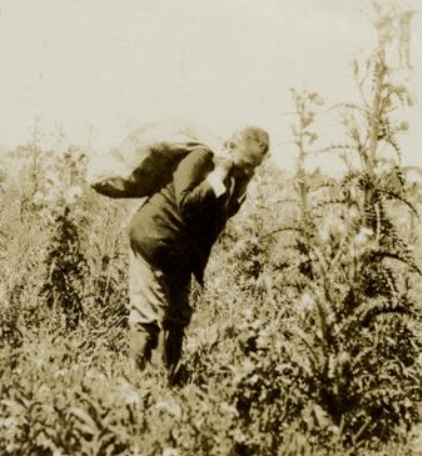
John Bradford (1941-2026)

The native plant community has lost a superb botanist, naturalist, and photographer.   And I’ve lost a 20-some-year collaborator and wonderful friend.  John Bradford passed away peacefully on April 24 after a spell of illness.  John was utterly unique in his razor-sharp knowledge of plants, photographic talents, enthusiasm for nature,.    And it wasn’t all greens:  his nature realm extended to birds, frogs, and a special warm spot for spiders.

John tackled the local flora shortly after relocating with his wife Dee from Grand Cayman to Jensen Beach in the 90s, his first steps being botany classes at the University of Florida Ft. Pierce.  After learning all they had to teach, the professors suggested he drop by Palm Beach State College because we conducted weekly native plant field trips. He took that advice and rapidly became an integral component of those excursions.   Then he proceeded to help us set up a small herbarium,  and started building a photo collection central to illustrating classroom curriculum materials.  That was just a beginning.

Not only did John contribute photos but he acquired a knowledge of botany on a par with professional botanists.   We turned out to be natural collaborators and worked jointly on too many projects to list, including wildflower guide booklets,  a grass and sedge website,  revision of a weed booklet, an online native plants class, a research paper on Butterworts, and plenty more.   He suggested starting the present blog to document our weekly fieldtrips.  Maybe 40 trips a year X 20 years.  John on his own developed website photo and video guides to most of the local  natural areas.   His knowledge and abilities exceeded those of many prominent naturalists, but he disdained self-promotion and did not enjoy public speaking, nor  did he enjoy writing despite being a fine author if coerced.  Like many highly talented people, doing what he enjoyed was the reward. With little fanfare, John’s photos appear in a lot of publications and websites.

John had an unusual bragging right.    Many people find county record plant occurrences.  Those may warrant sending a specimen to a museum.   A state record can result in a journal article.  National records are rare in the U.S.   John had a continental record.  We were working in Halpatioke Park in Stuart, and John had compiled a chart of useful identification characteristics for some local grasses.   He encountered a specimen that did not fit his chart.   My  erroneous reaction was, “shoehorn it into one of those species.”   In typical adamant fashion, John  contended that failure to fit was cause for action,  so we sent a sample to a specialist at the Missouri Botanical Garden who determined it to be the first finding of Steinchisma laxa in North America, perhaps a seed arrival on Hurricane Wilma.

This is not the place for an obituary, but some readers might be interested in knowing that John wasn’t all just nature and cameras.    Few folks know that in the Army he recovered and repaired disabled army tanks in Germany, and that young John was a race car driver,  pit crew chief, and scuba diver.   More recently, he hand-constructed artistic  wood-framed  stables and similar buildings for rural clients with such tastes.   And if you had any mechanical  or home maintenance problem, or a question about Formula 1 his advice was solid.  John Bradford was absolutely one of a kind, and speaking of kind, he was that as well.     He proved that brilliant talents with a modest ego can fill the largest shoes.  


In a separate blog  will appear links to John’s on-line legacy.

 
18 Comments

Posted by on April 25, 2026 in Uncategorized


Different Styles of Swamp-Dwelling:   Straight to the Point or Hedge Your Bets

The blog today is not about Cypress trees, but let’s wade there first as a step into swamp tree shapes.   Back in 1987 Georgia biologist Howard Neufeld wrote a fascinating article about Bald Cypress and Pond Cypress.  His observation was that  Pond Cypresses tend to be taller (for any given trunk diameter),  to have fewer branches, and to have leaves along the branches (as opposed to toward the branch ends), and broader based.   By contrast, Bald Cypress is stockier, more branched with the leaves more concentrated toward the branch tips, and not broadened so much basally. 

As Neufeld saw it, the thinner, more-conic Pond Cypress was less costly to build (fewer smaller everything ),  less prone to sun stress,  and more drought tolerant (by having simpler and overall less  plumbing).   The more-conical shape allows nice even filtered light deeper into the tree, and allows the lower branches good illumination.   Neufeld interpreted pond cypress to have evolved frombig domineering muscular bald cypress as a lighter nimble cousin in changing drier habitats, as opposed to competing massive single-species stands in plenty of water.

Thus inspired, as a semi-swamp dweller, today I was messing around in a swamp near the southern limit of the beautiful Loblolly Bay sharing its cottonmouths with large Dahoon Hollies.   Both species rise up above the dense swamp canopy, and when the Hollies and Bays get above the lower canopy  their shapes contrast, reminiscent of the Cypress situation.   Dahoon Holly is the “Bald Cypress” copycat, comparatively hunky, highly branched, and  irregular in shape.   

To the point!, Loblolly.

Loblolly Bay rises like Space-X, pointed and conic.    It seems to punch aggressively through the understory with one thought: “get above shade”  undistracted.  So purposeful!   And when it achieves that purpose, its base can broaden and expose those big glossy leaves to photosynthesis.    The Holly does ok too in its own more cautious fashion:   it tilts this way, then tries another, investing in multiple trunks and branches at all angles,  experimenting,  and exploring obstacles,  competitors,  sunspots, openings, and shadows.   

Sort of resembles human affairs.  Rush brashly  to the goal, and you might win with luck in  an ideal place and time.   On the other hand, if you bob and weave you might win in diverse suboptimal places and times.  Wonder if the tree shapes have anything to do with Loblolly Bays living confined to a few particular habitats,  Dahoon Holly wangling into more diverse circumstances, even though their overall geographic ranges are the same.

Fun fact:   Loblolly Bay is in the tea family and Dahoon Holly is an historical source of yaupon teas. 

Different Styles of Swamp-Dwelling:   Straight to the Point or Hedge Your Bets

The blog today is not about Cypress trees, but let’s wade there first as a step into swamp tree shapes.   Back in 1987 Georgia biologist Howard Neufeld wrote a fascinating article about Bald Cypress and Pond Cypress.  His observation was that  Pond Cypresses tend to be taller (for any given trunk diameter),  to have fewer branches, and to have leaves along the branches (as opposed to toward the branch ends), and broader based.   By contrast, Bald Cypress is stockier, more branched with the leaves more concentrated toward the branch tips, and not broadened so much basally. 

As Neufeld saw it, the thinner, more-conic Pond Cypress was less costly to build (fewer smaller everything ),  less prone to sun stress,  and more drought tolerant (by having simpler and overall less  plumbing).   The more-conical shape allows nice even filtered light deeper into the tree, and allows the lower branches good illumination.   Neufeld interpreted pond cypress to have evolved frombig domineering muscular bald cypress as a lighter nimble cousin in changing drier habitats, as opposed to competing massive single-species stands in plenty of water.

Thus inspired, as a semi-swamp dweller, today I was messing around in a swamp near the southern limit of the beautiful Loblolly Bay sharing its cottonmouths with large Dahoon Hollies.   Both species rise up above the dense swamp canopy, and when the Hollies and Bays get above the lower canopy  their shapes contrast, reminiscent of the Cypress situation.   Dahoon Holly is the “Bald Cypress” copycat, comparatively hunky, highly branched, and  irregular in shape.    Loblolly Bay rises like Space-X, pointed and conic.    It seems to punch aggressively through the understory with one thought: “get above shade”  undistracted.  So purposeful!   And when it achieves that purpose, its base can broaden and expose those big glossy leaves to photosynthesis.    The Holly does ok too in its own more cautious fashion:   it tilts this way, then tries another, investing in multiple trunks and branches at all angles,  experimenting,  and exploring obstacles,  competitors,  sunspots, openings, and shadows.   

Dahoon, exploring its options

Sort of resembles human affairs.  Rush brashly  to the goal, and you might win with luck in  an ideal place and time.   On the other hand, if you bob and weave you might win in diverse suboptimal places and times.  Wonder if the tree shapes have anything to do with Loblolly Bays living confined to a few particular habitats,  Dahoon Holly wangling into more diverse circumstances, even though their overall geographic ranges are the same.

Fun fact:   Loblolly Bay is in the tea family and Dahoon Holly is an historical source of yaupon teas. 

 
Leave a comment

Posted by on April 17, 2026 in Uncategorized


Prickly pears are everywhere arid(plus), and good for lotsa stuff

Opuntia (many!) species

Cactaceae, the Cactus Family of course


Work time in a scrub area last Tuesday was extra cheery due to the sunshine yellow prickly pear blooms as fancy as roses, lovely as a flower can be.    Bet they help neighboring flowers of other species become pollinated by drawing pollinators from round about.  

All photos today by John Bradford

Less  cheerful, trudging through a scrub you suffer a hot stab to your shin, look down, and not only is there a cactus spine impaling your flesh, but attached to the nasty spear is a small stem segment.   Yanking it out hurts, but congratulations, you just discovered a key to prickly pear distribution.    Those detached pads cover the broken edge quickly with mucilege goo that hardens like epoxy,  then the pad can live eternally to reroot wherever it shakes loose.     Pad relocation has something to do with the global prickly pear presence (native in the New World, introduced in the Old World):

Map from Plants of the World online

Some Opuntia species are so dedicated to stem-piece dispersal they have stopped producing fertile seeds altogether.  Back in 1892 Arizona naturalist J.W. Toumey wrote about the spines propping the broken-off stem pads  above the ground.   That’s handy:  helps with cooling, keeps ground bugs and fungi off, and makes the pad more likely to grab a passing beast.   To complicate regeneration further, some populate their seeds with a clonal piece of the mother plant instead of an actual embryo.   Even more oddly, the fruits can take root directly even if the seeds they contain don’t. 

Most opuntias and close relatives have chromosomal aberrations to interfere with normal sexual processes.   Although untested for cacti so far as I know, there is a general association between ancient cultivation and chromosomal oddness mixed with clonality.   Might apply to prickly pears.

On the downside, cochineal insects grown on cultivated prickly pears for purple dyes have escaped detrimentally onto our native prickly pears, a topic covered in a prior blog.

Human uses for prickly pears are old, widespread, and diverse, so you can rest assured long-ago people moved them around.   There is evidence in Mexico of ancient prickly pear domestication, that not a big surprise. Plants that are easy to propagate with edible stems and fruits, with 100 additional uses happy to grow in deserts are a gift to cherish.  That map above shows how prickly pears have gotten around the Old World, in some places  being pests.  But when not pests, in addition to tasty, water-filled fruits and stems, the vast medicinal uses are too diverse to list. Pick any ailment, some you never heard of.   There are prickly pear wines and brandies, and pancakes.  Have you seen expensive hydrogels added to garden soil to retail moisture?  Prickly pears are the original wild hydrogel, long used in Italy especially for growing cucumbers.  There is modern  commercial interest in PP neutraceuticals, whatever a neutraceutical is.  Remember that quick-hardening mucilage?   Cactus pads have been used as spreaders to apply the smooth mucilage to boat hulls to make them glide with ease.  Uses as sewing needles and as field medical probes are obvious and true.   More interestingly, ancient peoples found bundles of the spines useful as a combination needle and paintbrush for tattooing.  Like an old-school smallpox vaccination.  

Opuntia stricta. Explain this shotgun distribution! (Map from BONAP).

 
4 Comments

Posted by on April 4, 2026 in Uncategorized


Tags: , ,

Combleaf Mermaid Weed, Weird in the Wetlands

Combleaf Mermaid Weed, Weird in the Wetlands

Proserpinaca pectinata

Haloragaceae


What Linnaeus had in mind in 1754 when he coined the name Proserpinaca is its first mystery. A leading possibility, not my original idea, is Proserpina, Roman goddess of springtime and of the underworld. The plant  Proserpinaca does rise up from the underworld mud in the springtime like a little green goddess mermaid.  Pectinata means roughly, “looks like a fish skeleton.”

Proserpinaca pectinata with fruits by John Bradford.

You don’t have to work hard in dried out marshbottom mud  to find Proserpinaca pectinata rising, creeping, flowering, and fruiting.    We have two (+) species of Proserpinica around here, but let’s focus on just one.   I have no particular point to make about P. pectinata, except that it is shy,  odd,  and poorly known.

In flower, by JB. Pinkish stigmas between yellow anthers.

Looks like it is getting its own yellow pollen onto the pink stigmas.

Odd thing 1.  The mermaid lives in two separate regions.    The main region is semi-coastal from New England, across Florida and  Cuba to Texas.   The curious second region is central Tennessee.   A skeptic might say, well, some bird probably dropped it there and it spread.  Agreed!  But birds probably drop its little fruits all over the place, so why “take hold” and spread just in the center of Tennessee?   I dunno.

Map 1999 by botanist P. Catling. What’s going on in Tennessee?

Odd thing 2.  When the marsh bottom dries Proserpinaca can explode into a green carpet of zillions of crowded individuals covering a lot of space.   How does it do that?    The fruits are hard, floaty little “nutlets,” and clearly get around.  But at any given moment there don’t seem to be enough of them to take over, and you don’t see them sprouting  on the mud anyhow.   So where’s all that massive new mermaid coming from?   Old fruits accumulating dormant  in the mud? (probably)  Stem and root fragments breaking apart and floating around? (probably, the stems root where they touch).   Surviving plants that persisted during the last  inundation?  (probably).   Stem-creep? (probably).  That’s a lot of probablys.  Wonder what the main source of the springtime mermaid explosion is.   Maybe not even in my list.

Prolific!

Odd thing 3. Itty bitty flowers having no appreciable petals.   The flowers have three pink fuzzy pollen-receiving stigmas and three yellowish anthers releasing pollen.  The entire plant being short, the flowers are semi-hidden near the ground. Googling to discover the pollinators yields three (not necessarily exclusive) assertions by folks who obviously do not really know:

  1. Wind pollination (I doubt that, as the flowers are hidden down out of the wind; they tend to be relatively few, and they don’t seem well “designed” for putting pollen in the wind.)     ((But never say never.))
  2. Unknown insect visitors.  (Bet that occurs. Would be fun to catch visitors red-handed.)
  3. Self-pollination (I like that possibility:   even in todays photo you can see self-pollen slopping onto the stigmas.  Self-pollination would explain why the  flowers reliably form fruits.)

Odd thing four:  The leaves  have tiny white doohickies directly in the angle where the leaflet joins the central leaf stalk.  The little attachments are made of several cells, and under a microscope look like a cluster of grapes.   These are a mystery.  Water lilies have somewhat similar structures, called hydropotes (“water drinkers”), but those probably do not drink water, and they too are of unknown function.   Many plants have water-release “valves” called hydathodes at the ends of veins. Could be, but the placement and appearance are very iffy. Anybody’s guess can be the function of the tiny appendages, if any.  Something to do with water uptake and output, or dissolved material?  Feeding tiny insects such as ants, and if so, why?   Help draw visitors to the flowers? Make the leaves taste like $#@#@! to leaf eaters?    Breaking free and micro-sprouting?

Thingamajigs at leaflet bases

Thingamajg highly magnified

 
12 Comments

Posted by on March 27, 2026 in Uncategorized


Tags: ,

Big ol’ Pond Apple Sittin’ on a Knee—G-R-O-W-I-N-G

Big ol’ Pond Apple Sittin’ on a Knee—G-R-O-W-I-N-G

PA by John Bradford

[Don’t forget: floridagrassesandsedges.net]

The history of plant ecology is for good reason preoccupied with competition between and within species—-you know, survival of the fittest as the very motor of evolution.   On the other side of the uneven coin, mutual aid or maybe one-sided aid, facilitation, never gets as much stage time.  I’m sort of fascinated by it, also with cypress swamps. Let’s join the two.

There’s a long-standing perception that in favorable conditions competition dominates, and that in harsh conditions facilitation is more likely.  Obvious examples:—let’s say in the desert small plants “taking shelter” under scattered shade  trees, or in a Florida scrub smaller creatures taking refuge in gopher tortoise burrows.   Or In a flooded marsh you see small plant species clustering on the raised hummocks of larger plants.  This last example is close to today’s slightly more peculiar case of sizable trees seated preferentially on top of smaller plants. 

Floating fruits, big tough seeds by JB

I spend too much time in cypress swamps, and declare that today’s situation is not universal  It seems to be curiously situational.    Step carefully with me into the swamp just east of the main parking lot across from Jupiter Farms Road at the Cypress Creek Natural Area. (This is not a particularly aesthetic destination for a Sunday stroll,  with barbed wire,  broken glass, trash, and feral hogs.)

Pond Cypress by JB

What you see is a tall overstory of big beautiful Pond Cypress, with sunlight shining through now during the leafless season. There are several mostly small woody species in the understory, but the striking thing is that the vast majority of those plants are Pond Apples, most of them biggish,  averaging 16 inches diameter at the base.  I temporarily marked four corners in the swamp roughly 130 feet on each side, about 1/3 acre.     In that plot were 62 tree-sized Pond Apples under the Pond Cypress.  And now hold on to your funny looking hat,  51 (82 percent) of them were seated directly upon Pond Cypress knee mounds.   In many cases,  the knee mounds were so overtopped by the PA trees that little knees were merely peeking out modestly between the fluted flanges on the Pond Apple bases. One Pond Apple base per knee mound.

PC knees with no guest.

Are the Pond Apples taking over “on the backs” of the Pond Cypress?   Well, there is zero Pond Cypress apparent regeneration under present conditions,  although the big cypresses seem fine & dandy above their knee-squatters. Come back in a hundred years…or after the next hurricane or fire, then we’ll know who’s king of the swamp (for the moment).

Pond apple sitting on a knee mound. See the little light tan knee front center peeking out from under its larger friend?

You can’t keep a good knee down.

Any horticulturist can see those knee mounds are wonderful little raised garden beds complete with aerated compost and the ability to snag floating Pond Apple  apples.  So a coarse explanation of the knee-sitting is no big deal,  but the cool things in nature are more often the odd  little deals.

 
1 Comment

Posted by on March 21, 2026 in Uncategorized


Tags: , , , , , ,

ANNOUNCING! For the three people in the world who care…our old grass site (dating from 2004) is back online under a new url:   www.floridagrassesandsedges.net

ANNOUNCING! For the three people in the world who care…our old grass site (dating from 2004) is back online under a new url:   www.floridagrassesandsedges.net

click it here


therefore a classy grassy blog today…

Maidencane is as Smart as a Slime Mold

Panicum hemitomon  (Hymenachne hemitomon)


Slime molds are famously clever microbes. Put one on one side of a maze and a food tidbit on the far side,  and the slimer triumphantly solves the puzzle.  Sort of.  It slithers hither and thither confined by the maze, extending throughout.  Eventually the widespread exploratory portion of the s.m. encounters the morsel, so the microbe concentrates on that pathway.   Think of bees exploring for flowers, with successful foragers establishing a collective route to the sugary blossoms. That brings us to today’s “thing.”   It is incredible how spreading rhizomatous marsh plants colonize and divide a marsh into single-species patches, maybe an exclusive acre of  Knotted Spikerush here, a  plue zone of pure Pickerelweed over there.   That quilt doesn’t form overnight.  Think of all the “exploring” by creeping rhizomes like giant slime molds: all the pushing, shoving, border disputing,  poisoning,  social climbing, and jostling until it is all sorted out into the patchwork we see from the boardwalk. Some patches have deeper water longer, or more nitrogen pollution, or muckier soil, giving different species patchy advantages according to their needs and tolerances,

We are not air snorkels.

Anyhow, I have a thing for cypress swamps, and enjoyed today a nice example of patchy life under the pond cypress,  with a twist—a single species free of competitors.    Astoundingly few non-woody plants grow on cypress swamp floors. Well yea, ferns, but ferns are ferns,  and you could count the remaining herbaceous species on your toes.    The floor of a cypress swamp is a fascinatingly narrow ecological filter:   suffocating seasonal flooding, a thick layer of duff and semi-decayed  needles,  seasonal deep shade,  and dry-season drying.    In the swamp I explored today one species was the absolute ruler, but very unevenly.   Maidencane Grass can stand up to the harsh swamp tortures, but across the swamp it ranges from dense expansive lawns, to modest clumps, to scattered individuals, to none.     

Many here

A few here

Not many here! All these photos a stone’s throw apart.

Patchiness is easy to envision when forced by competitors, but in the cypress swamp there’s a different pattern.  The strongest Maidencane growth is generally where the cypress trunks are fewest.  That is, within the swamp the cypresses are subtly patchy, probably having to do with varying hydrologic conditions combined with the occasional gap from treefall.  I don’t think the water conditions are the main control of the extreme Maidencane patchiness.  Although untested, the driving force appears largely to be the relative light conditions caused by uneven cypress positioning.   The Maidencane is probably fluctuating at the edge of its shade tolerance “in exchange” for a monopoly on the swamp understory herbaceous layer. Like a giant slime mold, it spends eternity floating and creeping around the swamp, “finding the food”  in relatively bright spots and fading out when prospects dim.

 
12 Comments

Posted by on March 12, 2026 in Uncategorized


Tags: , , , , , , ,

Up and Downs in the Bald Cypress Swamp

Up and Downs in the Bald Cypress Swamp

Every introductory Biology textbook has a famous graphic,  a vertical seashore rock with its base in the ocean and its top exposed, home to barnacles.  Conditions toward the submerged rock bottom differ from conditions rising to the splash zone.   If one barnacle species is alone it spreads out up and down the rock as far as it can tolerate in both directions.    But if there are two species,  one may compete the other into a narrower portion of the rock.  And, having divvied up the habitat vertically, everybody coexists in two stacked bands.

Welcome to Biology class! Barnacle social life.

There’s a better example in our local Bald Cypress swamps, although the competitive dynamics differ.    In a swamp there’s a rough tendency toward four stacked rings on the cypress lower trunks rising from the seasonally submerged base to above the high water line.    The vertical changes in conditions bottom-up make the barnacle stacking seem simple.  Here is a Cypress Creek report from yesterday.  From bottom up, the four bands are dominated by four species, each with features suited to its position relative to the flooding pattern. This is a nice example of an “ecological filter” at work, allowing occupancy only to competitors with the right abilities to pass through the filter.  A shady swamp with rising and falling water is a fairly harsh filter.

By John Bradford

The bottom band (1) Sematophyllum adnatum, a common widespread moss, here surviving at the tree base well below the high water line.   It lives on smoother bark than the flaky bark at and above the water line.  Terrible place to grow!  At high water, dark, muddy,  suffocated.    Perhaps the reason it “owns” this band is the ability to cling to life under nasty mudwater for extended periods.   Then when conditions improve,  it creeps across the base as a tiny weedy vine reclaiming space.  Probably nobody has ever measured the growth rate, but I’ll bet it is fast, the cheap thin leaves being a clue to quick recovery.   This species is not fighting crowded competition, but rather floodwater.

Moss 1. Sematophyllum creeping.

The second band (2) moss is Syrrhopodon texanus presiding presides over the rising and falling water line.   The Syrrhopodon band can sometimes be particularly widedancing with the fluctuating water line. It often has its own “sub-bands”   functioning as  timestamps from happy times (about right) relative to the water line, and sadder times (when the water line was in a better place). That is, rising and falling water leaves a record on the Syrrhopodon mood.  Plants growing in subdued light often have comparatively dark leaves, as does this species.  The fit to the waterline lifestyle extends to reproduction.  Mosses mostly spread by airborne spores, but it makes more sense for a waterline grower to float from tree to tree by water.  This species and some relatives make tiny little floaters on their leaves which bypass the need for dusty spores to blow through the windless swamp.  Some species of Syrrhopodon have no known spore production at all. Now that we’ve climbed the trunk into better conditions, life is more competitive, and this moss tends to grow crowded with vertical stems, like high-rises in the big city.

Moss 2, Syrrhopodon at the high waterline.

Syrrhopodon in mixed moods.

Syrrhopodon releasing its leaf-tip floaties.

Rising to the third band, we’re above the water line with intermittent drying increasing as a threat.  From submerged, to following the water, line to drought—-all in a  lizard’s climb.  Moss (3) is Leucobryum albidum, also crowded and vertical-ish, but with a new feature.  In stead of dark green, it is whitish (leuco-), which ties in with that dangerous drying.  The leaves are a bit succulent with empty (white) cells that can store water. Micro-cacti!

Moss 3. Leucobryum. A wee bit succulent.

By the time we get to level 4, drying is a deadly threat, and the mosses cede the trunk to lichens, undisputed masters of life in high dry places.

Lichens now take over.

 
6 Comments

Posted by on March 6, 2026 in Uncategorized


Tags: , , , ,

Snow Squarestem is a Little Disturbed: From Hogs to Volcanoes

Melanthera nivea

(Melanthera means “black anthers,” and nivea means “snow”)

Asteraceae

SQS by John Bradford


Around here I tend to think of Snow Squarestem as a modest, attractive little native wildflower encountered occasionally trailside in moist areas.  But in some ways it looms a little larger.  The plants likes disturbance, and my encounter with it yesterday was along a wetland trail with the marginal soil torn asunder by feral hogs, which seemed to favor the plant. It comes up from the soil seedbank when the hogs or other disturbers disturb. I wonder how long the seeds (achenes) can sleep awaiting their moment.

By JB

Why think it rises from disturbed seedbanks?   There are places in Southern Mexico where slash and burn agriculture is practiced.  Farmers cut forest, burn the residue, grow crops over a limited period, and then move on.    Looking at post-abandonment recovery of such sites, ecologist Jorge Meave and others found Snow Squarestem to be the most abundant re-invader.  

To go from unsurprising to weird, in Nicaragua biologist Hilary Erlener and collaborators reported (in Pan-Pacific Entomologist Vol 92 2016) a species of ground-nesting bee to live adjacent to an active volcanic vent spewing poison gas and nasty ash.    The only plant nearby on the volcano, and feeding the hotfooted bee was Snow Squarestem.

Rising opportunistically from churned soil from the Central U.S. to Brazil,  you might say Snow Squarestem is a mighty colonizer, despite its humble aspect.  Mighty colonizers must make a ton of seeds to deposit in the seedbank.  Some weeds, such as Dandelion, do that by skipping pollination altogether. But maybe a “more textbook”  approach is to be very good at getting pollinated, as pollination spawns seeds—whether in Kentucky, Mexico, or Guyana.   That wide range of places might imply “welcoming” a corresponding wide range of pollinators.   Seems true.  Below are those I managed to snap standing like paparazzi a few minutes yesterday by a clump (and that was merely one clump in  one place at one time,  and I missed some).   The plant most certainly entertains all visitors.

Yesterday:

 
5 Comments

Posted by on February 27, 2026 in Uncategorized


Airplant Forensic Files

Potbelly AP by John Bradford

Ever notice, especially around Pond Cypress, how the Airplants, mostly Northern Needleleaf (Tillandsia balbisiana) and sometimes Potbelly Airplant (T. paucifolia) tend to be spaced far apart as if they don’t like each other?  

Often a foot apart or more, or one to a branch?   That’s just odd with no “yea that’s it” explanation.

I am a rock, I am an island

I’ve read the contention that they land and sprout infrequently, so that the wide separations are merely a random pattern.  Great from the armchair, until you go ground-truthing.  It is easy to find young Tillandsias close together on Pond Cypress branchlets, with under an inch separation, far closer than any big ones.  Some of the small individuals might be Ball-Moss (Tillandsia recurvata), the seedling identifications needing a better look.  The separation of large individuals seems likely to result from deaths of little losers in between.  

Young tillandsias just inches apart on Pond Cypress.

It’s been suggested that the larger tillandsias shade out the small ones, but there is no appreciable shade from a Tillandsia. AI, when consulted, cooked up the idea that the tree branches have “just so many” suitable establishment spots, but even if so, why would they be widely spaced?    And I can’t find anything special about the attachment spots, unless emerging Pond Cypress branchlets knock some off.

Does it have to do with the pattern of lichens on the branches, maybe some lichens eliminating tillandsias perched on the lichens?   That would be interesting, but I can’t find lichen kill zones. Do the tillandsias compete for nutrients or water running along the stem in rainwash, forcing the competitors to “spread out”?   But tillandsias use their roots for clinging, not to my knowledge for taking in nutrients, that seems implausible. What about toxin released by bigger tillandsias into the stemwash knocking off smaller competitors?   However, how often is there stemwash, and look how tough those non-absorbent roots are.   Naw, I don’t think so.

Maybe the spaced-out pattern has to do with wind and storms?   Do Pond Cypress branches with multiple tillandsias  “catch” too much wind and then twist, twerk, bust, sag, greenstick fracture, snap, or decay off?   Is one more airplant the last straw?   HMMMMMMM. Seems stretchy, but when you’re out of better ideas.  After all, the Tillandsias do have to grow exposed “out on a limb” (skinny twig) with few cypress leaves leaves where there’s plenty of sun (and wind).  One additional point in favor of this explanation:   the boring explanations often turn out to be right.  I learned that from Forensic Files!

So to sum it up. I don’t know. The “literature” doesn’t seem to know.  Generative AI generates bad ideas. Grasping at straws, I’m grasping at violent thunderstorms over-stressing over-loaded brittle exposed Pond Cypress branchlets. If you come up with the right answer, judged by its obvious “Eureka” correctness, you win a bushel of bragging rights.

Is that upstart right of center a “little too close” to the bad boy on the right? Trouble brewing?

 
8 Comments

Posted by on February 20, 2026 in Uncategorized