RSS

Tag Archives: pond apple

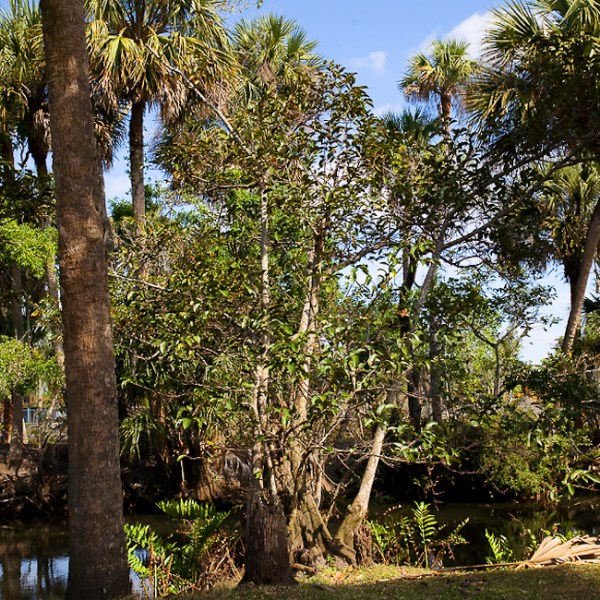
Big ol’ Pond Apple Sittin’ on a Knee—G-R-O-W-I-N-G

Big ol’ Pond Apple Sittin’ on a Knee—G-R-O-W-I-N-G

PA by John Bradford

[Don’t forget: floridagrassesandsedges.net]

The history of plant ecology is for good reason preoccupied with competition between and within species—-you know, survival of the fittest as the very motor of evolution.   On the other side of the uneven coin, mutual aid or maybe one-sided aid, facilitation, never gets as much stage time.  I’m sort of fascinated by it, also with cypress swamps. Let’s join the two.

There’s a long-standing perception that in favorable conditions competition dominates, and that in harsh conditions facilitation is more likely.  Obvious examples:—let’s say in the desert small plants “taking shelter” under scattered shade  trees, or in a Florida scrub smaller creatures taking refuge in gopher tortoise burrows.   Or In a flooded marsh you see small plant species clustering on the raised hummocks of larger plants.  This last example is close to today’s slightly more peculiar case of sizable trees seated preferentially on top of smaller plants. 
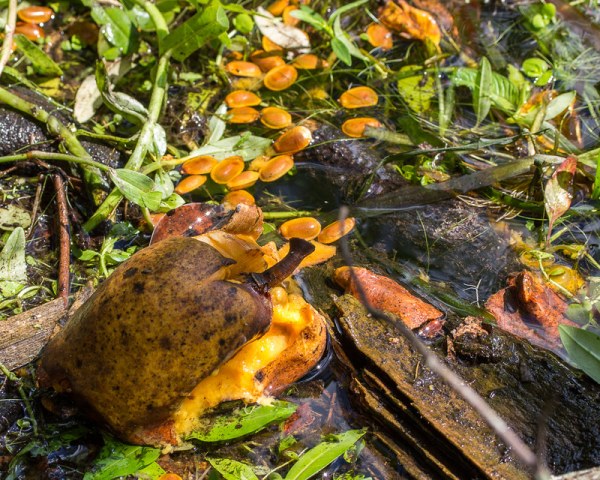
Floating fruits, big tough seeds by JB

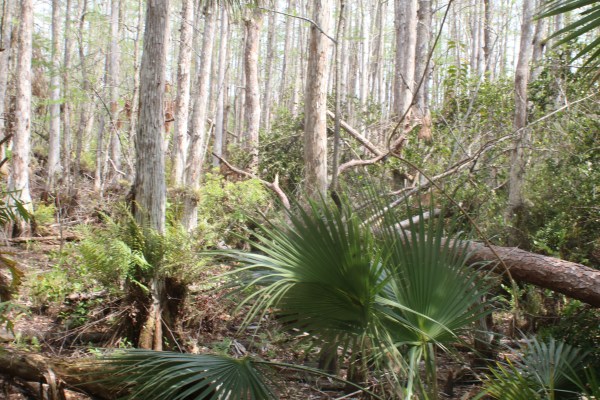
I spend too much time in cypress swamps, and declare that today’s situation is not universal  It seems to be curiously situational.    Step carefully with me into the swamp just east of the main parking lot across from Jupiter Farms Road at the Cypress Creek Natural Area. (This is not a particularly aesthetic destination for a Sunday stroll,  with barbed wire,  broken glass, trash, and feral hogs.)
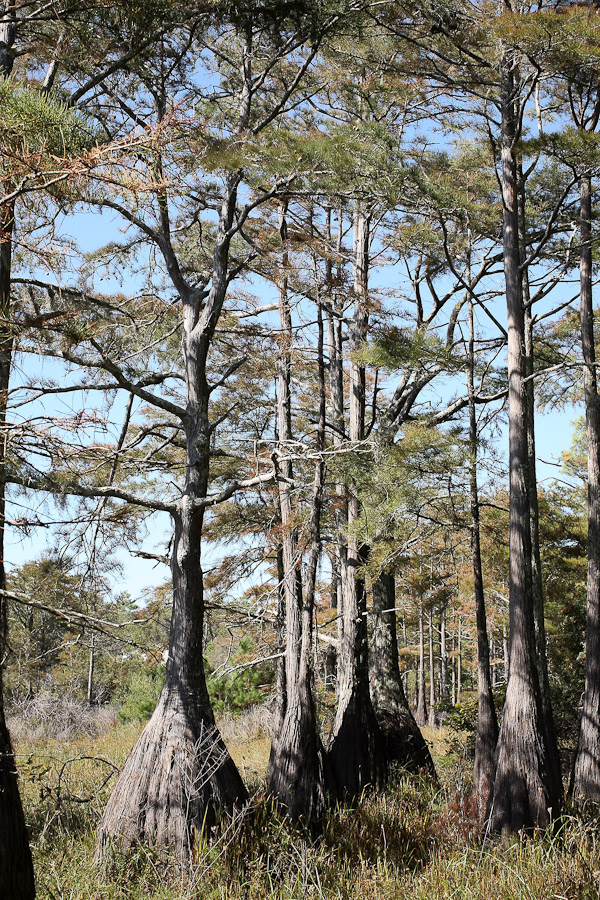
Pond Cypress by JB

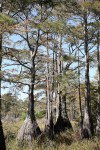
What you see is a tall overstory of big beautiful Pond Cypress, with sunlight shining through now during the leafless season. There are several mostly small woody species in the understory, but the striking thing is that the vast majority of those plants are Pond Apples, most of them biggish,  averaging 16 inches diameter at the base.  I temporarily marked four corners in the swamp roughly 130 feet on each side, about 1/3 acre.     In that plot were 62 tree-sized Pond Apples under the Pond Cypress.  And now hold on to your funny looking hat,  51 (82 percent) of them were seated directly upon Pond Cypress knee mounds.   In many cases,  the knee mounds were so overtopped by the PA trees that little knees were merely peeking out modestly between the fluted flanges on the Pond Apple bases. One Pond Apple base per knee mound.
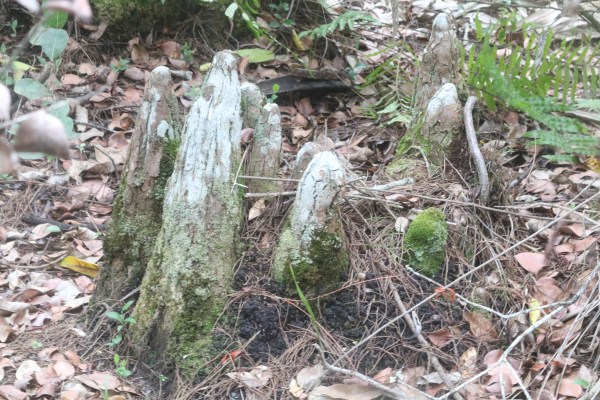
PC knees with no guest.

Are the Pond Apples taking over “on the backs” of the Pond Cypress?   Well, there is zero Pond Cypress apparent regeneration under present conditions,  although the big cypresses seem fine & dandy above their knee-squatters. Come back in a hundred years…or after the next hurricane or fire, then we’ll know who’s king of the swamp (for the moment).
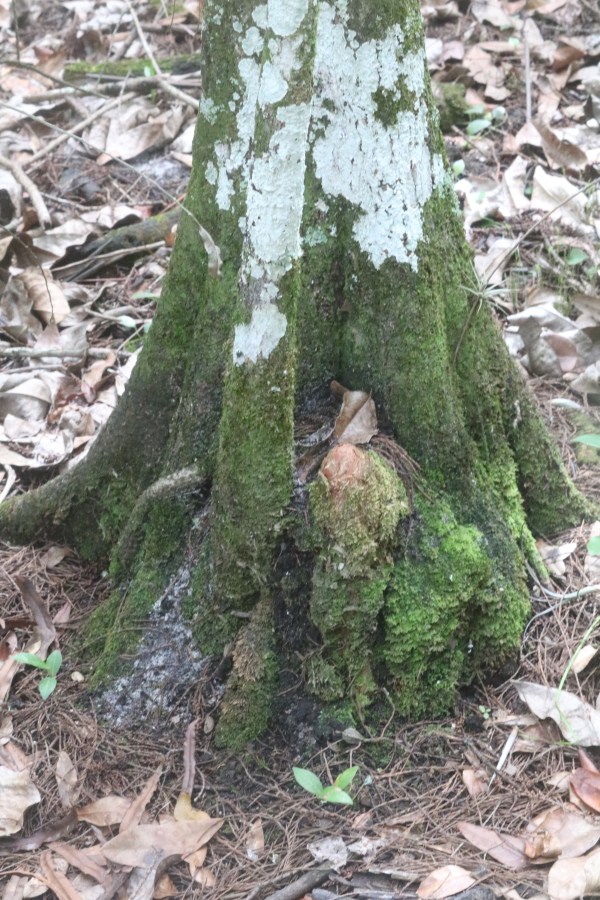
Pond apple sitting on a knee mound. See the little light tan knee front center peeking out from under its larger friend?
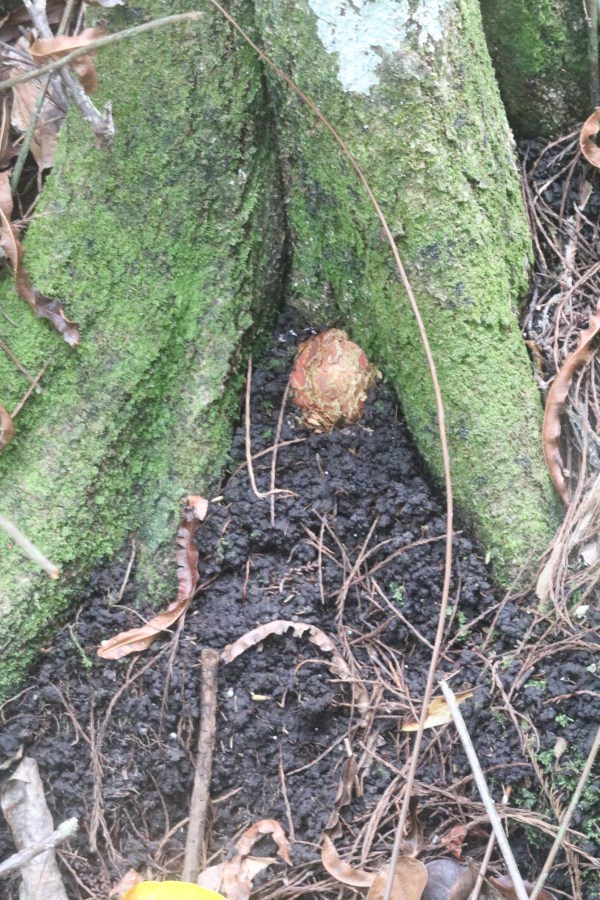
You can’t keep a good knee down.

Any horticulturist can see those knee mounds are wonderful little raised garden beds complete with aerated compost and the ability to snag floating Pond Apple  apples.  So a coarse explanation of the knee-sitting is no big deal,  but the cool things in nature are more often the odd  little deals.
 
1 Comment

Posted by on March 21, 2026 in Uncategorized


Tags: , , , , , ,

April Showers Bring Pond Apple Flowers

Pond Apple

Annona glabra

Annonaceae

How many beetle-pollinated flowers do you know?  Among a few, Pond Apple and Sweetbay Magnolia, both in flower now.

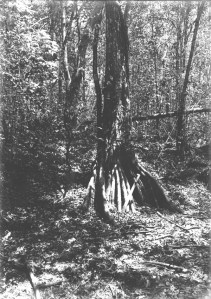
What I really like about Pond Apple lives primarily in my imagination and in old photos, especially ones taken a century ago by botanist John Kunkel Small.  Back in the day, as they say on Pawn Stars, Pond Apple was debatably “the”  broadleaf tree of the Everglades Area, especially the southern rim of Lake Okeechobee where it formed a Pond Apple forest, also an arboreal force to reckon with bordering Biscayne Bay.   Back then and there the PA’s became jungle trees to maybe 60′ tall, festooned with epiphytes and birds, and complete with buttress roots. Today we encounter the trees mostly as modest-sized individuals in wet habitats, or in cultivated landscapes.

Pond Apple by JK Small, 1917.

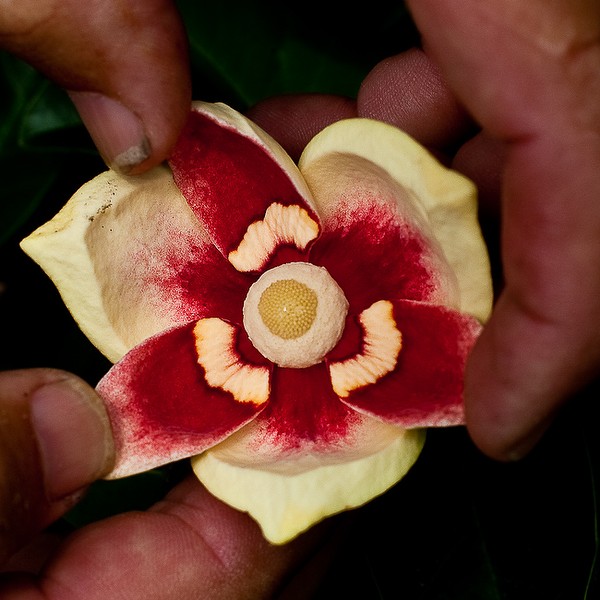
The primitive flowers have six thick fleshy petals, vanilla-yellow-white with reddish markings at the base.  There’s a huge number of stamens and a hundred separate carpels (female units), each with just one seed.  The female pollen-receiving stigmas become sticky and receptive before the flower enters its male phase.  The carpels fuse later into the “apple.”

The floral visitors are varied species of beetles drawn by the scent.  The flower tends to form a chamber that shelters the beetles and keeps them happy munching the succulent petals and perhaps mating during the flower’s passage from the female phase through pollen release.  The strongest fragrance emerges in the evening, which is also the time the pollen comes free to dust the critters.  The flower gets pollinated by providing a beetle rumpus room.

Most flowers serve nectar as a reward for insect visitors.  But Pond Apple provides a pound of petal-flesh as the price to pay for reproduction. (Similar to paying college tuition for human pondapples.)   If you think beetle pollination is weird, other Annona species rely on thrips, cockroaches, and probably sometimes flies to do the job.

Pond Apples range from Florida to South America, and to Africa.  Is the tree actually native in Africa?  I don’t know, probably not. The tree has become an invasive exotic nuisance in additional tropical regions such as Southeast Asia and especially in Australia, where it represents our revenge for the Melaleuca. (And its cousin the Bottlebrush getting pesky.)

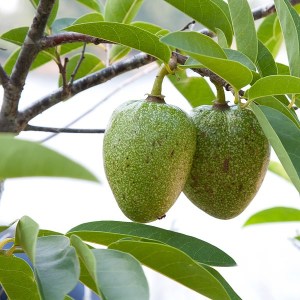
Pond Apple is in the same family as Pawpaws, which have similar flowers.  I ate a pawpaw once maybe a trifle unripe.  It knocked me out cold and I woke up vomitoria.  Closer kin is in the same genus are much-better-tasting fruits:  Atemoyas, Cherimoyas, Custard-Apples, Soursops, and Sweetsops.  Pond Apple serves as a locally adapted grafting rootstock for some of these, and has been hybridized with some of the tasty species.   Pond Apple fruits are yucky to humans, but raccoons savor the flavor.   Raccoon scat sometimes looks like PA seed conglomerate.  Pigs like them too, a fact well known to land managers where Pond Apple is an invasive pest.  So do iguanas and some monkeys.

Beetle party place (by JB). The white ring near the middle is a mass of stamens. The greenish-yellow center is a cluster of carpels (female units, which become the "apple").

The trees produce bioactive principles and have too  many historical medicinal uses to start listing.   Most interestingly, modern research has shown anti-cancer properties from the seeds.

Any good in the landscape?  Sure.  The PBSC Campus has several very purty specimens, and there’s a good-looking individual in my yard.   Although wet places are the natural home, the species fares well under normal residential conditions, even unwatered or only lightly assisted after establishment.  Sun or reasonable shade are okay.  The upside is general prettiness, fast growth, and curious flowers.  The downsides are fast growth,  low branching, unwieldy watersprouts, messy fruits, reportedly  toxic seeds, and seasonal leafdrop.   The seeds are easy to sprout, and yes, I’ve tried them plucked out of raccoon poop—works fine but really no need to go stalk a racoon.

 
7 Comments

Posted by on April 12, 2012 in Pond Apple


Tags: , ,