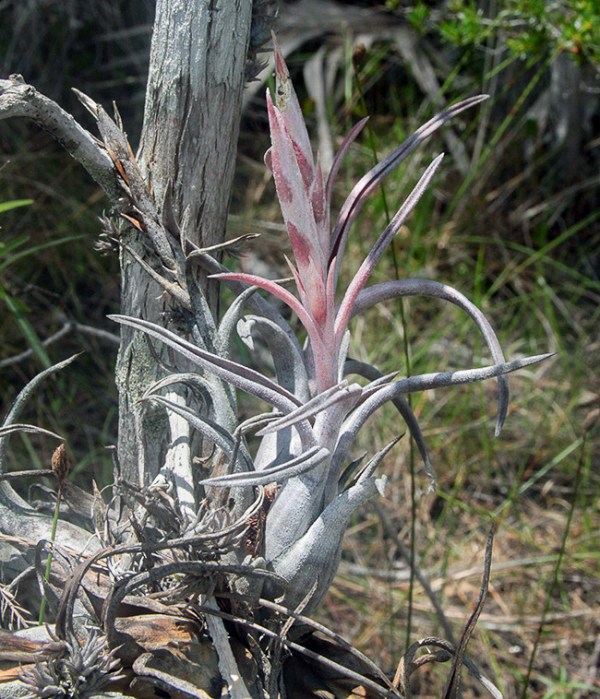
Potbelly AP by John Bradford
Ever notice, especially around Pond Cypress, how the Airplants, mostly Northern Needleleaf (Tillandsia balbisiana) and sometimes Potbelly Airplant (T. paucifolia) tend to be spaced far apart as if they don’t like each other?
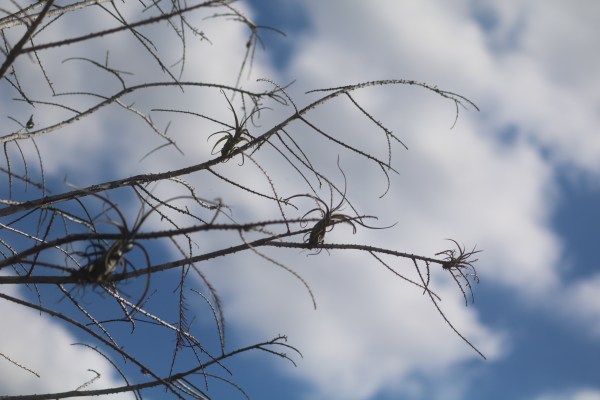
Often a foot apart or more, or one to a branch? That’s just odd with no “yea that’s it” explanation.
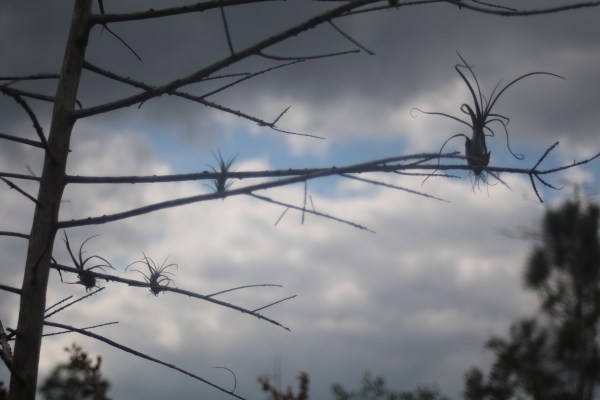
I am a rock, I am an island
I’ve read the contention that they land and sprout infrequently, so that the wide separations are merely a random pattern. Great from the armchair, until you go ground-truthing. It is easy to find young Tillandsias close together on Pond Cypress branchlets, with under an inch separation, far closer than any big ones. Some of the small individuals might be Ball-Moss (Tillandsia recurvata), the seedling identifications needing a better look. The separation of large individuals seems likely to result from deaths of little losers in between.
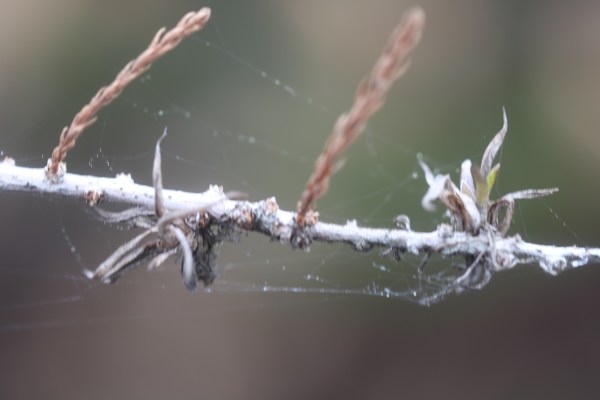
Young tillandsias just inches apart on Pond Cypress.
It’s been suggested that the larger tillandsias shade out the small ones, but there is no appreciable shade from a Tillandsia. AI, when consulted, cooked up the idea that the tree branches have “just so many” suitable establishment spots, but even if so, why would they be widely spaced? And I can’t find anything special about the attachment spots, unless emerging Pond Cypress branchlets knock some off.
Does it have to do with the pattern of lichens on the branches, maybe some lichens eliminating tillandsias perched on the lichens? That would be interesting, but I can’t find lichen kill zones. Do the tillandsias compete for nutrients or water running along the stem in rainwash, forcing the competitors to “spread out”? But tillandsias use their roots for clinging, not to my knowledge for taking in nutrients, that seems implausible. What about toxin released by bigger tillandsias into the stemwash knocking off smaller competitors? However, how often is there stemwash, and look how tough those non-absorbent roots are. Naw, I don’t think so.
Maybe the spaced-out pattern has to do with wind and storms? Do Pond Cypress branches with multiple tillandsias “catch” too much wind and then twist, twerk, bust, sag, greenstick fracture, snap, or decay off? Is one more airplant the last straw? HMMMMMMM. Seems stretchy, but when you’re out of better ideas. After all, the Tillandsias do have to grow exposed “out on a limb” (skinny twig) with few cypress leaves leaves where there’s plenty of sun (and wind). One additional point in favor of this explanation: the boring explanations often turn out to be right. I learned that from Forensic Files!
So to sum it up. I don’t know. The “literature” doesn’t seem to know. Generative AI generates bad ideas. Grasping at straws, I’m grasping at violent thunderstorms over-stressing over-loaded brittle exposed Pond Cypress branchlets. If you come up with the right answer, judged by its obvious “Eureka” correctness, you win a bushel of bragging rights.
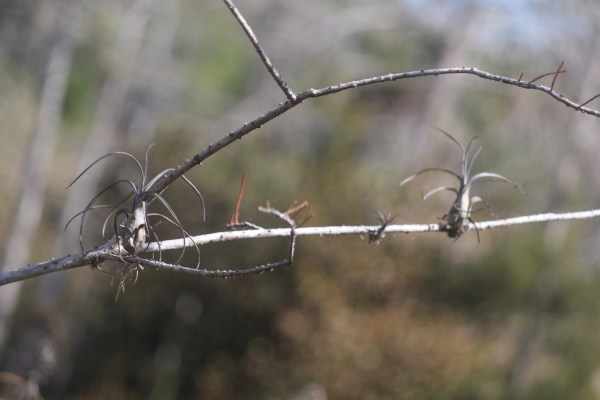
Is that upstart right of center a “little too close” to the bad boy on the right? Trouble brewing?
 John Bradford
 George Rogers
 George Rogers
 Dee Staley
 Treasure Coast Natives
Annie Hite
February 20, 2026 at 9:38 pm
I am as clueless as AI here but am enjoying the thought of tillandsias twerking.
Annie
theshrubqueen
February 21, 2026 at 3:52 pm
Bird poop!
George Rogers
February 21, 2026 at 6:57 pm
yea! My wife thinks it has something to do with birds too.
theshrubqueen
February 21, 2026 at 7:11 pm
God is in the details! I can visualize birds sitting in the same places.. think about ball moss on the power lines.
George Rogers
February 21, 2026 at 7:15 pm
Good point. So now when I’m out where the tillandsias and pond cypress grow, I’ll watch the birds, and where the droppings are.
WalterB
February 21, 2026 at 9:43 pm
The observed spatial distribution maybe a result of allelopathy. Tllandsia recurvata, (ball moss) is know to release exudates that inhibit congeneric epiphytes.
WalterB
February 22, 2026 at 2:32 pm
The observed spatial distribution of Tillandsia balbisiana and T. paucifolia maybe influenced by allelopathic properties of Tillandsia recurvata (ball moss) that can exude chemicals that suppress or inhibit spacial competition by congener epiphytes.
George Rogers
March 7, 2026 at 9:17 am
Hi Walter, and thanks. You must be correct. You’d think would be more-studied than it is.