therefore a classy grassy blog today…
Maidencane is as Smart as a Slime Mold
Panicum hemitomon (Hymenachne hemitomon)
Slime molds are famously clever microbes. Put one on one side of a maze and a food tidbit on the far side, and the slimer triumphantly solves the puzzle. Sort of. It slithers hither and thither confined by the maze, extending throughout. Eventually the widespread exploratory portion of the s.m. encounters the morsel, so the microbe concentrates on that pathway. Think of bees exploring for flowers, with successful foragers establishing a collective route to the sugary blossoms. That brings us to today’s “thing.” It is incredible how spreading rhizomatous marsh plants colonize and divide a marsh into single-species patches, maybe an exclusive acre of Knotted Spikerush here, a plue zone of pure Pickerelweed over there. That quilt doesn’t form overnight. Think of all the “exploring” by creeping rhizomes like giant slime molds: all the pushing, shoving, border disputing, poisoning, social climbing, and jostling until it is all sorted out into the patchwork we see from the boardwalk. Some patches have deeper water longer, or more nitrogen pollution, or muckier soil, giving different species patchy advantages according to their needs and tolerances,
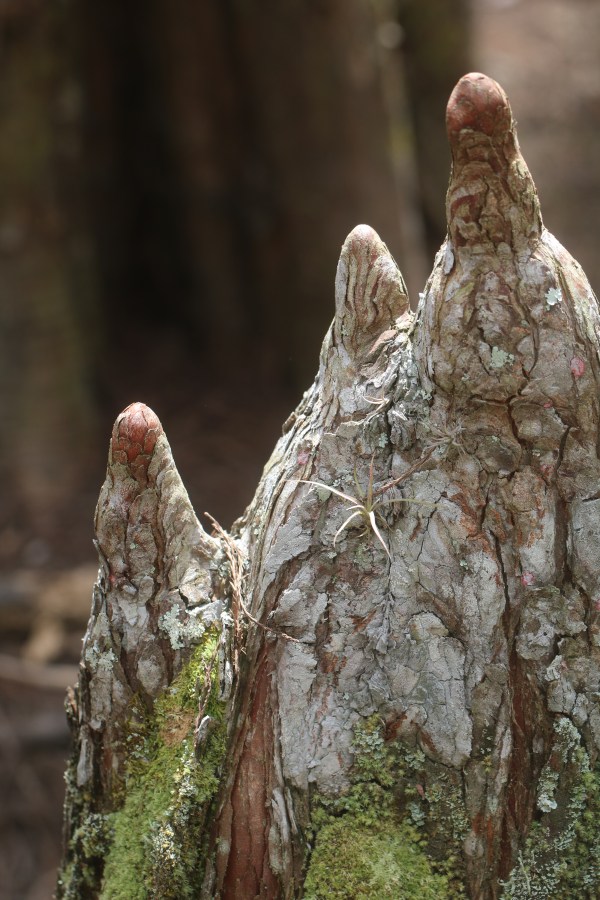
We are not air snorkels.
Anyhow, I have a thing for cypress swamps, and enjoyed today a nice example of patchy life under the pond cypress, with a twist—a single species free of competitors. Astoundingly few non-woody plants grow on cypress swamp floors. Well yea, ferns, but ferns are ferns, and you could count the remaining herbaceous species on your toes. The floor of a cypress swamp is a fascinatingly narrow ecological filter: suffocating seasonal flooding, a thick layer of duff and semi-decayed needles, seasonal deep shade, and dry-season drying. In the swamp I explored today one species was the absolute ruler, but very unevenly. Maidencane Grass can stand up to the harsh swamp tortures, but across the swamp it ranges from dense expansive lawns, to modest clumps, to scattered individuals, to none.
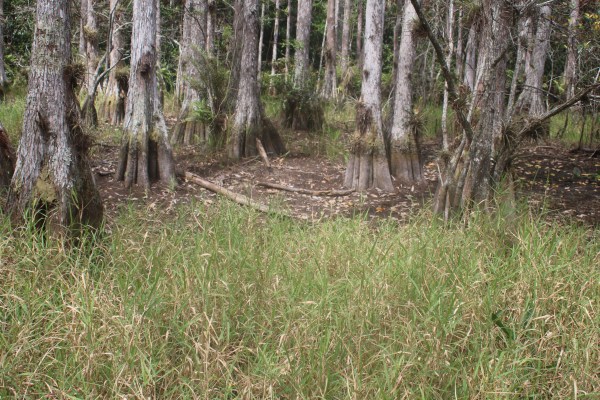
Many here
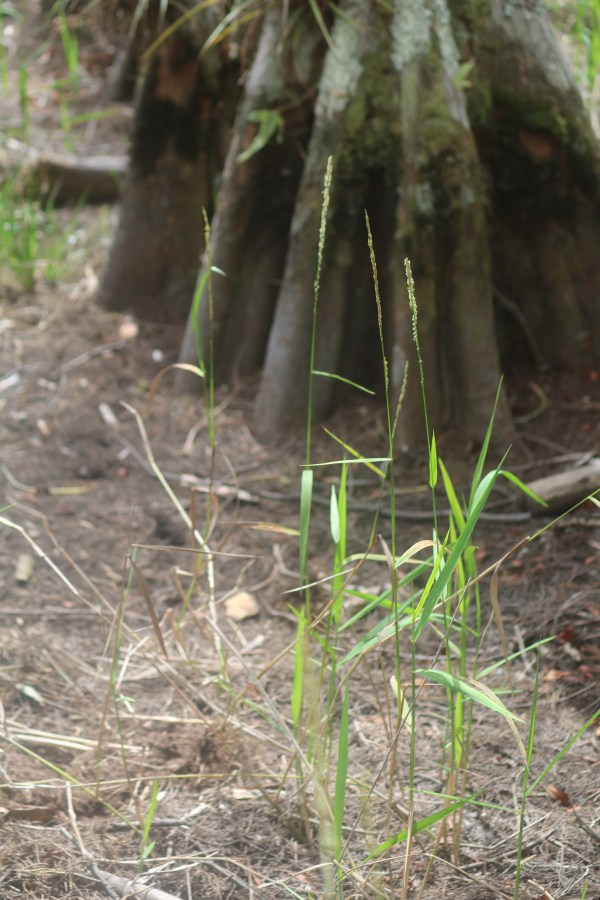
A few here
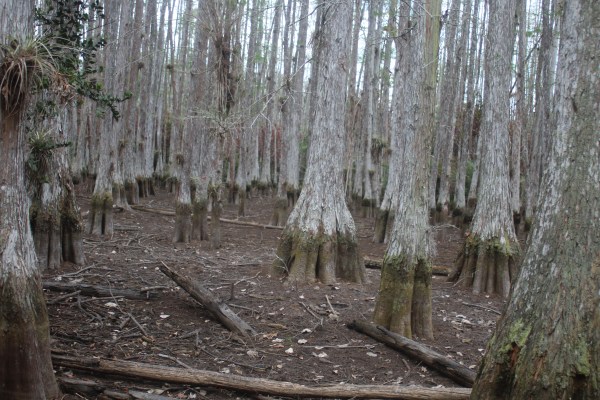
Not many here! All these photos a stone’s throw apart.
Patchiness is easy to envision when forced by competitors, but in the cypress swamp there’s a different pattern. The strongest Maidencane growth is generally where the cypress trunks are fewest. That is, within the swamp the cypresses are subtly patchy, probably having to do with varying hydrologic conditions combined with the occasional gap from treefall. I don’t think the water conditions are the main control of the extreme Maidencane patchiness. Although untested, the driving force appears largely to be the relative light conditions caused by uneven cypress positioning. The Maidencane is probably fluctuating at the edge of its shade tolerance “in exchange” for a monopoly on the swamp understory herbaceous layer. Like a giant slime mold, it spends eternity floating and creeping around the swamp, “finding the food” in relatively bright spots and fading out when prospects dim.
 John Bradford
 George Rogers
 George Rogers
 Dee Staley
 Treasure Coast Natives
boxorox94
March 12, 2026 at 5:53 pm
Thanks, l was worried.Sent from my Galaxy
George Rogers
March 12, 2026 at 8:23 pm
I was worried too….resurrecting a website is apparently quite a trick
Ray Caranci
March 12, 2026 at 10:49 pm
Very interesting!
okay, 4 people now 🙂
George Rogers
March 13, 2026 at 9:32 am
I knew it would go viral! Howya doing Ray?
Greg Braun
March 13, 2026 at 9:03 am
5 now! and I’ll forward to members of our plant vouchering committee. Thanks George, and John!
George Rogers
March 13, 2026 at 9:32 am
Sure appreciate that Greg! Thanks
Peter Grannis
March 13, 2026 at 9:04 am
I am the designated grass expert (Ha!) for my vouchering squad. May the gods protect me. Many thanks for the key, and i wonder who the other two people are.
George Rogers
March 13, 2026 at 9:33 am
Peter, All good green fun until you hit #$%%! Dichanthelium!
mkohner447@gmail.com
March 13, 2026 at 2:52 pm
Great stuff
Best Regards
Michael Kohner
561-445-1683
George Rogers
March 13, 2026 at 4:59 pm
Thanks Michael!
Arnaud Roux
March 15, 2026 at 8:17 am
Good news!
Don’t undersell yourself…your website was mentioned as a great reference or resource for grass ID for wetland delineation during a training.
I’m glad it’s back!
George Rogers
March 16, 2026 at 10:05 am
Hi Arnaud, So nice to hear from you…and so glad to hear, because I was thinking the site usage had sort of wilted.