Opuntia (many!) species
Cactaceae, the Cactus Family of course
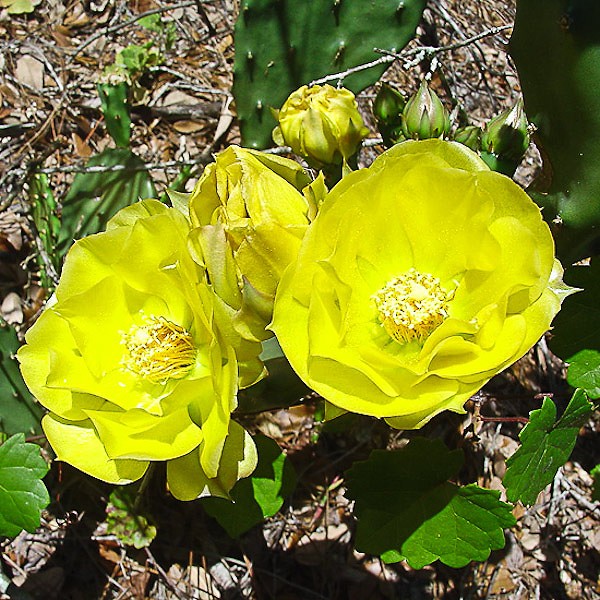
Work time in a scrub area last Tuesday was extra cheery due to the sunshine yellow prickly pear blooms as fancy as roses, lovely as a flower can be. Bet they help neighboring flowers of other species become pollinated by drawing pollinators from round about.

All photos today by John Bradford
Less cheerful, trudging through a scrub you suffer a hot stab to your shin, look down, and not only is there a cactus spine impaling your flesh, but attached to the nasty spear is a small stem segment. Yanking it out hurts, but congratulations, you just discovered a key to prickly pear distribution. Those detached pads cover the broken edge quickly with mucilege goo that hardens like epoxy, then the pad can live eternally to reroot wherever it shakes loose. Pad relocation has something to do with the global prickly pear presence (native in the New World, introduced in the Old World):

Map from Plants of the World online
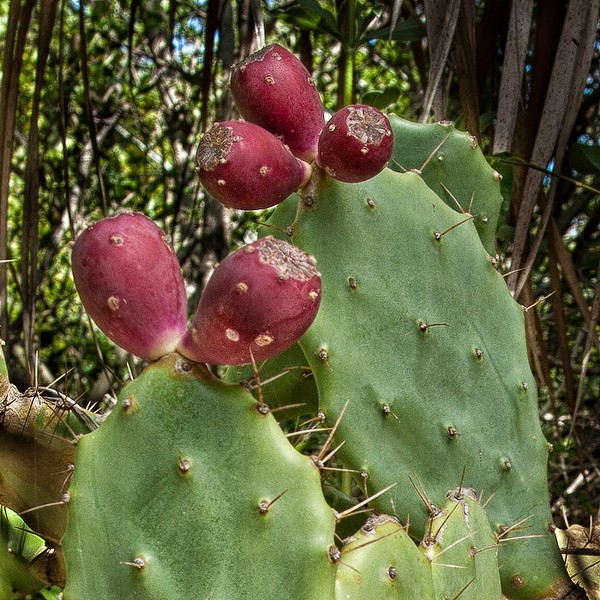
Some Opuntia species are so dedicated to stem-piece dispersal they have stopped producing fertile seeds altogether. Back in 1892 Arizona naturalist J.W. Toumey wrote about the spines propping the broken-off stem pads above the ground. That’s handy: helps with cooling, keeps ground bugs and fungi off, and makes the pad more likely to grab a passing beast. To complicate regeneration further, some populate their seeds with a clonal piece of the mother plant instead of an actual embryo. Even more oddly, the fruits can take root directly even if the seeds they contain don’t.

Most opuntias and close relatives have chromosomal aberrations to interfere with normal sexual processes. Although untested for cacti so far as I know, there is a general association between ancient cultivation and chromosomal oddness mixed with clonality. Might apply to prickly pears.
On the downside, cochineal insects grown on cultivated prickly pears for purple dyes have escaped detrimentally onto our native prickly pears, a topic covered in a prior blog.
Human uses for prickly pears are old, widespread, and diverse, so you can rest assured long-ago people moved them around. There is evidence in Mexico of ancient prickly pear domestication, that not a big surprise. Plants that are easy to propagate with edible stems and fruits, with 100 additional uses happy to grow in deserts are a gift to cherish. That map above shows how prickly pears have gotten around the Old World, in some places being pests. But when not pests, in addition to tasty, water-filled fruits and stems, the vast medicinal uses are too diverse to list. Pick any ailment, some you never heard of. There are prickly pear wines and brandies, and pancakes. Have you seen expensive hydrogels added to garden soil to retail moisture? Prickly pears are the original wild hydrogel, long used in Italy especially for growing cucumbers. There is modern commercial interest in PP neutraceuticals, whatever a neutraceutical is. Remember that quick-hardening mucilage? Cactus pads have been used as spreaders to apply the smooth mucilage to boat hulls to make them glide with ease. Uses as sewing needles and as field medical probes are obvious and true. More interestingly, ancient peoples found bundles of the spines useful as a combination needle and paintbrush for tattooing. Like an old-school smallpox vaccination.

Opuntia stricta. Explain this shotgun distribution! (Map from BONAP).
 John Bradford
 George Rogers
 George Rogers
 Dee Staley
 Treasure Coast Natives