Floridians live where plants meet salt. The ocean’s pretty big, and in other regions salty plants hang out inland at saline seeps, salt licks, salt flats, and even roadsides where salt trucks fight ice. Salt-loving plants are called halophytes, although how much any halophyte actually “loves” salt is always a reasonable question. Many salt-“loving” plants grow happily in un-salty cultivation, red mangroves for instance. Sometimes the “love” for salt may boil down to tolerance, making a salty habitat where a halophyte competes best. How plants need, prefer, tolerate, or cope with salt varies. Unrelated species have evolved salty ways in different fashions. Always fun to explore.
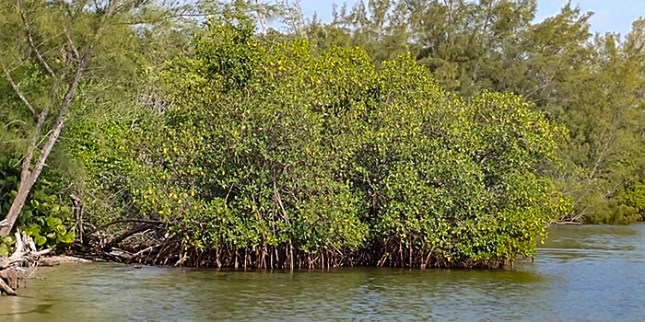
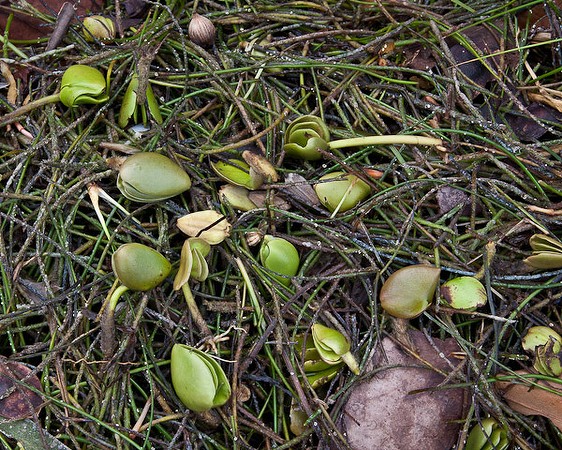
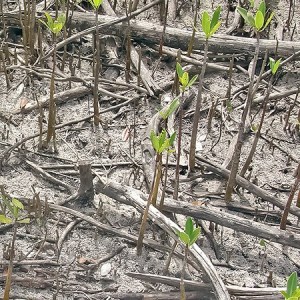
Start with mangroves. Around here we have red, white, and black, all unrelated to each other, and each with its own mechanisms for dealing with seasalt. Red mangrove holds down its internal salt concentrations by excluding it at the root. The gated community approach. Comparatively low internal salt levels might help red mangroves operate their complex system of pumping air to the roots, allowing growth in deep tidal water and suffocating mud. Just speculating on that.
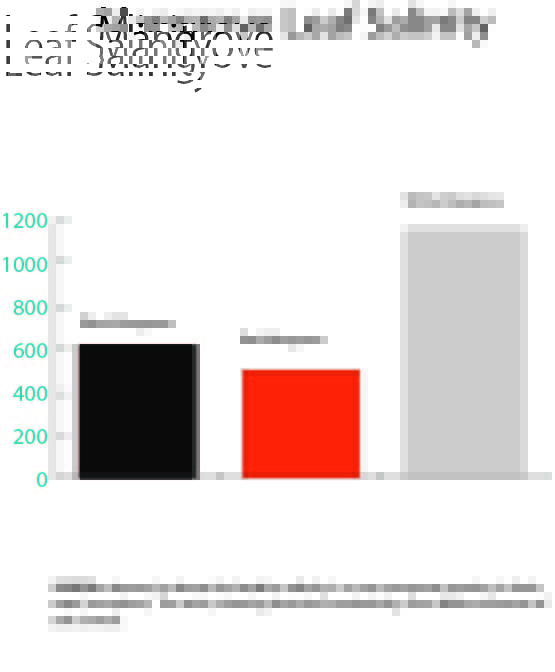
Salty tissues offer protection from bugs and fungi. Red mangrove, being the least salty of the local mangrove species, seems to have the most fungally infected and bug-eaten leaves of the trio.
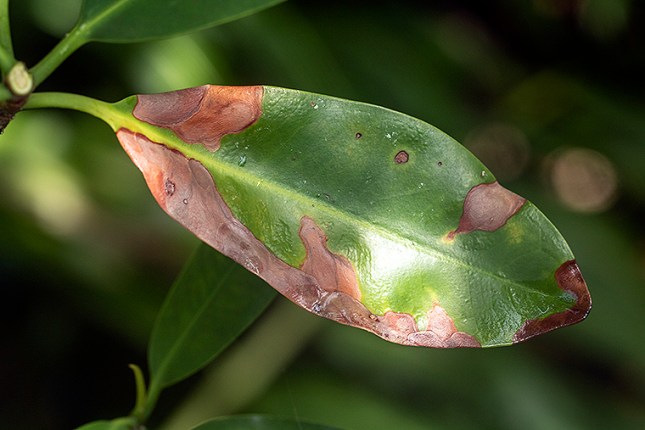
Red mangrove…low salt = high fungal trouble?
Black mangrove handles salt by secreting it onto the leaf. Much presumably washes away in rain, although a margarita-rim crust on the underside is fairly persistent. The pass-through salt system may help hold the internal salt levels down. In our measurements black mangrove was in the middle of the three saltwise, although there would be variation under different conditions. The salt crust was left in place for the measurements shown below.*
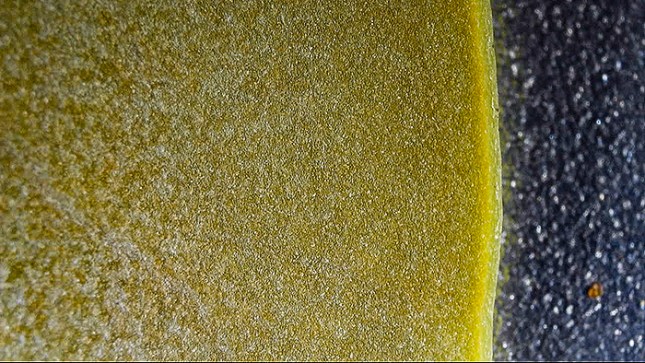
Black Mangrove salt crust on leaf underside
White mangrove can secrete salt from glands on the leaves, which are not those two nectar glands on the leaf stalk. It does not secrete as much as black mangrove, and in our experience does not become salt-encrusted. Instead, it has somewhat succulent leaves where salt collects internally. It had by far the highest salt concentration of the species measured.
Sacrificing entire leaves is costly. Another way to shed salt is to package it in little bladders, and then drop or pop them externally. Waste bags! Such ability is scattered a little in the coastal plant world, famously in the Amaranth-Chenopod Family, for instance the coastal plant Atriplex, Sea Orach. Its salt bladders appear mostly on the undersides and margins of young leaves. They fill and burst, leaving busted bag remnants and salt crud on the underside of the leaf. As with mangroves, botanists have determined the salty coating to be bug-deterrent.
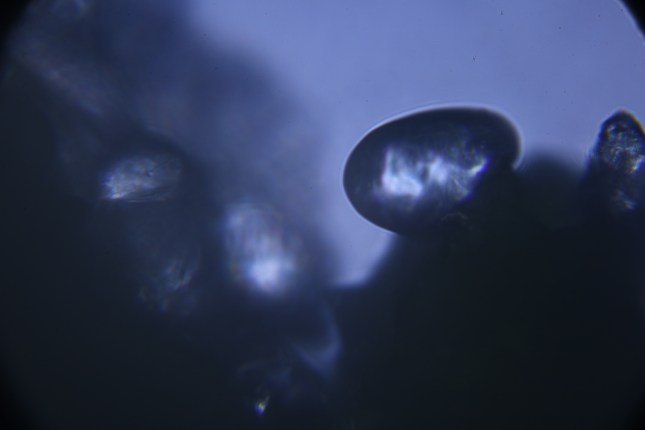
Atriplex salt bladder, microscope view
White mangrove gave us a hint already of another way to deal with salt: succulence. Seaside plants don’t have much freshwater to flush out salts or to cool evaporatively in the hot beach sun. Succulence gives salt sequestration, protection from temperature spikes, water storage, and maybe even padding from windy beach conditions. It must be a “good idea,” because seaside succulents abound: Batis, Cakile (sea rocket), Iva (marsh elder), Salsola, Scaevola (inkberry), Sesuvium (sea purslane), and more. Go find a beach plant and, if not a grass, odds are it is succulent.
Several grasses thrive in salty places without succulence. Some have microscopic salt glands on their foliage. Virginia Dropseed, a beach and dune species, is a photo-example. Each salt gland is a short two-celled bump surrounded by four taller bumps called papillae. Do the papillae protect the glands they surround?
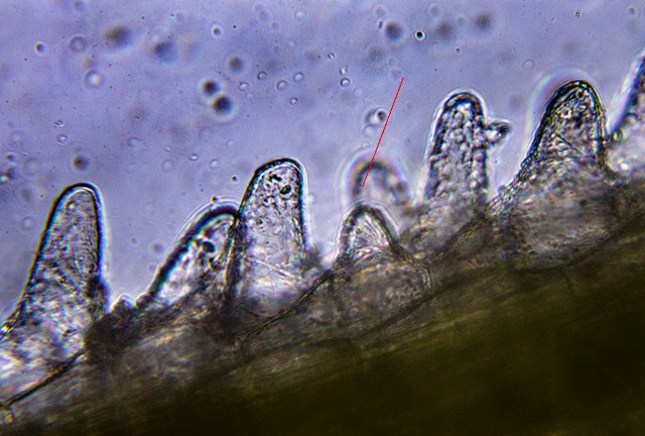
Virginia Dropseed grass. Small salt gland (red marker) surrounded by taller papillae, apparent protection for the gland.
Gland with papillae
Certain species we do not know as salty sometimes thrive in semi-salty places, becoming a wee bit succulent when hanging with salty friends. A local example is Virginia Creeper. Does the Creeper thicken as a result of salt exposure, or alternatively, are the thick-leaved Creepers a separate genetically adapted strain, salty ecotypes? For those with time and inclination it is easy to distinguish the two possibilities. Grow them in a common garden. Depending on the species, you can find either case. I strongly suspect with Virginia Creeper succulence is acclimation by individual plants…my bet is if you take a normal Creeper and grow it in salt it thickens. Either way, compatible solutes help…let me explain:
Salt sucks. It draws freshwater by osmosis. That is why if I drink sea water the brine in my stomach draws water from my surrounding tissues and dehydrates me. If you put a freshwater plant in saltwater, it wilts because the salt “sucks” the water out.
It is not just salt that does this, but any dissolved material. One way a plant can fight water theft by saltwater is to accumulate its own internal “salt” (dissolved material) to win the osmotic tug of war with the outside salinity. These protective “salts” are called compatible solutes. A well documented heavy user of compatible solutes is the mangrove associate Golden Leather Fern, Acrostichum aureum. At different points in its life cycle the fern uses different compatible solutes to keep its tissues just a little “saltier” than the surrounding water. Different levels of salt stress can bring forth increasing levels of compatible solutes.
Watch the wilt. Two VA Creepers. The one on the left from a mangrove swamp. The one on the right from non-salty “normal” situation. The two placed in saltwater at the same time and photographed over a few hours. The one from the mangrove swamp tolerated the saltwater. The other wilts painfully. CLICK
——————————————————————————————–
*Five leaves of each species were placed in the same volume of tapwater in a blender.
Zero” on the graphs was the level of saltiness measured in a cocoplum grown away from salt. The units siemens/m reflect electrical conductivity.
 John Bradford
 George Rogers
 George Rogers
 Dee Staley
 Treasure Coast Natives