Dull Leaf Coffee
Psychotria sulzneri
Rubiaceae
Today John and George continued exploration of Mariposa Cane Slough Preserve in Pt. St. Lucie behind Sam’s Club. Basing our species choice on beauty, today’s looker was the Dull Leaf Coffee, Psychotria sulzneri in full berry. This species is one of the four Psychotria species in Florida, three of them native, two indigenous to our area. The other local native is the Wild Coffee, Psychotria nervosa (the term “nervosa” refers to the leaf veins, not to a mental condition).
Psychotria is one of the largest Dicot genera, with over 1500 species around the world in warm climates. Some, including Psychotria punctata introduced in southernmost Florida, have symbiotic bacterial translucent dots in the leaves. Some produce psychoactive alkaloids, although the name “Psychotria,” is apparently not a direct reference to drugs, but rather to an ancient belief that species of this genus propped up the psyche, or soul. Wild Coffees are related distantly to the coffee we drink, and so far as we know, drinking preparations from Psychotria is dangerous (see comments on drugs above). Psychotria is in the Coffee Family, the Rubiaceae, an assemblage of many thousand species, including wildflowers (such as Innocence), garden selections (such as Ixora), medicines (such as Quinine), and weeds (such as Mexican “Clover”).
To transition into today’s chosen species, Charles F. and Pearl Sulzner were early Miami real estate investors who supported good causes, including botany, especially for the New York Botanical Garden. John Kunkel Small, Florida’s preeminent botanist and namer of P. sulzneri, represented the New York Botanical Garden and was connected to Miami philanthropy. He knew how to suck up. Charles Sulzner died tragically at age 85 after being clobbered by a streetcar in St. Petersburg.
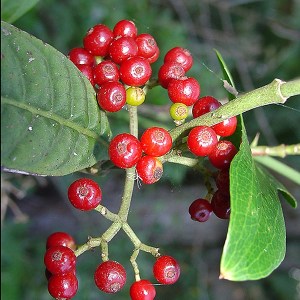
- The fruits (photo by JB)
The stunning berries (actually, drupes) on Psychotira sulzneri pass through a bright yellow phase on the way to scarlet, often resulting in flame-colored fruit displays, no doubt irresistible to birds. We will come back to the amazing flowers when the species is in bloom.
The most remarkable feature of Dull Leaf Coffee is not so colorful. Our two local Psychotria species have starkly different leaf coloration. Psychotria nervosa features high-gloss bright green. Psychotria sulzneri , by contrast, has a deep green velvet-matte finish, with a tiny kiss of blue. But why? That leaf color is not common in the plant world, although it occurs in other species. Folks with northern wildflower experience know “Wild-Ginger” (Asarum canadense) with similar coloration. The leaves are also reminiscent of some Hydrangea foliage, or to a couple of grass buffs like us, a wee hint of Blue Maidencane (Amphicarpum muhlenbergianum). What do all these have in common? Shade.
To slide into speculation: Psychotria nervosa is probably glossy as an adaptation to reflect excess sunbeams, just like a pilot’s mirrored sunglasses. That would not imply an inability to tolerate shade—it can. Perhaps delicate shade-tolerant photosynthetic mechanisms need that extra glossy sunscreen, just as the pilot’s delicate retinas need protection.
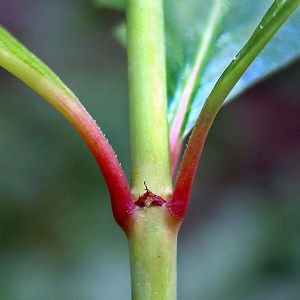
- Rubiaceae stipule (photo by JB)
Psychotria sulzneri is playing a different game. Its deep sub-green anti-reflective solar panels look like they are adapted to drink in every photon, allowing the species to flourish deep in the understory, which it does. Perhaps P. sulzneri has developed its own sun protection. When you go to the beach with sunblock it doesn’t show. So much to research, so few opportunities. Wouldn’t it be fun to be 22 years old, starting graduate school and looking for research projects with a lab and a grant!?
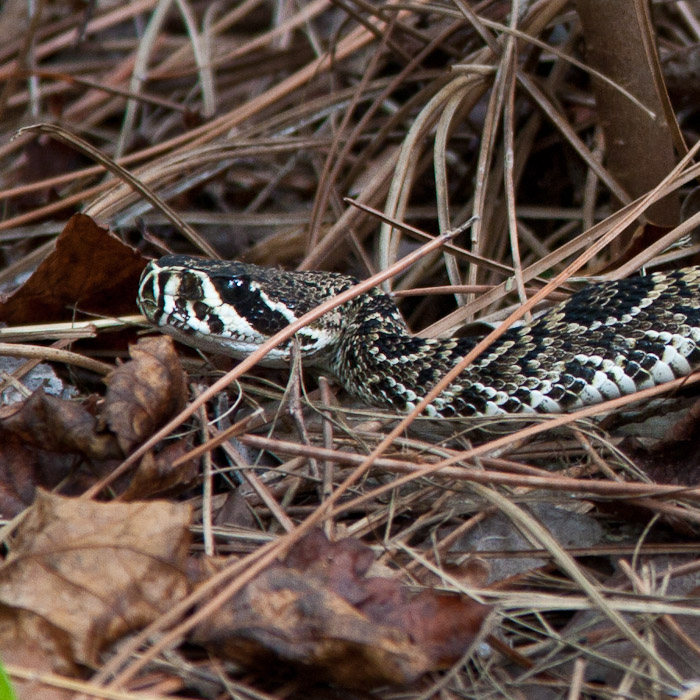
- By the Dull Leaf Coffeee (photo by John “snakes” Bradford)
 John Bradford
 George Rogers
 George Rogers
 Dee Staley
 Treasure Coast Natives