Virginia Buttonweed
Diodia virginiana
Rubiaceae
Today John and George visited the Palm Beach County Solid Waste Authority, a dump with benefits: a network of nature trails and ponds and fun times communing with wetland plants and a sunbathing gator. CLICK for a cyber-visit to the landfill.
As a fan of this native wetland gem, I am dismayed that the suburban lawn-culture has turned Virginia Buttonweed into a reviled hate-weed. Is the most interesting thing about a wildflower which carcinogen to spray on it? Spray HERE to glimpse the horror!.
Or go read the garden blogs—you’d think VBW was the Crack of Lawn Doom. So then to join the ranks of condescending blog-pundits holding forth on what to do if Buttonweed affliction keeps you awake at night: Enjoy it! (Then turn down the sprinklers.)
VBW is native across much of the eastern U.S. and extends into South America, its spread conceivably aided by migrating waterfowl. The plant can repopulate from busted fragments, and Canada Geese reportedly eat it. Perhaps they are travel agents, sharing the beauty from golf course to golf course. Also, the little barrel-shaped fruits become corky and float away. Today was a good monsoon day for that. Did I mention that the species is semi-aquatic, probably adapted to wet disturbed shores where floating matters?
In recent times Virginia Buttonweed has turned into a weedy turf pest in the Southeastern U.S., and far beyond, including Asia. Why has this cute little puppy become a bad dog? Well, it’s adapted to intermittently wet disturbed sunny places with impaired drainage. In other words, stream banks, marshy fields, and suburban lawns on compacted soil soused with automatic sprinklers.
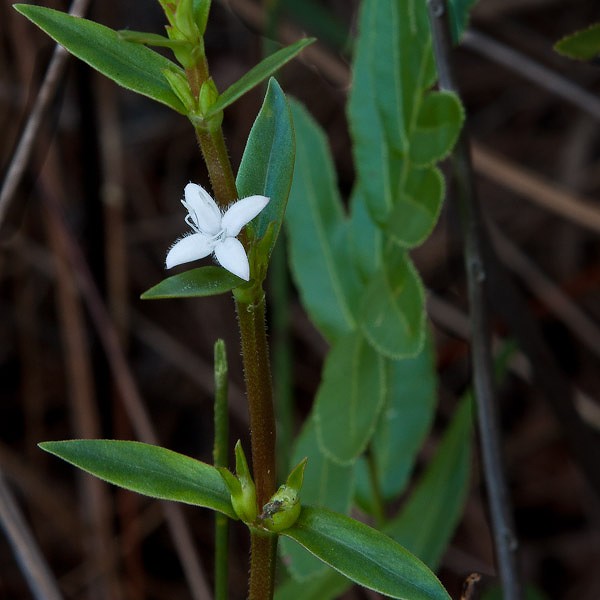
Diodia virginiana yesterday (JB)
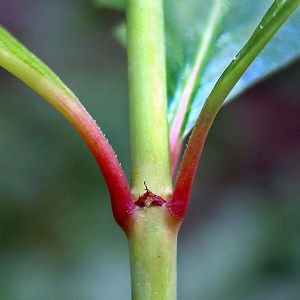
Among the plant’s odd adaptations are two features sometimes found in other members of the Coffee Family. First, the tissues contain tiny acid needles probably there to minimize grazing. (Even if the needles do not bother a Goose, they might discourage insects.) Secondly, around the stem at each node there is a saclike membrane (a specialized stipule). The membrane is a translucent ziplock bag that holds water around the developing young flowers, around the young fruits, and possibly around tender points of root origin. The plant can (as I speculate!) collect and retain moisture around its key parts during dry moments in its amphibious life cycle. No wonder it likes those lawn sprinklers. CLICK this link to see the membrane in Diodia (teres) as the white cup with fingers on the rim, surrounding the base of the flower. Having a similar adaptation and even more prevalent in Florida turf is Mexican-Clover (Richardia grandiflora).
This little wildflower is one tough customer. It can regrow from it own fragments. The stem sprouts roots where it contacts the ground. There is a report of deeply buried seeds sprouting, this being perhaps an adaptation to being covered in silt? And most intriguingly, the species reputedly forms underground flowers, a feat (if accurate) it shares with its fellow-member of the Coffee Family, Innocence (Houstonia procumbens) and with other unrelated local species, such as Blue Maidencane Grass. In the old sketch below, it looks like the bottom-most fruits might have been in the mud.
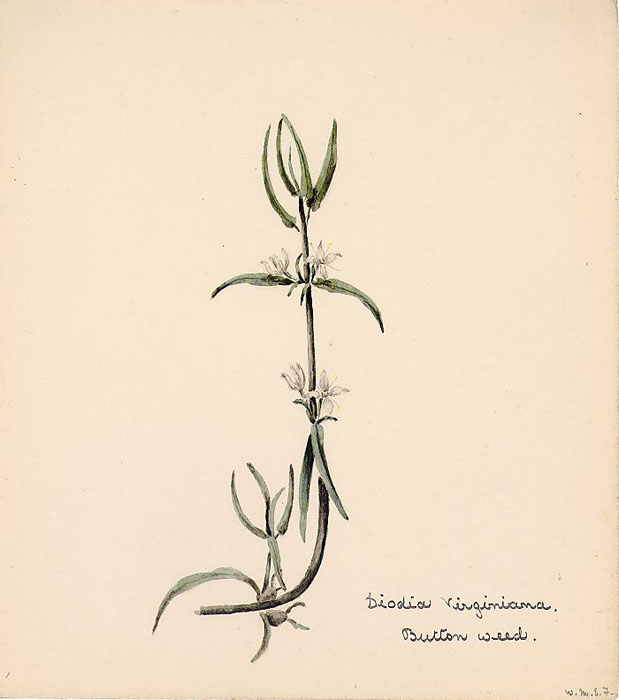
Sketch from the Internet. Selected to show the lowdown flowers (fruits).
You may ask yourself, “what has this creepy plant got to do with coffee?” Glad you asked: it is fun to find out the family relationships of familiar plants, because then family resemblance shine through. Look how similar the Virginia Buttonweed blossom is to the Coffee flower. The Buttonweed fruit even looks like a little coffee bean.
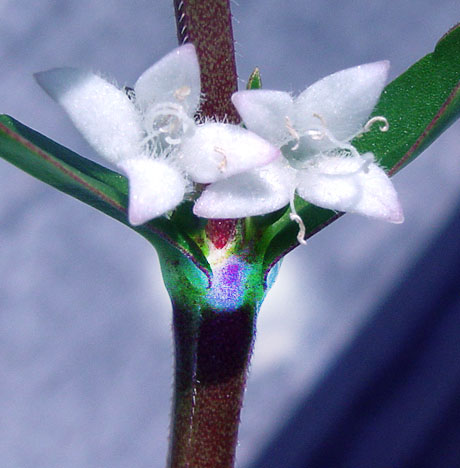
All in the family: Buttonweed flowers looks similar to related coffee flower.
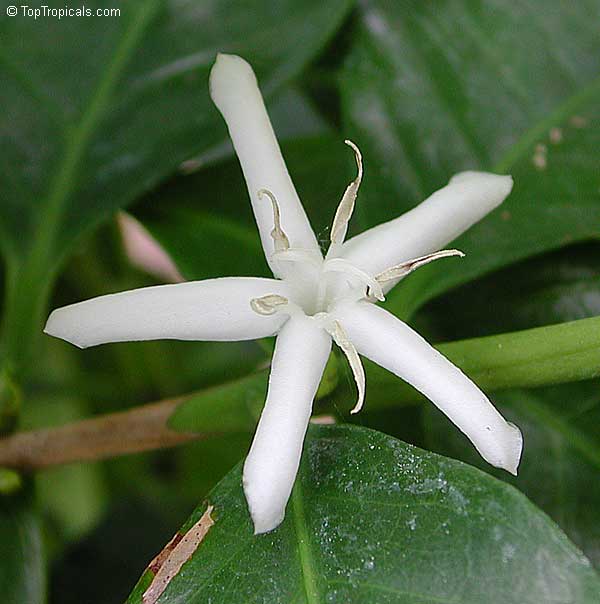
Coffee flower (from Top Tropicals plant nursery)
 John Bradford
 George Rogers
 George Rogers
 Dee Staley
 Treasure Coast Natives