Wild Coffee
Psychotria nervosa
Rubiaceae
Answer: I’d like to get my mitts on the numbskull who made up the English names for the plants of the world. The only connection between the Wild Coffees and Starbucks is joint membership in the Coffee Family, the Rubiaceae, along with 12,999 other close relatives. There is a little visual similarity between a Wild Coffee and Coffea arabica, but chalk that up to broad family resemblance. The genus of Wild Coffees, Psychotria, with some 2000 species, is one of the largest genera of woody plants.
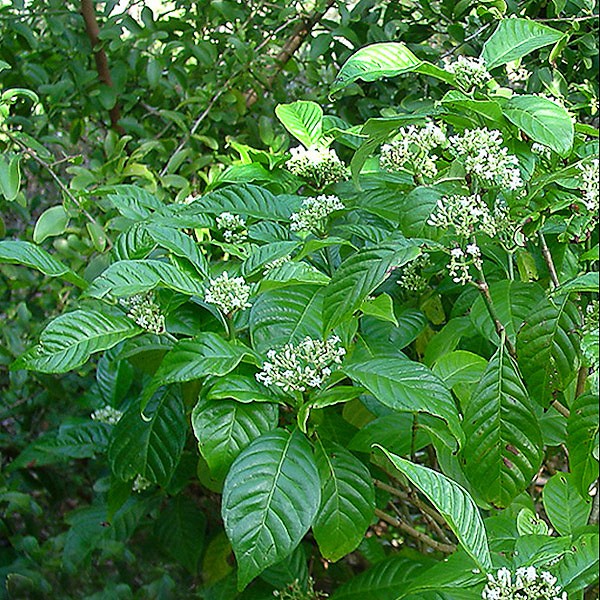
Wild Coffee (by JB)
Would you make a cup of “coffee” from Psychotria? No, unless maybe you are a Shaman, and few Shamans read WordPress blogs. The traditional uses of Psychotria include ayahuasca. Ayahuasca is a variable mind-altering Amazonian ceremonial concoction where the main psychoactive ingredient comes from the Banisteriopsis Vine in the Malpighiaceae (represented in south Florida by weedy Hiptage, garden flowers, and native Locust-Berry (Byrsonima lucida—another day another blog).
Psychotria adds kick to the ayahuasca with a drug known as dimethyltriptamine (DMT). So, then again, maybe Starbucks should take a second look. Psych-otria and psych-adelic come from the same Greek word psyche for mind and soul. Psychotria extracts serve also in arrow poisons as well as fish and vermin-killers. So please don’t make “wild” coffee unless you are a licensed shaman.
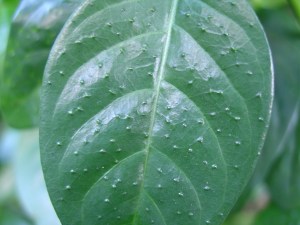
Two thousand species worldwide, four in Florida, three native. The non-native species, Psychotria punctata from southern Africa is cultivated a bit in southernmost Florida and apparently escaped a little. Its claim to fame is foliage punctuated with translucent bacterial nodules (see the photo). But this is a native plants blog, so back on-task. Our three natives are:
1. Bahama-Coffee is Psychotria ligustrifolia (P. bahamensis) on limestone in Miami-Dade and Monroe counties, in the Bahamas, and on other Caribbean islands. It differs from P. sulzneri by having glossy (vs. dull) leaves, and differs from P. nervosa by having smaller more compact form and smaller leaves with less-impressed veins. The compactness, overall good looks, and shade-tolerance give Bahama Coffee a role in native plant landscaping. A tough and beautiful planting has graced the Palm Beach State College campus for many years in serious shade and with little to no irrigation.
2. Dull Leaf Coffee, aka Sulzner’s Dull Coffee (or other variations on similar names), P. sulzneri , is a pretty shrub with flat-toned leaves having a velvety sheen. (More on this species at (http://wp.me/p1H7HW-b3). It is a hammock dweller from southern peninsular Florida to Costa Rica.
3. The most-cultivated Wild Coffee is Psychotria nervosa. The “nervosa” does not refer to a state of mind, but rather more mundanely to the leaf veins (nerves) which are deeply grooved. This species (and Bahama Coffee) have domatia beneath the leaves. Psychotria nervosa differs from the other two by having tiny calyx teeth (sepals). It ranges naturally from Jacksonville to South America.
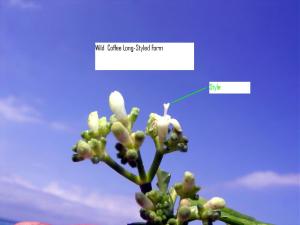
Wild Coffees are prime examples of an odd biological phenomenon, heterostyly (HET-er-oh-style-ee), that is, having styles of different lengths. Flower vocabulary refresher: the style is the elongated part of the female unit at the flower center. It is tipped by the pollen-receptive stigma, and its base is the ovary where seeds develop. This is important, so remember that the stigma is the pollen-receptive tippy top of the style. Stamens make pollen at their own tips.
Many Rubiaceae are heterostylous (het-er-oh-STYLE-us), including such Florida native “coffees” as Mitchella, Morinda, Guettarda, and others. (To lllustrate, I’m going to use Guettarda (Velvetseed) for the convenient reason I have good pictures. Psychotria is the same for present purposes. )
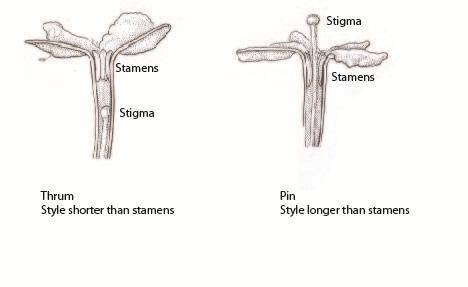
Heterostyly is an adaptation to force flowers to cross-pollinate. In heterostylous species there are two breeding strains, and each is forced to cross exclusively with the other strain. Here is how it works.
In one strain, the flowers have long styles (with those pollen-receiving stigmas at the tips) and short pollen-making stamens. These long-styled flowers are called “pin” flowers. Think of the long style as a pin.
The other strain has the reverse: short styles and long stamens . (“Thrum” flowers. Thrum sounds like Tom Thumb and he was short.)
Think of the pollinating bee as a dipstick probed into a flower with the bee’s nose going in deep and the bee’s knees remaining out near the entrance to the flower. (This is oversimplified using nose and knees to make a schematic point. The actual touchpoints vary among species.)
In a pin flower the bee’s nose touches the short stamens while the bee’s knees touch the pollen-receptive stigma on the tip of that long style. Flip-flopped, in a thrum flower, the bee’s nose touches the short stigma and the bee’s knees touch the long stamens.
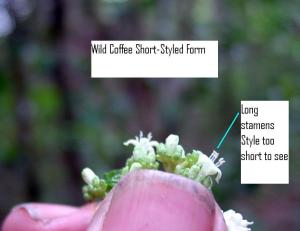
So then, when the bee visits a pin flower, the short stamens powder its nose with pollen. If it flies to another pin flower the pollen-dusty nose is not aligned for pollen-drop-off. For this bee to drop off its pollen, it must switch to a thrum flower where the nose can pollen-dust the short stigma. In Psychotria you can distinguish pin and thrum flowers with a hand lens. (You can tell the styles from the stamens because each flower has one style but five stamens.)
[Drawings by Karen Stoutsenberger, from Rogers, G. K. The Genera of Rubiaceae in the S.E. U.S. Harvard Papers in Bot. 10: 42. 2005.]
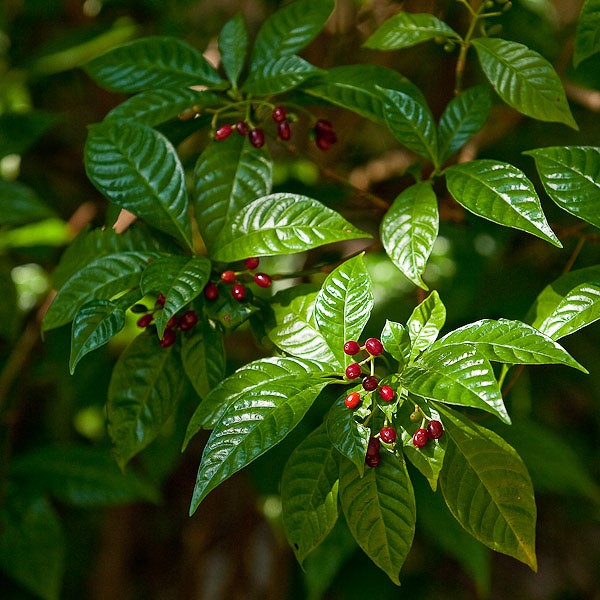
Wild coffee (by JB)
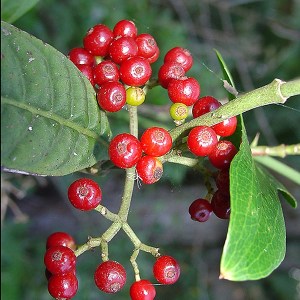
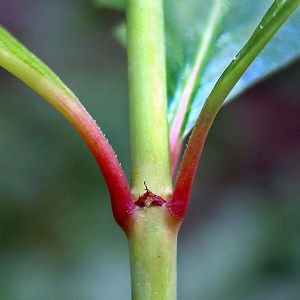
 John Bradford
 George Rogers
 George Rogers
 Dee Staley
 Treasure Coast Natives