Sundew
Drosera capillaris and other species
Droseraceae
We don’t actually have any moors in town. That’s for our U.K. blog correspondent blog friend Mary. But John and I today were lost spirits adrift in Seabranch State Park. But don’t think all’s hunky dory just because there is a restroom and a Ranger. Deep and dark where the Rangers dare not go lurk magic mushrooms, witch grass, devil’s potato, poison ivy, and gargantuan mutant plants drooling for fresh meat on Halloween.
We were bewitched by the bloodthirsty Sundews, species of Drosera, almost 200 carnivorous species worldwide, five in Florida, and two in our usual enchanted forest.
Our locally common Drosera capillaris is not closely related to the other Florida species; rather, its two closest relatives are South American. Sundews get around as if they had broomsticks.
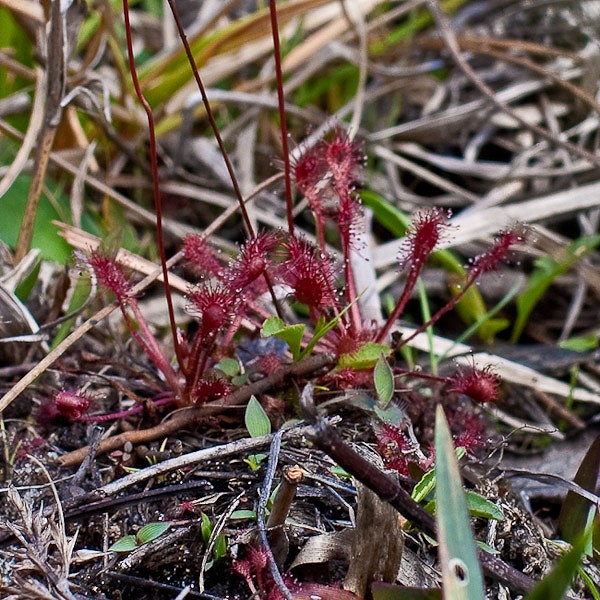
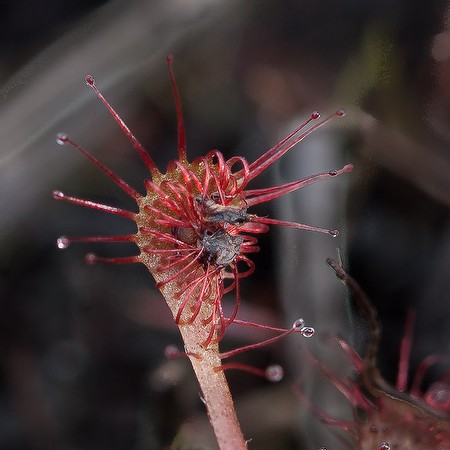
Sundew. All photography today by John Bradford.
Why would a nice little rosette turn to the carnivorous side? Plants, after all, make their own food by photosynthesis, so who needs butchery? Flesh-eating plants indulge in cannibalism not for energy, but for what we might refer to as fertilizer elements. When a plant harvests an insect—or a human—we’re talkin’ nitrogen and phosphorus in habitats where N and P don’t come easily.
Knowing that, some thinkers might now wonder, if N and P come from the beef, how does the Sundew acquire additional micronutrients. With preliminary research, so far it seems the minor nutrients arrive by root in the usual fashion, but the weird thing is, the Sundew roots require pre-activation by a blood meal up top.
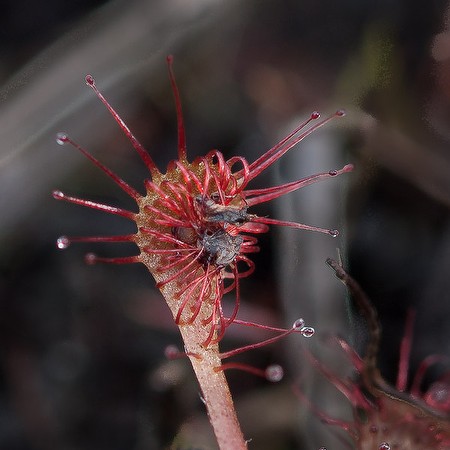
Gotcha! (Before the spider did)
It might be a good idea here to mention what the Dews do. Their paddle-shaped leaf blades have on the upper surface fearsome tentacles tipped with glistening sticky glue. Birdlime for bugs. The reddish foliage no doubt attracts victims to the plant. When a tiny buggie touches the sticky hairs the creature naturally gets agitated and starts kicking and cursing, only to become mired like Brer Rabbit whupping the tar baby.
When an insect is entrapped in some of the hairs, separate previously uninvolved hairs on the same leaf reportedly bend toward the atrocity. How do they know to do that? It’s a mystery of nature. The hairy entanglement pushes the twitching corpse onto the surface of the leaf blade where enzymes suck the last spark of life from the foul remains.
In some Sundews, although probably not our local species, spring-loaded hairs around the leaf margin fling incoming insects onto the lethal sticky hairs toward the center of the blade.
A single Sundew doesn’t snuff many insects. But an entire Sundew meadow can decimate the ranks of those embarrassing creepie-crawlies worse than an angry ORKIN man might. This puts the plant into competition with predatory beasts, possibly the only documented case of animal vs. plant competition for food. The cheated beastie is the Wolf Spider who in a huff builds a supersized web when Sundews force the extra effort. And to balance the scales of justice, the Sundew too suffers diminished performance in the company of the ungracious arachnids. (Based on recent Florida research by ecologist David Jennings and collaborators.)
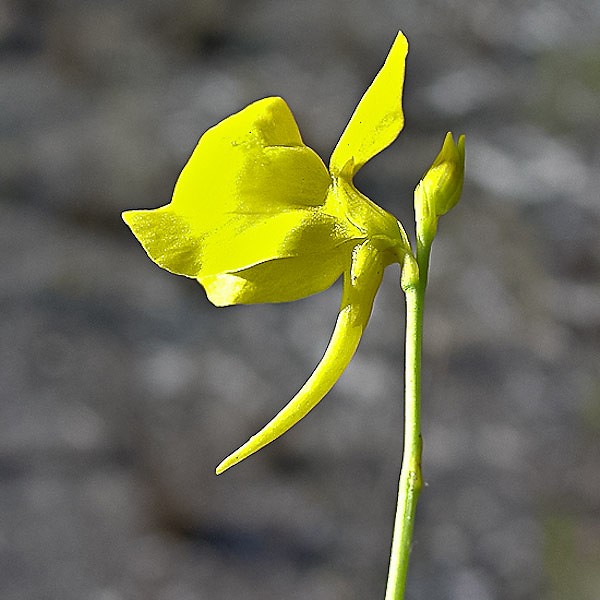
Sundews live not by nutrition alone. They too need love, or at least love’s outcome: pollination. If I were a pollinator on the wing, I’d shun those gooey botanical bastards with their deadly flypaper just under my six feet! No thanks, I’ll go trick or treating in safer neighborhoods. USF Professor Frederick Essig has observed the flowers to host surprisingly few visitors. He observed further that as the day progresses the flowers close up, pushing the male stamens with their pollen against the female stigmas of the same flower, effecting a pollination “selfie.” As he speculated credibly, the automatic self-pollination may allow Sundews to multiply in a jiffy to populate the entire mud bank. Don’t wait for pollinators, gobble them, then go pollinate yourself.
Our day in the park started out fine, but we did experience an unfortunate incident upon wandering a bit off the beaten path trying to photograph a bird. There is a remote swampy corner where the plants are so vastly oversized you have to wonder if something has caused mutations. The deeper you push into the swamp, which is tough to penetrate, the plants and spiders become increasingly massive and bizarre until you lose sight of the sky in the gloom, with animal “voices” whispering and grunting from the shadows. We wondered if maybe the mutations dated from a radiation leak at the nearby Hutchinson Island nuclear plant. I was concerned about going into that ominous place, fearing mutation myself, but John couldn’t pass up a hot photo op. (He has a new lens.) So in he charged while I waited safely on the trail eating fruit and nut granola bars. After hearing some strange sounds, maybe toads, in the distance, and after waiting an hour, I reckoned John must have found an easier trail out and returned to his hearse to skulk back to his unholy lair in time to feed his bats. Or perhaps chickened out and skedaddled when the raven spoke. So, unconcerned, I departed too. But later, the office called because a worker found a camera along the trail and was canvassing the park volunteer roster to find the owner. Yes, John’s camera was easy to identify by the new lens. You may view footage recovered from it. CLICK if you dare. If you’ll join the search mob, we’ll meet at the graveyard at the stroke of Midnight. Bring your own torch, and I”ll pick up some eye of newt. Happy Halloween.
 John Bradford
 George Rogers
 George Rogers
 Dee Staley
 Treasure Coast Natives