RSS

Tag Archives: Bladderwort

Purple Bladderwort Has Aquaponics

Utricularia purpurea

(A utricle is a sac.)

Lentibulariaceae

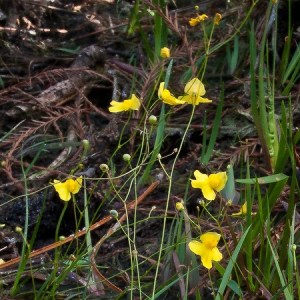
Brightening shallow waters and wet muds round town right now are intricate carnivorous plants, the bladderworts, in some places thousands of them.   Several Utricularia species make Palm Beach County a better place, all of them showy yellow-flowered, except one,  purple bladderwort having, duh, purple flowers.
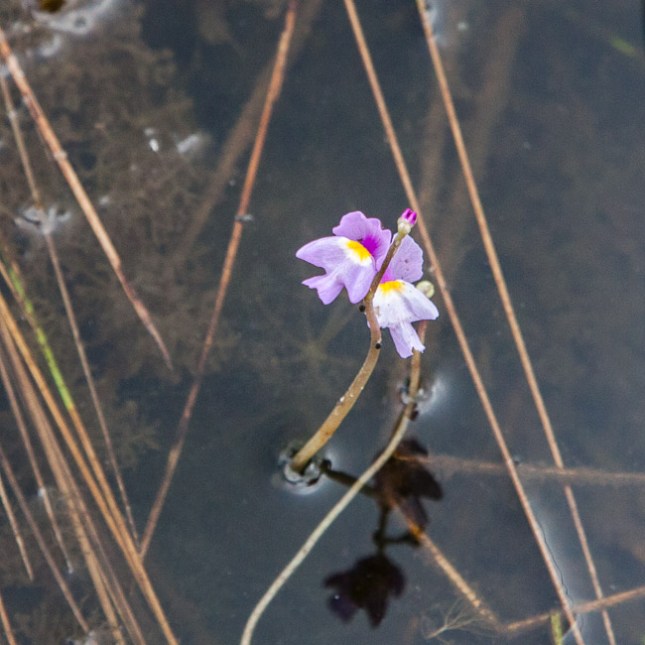
Utricularia purpurea 7

PBW by John Bradford.

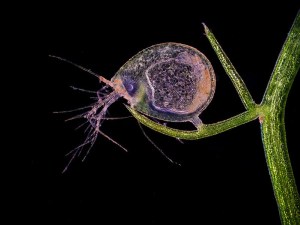
We’ll get acquainted, but first a word about bladderworts in general.   They typically have finely divided stringy leaves and live in shallow water or in wet mud.  Flowerless you could mistake them for algae.  Look closer though, on the foliage are tiny (let’s say 1 mm across) bladders, little slurp-traps with a trap door and trigger hairs.  Tiny creatures swimming by trigger the triggers, and SNAP,  the trap springs open like the wicked witch’s oven, and the small passerby becomes lunch.
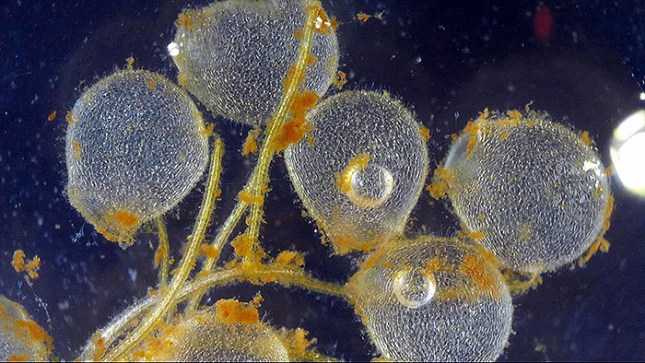
utricularia purpurea traps with debris

Death traps magnified, with clinging brown detritus.

Utricuaria purpurea is one of over 200 worldwide species of bladderworts, and its astounding distribution extends from Central America to somewhere along Hudson Bay.   It takes the cold bravely via tiny tubers called turions hiding safely in the lake bottom mud.   In our area the foliage masses can be the size of a garbage can, often looking brown.
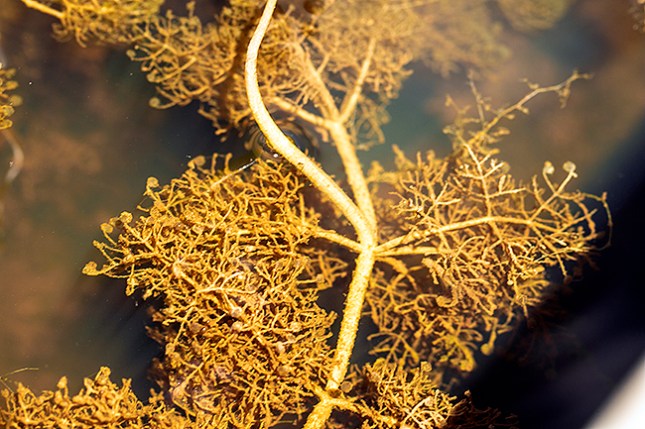
Utricularia purpurea foliage

Foliage with traps.

The inconsistent tendency toward brown is not a sign of morbidity.   Under the microscope even brown leaves sustain healthy chloroplasts.    The brown seems to be largely material clinging to the foliage, including dead and living algae,  mixed detritus, diatoms, fungi, cyanobacteria, and who knows what.  No doubt the mix depends largely on the site.
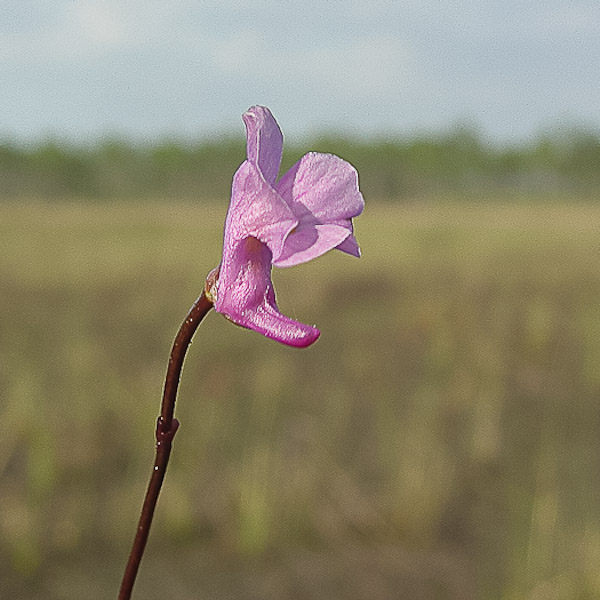
Utricularia purpurea 1

The flower by John Bradford.

Now back to those fearsome traps.    Utricularia purpurea is one of the species calling the role of the traps into question.     Today’s speculations are not necessarily mine, as other observers have given this matter study and thought.
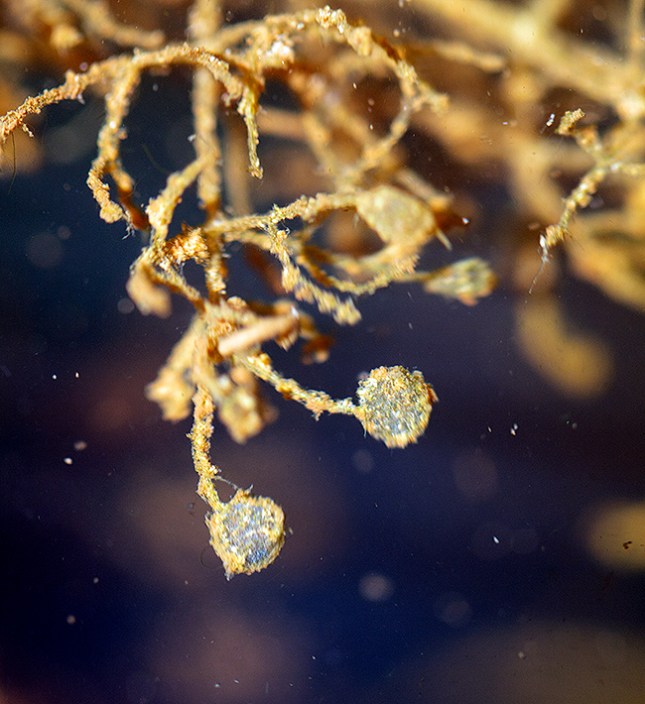
utricularia traps in water

First of all, a study in one place and time is a snapshot,  and just like a snapshot on Facebook, it is inadequate to assess the big picture.   That said, there are reasons to suspect that, “catch a bug and eat it” is not the whole truth and nothing but the truth, even though the traps contain glands producing digestive enzymes.   But there’s more to it:    First of all, the plants invest substantial resources in making those traps, which, however, often appear under-rewarded with the expected victims (but not always).   Secondly, the plants secrete carbon compounds into the trap fluid, as though they are feeding something.   Third, the traps contain a lot of healthy squirming life other than dying victims.   The traps are home to micro-ecosystems of bacteria, sometimes cyanobacteria, apparently healthy protists, and some small multicellular varmints.  Below is a short movie made today of residents in the traps.  Check it out:

CLICK HERE to see life in the trap.

Which are victims?   Which are exploiters or predators?   Which are bycatch?  Which have a mutually beneficial relationship with the plant? Which are in multiple roles?

In the last-mentioned case, biologists plausibly wonder if the plant is feeding its trap colony food from photosynthesis (those carbon compounds) and receiving in exchange nitrogen and or phosphorus waste from those within.    What a great area for research.

You may be asking, if the trap has all those tiny inhabitants, how do they get in?   It turns out even minute stimuli can say, “open sesame,” and the traps can open and close repeatedly, even in a short time.  I’ll bet I know how they all get out…ultimately as fertilizer.  In short, perhaps instead of merely being trappers, bladderworts invented microscopic aquaponics.


—————————————————————————

For those who want to dig deeper:

https://www.jstor.org/stable/2657137?seq=1#page_scan_tab_contents

https://academic.oup.com/jxb/article/61/1/99/567342


3 Comments

Posted by on August 17, 2018 in Purple bladderwort, Uncategorized


Tags: , , ,

Bladderworts and Other Bugivores

Drosera capillaris   Droseraceae

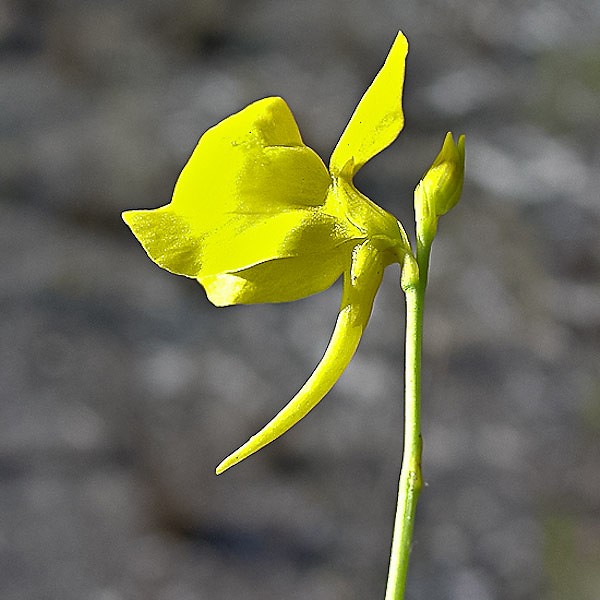
Horned Bladderwort (by JB)

Today John and George  explored  a small pond and adjacent Bald Cypress swamp margin in Jonathan Dickinson State Park near Hobe Sound in preparation for an upcoming educational event.   Carnivorous plants ruled today, so here we go on Bladderworts n’ stuff.   We scored a  Utricularia hat trick, encountered three different species all in flower in a small area.  Generally called Bladderworts,  the  genus contains 214 species altogether.

Zig-Zag Bladderwort (by JB)

Flesh-eating plants represent diverse plant families of Monocots and Dicots, and are not closely related to each other.   They have evolved in situations where the main plant nutrient, nitrogen in its various forms, is in short supply,  or where impaired root functions make it hard to take up, or where roots are absent altogether,  as in Utricularia. Insectivory  captures nitrogen in sterile sandy soils, in acid substrates, on epiphytic perches, in anoxic muds, and sometimes in aquatic habitats.  Utricularias look more like Algae than Flowering Plants—until you spot the beautiful flowers.

Genlisea with trap (Google Images)

The Genlisea traps are tubes, topped with two weird  long twisted appendages at the open end.   They look a little like those blow-up arm-flapping tube men they use to draw attention to used car lots and furniture sales.  The armlike appendages have inward pointing hairs.   Varmints swim in but can’t back out, because the hairs are a unidirectional valve,  as some fish traps catch fish.  The Genlisea traps are technically rolled leaves, so it is possible they evolved from simpler ancestors having in-curled blades resembling those of Pinguicula, making Genlisea sort of a “missing link” between simple Pinguicula and the complex traps in  Utricularia.   Perhaps relevant to this, Genlisea species have foliage leaves in rosettes  resembling those of Pinguicula.

Bladderwort bladder with trigger hairs (Photo by Jose Almodovar)

Utricularia traps are bladder-shaped or look like one of those goatskin wine squirt bottles favored by skiers.    The door leading into the bladder has a trap door.  Near the trap door are microscopic trigger hairs.  When the victim jostles the triggers,  the trap door releases and the bladder expands rapidly, sucking in the meal, as a slurp gun sucks in an aquarium fish. The in-slurp happens in a tiny fraction of a second.

CLICK for video

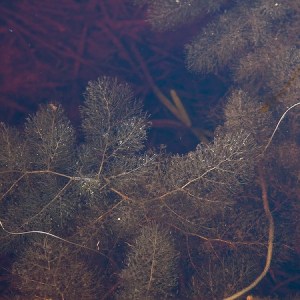
Today’s three Utricularia species are a study of variation within a single genus.   Leafy  Bladderwort  (U. foliosa) lives suspended gracefully in the standing water,  looking at first glance like a green alga waving in the pond.   It builds up huge slippery biomass.   Oddly, the species is distributed in the Americas and in Africa.

Leafy Bladderwort in water (by JB)

The other two, Zig-Zag  Bladderwort (U. subulata) and Horned Bladderwort (U. cornuta), inhabit  moist muds.   They both have fine threadlike leaves hidden in the soil.    They differ in their flower structures:  living up to its name (cornuta = horned), Horned Bladderwort has a long horn-shaped spur on the flower.   Zig-Zag Bladderwort is one of several species in ur area capable of making cleistogamus flowers: tiny flowers that self-pollinate (or somehow develop seed) and never open.

This species has a second quirk.  Where are the photosynthetic leaves?  It has some leaves but not much.  Botanist Wilhelm Barthlott and collaborators, citing earlier research, discuss this species as one of the few “carnivorous” plants that derives energy and not merely minerals from carnivory.

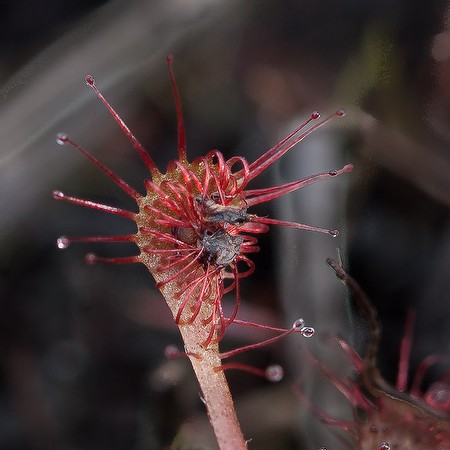
Around our feet, the Bladderworts had competition for the buggy menu.  The wet ground was littered with beautiful tiny Sundews (Drosera capillaris).  The reddish leaves on these are shaped like spoons and are covered topside with long hairs, each hair with a glistening glandular tip.   Insects who touch the tarbaby get in worse and worse as they struggle, until the goo-tipped hairs bend inward and press the corpses to the digestive leaf surface.

Sundew enjoying lunch (Photo by JB)

 
Leave a comment

Posted by on December 21, 2011 in Bladderwort, Sundew


Tags: , , , , , , ,