Morning Glories
Ipomoea species
Convolvulaceae
John and George missed getting to the field this week, John with house guests, George with the flu and with adult children home. So we take a lazy armchair look at a nourishing and photogenic genus. Ipomoea has around 500 member species, with about 25 in Florida natural areas, wetlands, gardens, and Winn Dixie. This is the genus of Sweet Potatoes (Ipomoea batatas) and of various species significant in ethnobotany, in gardens, as invasive exotics and weeds, and at rock concerts. (Remember Morning Glory seeds?, If not, Google.)
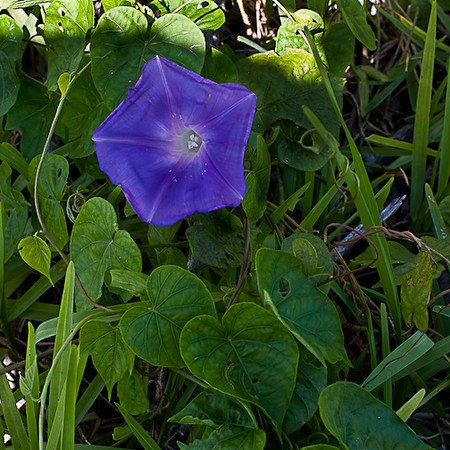
Ipomoea indica (by JB)
Ethnobotany first. Sweet Patooties originated in the American tropics with their cultivation dating back thousands of years. They sure have gotten around, making their way westward into the Tropical Pacific in pre-European times. How exactly that came about remains hidden in the mists of history, despite plenty of discussion and conflicting hypotheses. Our utterly worthless and 100% non-original guess is that they came back across the Pacific with Polynesians who visited South America and then went back. And this is our segue into another weird story of Sweet Potato relocation, with a Florida connection.
The Archbold Biological Station near Lake Placid is dedicated to ecological research, especially of scrub. Its 1941 founder Richard Archbold (1907-1976) did not earn his glory studying Red Widow Spiders in Florida scrub, but rather as an adventurer, aviator and jungle explorer, especially in New Guinea. An Indiana Jones kinda guy, he was the first recorded Western explorer to discover the Baliem Valley in New Guinea, home to an isolated Stone Age population lost to the bigger world until Archbold’s 1938 visit. What a find. This was the heyday of aviation-borne, National Geographic feature exploration, and the New Guinea folks were cannibalistic and wore scary tusks to make it totally cool. You may now visit as an eco-tourist.

New Guinea Dani Tribesman (Google Images)
Back then a remarkably large lost population of farmer-warriors occupied a high misty jungle valley surrounded by treacherous mountains. Today perhaps they wish they had not been found, especially because a member of Archbold’s group shot and killed one. Not a great ice-breaker.
Now there are a million fascinating aspects to this, but only one ties in to today’s topic: guess what that lost civilization was growing? Sweet Potatoes, an American plant. (They had interesting gourds too, but that is a different story.) But to return to the amazing point with emphatic redundancy: a species from the New World was the primary crop, cultivated with finesse thank you, in the hands of an isolated mountain tribe with no prior western contact. Dang. How that came about is not 100% clear. Biologist Jared Diamond suspects historical Spanish mariners to have something to do with it. More intriguing (if less likely) is the possibility that the pre-European movement described above extended as far as New Guinea. Comparative DNA study will sort all that out soon enough.
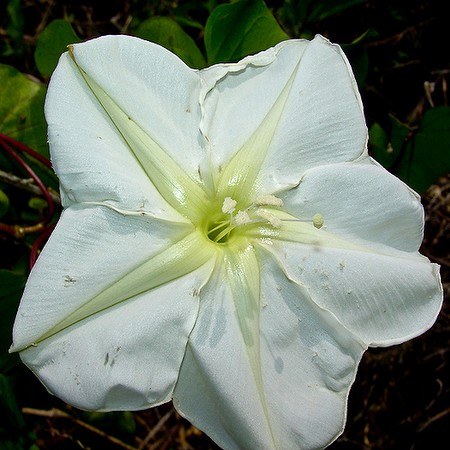
Ipomoea alba (by JB)
And speaking of weird Sweet Potato redistribution, closer to home, floristic super-botanist John Kunkel Small wrote about Giant-Rooted Morning Glory (Ipomoea macrorhiza) persisting from probable ancient cultivation on Florida Native American middens. If not cultivated, it was clearly at least a sanctioned “camp follower.” Whether or not the species is “native” in Florida seems unclear (and way interesting), placing it in the same native-or-not category of other midden present-day survivors and archaeological remains as papaya, red peppers, and possibly the “native” agaves.
For a species most definitely not native, we have Water Spinach (Ipomoea aquatica), which came to us from Tropical Asia, where it is an important and prolific staple. In the U.S. and elsewhere, however, Water Spinach has become a Category I invasive exotic, floating on the water surface and extending its green tentacles by 10 cm per day. Today’s invasive exotic may feed and fuel the hungry world someday, so no need to be a hater.
Moonvine (Ipomoea alba) is a night-blooming species with big moon shaped lunar-white flowers pollinated by moths in the moonlight. It once festooned the Pond Apple forest around the southern rim of Lake Okeechobee. Earlier observers marveled at its abundance, and it remains marvelous in places. This worthy vine has earned respect in nocturnal gardens worldwide where white blossoms in the breeze dangling from tropical pergolas may tilt the mood to enchantment and romance.
To flip to the other enviro-extreme, Railroad Vine (Ipomoea pes-caprae) is familiar to Florida beach bums. The purple funnel-shaped flowers rise from the stems stretching across the salty sand like a railroad crossing the Mojave Desert. The leaves resemble a goat’s foot. This indestructible vine survives relentless abrasion as well as beach sun and salt, and has an impressive ability to regenerate from severed stem chunks. This and other Ipomoea species contain anti-inflammatory compounds of interest in a modern pharmacological context. If you get zapped by a Jellyfish at the beach, here’s a new idea to challenge the famous ol’ weewee therapy. No thanks, really, on both.
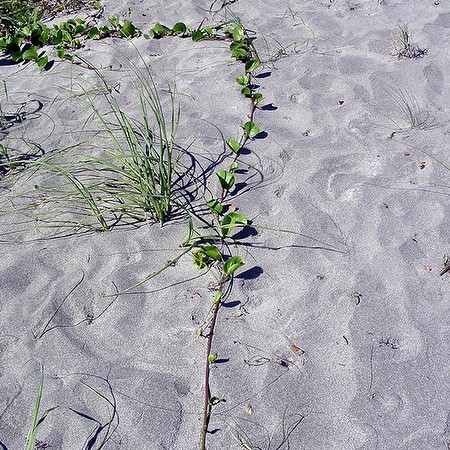
Railroad Vine on the beach (by JB or GR?)
If we were writing a book we could go on into scads more Ipomoea species, but we’re just having fun here, so let’s quit while it is still fun.
 John Bradford
 George Rogers
 George Rogers
 Dee Staley
 Treasure Coast Natives