RSS

Author Archives: George Rogers

Unknown's avatar

About George Rogers

Florida botanist

Why Do Figs Taste Crunchy?

Strangler Fig

Ficus aurea

Moraceae

As a kid on Florida vacations I found it scary that a malevolent tree strangles innocent others like the living garrote of the Green World.  A more mature perspective is less ghastly, and of course the Ficus (Fig) does not actually strangle anything; it merely exploits its host tree for a cheap perch in the sun, eventually growing over and around the host, competing for light and eventually root space.  I’ll bet the host generally lives a long and prosperous life despite its hitchhiker.
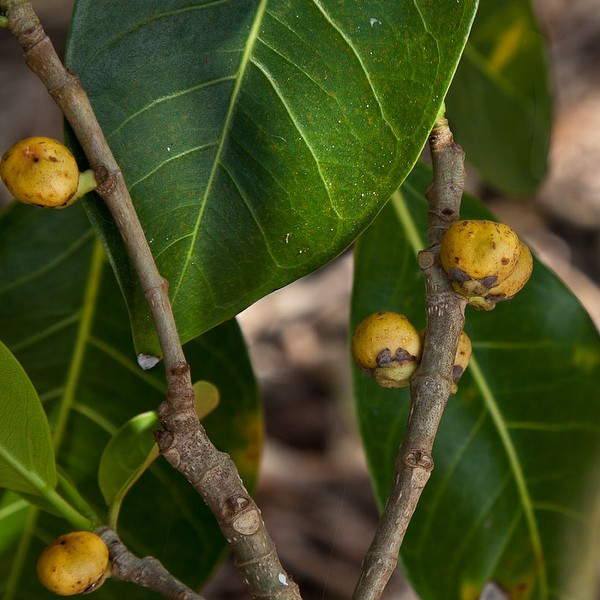
Figs on Ficus aurea (by JB)

In a recent blog Mistletoe was cast as a smart parasite for supporting its host.  Strangler Figs, by contrast, can be indifferent to host’s fate because in time the Stranglers stand on their own two feet.  Sorta like the guy whose wife works in Wal Mart to pay for his Med School until he graduates and runs off with a nurse.

The young Strangler Fig sitting in a tree sometimes looks like a parasitic Mistletoe early on, and some observers have attributed the Ficus with a propensity for parasitism.  However, tree biologist Peter Tomlinson emphasizes the exploitation to be merely epiphytic.  But when the host dies does the strangler benefit nutritionally from the host’s decay?  (Probably not)

Forest tree babies struggle for light under taller canopy trees, so each forest tree species needs a coping adaptation to survive its shaded youth.  Many evolve large food-filled nuts to sustain the sapling until it rises high enough to compete effectively or until  a canopy gap opens.  Figs have a different plan:  they form lots of tiny bird-dispersed “seeds” (technically achenes) carried by birds to lodge in nooks and crannies high and bright on matrue trees.  Then they grow bassakwards from canopy downward to the ground.  Many additional Ficus species have similar tendencies.

Strangler Figs are Ficus aurea, one of 750 Ficus species worldwide.    The other Florida native is the Bearded Fig (Ficus citrifolia) almost restricted to the southern tip of Florida and the Caribbean.  Its whiskerish dangleroots reputedly account for the island name Barbados, translated as “bearded.”  Florida is home to numerous cultivated Figs, some of them escaped nuisances.   These garden Figs include the Banyan, Bo Tree, Counciltree, Cuban Laurel Fig,  Edible Fig, India Rubbertree, and more.

The “fruit” (the fig) is a swollen stem with a hollow cave inside. The cave is lined with tiny male and female flowers followed by seedlike fruits.  Pollination is by itsy bitsie teenie weenie wasps who enter through a portal at the end of the fig.  Stranger Fig has just one species of pollinating wasp (Pegoscapus mexicanus), which is perhaps why it does not (or not often) hybridize with Bearded Fig, which has its own wasp pollinator.

With variation among species, the general pattern is that female wasps enter the fig “fruit” and lay their eggs into the ovaries of specialized female flowers.  Male wasps hatch forth from the eggs inside those flower ovaries and proceed to fertilize the immature female wasps while the girls are still confined within their Fig flowers.  How do they do that?  The motivated guys chew their way through the flower ovary wall to the females, who later use those chew-holes to escape.

Upon exiting its flower-ovary but still inside the fig chamber, the pregnant female wasp packs pollen into a specialized pocket on her body.  Then she flies out to go a different fig to transfer pollen and lay eggs.  She must deliver pollen reliably because no pollen = no flower ovary growth, and no ovary = no nursery for her babies. Something to try: Bust open Ficus aurea “fruits” and find the little wasps inside.

One or more interloper wasp species use Stranger Figs as brood chambers without contributing to pollination.   One such sneaky pete  (Anidarnes bicolor) injects its eggs from the outside of the fig, positioning them to mature on the inside relying upon successful pollination by the proper pollinating wasp.

Have you ever seen a Strangler Fig germinated on the ground?  Yes, but not that often.  The seeds require a sustained moist substrate, most often in Cabbage Palm boots.

Starting out as epiphytes and living years on high before rooting in the ground, Strangler Figs contort around the host, which is why Bonsai enthusiasts like them.  In this connection Ficus wood structure is unusual.  Now we enter the speculation zone with a visual aid.  The wood photo is a cross section…think of viewing a stump surface through a powerful microscope. (The image comes from the University of North Carolina wood collection.)
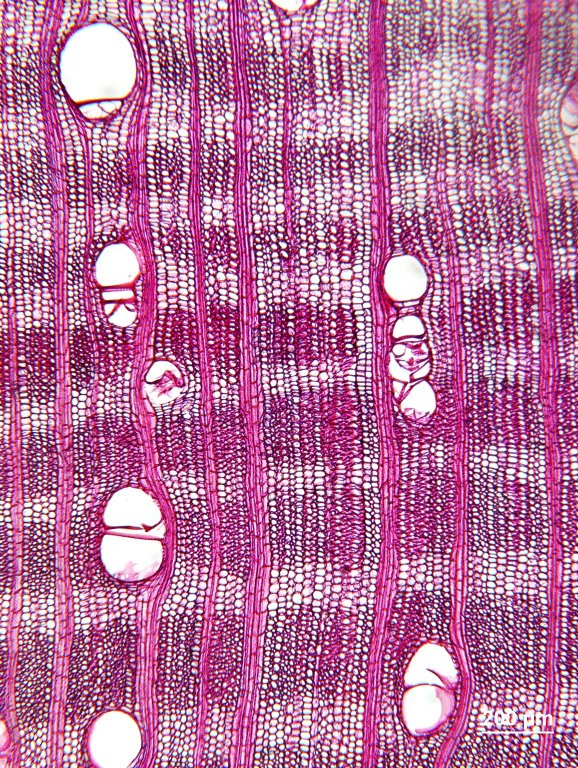
Strangler Fig wood with alternating light (storage tissue) and dark (true wood) horizontal bands. (The vertical bands are “wood rays.” The roundish openings are large water-conducting pipes.)

Strangler fig and related species have something unusual:  bands of living storage tissue (axial wood parenchyma) layered in broad bands in the otherwise dead wood.  (Normal wood is predominantly dead water-pipe and support cells.)   The oddly abundant living storage tissue is conspicuous as those light-colored horizontal bands alternating with the darker bands of proper dead wood.  The living bands sequester water and starch, not a normal wood function in other plants.  Why do they do this?

Most epiphytes face a “dry” life trapped above the ground using their roots to cling to the host instead of accessing groundwater and storing starch like conventional roots.   Epiphytes throughout the plant world consequently develop diverse coping adaptations:  succulence, animal symbioses, suspended animation, the expandable pseudobulbs and sponge-covered roots of orchids, the tanks of epiphytes, elaborate scales and hairs, and more.   The weird and plentiful storage tissue seems to be the Ficus answer to the basic epiphyte lifestyle challenge.  There’s just a wee bit of “cactus” built in.
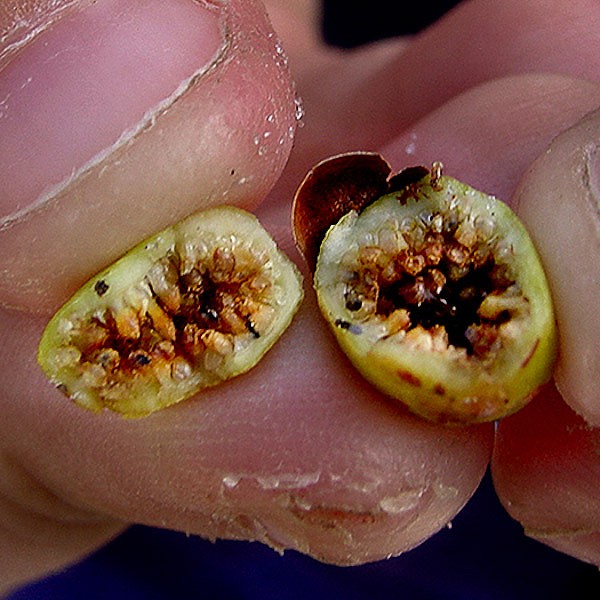
Open fig from Ficus aurea, showing tiny orange “seeds’ (which are technically the fruits. The entire fig is technically a hollow open stem. The hollow seed-lined space is the “cave’ mentioned in the text. You can find dead wasps in there. (Photo by JB, fingers Evan Rogers, Evan Rogers by GR)
 
6 Comments

Posted by on April 5, 2012 in Strangler Fig


Tags: ,

Alligator Flag is a Snappy Wildflower

Alligator Flag

Thalia geniculata

Marantaceae

Which wildflowers have the most complex awesome magnificent pollination mechanisms?  Orchids?  Naw.  Orchids are okay if you like Nero Wolfe, but the truly cool flowers around here belong to Alligator Flag (Thalia geniculata), one of the only two members of the Maranta Family (Marantaceae) native to the United States, and possibly the largest native herb.  The similar Powdery Thalia (Thalia dealbata) grows across much of the southern U.S. but not in Florida to my knowledge.

Thus native plant enthusiasts perhaps don’t encounter the Marantaceae often, but warm-climate gardeners  and interiorscapers enjoy Calathea, Maranta, and Stromanthe.  The popular houseplant known as Prayer Plant is a Maranta.  An odd feature Marantaceae share with Cannas, Gingers, and Spiral-Gingers is that the showy parts of the flowers are mostly derived from stamens (staminodes) instead of the petals, which tend to be inconspicuous.  Floral features we’re about to explore for Thalia are shared in part with some of these kin-plants, especially other Marantaceae.

Thalia geniculata ranges broadly from Florida southward to Buenos Aires.   More interesting are three similar “species” in Africa.  Marantaceae expert Dr. Lennart Andersson interpreted the African representatives to be invasive exotic descendants of American Thalia geniculata relocated to Africa hundreds of years ago, possibly on slave ships.  Although not offered by anyone as an explanation for the boat ride, Florida plant icon Julia Morton mentioned edibility of the boiled rhizome.  An abundant edible “root” in the areas of slave commerce sounds like a food source for the return trip.  Arrowroot starch comes from cousins in Maranta and Canna.

skipper-on-alligator-flag

The origin of the name “Thalia” is a head-scratcher.  Thalia in Greek mythology was one of the three graces, daughters of Zeuss, and her name came in turn from a similar Greek word for “blooming,” a perfect name for the graceful plants.  But hold on there!   According to unassailable old botanical references, that’s not where Linnaeus got the name, but rather for Johann Thalus a German naturalist killed in an unfortunate carriage mishap.

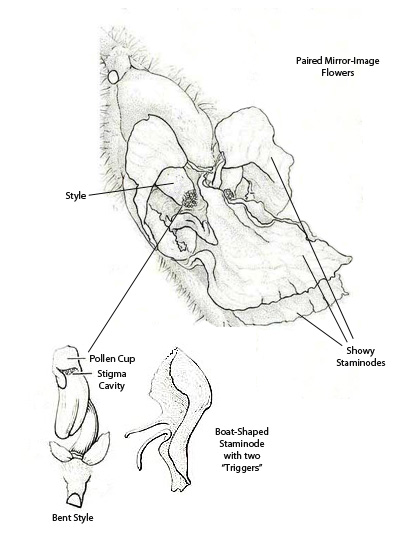
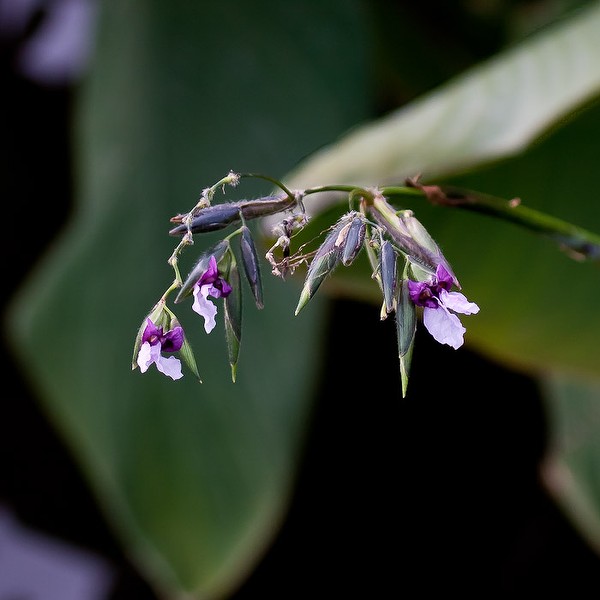
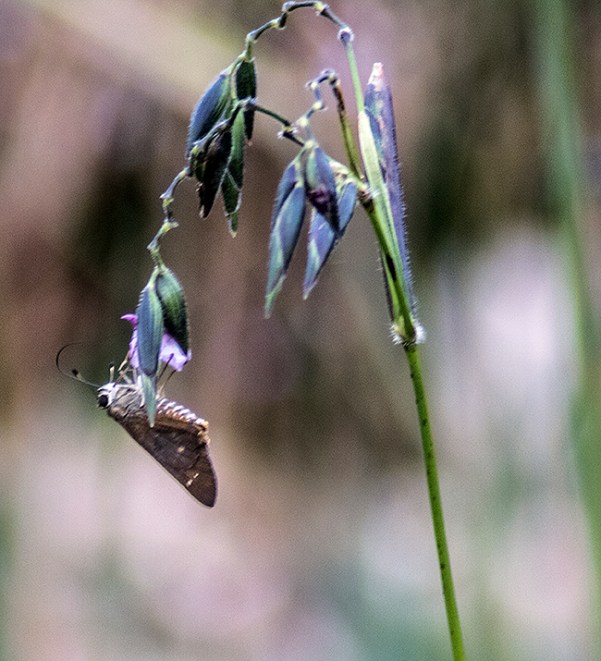
Now for those crazy flowers.  This will take some concentration, so listen up, and next time you see Alligator Flag  growing wild, first look for those flagged gators, then examine the flowers.  As with other Marantaceae,  they are in mirror-image twin pairs.  That’s just plain weird (and pretty).  Second, as already mentioned, the showy parts are predominantly modified stamens posing as petals.  Remember the term staminode.  The real kicker, almost literally from the bee’s perspective, is the rat-trap snap pollination mechanism.  When a carpenter bee probes the flower, the style snaps upward abruptly.  Try poking a pine needle or pencil tip into a blossom—you can snap it too unless a bee beat you to it.

Analyzing every floral organ is beyond the scope of our light and fun blog. (Interested readers can reference the journal article noted below.)  But here is the core of it all.  The style is hairpin-bent with the stigma (pollen-receptive organ) a cavity just beyond the bend.  Exactly at the bend is a little cup where the anther (pollen-producing organ) deposited the pollen while the flower was still in the bud.  That is, the flower uses the style to deliver pollen to the pollinator.

The hairpin style, with its scooplike stigma and its little cup of predoposited pollen, lies like a hotdog in a bun inside of a boat-shaped staminode.  Think of a guy lying in a canoe.  Think of Dracula in a coffin.  The boat-shaped staminode has two fingers rising from its side and wrapping  over the cocked style.  Those two fingers are apparently triggers to unleash the snap.  Before the event, the knuckle with the pollen cup is near the mouth to the flower.

When the carpenter bee or your pine needle disturb the triggers(s), the style pops up and curls inward in a split second.  Think of the guy lying in the canoe suddenly sitting up, or Dracula doing the Transylvania Twist.

When the style snaps up and inward, first the stigma scoop scrapes across the bee’s tummy removing any pollen it has brought from a different flower.  Then a nanosecond later in the same snap the pollen-bearing cup brushes new pollen onto the bee.  The snap no doubt kicks out the dismayed bee, and closes off the entrance to the flower, which has no further need for visitation.

[Notes.  John Bradford took the beautiful photo.  The drawing comes from Rogers, G. The Zingiberales (Cannaceae, Marantaceae, and Zingiberaceae) in the Southeastern United States. J. Arnold Arb. 65: 5-55. 1984.]

 
13 Comments

Posted by on March 29, 2012 in Alligator Flag


Tags: , ,

Win-Win With Mistletoe

Oak Mistletoe

Phoradendron leucarpum (better known as P. serotinum)

Viscaceae

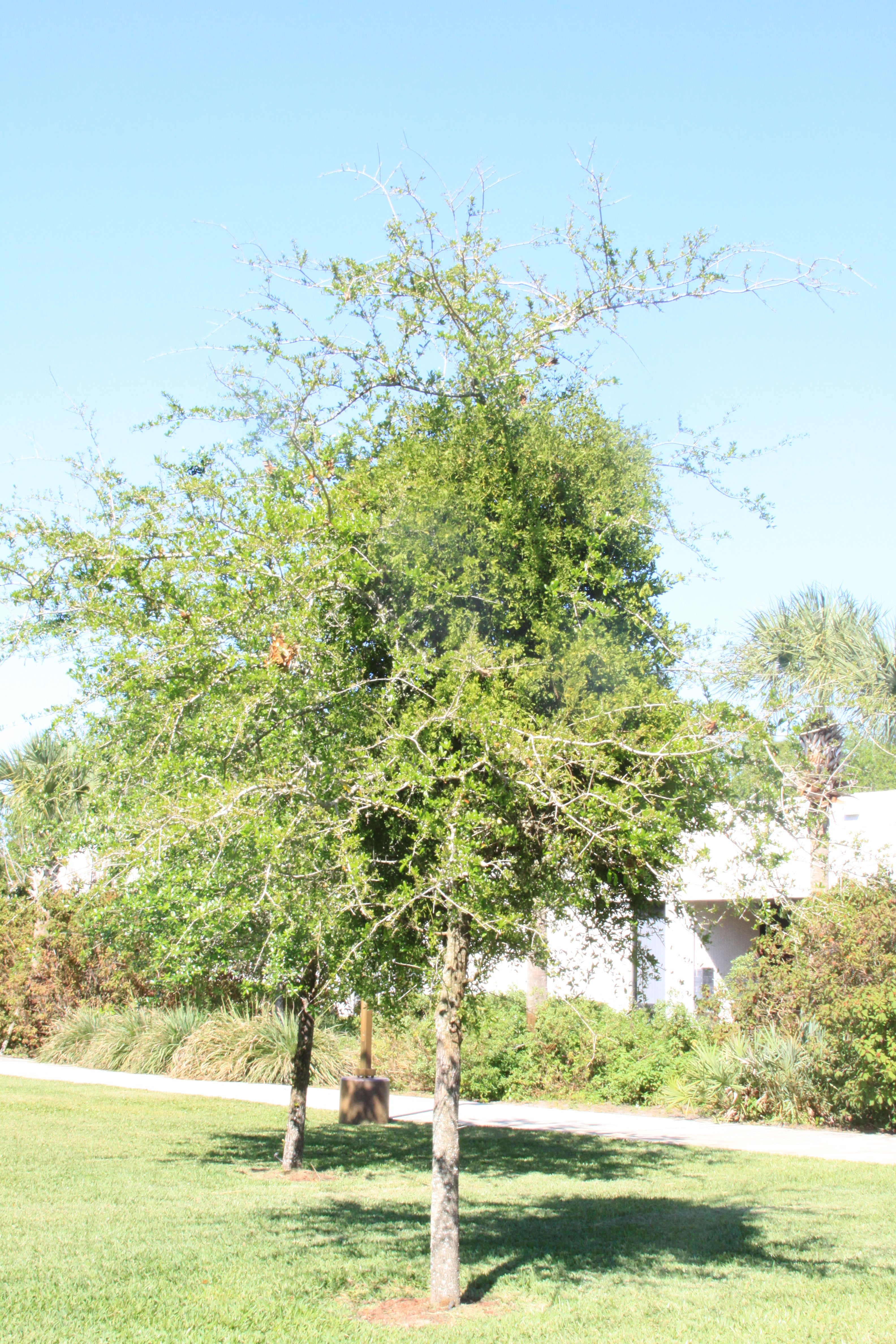
Oak Mistletoe ranges across most of Florida, except for the southernmost counties, with the southern  gap pronounced in the east, so the presence of a large Mistletoe on a small Live Oak literally a stone’s throw from my office in Palm Beach Gardens is surprising.  It doesn’t quite belong here. That the species is “natural” on our campus is less likely than a hitchhike from a distant plant nursery.   But there’s the plant in all its fruiting glory, so it gets attention now.

Image

Above:  Oak with Oak Mistletoe on PBSC campus.  Fifty percent of the biomass in this picture is the Mistletoe.  Is it contributing sugar to the relationship?

Two native Mistletoes grace the state of Florida.  Today’s species, Phoradendron leucarpum, has a checkered history of different definitions by different taxonomists, but long story short, it ranges across much of the southern and south-central U.S.  The other, Phoradendron rubrum, Mahogany Mistletoe, is more at home in the Caribbean with a toehold in the southern tip of Florida.  Its fruits are reddish.  The traditional European speceis Viscum album looks much like our Oak Mistletoe, which is likewise suitable for Happy Holidays smoochin’.   (As recently resubstantiated by Mistletoe expert Justin Bieber. KLICK)

[Oh no,  I hope this blog does not come up when fans search Google for Justin Bieber.  Not much—they would find it among eight million hits.  And if they do, that’ll be good for our hit counter.  If you found this by looking for Justin, hey, broaden your horizons and learn about nature too.]

Mistletoes are reputedly parasites, taking water and inorganic minerals from the host while conducting their own photosynthesis, but hold the fone!  Life is never simple, and here is the fun weird part:

Research has shown Mistletoe to transfer photosynthates (sugars and related compounds) to the host tree.  The Mistletoe and the host are trading commodities.  The relationship appears in truth to be symbiotic, one of those win-win outcomes so beloved by administrators.  A good parasite does not kill its host, and  a sophisticated parasite supports its host!  (Reminds me of contributions to the Sierra Club by big polluters.)

Image

The points of contact between the Mistletoe and its host are remarkable.  The MT makes structures that run along the host bark, like a grass runner running across the surface of the ground.  From the “runners” branch rootlike organs sinking into the host.  The rootlike stuctures come into intimate internal contact with the host in three tissues regions:

1. The growing tissue of the MT is usually embedded in the growing tissue of the host (the cambium under the bark).  Thus they grow together.  Nice trick.

2. The water-conducting cells of the MT join the water-conducting cells of the host within the wood using the same connections the host uses for its own cells.  That is, the water-theft is immediate and direct as though the two were the same plant.  In terms of internal anatomy, they are.

3. Here is the puzzler.  The MT “roots” extend also into the sugar-conducting cells of the host in the young bark.  This is mildly odd since the MT has in the past been regarded, as we know, mainly as a water-parasite.  But, two things:  first, to get to the wood, the MT has to pass through the bark anyhow.   And, second, we already know that when it comes to sugar, the MT seems to give back rather than just take.

Another oddity is the pattern of host specificity in at least Oak Mistletoe.   If you take a broad look at its host species choices it comes across as fairly unpicky, but in portions of its range the species can have favored host species, not always Oaks.  This has led mistletoeologist Dr. Job Kuijt  to speculate on host-specific races within the broader MT species.

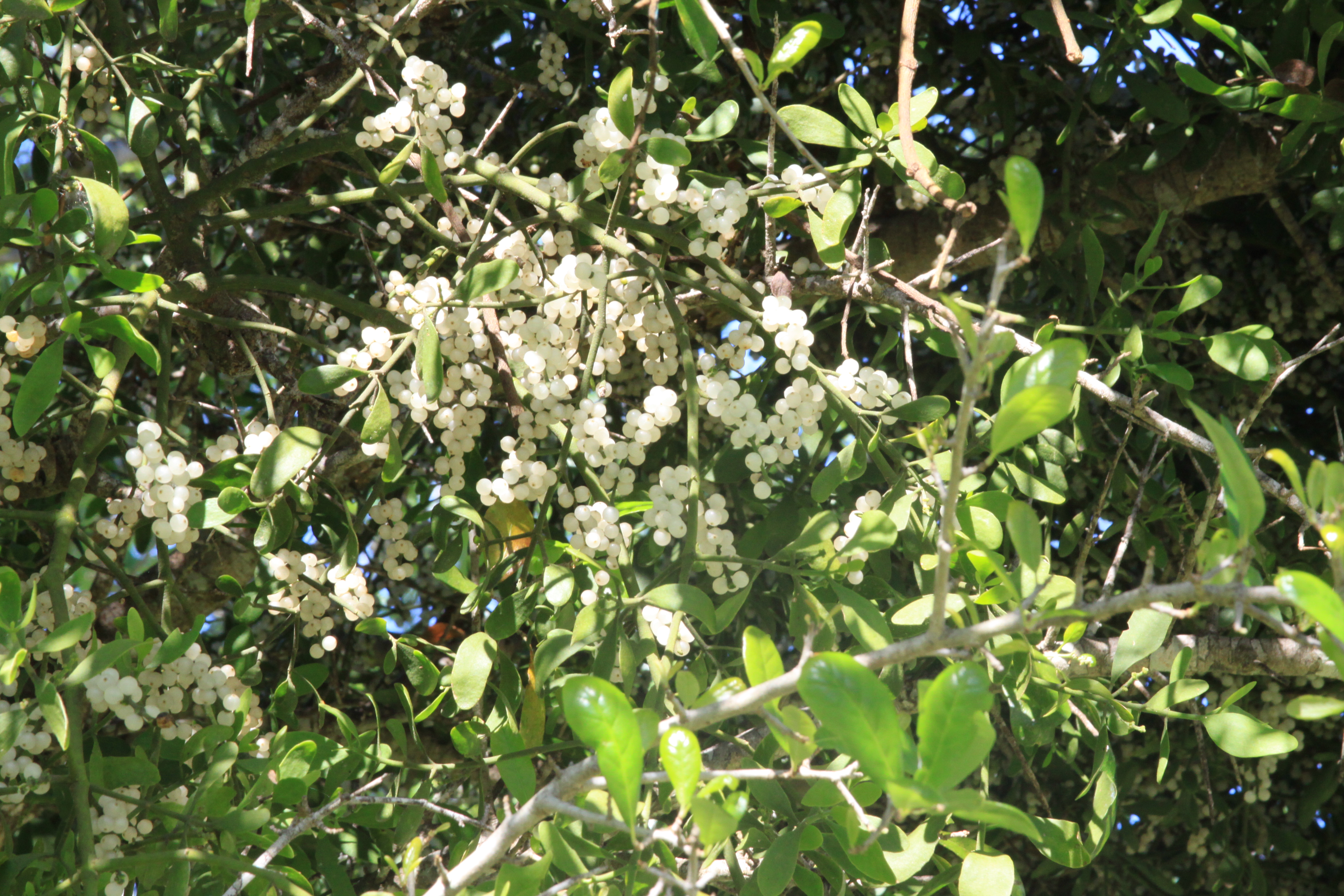
The abundant white berries look tempting, but to people they are poisonous, sometimes fatally.  When squashed they turn to viscous glue, hence the family name Viscaceae.   They are adapted to cling to any body part of any critter coming into pressure contact with them, and I think the stickiness remains functional after passage through a bird. (More research needed on that.  Will use the Muscoy ducks in my yard.)

What a weird name, Mistletoe.  But what does it mean?  Googling turns up controversy, but the best (IMHO) origin comes from ancient English, as explained in detail in my good old desktop dictionary, with the “toe” evolving from “tan,” which means twig.  The Mistle part is more cryptic and controversial, but a cluster of ancient English-Germanic words resembling “missel” relate to urination.  This leads to loose translations of the name as “dung twig,” referring to the way the gummy seeds are deposited on host twigs via birds, including the European “Mistle Thrush,” aka appropriately Turdus viscivorus, the second word meaning mistletoe-eater.

 
6 Comments

Posted by on March 23, 2012 in Mistletoe


Tags: ,

The Secret Life of Spanish Moss

Spanish Moss

Tillandsia usneoides

Bromeliaceae

A fond childhood memory originated when my Lake Alfred grandmother sent a box of Spanish Moss to my home in West Virginia.  Perhaps the Spanish Moss was packing material for something else.  If so, the something else is long gone, and the moss memory lingers.  Amazing exotic stuff for West Virginia kids!  It still amazes me.  All my life I’ve believed the name “Spanish” Moss refers to the beards of the Conquistadors.  Hope that’s correcto.  One thing is sure:  it is not a moss.

Spanish Moss flower (by JB)

Spanish Moss is Tillandsia usneoides, a Bromeliad.  Native plant enthusiasts know that most epiphytic Florida Bromeliads, “airplants” to some, are species of Tillandsia.  Arguably the prettiest is Cardinal Airplant (Tillandsia fasciculata).  Gardeners know a different array of Tillandsias and a much broader family of Bromeliads, from Pitcairnias to Pineapples.

Walking across the PBSC campus this morning, I ducked a tree-beard and noticed it to be in full bloom.  It wants attention, so here we go.

This plant hangs around unrooted, not even enjoying  the obvious tree-top adaptations of other epiphytes, such as the tanks of bigger Bromeliads, the pseudobulbs and specialized roots of Orchids, or the hairy rhizomes of Polypody ferns.  How does Spanish Moss get away with it?   How does it take in water?  How does it photosynthesize up there in the sun without frying?   Does it have a sex life?

On the sex life.   Spanish Moss relocates vegetatively as fragments blow in the wind or cling to birds.   Beyond such cloning there are pretty little greenish flowers, which when pollinated make little capsular fruits releasing tiny little wind-borne fluffy seeds.  Just a guess here, but I’ll bet when those seeds parasail from one tree to another they often  catch in pre-existing Spanish Moss, giving them a soft landing (and a future sex partner).

The water issues.  Spanish Moss and other Tillandsia species get their gray grainy look from a covering of hyper-absorbent scales that trap water and dissolved nutrients from rain, mist, dew, humidity, and bug spit.  You could scarcely design better water-catcher-holders if you tried.  The bases of the scales penetrate the leaf surface and conduct water downward into the plant like reverse roots.  The entire mechanism is refined and effective.  When dry, the winged edges of the mushroom-shaped scales tilt upward, admitting water underneath.  When that occurs, the edges come down, capturing the water and allowing it to absorb into the dead hollow scale cells.  The water passes from the wings to the center of the scale.  The cells at the very center have thick upper walls, which lift when the cells are filled with water.  As the water empties downward through the base of the scale into the leaf the thick upper walls of the central cells pull downward sealing the water in.  Think of water swirling down a drain pulling the drain plug closed.

Leaf scale from Spanish Moss. Top scale is dry. Bottom scale is wet, showing passage of water into the plant. Credit is given in article.

But why doesn’t that skinny little stem dry out in the Florida sun?  In addition to the scaly covering, Spanish Moss has a special ability found   scattered throughout desert plants.  Let’s define the problem:  a plant needs to breathe in carbon dioxide just as we breathe in oxygen.  But, just like us, the cost of “breathing” is water loss.  When the sun is hot and harsh the cost (water loss) can exceed the benefit (breath of life) when the two happen simultaneously, as in people, dogs, and most plants.  But Spanish moss and desert plants have what’s known as CAM photosynthesis.  This is not the place to ponder the anatomical-biochemical mechanisms, but rather to comment superficially that Spanish Moss and other CAM plants breathe in their carbon dioxide during the cool moist night, then store the carbon dioxide for use in photosynthesis during the dry sunny day.

The “usneoides” in the name refer to a lichen, Usnea, which looks and behaves in much the same way despite being unrelated as can be; a lichen is a combination of a fungus and alga.  Lichens have two famous abilities:

1. They can dry out and go into “suspended animation” until rehydrated.  So can Resurrection Ferns, Selaginellas, and Spanish Mosses.

2. They capture radiation and air pollution.  So does Spanish Moss, which is especially prone to capture toxic heavy metals form the foul air.  Pollution accumulation has been suggested as a reason Spanish Moss is rare within New Orleans but abundant in surrounding areas.

                                         Spanish Moss has many uses (Photo stolen from Internet)

Anything as absorbent, plentiful, and soft as Spanish Moss can be assumed to have historical uses.  Those for Spanish moss abound, florists’ wrappings, insulation, bird’s nests, and the one use that just has to be mentioned is flaming arrows.

———————————————————————-

Confessions:  I’m using the same essay for both my blogs this week—they overlap.   The drawing of the leaf-scale comes from Benzing, D. H. Vascular Epiphytes: General Biology and Related Biota. P. 105. 2008.

 
2 Comments

Posted by on March 16, 2012 in Spanish Moss


Tags: ,

Lizard’s Tail

Lizard Tail

Saururus cernuus

Saururuaceae

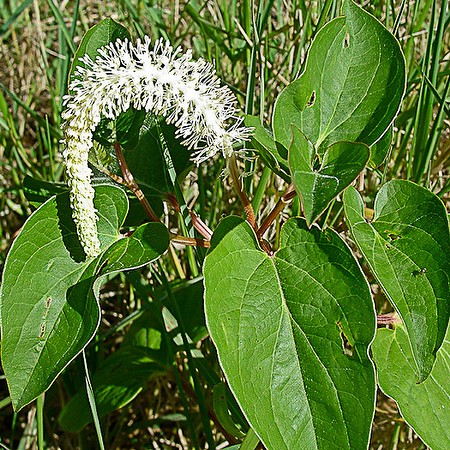
Think of a name having the letter “u” in it 5 times, uuuuuh, not so many.  Saururus cernuus translates as nodding lizard tail, and the arched tapering inflorescence fits the name.  Here’s another annoying question: what do Lizard Tails and alligators have in common?  Yes, they both live in the same habitat as Pogo, and more interestingly they both belong to a two-species genus where one species lives in Eastern North America and the other hangs its hat in eastern Asia.  Divorced couples like that have long fascinated biologists as “Eastern Asian-Eastern North American Disjuncts.”  They are separated relicts from the Miocene Epoch 23-5 million years ago when distributions were more or less contiguous across the Northern Hemisphere.  The primary connection was a Russian-Alaskan land bridge, now the Bering Strait.

Lizards Tail flower spike (by JB)

A colorful species related to Lizard’s Tail and familiar to gardeners is Chameleon Plant Houttuynia cordata. http://hcs.osu.edu/hcs/tmi/plantlist/ho_rdata.html

Readers familiar with Kava Kava may see or smell resemblance to LT in the plant form, leaf shape, inflorescence, and root beer-licorice fragrance upon being crushed.  They are vaguely related.  Kava Kava is a member of the Pepper Family, where Lizard’s Tail has been placed by some taxonomists.  A separate segregate family Saururaceae is the treatment in most contemporary references.  As with Kava Kava, Saururus has a substantial history in traditional medicine.  Not to bore you with a list of every way the plants have assuaged some disgusting ailment, what’s more interesting is applications to treat sores and wounds characterize the American and Chinese species alike.  And as with Kava Kava, Lizard’s Tail is reputed to be sedative.  Also noteworthy are applications to relieve pain, with modern research confirming neurological activity.

That showy white arched inflorescence has specialized insect-adaptations, including UV patterns invisible to mere mortals and floral fragrance.  Yet one study in Louisiana showed most of the pollination to be by wind, at least there and then.  How many species are adapted to insects and to wind?  The flowers are protogynous (= female, then male) and do not self-pollinate much, if at all.  When pollen from the same individual plant is transferred to the stigma, the pollen is recognized as “no good” and is murdered summarily.  The floral spikes are dragon-fly landing platforms, and the big bugs kick up a cloud of pollen.  That might be insect-assisted wind-pollination.

Flowering along the spike proceeds gradually like a burning sparkler, keeping pollination activity going for weeks.  As the spike matures into the fruiting stage, it straightens out and releases tiny “nutlets” resembling the small dry fruits of other aquatic plants, such as Alisma, Echinodorus, Sagittaria, and sedges.  Presumably such little achenes and nutlets cling to or pass through waterfowl.  Of course they float too and root, as do pieces of the extensive rhizome.

The spike straightens in fruit (by JB).

 
2 Comments

Posted by on March 9, 2012 in Lizard's Tail


Tags: ,

Domatia—Anybody Home?

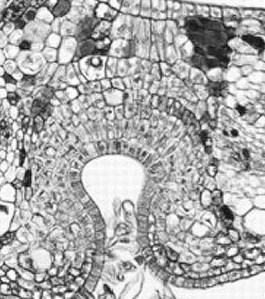
A widespread but inconspicuous feature across the plant world is the presence of domatia on leaves or other organs.  Domatia (doe-MAY-shaw, not doe-MAT-ee-ah) are tiny homes the plant provides, sometimes with food, to varied small critters, often ants, mites, or even  bacteria in symbiotic exchange for services rendered. Among local native species, especially conspicuous domatia decorate the leaves of members of the Combretum Family:  Buttonwood (Conocarpus erectus) and White Mangrove (Laguncularia racemosa); domatia occur also on their locally cultivated and escaped exotic cousin Tropical-Almond (Terminalia catappa).

Pit type domatium in cinnamon, microscopic section. From Ann. Bot. 97: 601. 2006

Domatia come in varied sizes and shapes.  Those on leaf blades usually sort into four different categories:  pouchlike (sometimes called marsupiform), hair tufts (as in many oaks), pits, and pockets.  Those of Buttonwood and of White Mangrove appear to be the pit type—tiny cavities in the underside of the leaf.  Their tiny size  begs the question of,  “what micro-creature lives in there, and what can it do for the plants?”

Specific mite data on today’s plants are not in hand, but in general itsy bitsy leaf domatia are thought of as refuges for predatory or fungus-eating mites serving their botanical landlord by eating other mites or pathological foliar fungi.

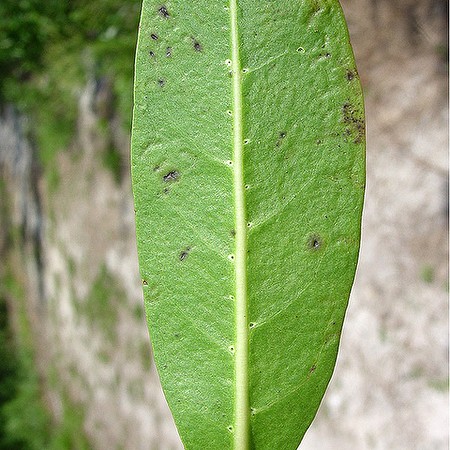
Buttonwood domatia (by JB)

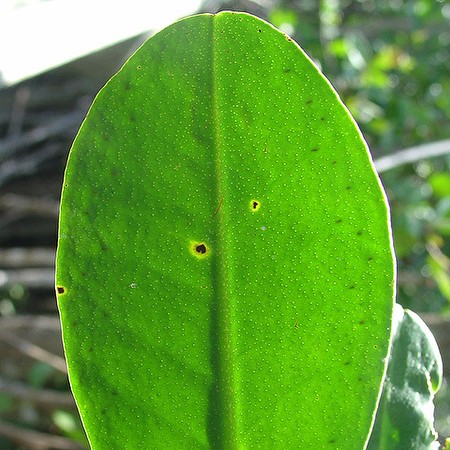
The White Mangrove and Buttonwood domatia are useful for identification.  In Buttonwood (including “Silver Buttonwood”)  flip over the leaf, then look along the central vein; the domatia are in the angles where the secondary veins branch off the main vein, looking like little blackheads.  In White Mangrove they are in a line along both leaf margins, about a quarter inch in from the edge.

White Mangrove. The domatia are dark spots in a row inside the leaf margins. (By JB)

 
1 Comment

Posted by on March 4, 2012 in Domatia


Tags: , , , ,

Duppies, Cheeseshrubs, and Noni Juice

Morinda royoc

Rubiaceae

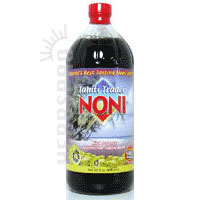
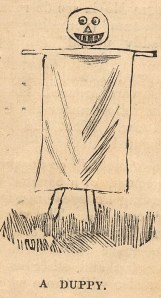
Want to spend twenty bucks on a highly touted bottle of odd-tasting health-promoting antioxidant juice?  Then Noni Juice is your oyster.  Probably based in limited truth and enhanced by volcanoes of hype, the ancient Polynesians had a thing for Noni.  Hawaii is the epicenter for Noni Juice now, and the tree (Morinda citrifolia) is grown in other tropical climates, a lot in the Caribbean, and a little in Florida.  We tried one at PBSC but Jack Frost murdered it.  The Caribbean name for the tree, “Duppy Apple,” refers to the similarity between the lumpy white fruit and a lumpy white ghost, a duppy.

The possibility that Noni is good for you is not far-fetched, although I have no idea of any underlying science.    In the Caribbean the species serves for alleged analgesic properties, like an aspirin.  And that rings plausible.  Noni belongs to the drug-laden Coffee Family, the Rubiaceae, from which one drug, caffeine, makes me feel painless at 6 am every day.  Fact is, the Rubiaceae is a hotspot of alkaloids and bioactivity.

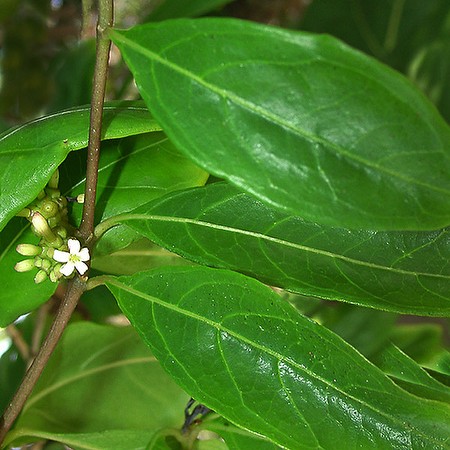
Is Noni a Florida native?  No, but we have our own close relative, Morinda royoc, which is similar, except for being more of a vine than a tree, and being  smaller in all dimensions.  Although not sold in bottles with a Polynesian motif, Morinda royoc  has its own place in traditional medicines to the point of having local populations abused by collectors.  Uses for Morinda royoc extend from lumbago to scurvy.  (Today’s vocabulary lesson: antiscorbutic.)  Echoing Noni, pain relief receives prominent mention.  Morinda  royoc extracts are sort of a mild “revitalizing” stimulant, in a coffee-ish sort of fashion.

Morinda royoc (by JB)

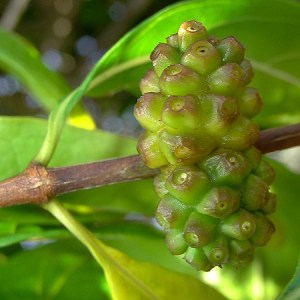
This plant has oodles of so-called common names, none of which I’ve ever heard anybody apply seriously: cheese shrub (they say from the odor of the fermenting fruits), mouse pineapple (the fruit resembles a  mini-pineapple),  Redgal, Indian Mulberry, and an anatomically descriptive handle we’ll modify for polite blogging as “Low Budget Viagra Shrub.”

You don’t see Cheese Shrub often.  It is sort of an unpretentious clambering semi-shrub-semi-vine in coastal hammocks, often on dunes immediately overlooking the sea.  The vine is related to, resembles, and hangs around literally with Snowberry (Chiococca alba).  The leaves are opposite, often a little yellowish, and provided usefully (for identification) with a stipule between the bases.  The star-shaped white flowers are clustered in the constellation that will become the bumpy mouse pineapple, which eventually matures orange.  The fruit is a natural sea-dispersal pod—tough, thick, padded, and with built-in hollow floats.

Mouse Pineapples (not quite ripe, by JB)

We have a tissue culture lab at PBSC, and a protocol for micropropagation has been published, so with much patience and optimism we’re going to dry to grow our own little Redgal, whatever that means.

 
3 Comments

Posted by on February 25, 2012 in Morinda royoc


Tags: , ,

Don’t Get Your Nicker(Bean)s in a Twist

Nickerbean  Caesalpinia bonduc  Caesalpiniaceae

 Baybean Canvallia rosea Fabaceae

John is off boat-anizing in the Bahamas, and somebody had to stay in town to do the chores.  This week my Palm Beach State College Native Plants Class visited John D. MacArthur Beach State Park on Singer Island, with a brief foray onto the beach, where the Sea Lavender was magnificent.  Also fun on the sunny sand are the beans drifted up on the sand as well as growing there, a fascination dating back to my life in the Caribbean.   Two beachy beans were around:

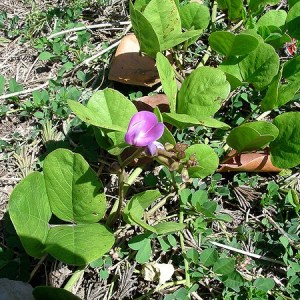
Baybean (Canavallia rosea) creeps across the sand, often in the company of its likewise creepy friend Railroad Vine (Ipomoea pes-caprae).  Interestingly, the two have almost identical rose-violet flower colors, although of very different structure.  Baybean has distinctive trifoliate leaves, hose rose-colored pea-type flowers, and a big thick pod full of tough beans.  The beans are the interesting part.

Baybean (by JB)

They contain an amino acid called canavanine, which is one of the world’s most interesting poisons due to its insidious mode of action.  Canavanine is named for Canavallia, although the toxin occurs in many other legumes.  A little background.  Proteins are chains of amino acids.  They are comprised of about 22 different amino acids, of which canavanine is not properly included.  It resembles the legitimate amino acid arginine, and sneaks into proteins in disguise.   A chain is as strong as its weakest link.  If you eat Baybeans the no-good canavanine infiltrates your proteins where arginine belongs, damaging the protein.   It is a case of sabotage, as if a bad spy sneaks into the airplane plant and replaces the good rivets with ones that break apart when stressed, or if you replace “a” with “c” throughout a computer program.

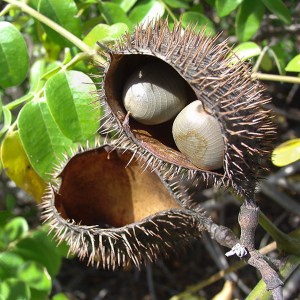
The other seabean prevalent in MacArthur Park is a bristly old friend from the Caribbean, nickerbean (Caesalpinia bonduc).   It defends itself before you get to its toxins:  the vine is thorny, and the pods looks like a porcupine clam, loaded with hard glossy gray spherical seeds the sizes of grapes.  The indestructible seeds have hollow spaces allowing them to float, and float they do, for example all the way from the Caribbean to northern European beaches.  I have picked them up from the beach, abraded them until a little white shows through, and sprouted them in a pot, where they grow like a thorny Jack’s Beanstalk.

Nickerbeans (by JB)

“Nicker” comes from an old name for marbles, and the seeds do serve as substitute marbles in games.  In my experience, the ancient game Wari (Mancala) was popular in Barbados, and nickerbeans turn up as the “marbles” on the board.  They make good necklace beads and slingshot ammo too.  My favorite website, Wayne’s World, suggests rubbing them rapidly on fabric, which heats them up to a surprisingly high temperature due to their mini-wrinkled surface, and then branding your friend for a comical prank.

Do not try that on your spouse (believe me).

 
7 Comments

Posted by on February 18, 2012 in Baybean, Nickerbean


Tags: , , ,

Wax Myrtle Makes Its Own Luck

Myrica cerifera (Morella cerifera)

(Cerifera means wax-bearing)

Myricaceae

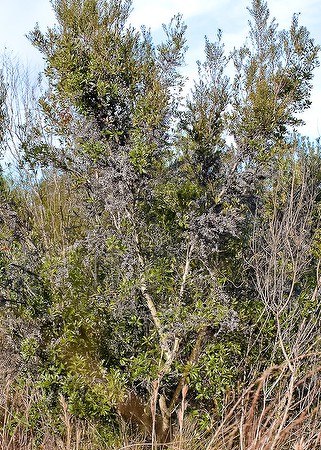
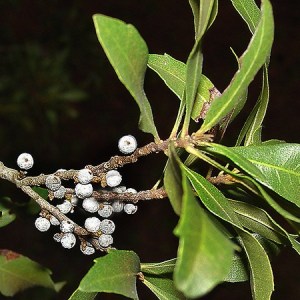
John and George visited Halpatioke Park today in Stuart and pondered Wax Myrtle in full “berry” with newly emerging spring flower clusters, if Feb. 10 is spring.

Wax Myrtle (photo by JB)

Wax Myrtle and Bayberry (M. pensylvanica)—think candles in Cape Cod tourist stops—are close cousins.  Myrica pensylvanica ranges from Canada to the Carolinas.  With a little overlap in range and consequent hybridization, Wax Myrtle (Myrica cerifera) grows from Maryland to Central America.  Thus some folks refer to Northern Bayberry (pensylvanica) and Southern Bayberry (cerifera).

A quick nod to noteworthy relatives:  Myrica inodora, named by William Bartram, lives in and near the Florida Panhandle.  Another Florida resident Myrica heterophylla (or M. caroliniensis, or neither),  lives  across much of the Southeast southward to central Florida.   It differs from M. cerifera by having its leaf glands restricted to the underside of the blade.  The taxonomy and nomenclature of this species is unsettled.  Readers with northern experience may recall Sweet Gale (Myrica gale) and Sweet Fern (Comptonia peregrina).

Bayberry fragrance and wax come from boiling the fruits and foliage, mainly of M. pensylvanica.  You’d have to be a big-time boiler to generate one candle, or you might mix Bayberry fragrance in with a different wax.  By the way, the plants are separate male and female.

The seeds reportedly won’t germinate if not de-waxed, and certain birds do this in their digestive systems.  The Yellow Rumped Warbler has a special taste in its broad diet for Myrica fruits, especially during migration.   Interestingly, they go also for Juniper “berries” too, which are likewise blue, pungent-oily, and wax-coated.    Migrating birds have high metabolic demands and use lipids as stored fuel.

Ecologist Clarmarie Moss devoted a portion of her 1993 Masters Thesis to these berry important matters.  Myrica fruits and Juniper “berries” topped her chart in terms of “optimal lipid profitability.”  She found the range of the Yellow Rumped Warbler tied to Myrica distribution in place and time.  She noted that the mutualism between the two species fits a model known in other bird-plant relationships were the comparatively non-showy and peekaboo fruits in the foliage shadows favor the birds adapted to the relationship.  Preferred customers.

Yellow Rumped Warblers (from Google Images)

Wax Myrtle is clearly a successful species, and as my mother used to say (well, she still does): you make your own luck.   Wax Myrtle improves its habitat by enhancing the soil and by bullying the competition.  Ever wonder why Wax Myrtles are so willing to grow here, there, and everywhere?  They belong to the select group of non-legumes blessed with their own bacterial root nodules.  In our area that clique includes Australian-Pines and Silverthorns, both weedy and tolerant of poor soils.  Oddly, most of the non-legumes with bacterial nodules all share the same bacterium, Frankia alni, a filament-shaped bacterium once thought to be a fungus, and very different from that associated with legumes.  It transforms atmospheric nitrogen to ammonia.

Does the lawn look a little iffy around the Wax Myrtles?  They poison competing vegetation, including pines, grasses, and even Brazilian Pepper.  Experimenters have doused plants with Wax Myrtle extracts and shown the herbicidal effect under “lab” conditions.  It would be interesting to study weed distribution around Wax Myrtles.  The effect may not be 100% negative, since there could be species immune to the toxin and favored by the ammonia-enriched soil.  A project for another day.

In short, next time you brush past a Wax Myrtle, show some respect.  How many shrubs provide aroma therapy, jet fuel for warblers, free fertilizer, and Round-Up-free weed control?

 
7 Comments

Posted by on February 12, 2012 in Wax Myrtle


Tags: , , ,

Don’t Let Your Beauty Droop

Beautyberry, French Mulberry

Callicarpa americana

Verbenaceae (traditional classification) (alternatively Lamiaceae)

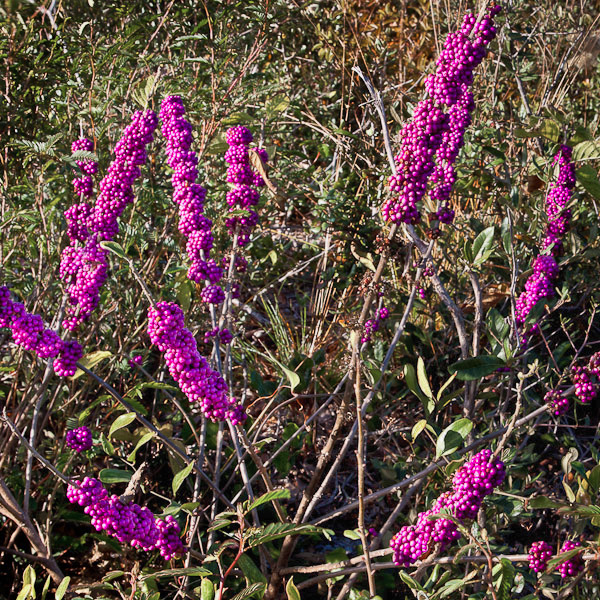
Hey birds, come on down! (by JB)


The well named Beautyberries are looking so beautiful that the spotlight must fall on them today.   The main photo is John’s work, taken in the natural area entered through Bert Winters Park in Juno Beach.

Anyone who has ever been outdoors knows that many plants make berries, often abundantly, but Beautyberry is the superstar in terms of volume and color.  Who is eating all those little beauties?  Lots of critters, mammals and birds.  One of the main Beautyberry-eaters is the American bobwhite.  Wild turkeys gobble them up.  And so forth, from songbirds to raccoons.

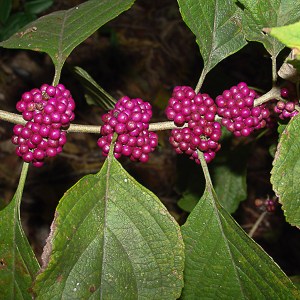
To set the record straight, technically speaking, the beautiful fruits are not berries, but rather drupes, but who would name such a fancy shrub “Beautydrupe”?

Why so drupe-prolific?  For a broad answer, the biological world is divided into what some biologists refer to as r-strategists and K-strategists.  The r in r-strategist stands for “rate” (of reproduction).  R-strategists spawn a lot of offspring fast, spreading them abundantly in the world to launch the next generation.  The investment is in quantity, not in quality, a shotgun approach.  These are rats, dandelions, and tadpoles in the kiddie pool.  R-strategists tend to be pioneers, species that exploit disturbed habitats before the competition intensifies.  R-ish plants tend to be broad in soil tolerances, sun-loving, abundant in production of small cheap easily dispersed fruits, and able to flower on young growth.  You know, like Beautyberry.

By contrast, K-strategists (the K stands for Karrying Kapacity) are species of undisturbed highly competitive habitats—for instance mature forests.  Here it is better to put the parental  investment into quality of offspring, that is, providing nurture or whatever it takes to achieve a successful launch in a competitive world: nut trees (with big fleshy seeds), elephants, and gray-haired parents with children in college.

Beautyberry has a lot of “r” in its spirit.  Grow anywhere.  Rise up with moxie and flower and fruit quickly.  Make oodles of showy little berries.  Induce lots of birds and rodents to drop the seeds all over the place.  Invade disturbed sites.  With foliage out of the way in the cooler berry-show months, the plant’s gimmick seems to be advertising.  Those big clusters of candy-colored berries must draw birds from afar, and when in an open disturbed area look like a come-on to entire migrating flocks.

A second way Beautyberry faces disturbed habitats is robust recovery from fire (which it seems to like), heavy browsing, and other trauma.  Foresters call this shrub a moderately shade-intolerant “early- to mid-seral” species, which means it is at its best early after disturbance, persisting to partial forest regeneration, and declining during later maturation.  Flowering and fruiting all occur on the growth of the current season, including the sprouts rising from fires, creating a cheery decorative effect in the charred landscape.  A weed, but a mighty fine one.


Callicarpa is about as prolific in species as it is in fruits.  We have just one species here, scattered across the Southern U.S. and a little beyond.  China has 48 species out of a worldwide total of 140 callicarpas.  Mind boggling for sure.

We like to think of native plants as comparatively free of pests, but BB does have an interesting one.  What seems to be a viral infection is occasionally apparent in the leaves, but home-made, duffer-level Google searching leads about as far as, yep, there’s a virus, not adequately studied.

Gardeners like Beautyberry for obvious reasons, and it crops up in residential landscaping, although the rapid growth makes it challenging.  Those with a horticultural inclination should be aware also of the White Beautyberry, Callicarpa americana var. lactea, sometimes also called ‘Albofructus’.

In class this week we had a debate on what is the exact name for that color?  The proof was that guys don’t know colors.  Maybe a new color should be named “Callicarpa.”  Would make a cool eye shadow.

 
4 Comments

Posted by on February 4, 2012 in Beautyberry


Tags: , ,