Alligator Flag
Thalia geniculata
Marantaceae
Which wildflowers have the most complex awesome magnificent pollination mechanisms? Orchids? Naw. Orchids are okay if you like Nero Wolfe, but the truly cool flowers around here belong to Alligator Flag (Thalia geniculata), one of the only two members of the Maranta Family (Marantaceae) native to the United States, and possibly the largest native herb. The similar Powdery Thalia (Thalia dealbata) grows across much of the southern U.S. but not in Florida to my knowledge.
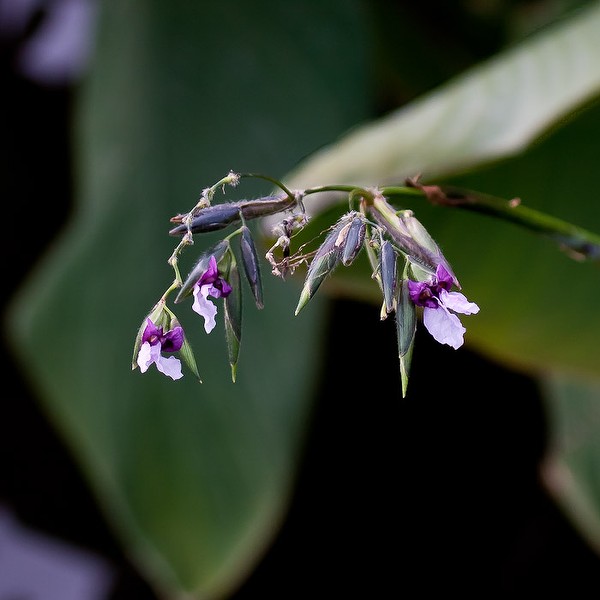
Thus native plant enthusiasts perhaps don’t encounter the Marantaceae often, but warm-climate gardeners and interiorscapers enjoy Calathea, Maranta, and Stromanthe. The popular houseplant known as Prayer Plant is a Maranta. An odd feature Marantaceae share with Cannas, Gingers, and Spiral-Gingers is that the showy parts of the flowers are mostly derived from stamens (staminodes) instead of the petals, which tend to be inconspicuous. Floral features we’re about to explore for Thalia are shared in part with some of these kin-plants, especially other Marantaceae.
Thalia geniculata ranges broadly from Florida southward to Buenos Aires. More interesting are three similar “species” in Africa. Marantaceae expert Dr. Lennart Andersson interpreted the African representatives to be invasive exotic descendants of American Thalia geniculata relocated to Africa hundreds of years ago, possibly on slave ships. Although not offered by anyone as an explanation for the boat ride, Florida plant icon Julia Morton mentioned edibility of the boiled rhizome. An abundant edible “root” in the areas of slave commerce sounds like a food source for the return trip. Arrowroot starch comes from cousins in Maranta and Canna.
The origin of the name “Thalia” is a head-scratcher. Thalia in Greek mythology was one of the three graces, daughters of Zeuss, and her name came in turn from a similar Greek word for “blooming,” a perfect name for the graceful plants. But hold on there! According to unassailable old botanical references, that’s not where Linnaeus got the name, but rather for Johann Thalus a German naturalist killed in an unfortunate carriage mishap.
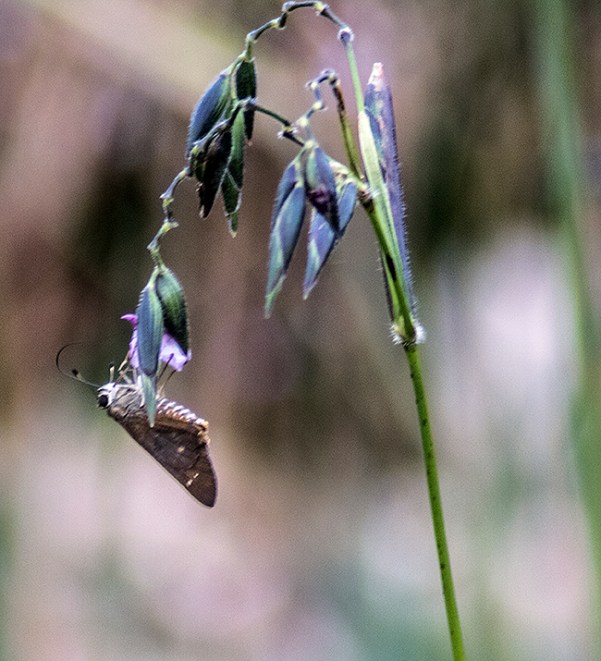
Now for those crazy flowers. This will take some concentration, so listen up, and next time you see Alligator Flag growing wild, first look for those flagged gators, then examine the flowers. As with other Marantaceae, they are in mirror-image twin pairs. That’s just plain weird (and pretty). Second, as already mentioned, the showy parts are predominantly modified stamens posing as petals. Remember the term staminode. The real kicker, almost literally from the bee’s perspective, is the rat-trap snap pollination mechanism. When a carpenter bee probes the flower, the style snaps upward abruptly. Try poking a pine needle or pencil tip into a blossom—you can snap it too unless a bee beat you to it.
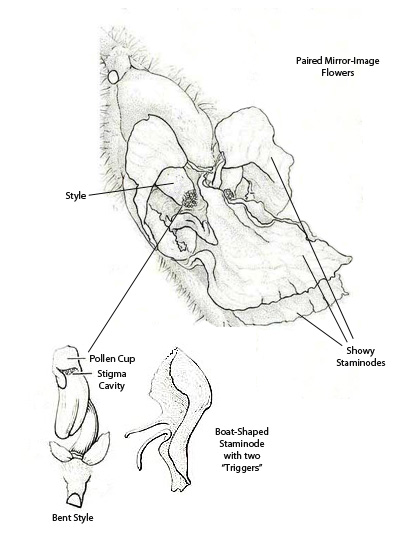
Analyzing every floral organ is beyond the scope of our light and fun blog. (Interested readers can reference the journal article noted below.) But here is the core of it all. The style is hairpin-bent with the stigma (pollen-receptive organ) a cavity just beyond the bend. Exactly at the bend is a little cup where the anther (pollen-producing organ) deposited the pollen while the flower was still in the bud. That is, the flower uses the style to deliver pollen to the pollinator.
The hairpin style, with its scooplike stigma and its little cup of predoposited pollen, lies like a hotdog in a bun inside of a boat-shaped staminode. Think of a guy lying in a canoe. Think of Dracula in a coffin. The boat-shaped staminode has two fingers rising from its side and wrapping over the cocked style. Those two fingers are apparently triggers to unleash the snap. Before the event, the knuckle with the pollen cup is near the mouth to the flower.
When the carpenter bee or your pine needle disturb the triggers(s), the style pops up and curls inward in a split second. Think of the guy lying in the canoe suddenly sitting up, or Dracula doing the Transylvania Twist.
When the style snaps up and inward, first the stigma scoop scrapes across the bee’s tummy removing any pollen it has brought from a different flower. Then a nanosecond later in the same snap the pollen-bearing cup brushes new pollen onto the bee. The snap no doubt kicks out the dismayed bee, and closes off the entrance to the flower, which has no further need for visitation.
[Notes. John Bradford took the beautiful photo. The drawing comes from Rogers, G. The Zingiberales (Cannaceae, Marantaceae, and Zingiberaceae) in the Southeastern United States. J. Arnold Arb. 65: 5-55. 1984.]
 John Bradford
 George Rogers
 George Rogers
 Dee Staley
 Treasure Coast Natives