RSS

Author Archives: George Rogers

Unknown's avatar

About George Rogers

Florida botanist

Ludwigia –What a Tangled Web We Perceive When at First We Practice to Use Our Keys

Ludwigia

Onagraceae

Last Friday Billy, John and George survived a thunder squall on the Haney Creek Trail in (or near) Jensen Beach.  Beautiful site, but too much lightning and too many Ludwigias, aka Primrose-Willows.

Have you ever hurt your head attempting to key out a plant species only to find the glove don’t fit so you must acquit?  Did you pause and wonder:  is the problem the dumb key writer?  Or is it me overlooking something?  Or is it the plant?  The problem may be you or a goofy key writer, but sometimes the plant really truly does not fit.  Plants do not know we will them to fit into a stilted 18th Century system of classification.
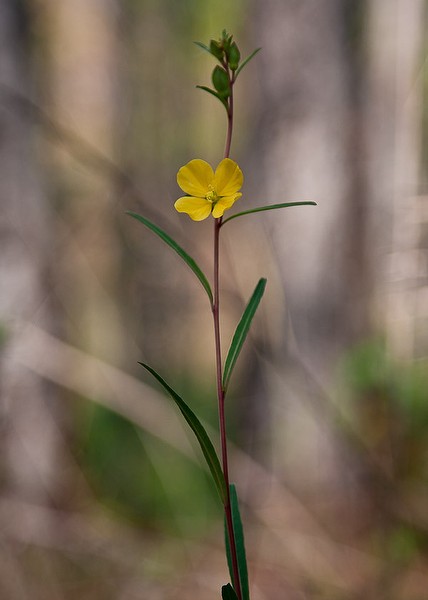
Ludwigia maritima (by JB) (It has two chromosome sets, so does John.)

Look at it this way.  Einstein figured out there’s no such thing as space and time. They’re human concepts.  I never really understood that, but I do understand sometimes there’s no such thing as species.  They’re human concepts.  What is amazing is how often plants do sort themselves out into species, but not always.

That all begs a big question: what is a species?  Well (somewhat animal-o-centrically) we’d like it to be a lineage of organisms that all look very much alike and breed readily with each other but with nobody else.  We’d like a species to be fairly widespread and ancient.  Nobody told all the plants about this, however.

There are groups of plants whose classification has never been resolved for the simple reason that their patterns of breeding, histories, and visible differences do not resolve into traditional species.   Ludwigia is a prime example, because its pattern of variation is nutty.  Hold this thought a moment as I set the stage with a little context.

Ludwigia consists of about 82 species around the world with North and South America points of concentration. Florida has about 28 species, some of them invasive exotics and others of questionable provenance.   Our immediate blog area has about 16 species.  That’s plenty.
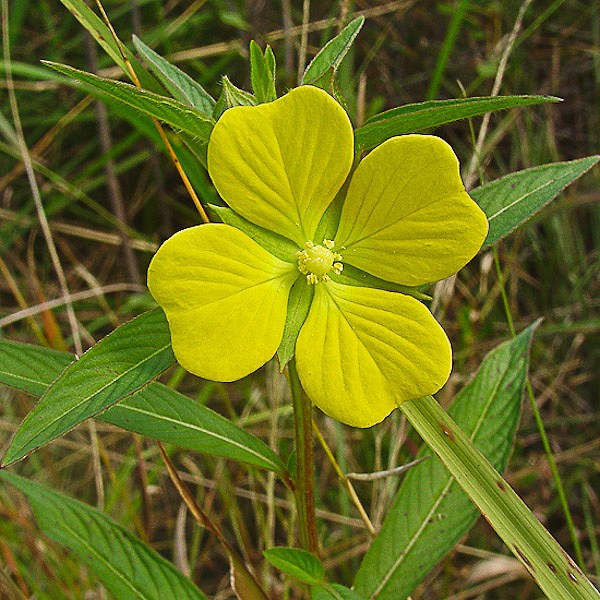
Ludwigia peruviana (by JB)

Florida Ludwigias range in size from little floating or mud-creeping weeds to shrubs taller than you are.  Some have big yellow buttercup flowers; several have no petals at all.   The fruits shapes are all over the map from cigarettes to dice,  the leaves can be opposite or alternate (and extremely variable even on single  individuals),  and the plants range from shaggy to bare.  In short, they are diverse, although you usually know one when you see one, like dogs.

Ludwigias are master weeds globally, including American species behaving badly overseas.   The distributions are so expansive that it is often impossible to pinpoint the exact regions of origin.  As an example,  L. octovalvis is a Florida wildflower and an Australian wildflower.  Some have moved around and have hybridized as aquarium plants, escaping when the aquarium gets dumped.  Peruvian Primrose-Willow (L. peruviana)  can reach 12 feet tall, and you could scarcely design a better wetland invader.  This South American exotic roots from floating stem fragments, and it makes seeds in massive numbers carried by water currents, birds, and anything that moves.  Needless to say, it can form monospecific stands along shores.  Yet others have restricted distributions.  Ludwigia stricta is Cuban and nada mas.

Now back to the species screwiness.  We need a quick lesson on chromosomes and hybrids.  Chromosomes usually come in pairs.  You and I have 23 pairs.  In any given pair, one member arrived from Dad in the sperm, the other from Mom in the egg.  The two chromosomes sets came together (in Rochester in 1952) and paired up in the fertilized egg that grew into me.   Many hybrids are sterile because chromosomes from the sperm of one species and the egg of a different species don’t pair up properly in the fertilized egg.  It would be like sending two kids to run through Beall’s Outlet and each toss 5 shoes into a bag.  Mismatched “pairs” will result The mismatch may prevent  the hybrid from developing or functioning fully, or perhaps from making is own viable sperms and eggs.  A mule.

But plants often do something weird — many double their chromosomes, the equivalent of a person having 92 chromosomes instead of 46.   Or the equivalent of taking that bag full of Beall’s shoes back through the store and adding in the matched shoe for each one the kids tossed in, doubling the shoe total in the bag.

Chromosomal doubling is rare but happens, creating a bizarre but true circumstance.  If a hybrid suffering from mismatched chromosomes has its chromosome number doubled,  then each chromosome has a matched  partner.  This allows plants to form stable fertile hybrids with novel chromosome numbers, having four, six, eight or more chromosome sets.   Bread wheat has six sets. Strawberries have eight.  Multiple chromosomes sets or the plants having them are called polyploids. All of this happens in Ludwigia, and many of the “species” are really stabilized hybrids with differing levels of polyploidy.  Ludwigia maritima has two sets of chromosomes (8 chromosomes in each set for a total of 16).  By contrast, L. peruviana reportedly has 12 sets of chromosomes.  A dozen!

Several of the Ludwigia species in the Southeastern U.S. belong to an odd complex mix of four chromosome sets, or six.  Those with four sets cross freely, a process aided by human disturbance which creates unnatural intermixing.

Making matters worse, the plants reproduce clonally by fragments, stolons, and by self-fertilization, so  any given hybrid can spread.  When you try to identify a Ludwigia, are you holding a “species,” or some sort of hybrid resulting from free mixing and clonal propagation ?

Here are some selected examples to underscore the screwiness:

Ludwigia linearis and L. linifolia are similar with linear leaves and a single chromosome pair.  They differ because a fragment of one chromosome has flipped within the chromosome. They cross to make fertile offspring.

Ludwigia alata is apparently a stabilized hybrid with six sets of chromosomes between L. lanceolata (four sets of chromosomes) and L. microcarpa (with two sets)

Ludwigia curtissii has eight sets of chromosomes, suggesting that is a stable hybrid of perhaps four other species.

Are you confused?  If so, good, my work here is done.  The point being that sometimes plants mix and match in ways that don’t represent slowly evolving, evenly branching evolutionary trees.  The take-home lesson is that:  if the identification key and nature don’t match, maybe the problem is nature and not you (but it is probably you).  On a serious note, nature does as nature does, and there are limitations to our taxonomic system.   You can’t capture all variation with families, genera, and species any more than you can capture all people with a chart of personality types.

——————————————

Here is a mini-guide to selected local Ludwigias from a booklet John and I threw together back in 2007. Don’t bet the farm on it.

Leaves opposite: creeping (or floating) weed of wet shores…Ludwigia repens

Leaves alternate:

Petals absent:

Flowers in a tight spike:  Ludwigia suffruticosa

Flowers not in a spike:

Fruit < 2 mm long: L. microcarpa

Fruit 2-3 mm long: L. curtisii

Fruit 3-4 mm long, plant hairless, stem winged: L. alata

Fruit 3-4 mm long; plant hairy: L. pilosa

Petals 4 in number:

Stamens 4:

Capsule round, longer than wide:  L. linifolia

Capsule square, as wide as long: L. maritima

Stamens 8:

Petals 4-5 mm long: L. erecta

Petals 10-30 mm, plant not very hairy:  L. octovalvis

Petals 25 mm, plant fuzzy: L. peruviana

Petals 5 in number:

Stem shaggy with long hairs: L. leptocarpa

Stem hairless or with short hairs, usually floating: L. peploides
 
11 Comments

Posted by on June 13, 2012 in Ludwigia


Tags: ,

Loblolly Bay – Who Says Natives Don’t Have Showy Flowers?

Loblolly Bay

Gordonia lasianthus

Theaceae

What do tea, camellias, Franklinia, and Loblolly Bay have in common?  They all belong to the Tea Family, and their saucer-shaped flowers look the same.  In the Southeastern U.S. we have (oops, had) three stunning native Camellia relatives.  Stewartia malacodendron, Silky-Camellia, in Florida is restricted to the Panhandle.  Stewartia ovata, Mountain-Camellia, is in the Southeast although probably not naturally in Florida except for minor cultivation.  Franklinia is long gone, since 1803 from its sole known natural site in Georgia, and the fascinating story of this species is unfortunately beyond the scope of our mission.   (CLICK)  Its discoverer, William Bartram called the shrub Gordonia pubescens due to its resemblance to today’s Gordonia, and even some modern taxonomists have upheld classifying Gordonia and Franklinia together in Gordonia, a contention supported by their willingness to hybridize, although the progeny may be sterile like a mule.  There are multiple border disputes around the genus Gordonia.  The resemblance connecting Franklinia and Loblolly Bay extends to the names:  pubescens means hairy, and lasianthus means shaggy-flower.  Franklinia and Gordonia have shaggy flowers.

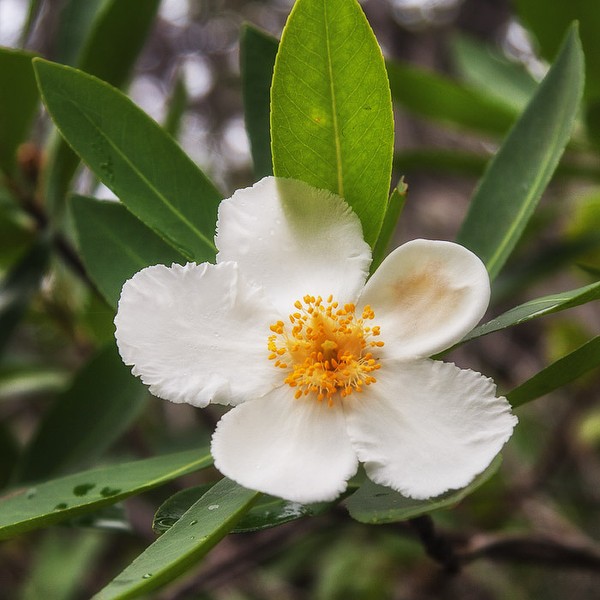
Gordonia flower (by JB)

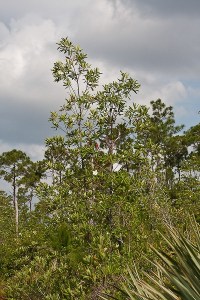
Loblolly Bay (Gordonia lasianthus) is an exquisite shrub or tree in wet habitats from North Carolina to Mississippi to Florida.  The southern limit, at least near the Florida eastern coast, is pretty sharp.  In Palm Beach County Loblolly Bay is scarce and spotty at best, but hop in a car and drive 20 minutes to Stuart, and the species is robust and plentiful.  We hopped in the car last Friday and went to Stuart.

Billy Cunningham, a charter member of our flower-peeping posse, was away in North Carolina for several months and has now returned.   He, John, George, and a gregarious white cat marched across Billy’s land near Stuart and gawked at the Crinum Lilies, Yellow Bidens, millions of Elliott’s Xyris, Carolina Redroot, and Loblolly Bay all in competition for “best in show.”

Why is Loblolly Bay abundant north of a line between Stuart and Jupiter, and rare below that line?  I do not know.  It prefers acid soil, but that doesn’t seem at first blush to be the key.  More intriguingly the Loblolly line resembles the ill-defined border between horticultural hardiness zones 9 and 10, although the mixed opinion in a sampler of horticultural write-ups fails to show a strict need to chill the seeds.  We have grown it south of the border at Palm Beach State College in Palm Beach Gardens, although the specimen was not enthusiastic.

The Loblolly Bays are blooming now with white blossoms the size of teacup saucers, having a yellow center.   You could mistake them for a Camellia, but, unlike those garden favorites, the Loblolly Bay belongs right here.   The flowers are wide open, fragrant, and inviting.   For pollination they seem to welcome everybody.  Beetles and/or bees are probably the main pollinators, and additional recorded floral visitors include hummingbirds, flies, and thrips (anyone with a microscope knows thrips often say peek-a-boo from flowers under dissection).  (Common exclamation in Botany class:  “there’s a bug in my flower!”)

Gordonia tree near Stuart (by JB)

Being so splendid, why is the species not cultivated more?  It is cultivated but has a reputation as challenging,  probably due to its fussy preference for wet fertile acid soils and for protection from excessive exposure.   Moreover the tree has shallow roots and (just guessing) perhaps favorite mycorrhizae.  Growth is slow.  Nematodes, borers, and other insects attack stressed specimens.  But don’t let me throw cold water on it.  My problem is merely living too far south.  Early Florida horticultural honcho Henry Nehrling extolled at length the charms and successes of Loblolly Bay transplanted from the wild into his garden near Orlando.  Exceptional specimens can exceed 80 feet tall.  Fifty feet is a more realistic, and those around Stuart within my experience are mostly about 20 feet.   A columnar silhouette is common.  Fires knock it back, and the tree resurrects via basal suckers.

The good looks are not limited to the flowers.  The fruit is a handsome capsule, opening to release winged seeds.  The foliage reddens as autumn sets in, bringing fall color to places otherwise deprived.

 
4 Comments

Posted by on June 6, 2012 in Loblolly Bay


Tags: ,

Autograph Trees – Who Needs The Guys?

Autograph Tree, Pitch-Apple, Rose-Apple

Clusia rosea

Clusiaceae

Image

The Autograph Tree (Clusia rosea), also called Pitch-Apple or Rose-Apple, is presumably native from the Keys, more or less, to South America.   It may seem a stretch at first glance, but this tree is kin to the yellow weeds known as St. Johnsworts, which are sold in health food stores as natural antidepressants, and which cause dermatological ailments in cows.  First paragraph, and we’re off-topic already.

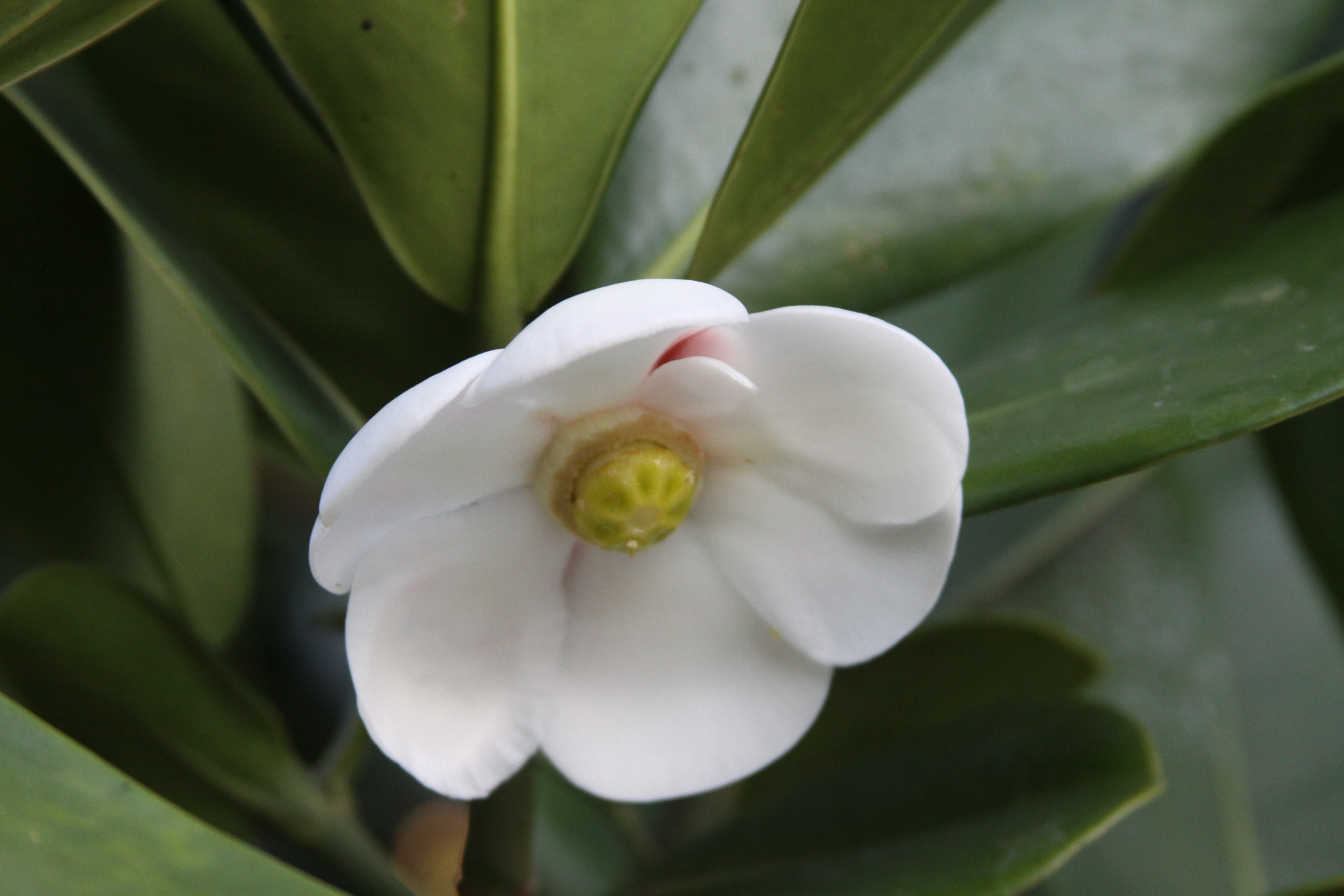
Back to Autograph Tree, and a little descriptive info to get us all on the same leaf.  Today’s species can become a substantial tree, let’s say 35 feet tall with a hunky trunk.  One in my yard went from a potted plant to about 20 feet tall in a decade.  The foliage is full, thick, and utterly opaque, forming a dense screen against peekaboo, noisy neighbors, and wind.  The canopy snags the wind maybe too much; a big branch at my house busted this summer in a thunderstorm.  The paired leaves are thicker than leather, almost succulent, and the flowers are big and round, white and blushed variably with a rose.

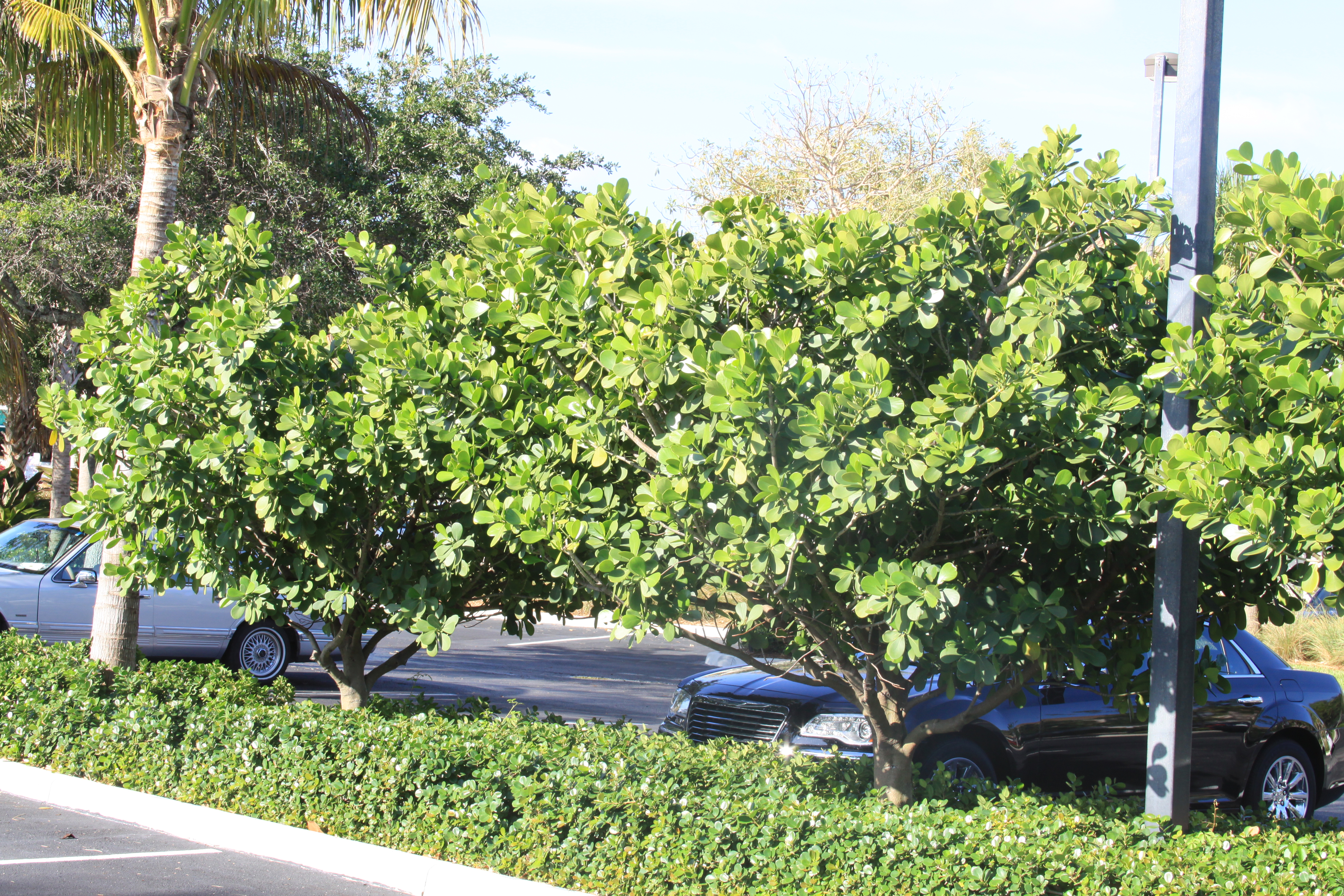
The species is a player in landscaping.  It is attractive as well as rugged and forgiving, easy to grow.   Sunshine is best.  It thrives despite drought (but prefers adequate water), harsh life, thin poor soils, alkaline dirt, and salty breezes.  Bug and disease problems are few, except maybe for some scale insects.  It is almost idiotproof.  Good parking lot tree.

Image

Still better for the landscaper, Autograph Tree sneers at damage and pruning, making it an option for large hedges, given its opacity and its tendency for low, multi-trunked growth.  Alternatively, training can yield a conventional single-trunked tree.

Authors are fond of pointing out similarity to the Seven-Year Apple. Casasia clusiifolia, in the Coffee Family.  There is no relationship, and Casasia differs by having thinner leaves with stipules.

The name “Autograph” Tree comes from the persistence of the leaves.  You can scratch your initials and those of your sweetie onto them, and that Pepe Le Pew vandalism may linger longer than your beloved.  The “pitch” in the name refers to the gooey sap with uses overlapping pine pitch, such as gunky boat caulking.   The “apple” is the toxic fleshy fruit.   It opens like a shady guy at the bus station selling watches from inside an overcoat, to display seeds with orange-red arils.  Arils are appendages on seeds useful in dispersal, in this case by birds. The arils are rich in fats, to the point that some Clusia-relatives have edible arils served in the kitchen.  (Forget it.)

Now that we’re past all the boring stuff, let’s look at what makes the tree interesting.  They look just a little like Strangler Figs, and likewise can start life perched on another tree and then drop roots to the ground, eventually engulfing the helpful host tree.  Autograph Trees can sometimes wind up with stilts looking much like a Strangler Fig from the distance.

The extent to which wild Autograph Trees persist in Florida is debatable, probably just some in the Keys.  The wild(ish) individuals are reportedly all female, but no worries:  Those female trees form mature fruits and seeds without benefit of male pollination. The offspring are clones of the mother, and there can be more than one embryo per seed.  Here we have a species perfectly adapted to island-hopping.  A single bird delivering a single seed can bring to an island multiple potential baby trees, each capable of reproducing more clones without benefit of males.  Perhaps the entire Florida population is a sorority descended from a single dispersal event.

Those female flowers do develop token male stamens, but the stamens form no pollen.  Instead, they ooze resin.  Bees use the resin for caulking their nests, a rather unique floral reward.


Tags: , , , ,

Tall Pinebarren Milkwort

Tall Pinebarren Milkwort

Polygala cymosa

Polygalaceae

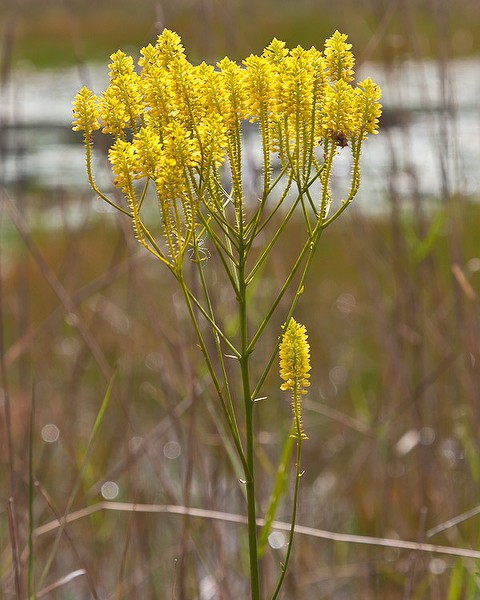
Today John and George walked Jonathan Dickinson State Park near Hobe Sound and decided unanimously that a  wildflower may enter our blog for sheer floral performance.  Today’s star was Tall Pinebarren Milkwort forming a galaxy of countless waist-high lemon yellow wands along the shallow marshy shores.  The wands extending ever-smaller toward the horizon are an artist’s lesson in perspective.  You could scarcely find a happier wildflower, except maybe its doppelganger, the Low Pinebarren Milkwort (P. ramosa) which differs by having broad (vs. nearly linear) leaves in its disappearing basal rosette.  These species are biennials or probably sometimes annuals.

Yellow wand (by JB)

That floral showcase has to attract somebody.  Who knows what list of insects stop by?  Recorded in the literature is a leafcutter bee (Megachile brevis pseudobrevis).  The bee, interestingly, can make its cylindric home cells of cut leaf pieces in grassy places, such as the marsh occupied by the TPBMW, in contrast with the woody haunts of most leafcutters.  Of course the bee and the flower have broader social circles than each other.

Why are Milkworts called Milkworts?  Wort is an old name for an herbaceous plant, but why the milk?  Do they lactate when fractured?  No. The botanical name Polygala translates loosely from Greek  “mega moojuice,” and reflects an ancient belief in the ability of Polygala to keep the cows drippy.

The cow connection may tie in somehow with root aromas associated with many Polygala species, although apparently not our swampy P. cymosa.   Polygala is a a huge worldwide genus, and some species have roots smelling of wintergreen, this  probably explaining the name “candyroot” applied to some.  That wintergreen fragrance comes from a derivative of salicylic acid, more or less aspirin, and this in turn partly explains the popularity of Polygala root in traditional medicines, especially in Asia, where among other benefits, you can use root extracts to quit smoking.  (Don’t try it— they contain toxic saponins and who knows what other forms of bioactivity?)  The point here is, if you want a genus where the roots have served to treat just about everything, here it is.

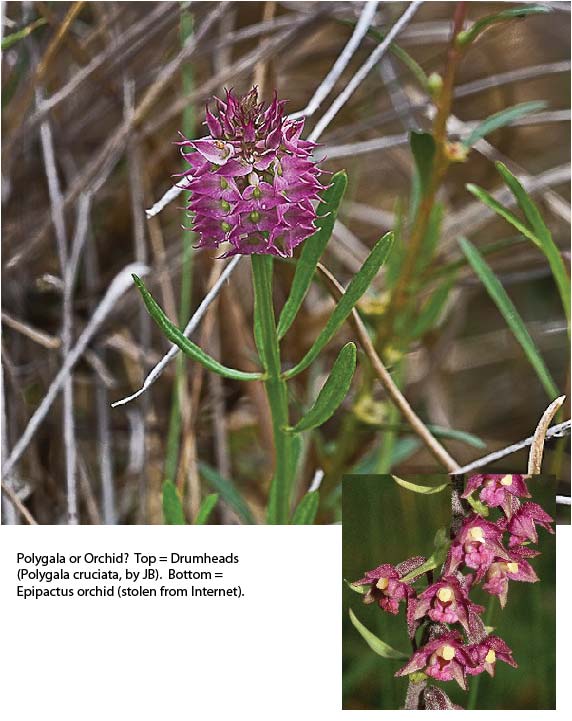
Another stellar quality of Polygala is its diversity in floral colors and arrangements.  They are the perfect classroom examples of diversification in a genus.  The floral colors can be purple, rose, yellow, yellower, orange, white, and more. The flowers can be solitary, in cylindric drums, in narrow spikes, in globes,  in candelabras, and so forth and so on.

They are reminiscent of Orchid flowers, and sometimes of Orchid flower arrangements.  The resemblance to Orchids (or the other way around to be less Orchid-o-centric) includes the overall shapes of the blossoms, especially their horizontal lip, this differing from the other petals and sepals, and textured or patterned.   We have overheard observers mistake Polygalas for Orchids. We scoff in derision.

Polygala seeds demonstrate an occasional wildflower adaptation—they have a small ant-snack called an aril (or eliaosome, or caruncle) attached.  The ants drag the seeds to the ant nest, which from the seed’s standpoint is a tilled, enriched, weeded, and guarded garden.  The aril in Polygala cymosa is small, however, perhaps because the species is semi-aquatic and not in prime ant habitat.  It may tilt more toward distribution tricks characteristic of such water-neighbors as Sagittaria, Echinodorus, and Alisma.  These have tiny seedlike fruits with raised surface patterns.  The similar small P. cymosa seed likewise has a waffle surface pattern.  It has been speculated that such “treads” might help small wetland fruits and seeds cling to the muddy feet of waterfowl helping the plants jump to new ponds.

 
6 Comments

Posted by on May 24, 2012 in Tall Pinebarren Milkwort


Tags: , ,

Gopher Apple

Gopher Apple

Licania michauxii

Chrysobalanaceae

 CLICK

To set the stage, enjoy a trip to Jonathan Dickinson State Park and cyber-visit the Gopher Apple in John’s Gigapan Image.  You can zoom in and out, and move around.  This shows GA’s at their correct size, 1 foot tall.

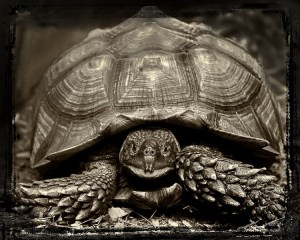
Do Gopher tortoises really eat Gopher Apples?  Yes, although the tortoises do have a broader varied diet, and the “apples” have a broader varied consumership.  Perhaps significantly, however, the range of the plant and the range of its armored namesake are similar.  Do the “seeds” (endocarps) have to pass through a tortoise to sprout? UF Prof. Sandra Wilson and collaborators report good germination after mere extended soaking in water.  Kinda disappointing in a fashion.

GA-eater, photo by JB

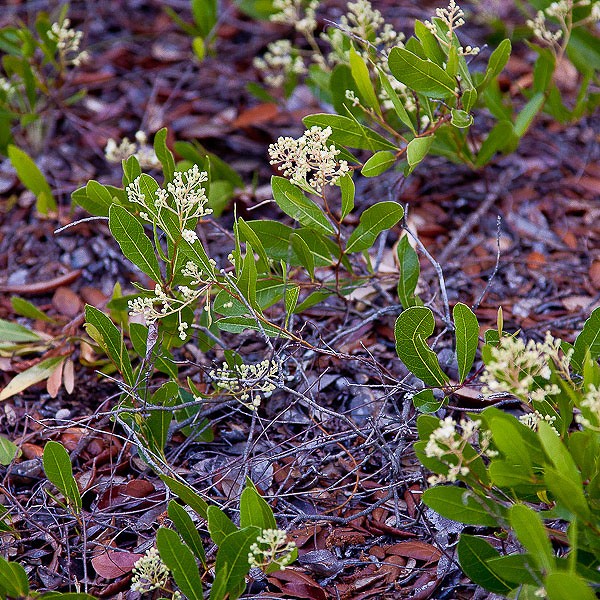
When you see a Gopher Apple you often see a few hundred in a mass, as in John’s Gigapan.  Those are probably all one big clone, spreading by thickened subterranean stems, the perfect way to survive in the fire-prone habitats favored by the species.

What would happen if there were no fires to keep knocking the GA’s down?  Recently John and I noticed a 5-foot shrub in Jonathan Dickenson Park near the RR tacks close to the site of the Gigapan, and from the distance the species seemed unfamiliar.   Upon closer examination, it turned out to be a shrub-sized GA on steroids with a trunk.  There’s a population there of numerous individuals of mixed sizes, from knee-high to eye-level plus.

At the time our conversation drifted to ascribing the freak size to RR herbicide spray.  (The common herbicide 2,4-D is a hormone mimic and causes funny things to happen.)  Another thought, perhaps proximity to the tracks saved the shrubs from burning, or perhaps not.  We’re not sure.  Further investigation showed us not to be alone we were not alone in our encounter with gigantism.  Daniel Ward and Walter Taylor reported similar unburned oversized Gopher Apples  on Merritt Island.  (Castanea  64: 263-265. 1999.)

Flowers and fruits by JB

Big Gopher Apples are  nice, but what would really get the camera clicking would be the matching 4-foot gopher tortoises.  But seriously now, Licania is a large tropical genus with shrubs and trees, so our little fire-adapted species probably has “grow-big” genes in its DNA, suppressed but not that suppressed (according to my unsubstantiated speculation).  Sort of like people have grow-a-tail genes in our DNA, suppressed, but not always.

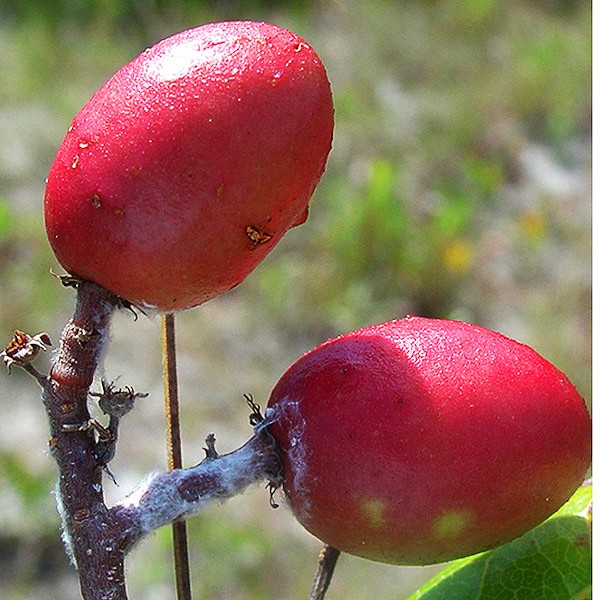
Look at the picture of the GA fruit.  Does it resemble the Cocoplum hedge outside your house?  The two are closely related, and earlier taxonomists joined them as the same genus.  Gopher Apples and Cocoplums are our two local reps of the large tropical family Chrysobalanaceae, which is traditionally regarded as related to the Rose Family, hints of which you can see in the pretty white Gopher Apple flowers.  DNA study shows the relationship not to be so close, however.

The Big Apple. These Gopher Apples are up to about 5 feet tall in full bloom, just steps away from the Gigapan site, but a different clump.

 
6 Comments

Posted by on May 16, 2012 in Gopher Apple


Tags: , ,

Canna

Canna

Canna flaccida

Cannaceae

[Posting off-schedule this week due to travel plans.]

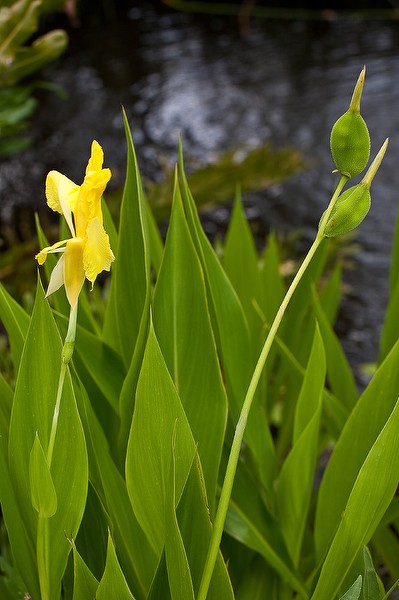
There aren’t many wildflowers showier than Cannas (pronounced CAN-ahs, not CAIN-ahs).   Our native species, Canna flaccida, is in some books dubbed “Bandana of the Everglades,” which fails to fit a species distributed from the Carolinas to South America, not to mention a silly mouthful.   “Gander yonder Mortimer,  methinks a Bandana of the Everglades.”  One thing for sure, Canna “Lily” is a misnomer;  Cannas are gingers in a broad (ok, overstretched) sense.  How about a simple “Wild Canna”?

Some escape cultivation in Florida.  Most notably, Indian Shot (Canna indica) is a skinny red-flowered  species.  Canna glauca can hybridize with Indian Shot.  Canna glauca resembles C. flaccida by having yellow flowers but differs by having erect (vs. drooping) petals.  And most of those those big reddish-orangish garden Cannas belong to a hybrid complex known as Canna Xgeneralis.  These crossed with our native Canna flaccida give an old line of garden hybrids called Canna Xorchiodes.

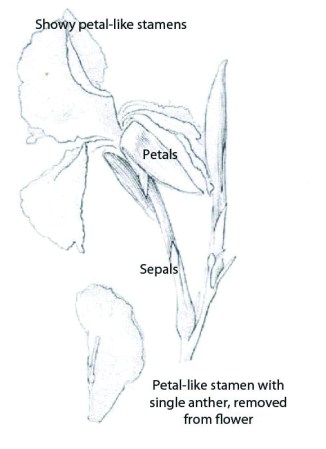
More interesting is the unusual way Canna flowers and those of some related families (especially the Ginger Family) are built.  The showy parts are modified stamens with no anthers (except for a half-anther on one of those showy stamens).  Go find a Canna flower and pluck it outside-in.  First come three sepals—they look normal.  Then come three puny petals.   And then proceeding inward you find all the big showy parts that look like petals; these are stamens.  Find the one with the half-anther.

Wild Canna occupies marshes and shores, and has landscaping and restoration uses in wet settings.  We’ve grown it in the PBSC Plant Nursery and encountered  a couple headaches.  They can be a little fussy.  Cannas are caterpillar food, especially for two species of “Canna Leaf Roller” caterpillars.  Try B.t., or better, drop the anthropocentric gardener mindset and switch to a more  biophilic outlook and say supportively, “Canna flaccida is larval host to the  brown-gold-and speckled Brazilian Skipper Butterfly  and to the Lesser Canna Leafroller moth.”  Additionally, the plants can host an ugly Rust fungus.

The fragrant short-lived flowers look best at dusk, and dawn (I hear), and presumably are pollinated by hawkmoths.

In addition to decorating our world, Cannas serve humanity in their own odd ways.  Canna indica (including “C. edulis“) has an edible rhizome cultivated as one of multiple sources of “arrowroot” starch.  The seeds look like rosary beads or buckshot, depending on your standpoint, and have served for prayer and mayhem.  A seed from a 600-year-old rattle in an Argentinian grave sprouted just fine.  The plants are grow-your-own mosquito coils burned to bug the bugs, and the foliage is a cheap locally produced snail killer to control the slimy varmints that carry the parasitic disease Schistosomiasis.

 
4 Comments

Posted by on May 8, 2012 in Canna


Tags: , ,

Sweetbay Magnolia

Sweetbay Magnolia

Magnolia virginiana

Magnoliaceae

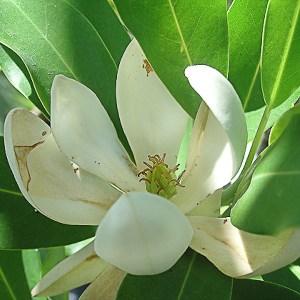
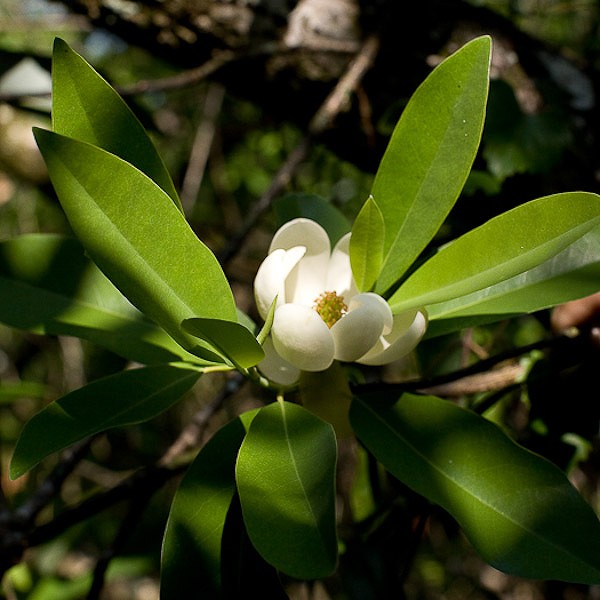
The Sweetbay Natural Area near the Palm Beach North County Airport is native plant paradise on a beautiful day.  Yesterday was such a day, and the PBSC Native plants class encountered the namesake tree in full sweet bloom.  The overall tree shape and foliage are as beautiful as the blossoms.  They stand out even from some distance as potentially (but not often locally) large, straight-trunked, and with assertive up-tilted branches.  The leaves flutter in the wind revealing white undersides.  Crush them and enjoy the “bay” fragrance.  The branch tips have enormous buds, each covered with a cone-shaped stipule looking like a lopsided dunce cap made by a dunce.

The foliage doesn’t usually show much insect damage.   There are (at least) two natural insecticidal compounds in the leaves, which discourage most herbivores except for the pretty yellow Sweetbay Silkmoth, which tolerates the poison and uses the tree as its larval host.

An old traditional view is that Magnolias have primitive flowers, although modern research has shown that notion to be overstated. The presumed primitiveness manifests as an overall lack of apparent specialization, especially possession of numerous, comparatively leafy-looking floral parts all separate from each other.    Additionally, the pollen, wood, and additional features are interpretable as more or less primitive.  Not many flowers have numerous separate pistils (seed-producing female units) as Magnolias do.  The resulting fruit is a collection of separate units (technically, follicles).  Each unit looks like a tiny leaf wrapped around two bright red seeds.  The gaudy seeds come loose and dangle to entice birds and other hungry agents of dispersal.

What they dangle on is a little interesting.   The water conducting cells in plants are dead, and in some cases they have spiral thickenings allowing them to stretch during growth.  Think of a slinky.  The seeds dangle on the remains of their umbilical cords, stretched slinky-shaped dead cells.

Back to the blossom.  It is big, white, perfumed, and pollinated by an array of beetle species.  Referring to Magnolias in general, the beetles sometimes enter the flower while it is still in bud while those still-closed petals block the “wrong” visitors.  The flowers are female and pollen-receptive at this juncture, with the consequence that they receive the correct pollen by beetle Fed-Ex.   After that, the flowers turn male releasing pollen and open fully.

Sweetbay flower (by JB)

The seeds behave in a way associated with mature or climax forests. Species adapted to mature forests, as opposed to early-succession pioneer species,  tend to have fewer seeds more equipped for shade-tolerance, that is, loaded with food reserves allowing the seedlings to live off of their parents trust fund (food packed into the seed)  until large enough to compete on their own.  Sweetbay seeds tolerate shade, to a point even “preferring ” it according to one study.  Shade favors first-year establishment, although bright light enhances subsequent growth.  In the first year the seedlings can rise two feet in a quest for the light.

Sweetbay Magnolias reach their largest most striking development in undisturbed and unburned wet places.    Yet they get back on their feet aggressively after being knocked down.  They regrow all spunky from fallen trunks, from stump sprouts, and from root sprouts after hurricanes and fires.

After trouble, they tend to reappear in clumps from stump bases, and that may relate to an odd adaptation called a lignotuber, which is vaguely reported for Sweetbay Magnolia without much corroboration (known to me at least).  Lignotubers are specialized survival-zones  at the trunk base.  These have starches and other carbs and nutrients, as well as dormant buds, all ready for post-apocalyptic repopulation.  A more-documented local lignotuber repopulator is the invasive exotic Australian-Pine.

Photo by JB

What about Sweetbays in landscaping?   This might be a topic to start an unwanted argument.   As background,  it might help to know the species is distributed from New England to South Florida and Texas, mostly in wet swampy habitats.  On one hand, there are beautiful examples in cultivation, and the species is abundant in the nursery trade with several names cultivars.  We had a fairly nice one on the PBSC campus, destroyed in a hurricane and a small one there now.  In cultivation, although the tree can flourish in a “normal” residential setting,  I’ve always felt that the specimens at PBSC were never as robust as you might like, probably due to being a little too high, dry, and in one case wind-swept with respect to their natural swampy inclinations.  UF IFAS Fact sheet SF-384 has little reservation about suggesting the species, listed an expected size to be 40-50′ X 15′-25′ good for limited spaces.   The authors hint at issues with “urban tolerance,”  so perhaps a guiding principle on using this species in the landscape is to not duplicate, but at least respect the acid-swampy, semi-shaded origins of this lovely species.

 
Leave a comment

Posted by on May 3, 2012 in Sweetbay Magnolia


Tags: ,

Wild Coffee FAQ: Can You Make Coffee with Wild Coffee? (No)

Wild Coffee

Psychotria nervosa

Rubiaceae

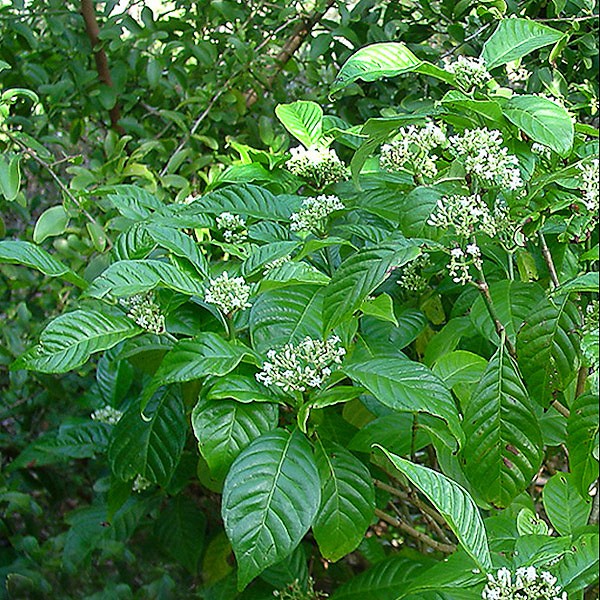
Answer:  I’d like to get my mitts on the numbskull who made up the English names for the plants of the world.    The only connection between the Wild Coffees and Starbucks is joint membership in the Coffee Family, the Rubiaceae, along with 12,999 other close relatives.  There is a little visual similarity between a Wild Coffee and Coffea arabica, but chalk that up to broad family resemblance.  The genus of Wild Coffees, Psychotria, with some 2000 species, is one of the largest genera of woody plants.

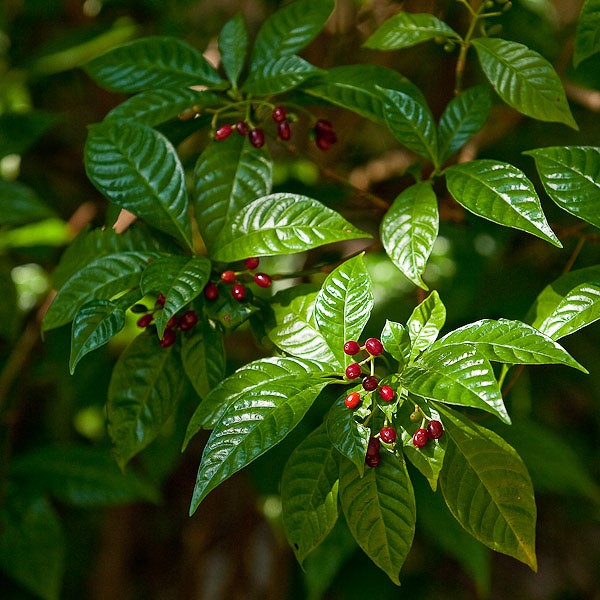
Wild Coffee (by JB)

Would you make a cup of  “coffee” from Psychotria?  No, unless maybe you are a Shaman, and few Shamans read WordPress blogs.  The traditional uses of Psychotria include ayahuasca.  Ayahuasca  is a variable mind-altering Amazonian ceremonial concoction where the main psychoactive ingredient comes from the Banisteriopsis Vine in the Malpighiaceae (represented in south Florida by weedy Hiptage, garden flowers, and native Locust-Berry (Byrsonima lucida—another day another blog).

Psychotria adds kick to the ayahuasca with a drug known as dimethyltriptamine (DMT).  So, then again, maybe Starbucks should take a second look.  Psych-otria and psych-adelic come from the same Greek word psyche for mind and soul.  Psychotria extracts serve also in arrow poisons as well as fish and vermin-killers.  So please don’t make “wild” coffee unless you are a licensed shaman.

Psychotria punctata (by GR)

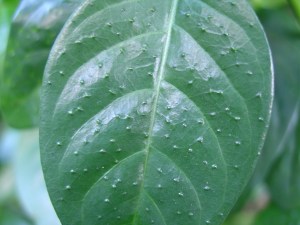
Two thousand species worldwide, four in Florida, three native.  The non-native species, Psychotria punctata from southern Africa is cultivated a bit in southernmost Florida and apparently escaped a little. Its claim to fame is foliage punctuated with translucent bacterial nodules (see the photo).   But this is a native plants blog, so back on-task.  Our three natives are:

1.   Bahama-Coffee is Psychotria ligustrifolia (P. bahamensis) on limestone in Miami-Dade and Monroe counties, in the Bahamas, and on other Caribbean islands.  It differs from P. sulzneri by having glossy (vs. dull) leaves, and differs from P. nervosa by having smaller more compact form and smaller leaves with less-impressed veins.  The compactness, overall good looks, and shade-tolerance give Bahama Coffee a role in native plant landscaping.  A tough and beautiful planting has graced the Palm Beach State College campus for many years in serious shade and with little to no irrigation.

2.  Dull Leaf Coffee, aka Sulzner’s Dull Coffee (or other variations on similar names), P. sulzneri , is a pretty  shrub with flat-toned leaves having  a velvety sheen. (More on this species at (http://wp.me/p1H7HW-b3).    It is a hammock dweller from southern peninsular Florida to Costa Rica.

3. The most-cultivated Wild Coffee is Psychotria nervosa.  The “nervosa” does not refer to a state of mind, but rather more mundanely to the leaf veins (nerves) which are deeply grooved.  This species (and Bahama Coffee) have domatia beneath the leaves.  Psychotria nervosa differs from the other two by having tiny calyx teeth (sepals).  It ranges naturally from Jacksonville to South America.

Wild Coffees are prime examples of an odd biological phenomenon, heterostyly (HET-er-oh-style-ee), that is, having styles of different lengths.  Flower vocabulary refresher:  the style is the elongated part of the female unit at the flower center.  It is tipped by the pollen-receptive stigma, and its base is the ovary where seeds develop.  This is important, so remember that the stigma is the pollen-receptive tippy top of the style.   Stamens make pollen at their own tips.

Many Rubiaceae are heterostylous (het-er-oh-STYLE-us), including such Florida native “coffees” as Mitchella, Morinda, Guettarda, and others.  (To lllustrate, I’m going to use Guettarda (Velvetseed) for the convenient reason I have good pictures.   Psychotria is the same for present purposes. )

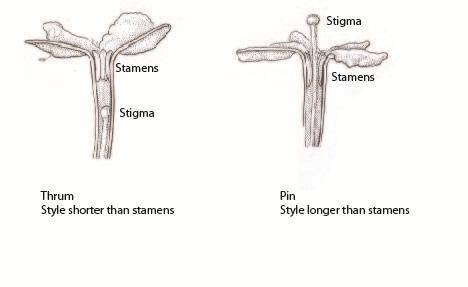
Heterostyly (using Velvetseed as a similar example)  Image credit in text.

Heterostyly is an adaptation to force flowers to cross-pollinate.  In heterostylous species there are two breeding strains, and each is forced to cross exclusively with the other strain.  Here is how it works.

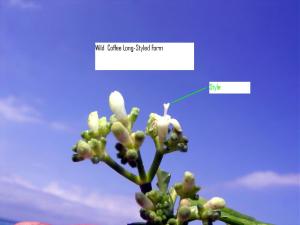
In one strain, the flowers have long styles (with those pollen-receiving stigmas at the tips) and short pollen-making stamens.  These long-styled flowers are called “pin” flowers.  Think of the long style as a pin.

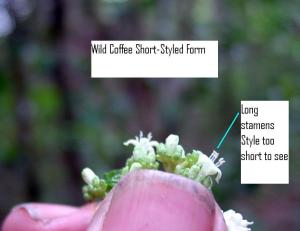
The other strain has the reverse:  short styles and long stamens .  (“Thrum” flowers.  Thrum sounds like Tom Thumb and he was short.)

Thrum. five stamens protruding, andshort  style hidden.

Psychotria nervosa pin flower.  Style is protruding, and stamens are hidden in the flower.

Think of the pollinating bee as a dipstick probed into a flower with the bee’s nose going in deep and the bee’s knees remaining out near the entrance to the flower.  (This is oversimplified using nose and knees to make a schematic point. The actual touchpoints vary among species.)

In a pin flower the bee’s nose touches the short stamens while the bee’s knees touch the pollen-receptive stigma on the tip of that long style.  Flip-flopped, in a thrum flower, the bee’s nose touches the short stigma and the bee’s knees touch the long stamens.

So then, when the bee visits a pin flower, the short stamens powder its nose with pollen.  If it flies to another pin flower the pollen-dusty nose is not aligned for pollen-drop-off.  For this bee to drop off its pollen, it must switch to a thrum flower where the nose can pollen-dust the short stigma.  In Psychotria you can distinguish pin and thrum flowers with a hand lens.  (You can tell the styles from the stamens because each flower has one style but five stamens.)

[Drawings by Karen Stoutsenberger, from Rogers, G. K. The Genera of Rubiaceae in the S.E. U.S. Harvard Papers in Bot. 10: 42. 2005.]

Wild coffee (by JB)

 
5 Comments

Posted by on April 26, 2012 in Wild Coffee


Tags: , ,

Have a Headache? Go Chew a (Willow) Stick

Carolina Willow

Salix caroliniana

Salicaceae

Willows grow everywhere from the Wind in the Willows to the Bible to our own back yards.  Long ago I ventured as a young botanist from Michigan to Brazil, expecting the Amazon to look like the pictures in National Geographic, only to be a little disappointed to find Willows just like Michigan along the first shores I saw.  But then again, just like disappointing people, Willows are not disappointing if you give them a chance, and we have plenty in South Florida wetlands.  There are 450 species worldwide.  In South Florida there’s one.

Carolina Willow

Carolina Willow (Salix caroliniana) ranges from Pennsylvania to Guatemala, making it one of those oddball species found in winter ice and in the steamy tropics.  Beyond Carolina Willow there are one or two mis-named “Willows” around (Itea, Ludwigia, etc.), and there are additional true Willows (Salix) native and cultivated in Florida generally in the Panhandle and northern Peninsula.

In Florida Carolina Willow is larval host for two lovely lepidopterans:  Io Moth caterpillars (green, bristly, and OUCH!!) and Viceroy Butterfly caterpillars (bird dropping posers).   Willows tend to be buggy and are prone to stem galls, leaf galls, and various other attacks at the six hands of gall wasps, sawflies (including the “Willow Sawfly”), beetles (notably native and invasive Willow Leaf Beetles), the Cottonwood Borer Skeleton Beetle, and others.

Today’s trees make straight lithe branches to the benefit of archers and basket-weavers.  Since prehistoric times, they have been used in making fences, canastas, fishtraps, willow-wattle fences, arrows, switches, and more.   Land managers like Willows because they flourish in reclaimed  wetlands.  (Others dislike willows because they can be invasive, including into sewer lines.)   The plants tend to be easy to propagate from cuttings, being  adapted to fragment in floods and root downstream.  They also make great rootstocks and scions for practice grafting.  We maintain some in the PBSC nursery for that purpose.

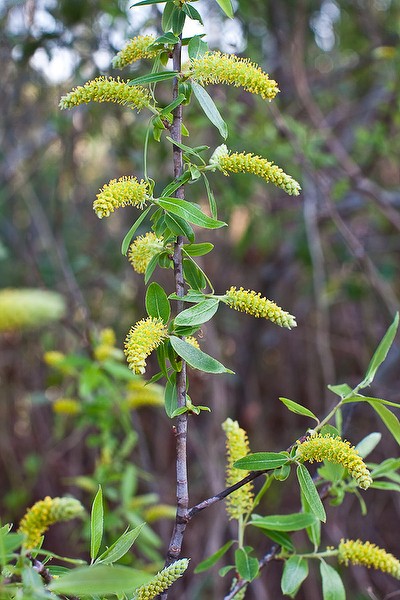
Willow catkins (by JB)

More notably, headache-suffers around the world have discovered  multiculturally that preparations from Willow bark relieve pain.  Aspirin is salicylic acid, named for the generic name Salix, although the distribution of salicylic acid (to apply the name loosely to a family of related compounds) is broad in the plant world.  Aspirin was historically extracted from Willows and from other plants; now it is synthetic.

Now for the good part:  Why do plants make salicylic acid to begin with?  Not to dull our pain.  The compound is a plant hormone able to arouse the plant’s “immune system” in the event of pathogenic invasion.  In recent years there has emerged a literature on the more subtle submicroscopic-biochemical side of plant self-defense and the role of salicylic acid in sounding the alarm.  The hormone has the fascinating ability to spread the word like Paul Revere through the air to other plants in the same population.  Willows can grow in massive stands as a monoculture.  Is this why they generate apparently exceptionally high levels of salicylic acid?

Willow flowers come forth early in the Spring, attracting pollinating bees before there’s much competition.   The flowers are in separate male and female catkins, which are elongate clusters of small individual unisexual flowers.  They are the pussys in Pussy-willows.

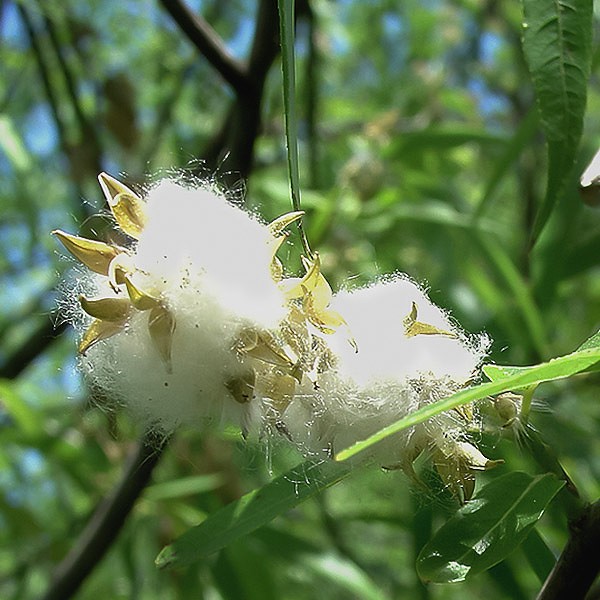
Most plants with catkins are pollinated by wind.  But Willows may have turned the beat around, reverting from wind pollination to insects.  Pollinator insects require compensation, and the Willow offers nectar, but from an unsual source, from highly modified petals and or sepals.  These organs somewhere in evolutionary history lost their showy functions in favor of becoming nectar glands, as though Willows “reinvented the wheel” (well, the nectary) long ago and far away. Then come the seeds on silky parachutes:  birdy delights for lining the nest.

Use these seeds to cushion your nestegg (by JB).

 
8 Comments

Posted by on April 19, 2012 in Carolina Willow


Tags: , , ,

April Showers Bring Pond Apple Flowers

Pond Apple

Annona glabra

Annonaceae

How many beetle-pollinated flowers do you know?  Among a few, Pond Apple and Sweetbay Magnolia, both in flower now.

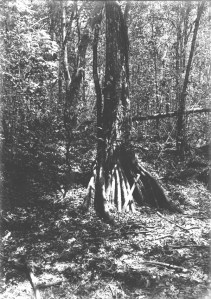
What I really like about Pond Apple lives primarily in my imagination and in old photos, especially ones taken a century ago by botanist John Kunkel Small.  Back in the day, as they say on Pawn Stars, Pond Apple was debatably “the”  broadleaf tree of the Everglades Area, especially the southern rim of Lake Okeechobee where it formed a Pond Apple forest, also an arboreal force to reckon with bordering Biscayne Bay.   Back then and there the PA’s became jungle trees to maybe 60′ tall, festooned with epiphytes and birds, and complete with buttress roots. Today we encounter the trees mostly as modest-sized individuals in wet habitats, or in cultivated landscapes.

Pond Apple by JK Small, 1917.

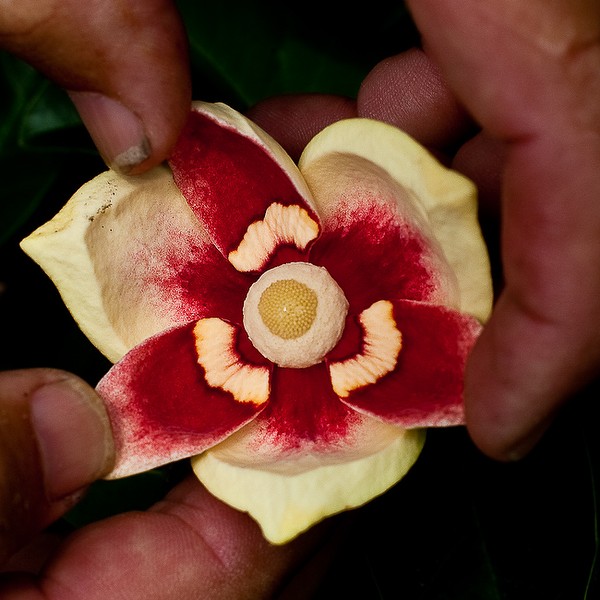
The primitive flowers have six thick fleshy petals, vanilla-yellow-white with reddish markings at the base.  There’s a huge number of stamens and a hundred separate carpels (female units), each with just one seed.  The female pollen-receiving stigmas become sticky and receptive before the flower enters its male phase.  The carpels fuse later into the “apple.”

The floral visitors are varied species of beetles drawn by the scent.  The flower tends to form a chamber that shelters the beetles and keeps them happy munching the succulent petals and perhaps mating during the flower’s passage from the female phase through pollen release.  The strongest fragrance emerges in the evening, which is also the time the pollen comes free to dust the critters.  The flower gets pollinated by providing a beetle rumpus room.

Most flowers serve nectar as a reward for insect visitors.  But Pond Apple provides a pound of petal-flesh as the price to pay for reproduction. (Similar to paying college tuition for human pondapples.)   If you think beetle pollination is weird, other Annona species rely on thrips, cockroaches, and probably sometimes flies to do the job.

Pond Apples range from Florida to South America, and to Africa.  Is the tree actually native in Africa?  I don’t know, probably not. The tree has become an invasive exotic nuisance in additional tropical regions such as Southeast Asia and especially in Australia, where it represents our revenge for the Melaleuca. (And its cousin the Bottlebrush getting pesky.)

Pond Apple is in the same family as Pawpaws, which have similar flowers.  I ate a pawpaw once maybe a trifle unripe.  It knocked me out cold and I woke up vomitoria.  Closer kin is in the same genus are much-better-tasting fruits:  Atemoyas, Cherimoyas, Custard-Apples, Soursops, and Sweetsops.  Pond Apple serves as a locally adapted grafting rootstock for some of these, and has been hybridized with some of the tasty species.   Pond Apple fruits are yucky to humans, but raccoons savor the flavor.   Raccoon scat sometimes looks like PA seed conglomerate.  Pigs like them too, a fact well known to land managers where Pond Apple is an invasive pest.  So do iguanas and some monkeys.

Beetle party place (by JB). The white ring near the middle is a mass of stamens. The greenish-yellow center is a cluster of carpels (female units, which become the "apple").

The trees produce bioactive principles and have too  many historical medicinal uses to start listing.   Most interestingly, modern research has shown anti-cancer properties from the seeds.

Any good in the landscape?  Sure.  The PBSC Campus has several very purty specimens, and there’s a good-looking individual in my yard.   Although wet places are the natural home, the species fares well under normal residential conditions, even unwatered or only lightly assisted after establishment.  Sun or reasonable shade are okay.  The upside is general prettiness, fast growth, and curious flowers.  The downsides are fast growth,  low branching, unwieldy watersprouts, messy fruits, reportedly  toxic seeds, and seasonal leafdrop.   The seeds are easy to sprout, and yes, I’ve tried them plucked out of raccoon poop—works fine but really no need to go stalk a racoon.

 
7 Comments

Posted by on April 12, 2012 in Pond Apple


Tags: , ,