Ludwigia
Onagraceae
Last Friday Billy, John and George survived a thunder squall on the Haney Creek Trail in (or near) Jensen Beach. Beautiful site, but too much lightning and too many Ludwigias, aka Primrose-Willows.
Have you ever hurt your head attempting to key out a plant species only to find the glove don’t fit so you must acquit? Did you pause and wonder: is the problem the dumb key writer? Or is it me overlooking something? Or is it the plant? The problem may be you or a goofy key writer, but sometimes the plant really truly does not fit. Plants do not know we will them to fit into a stilted 18th Century system of classification.
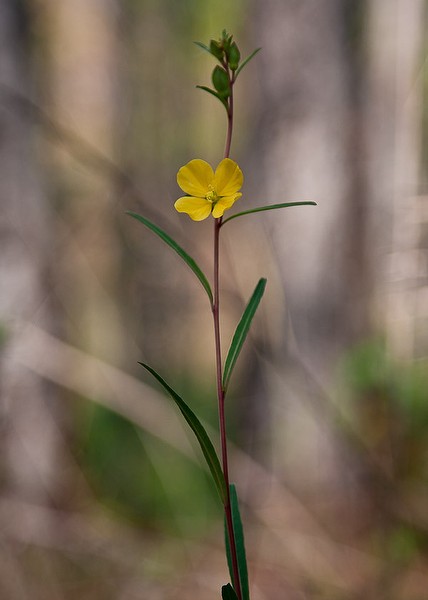
Ludwigia maritima (by JB) (It has two chromosome sets, so does John.)
Look at it this way. Einstein figured out there’s no such thing as space and time. They’re human concepts. I never really understood that, but I do understand sometimes there’s no such thing as species. They’re human concepts. What is amazing is how often plants do sort themselves out into species, but not always.
That all begs a big question: what is a species? Well (somewhat animal-o-centrically) we’d like it to be a lineage of organisms that all look very much alike and breed readily with each other but with nobody else. We’d like a species to be fairly widespread and ancient. Nobody told all the plants about this, however.
There are groups of plants whose classification has never been resolved for the simple reason that their patterns of breeding, histories, and visible differences do not resolve into traditional species. Ludwigia is a prime example, because its pattern of variation is nutty. Hold this thought a moment as I set the stage with a little context.
Ludwigia consists of about 82 species around the world with North and South America points of concentration. Florida has about 28 species, some of them invasive exotics and others of questionable provenance. Our immediate blog area has about 16 species. That’s plenty.
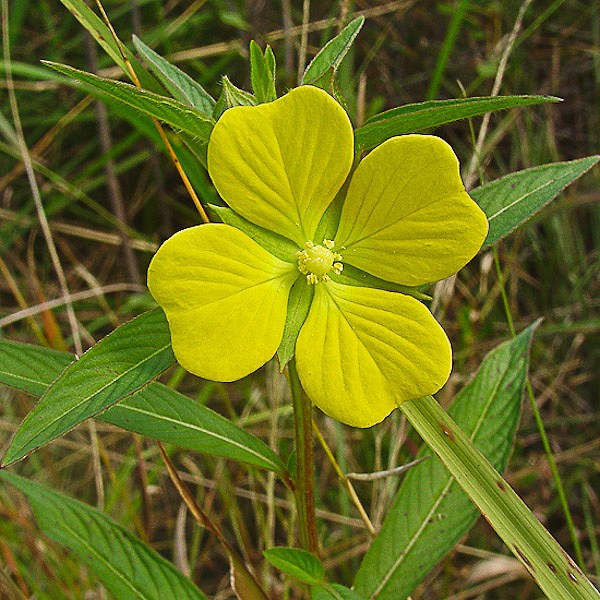
Ludwigia peruviana (by JB)
Florida Ludwigias range in size from little floating or mud-creeping weeds to shrubs taller than you are. Some have big yellow buttercup flowers; several have no petals at all. The fruits shapes are all over the map from cigarettes to dice, the leaves can be opposite or alternate (and extremely variable even on single individuals), and the plants range from shaggy to bare. In short, they are diverse, although you usually know one when you see one, like dogs.
Ludwigias are master weeds globally, including American species behaving badly overseas. The distributions are so expansive that it is often impossible to pinpoint the exact regions of origin. As an example, L. octovalvis is a Florida wildflower and an Australian wildflower. Some have moved around and have hybridized as aquarium plants, escaping when the aquarium gets dumped. Peruvian Primrose-Willow (L. peruviana) can reach 12 feet tall, and you could scarcely design a better wetland invader. This South American exotic roots from floating stem fragments, and it makes seeds in massive numbers carried by water currents, birds, and anything that moves. Needless to say, it can form monospecific stands along shores. Yet others have restricted distributions. Ludwigia stricta is Cuban and nada mas.
Now back to the species screwiness. We need a quick lesson on chromosomes and hybrids. Chromosomes usually come in pairs. You and I have 23 pairs. In any given pair, one member arrived from Dad in the sperm, the other from Mom in the egg. The two chromosomes sets came together (in Rochester in 1952) and paired up in the fertilized egg that grew into me. Many hybrids are sterile because chromosomes from the sperm of one species and the egg of a different species don’t pair up properly in the fertilized egg. It would be like sending two kids to run through Beall’s Outlet and each toss 5 shoes into a bag. Mismatched “pairs” will result The mismatch may prevent the hybrid from developing or functioning fully, or perhaps from making is own viable sperms and eggs. A mule.
But plants often do something weird — many double their chromosomes, the equivalent of a person having 92 chromosomes instead of 46. Or the equivalent of taking that bag full of Beall’s shoes back through the store and adding in the matched shoe for each one the kids tossed in, doubling the shoe total in the bag.
Chromosomal doubling is rare but happens, creating a bizarre but true circumstance. If a hybrid suffering from mismatched chromosomes has its chromosome number doubled, then each chromosome has a matched partner. This allows plants to form stable fertile hybrids with novel chromosome numbers, having four, six, eight or more chromosome sets. Bread wheat has six sets. Strawberries have eight. Multiple chromosomes sets or the plants having them are called polyploids. All of this happens in Ludwigia, and many of the “species” are really stabilized hybrids with differing levels of polyploidy. Ludwigia maritima has two sets of chromosomes (8 chromosomes in each set for a total of 16). By contrast, L. peruviana reportedly has 12 sets of chromosomes. A dozen!
Several of the Ludwigia species in the Southeastern U.S. belong to an odd complex mix of four chromosome sets, or six. Those with four sets cross freely, a process aided by human disturbance which creates unnatural intermixing.
Making matters worse, the plants reproduce clonally by fragments, stolons, and by self-fertilization, so any given hybrid can spread. When you try to identify a Ludwigia, are you holding a “species,” or some sort of hybrid resulting from free mixing and clonal propagation ?
Here are some selected examples to underscore the screwiness:
Ludwigia linearis and L. linifolia are similar with linear leaves and a single chromosome pair. They differ because a fragment of one chromosome has flipped within the chromosome. They cross to make fertile offspring.
Ludwigia alata is apparently a stabilized hybrid with six sets of chromosomes between L. lanceolata (four sets of chromosomes) and L. microcarpa (with two sets)
Ludwigia curtissii has eight sets of chromosomes, suggesting that is a stable hybrid of perhaps four other species.
Are you confused? If so, good, my work here is done. The point being that sometimes plants mix and match in ways that don’t represent slowly evolving, evenly branching evolutionary trees. The take-home lesson is that: if the identification key and nature don’t match, maybe the problem is nature and not you (but it is probably you). On a serious note, nature does as nature does, and there are limitations to our taxonomic system. You can’t capture all variation with families, genera, and species any more than you can capture all people with a chart of personality types.
——————————————
Here is a mini-guide to selected local Ludwigias from a booklet John and I threw together back in 2007. Don’t bet the farm on it.
Leaves opposite: creeping (or floating) weed of wet shores…Ludwigia repens
Leaves alternate:
Petals absent:
Flowers in a tight spike: Ludwigia suffruticosa
Flowers not in a spike:
Fruit < 2 mm long: L. microcarpa
Fruit 2-3 mm long: L. curtisii
Fruit 3-4 mm long, plant hairless, stem winged: L. alata
Fruit 3-4 mm long; plant hairy: L. pilosa
Petals 4 in number:
Stamens 4:
Capsule round, longer than wide: L. linifolia
Capsule square, as wide as long: L. maritima
Stamens 8:
Petals 4-5 mm long: L. erecta
Petals 10-30 mm, plant not very hairy: L. octovalvis
Petals 25 mm, plant fuzzy: L. peruviana
Petals 5 in number:
Stem shaggy with long hairs: L. leptocarpa
Stem hairless or with short hairs, usually floating: L. peploides
 John Bradford
 George Rogers
 George Rogers
 Dee Staley
 Treasure Coast Natives