RSS

Author Archives: George Rogers

Unknown's avatar

About George Rogers

Florida botanist

Smilax

Catbriars

Smilax species

Smilacaceae
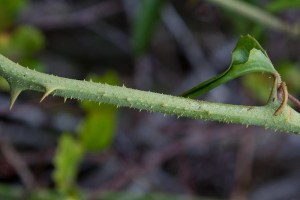
Ouch! (by JB)

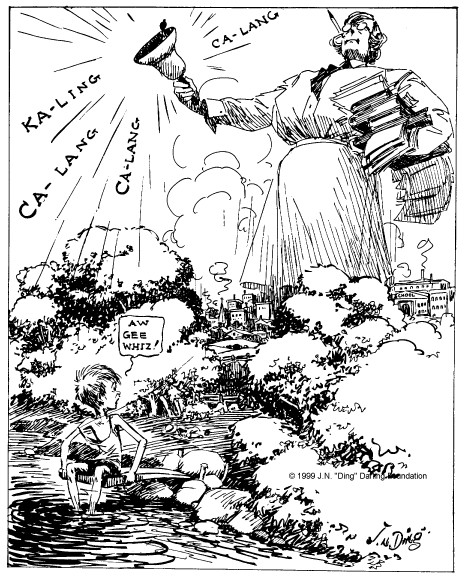
How did it get to be back-to-school time?  Clanging schoolbells thwarted this week’s Friday botanizing.  Before the rude interruption John and I were tangled up in Smilax (Catbriars).  You don’t get far in a Florida natural area before discovering these.  The late garden writer Sara Stein, in “My Weeds” displayed a negative attitude toward them:

“How can I explain how horrible catbriar is? It trips the feet and rips the skin…Its rhizomes are like steel cables.  They can’t be pulled up…Some pieces have been six-footers, and yet both ends were broken from the mother rhizome I will never reach.”
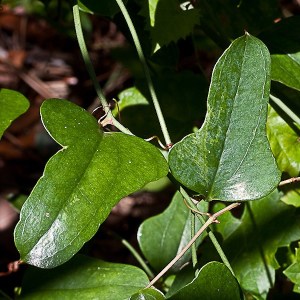
Smilax auriculata by JB

That mother rhizome can be as big as your arm, a real whopper.  No typhoon or fire is going to discourage that nugget of life.  But how about hungry hogs?    One of our species, Smilax bona-nox reportedly has prickles on the rhizome (at least sometimes—the species is variable).  This adaptation possibly evolved in the natural  range of wild peccaries and thus was pre-adapted to deter feral hogs, perhaps.  It would be fascinating to know if the prickly rhizome has affected the distribution and abundance of S. bona-nox relative to the piggy-wiggies who root and snoot hereabouts.  To repeat for emphasis, however,  the prevalence of prickly rhizomes in S. bona–nox is unclear—not the sort of thing botanist observe often.

Sara Stein didn’t like Smilax, but thirsty cowboys did when they passed on the whiskey in favor of a nice refreshing sarsaparilla.  Maybe those cowboys needed it for personal reasons: one of the early uses of sarsaparilla was to treat syphilis.  Different species of Smilax historically have wound up on dinner tables quite a bit:  the rhizomes as pseudo-spuds, as flour, as a natural jello, and as stand-in for asparagus.

Is munching Smilax is a good idea?  That the genus has a history in medicine is a sign of bioactivity, and bioactivity is a sign of potential consequences.  Smilax is sufficiently neurotoxic to be a potential treatment for seizures.  As sarsaparilla it served to alleviate rheumatism.  Some species yield steroid precursors.  So when we go walk the garden path, please don’t hand me a Smilax tendril to nibble (unless I’m having a seizure).

Botanist John Mitchell provides recipe for Smilax aphrodisiac some readers may wish to try:

  • Smilax roots
  • One white hot nail
  • Coatimundi penis

Chill the mixture for a week and take a teaspoon a day. (Let me know how it works.)

Smilax is the Monocot  twin to Dicot grapes, right down to the tendrils and fruit clusters.  They are related to Lilies, and the flowers look like tiny Lily flowers.  They don’t smell so great though — an older name for the genus is Coprosmanthus, meaning “dung-smelling flower.”  Of the dozen species in Florida, those encountered in the area of TC Natives are Smilax auriculata (very common, leaf blades usually with basal lobes, the leaf margins not bony, the midvein beneath the leaf jutting out similarly to the side veins, the female flowers with 2-3 stigmas), S. bona-nox (mnemonic: bona-nox has bony leaf margins), S. laurifolia (leaf usually narrow with the base unlobed, the midvein beneath the more prominent than the side veins, the female flowers with just one stigma), and S. tamnoides (bottom half of leaf margin with prickly little teeth). Good luck!  The leaf shapes are dismayingly diverse within species.

Note: The cartoon is by Ding Darling.

 
5 Comments

Posted by on August 20, 2012 in Catbriars


Tags: , , , ,

Red Mangrove Youngsters — Failure to Launch

Red Mangroves

Rhizophora mangle

Rhizophoraceae

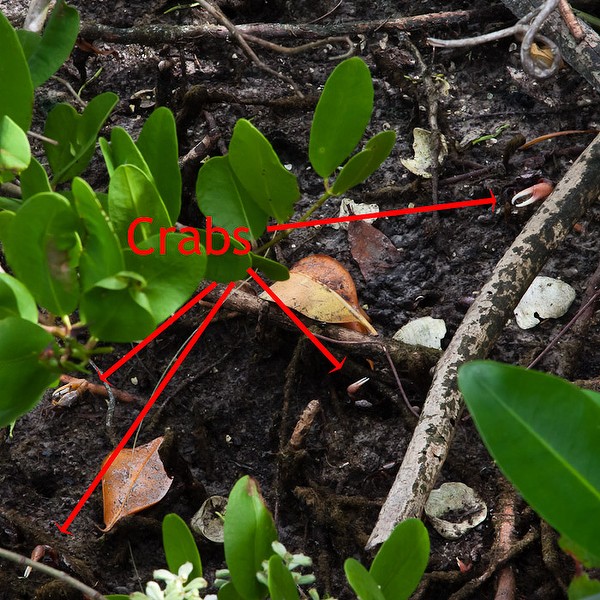
Today John and George sweated like jungle explorers through the Kiplinger Natural Area in Stuart, with distant thunder.  Worth the steambath though, with the blooming Loblolly Bays resembling a Camellia garden.  Even better, Red Mangrove babies were dropping from their mama mangroves onto the crabby Fiddler Crabs brandishing their big claws in the tidal mud.

CLICK to see a nice Mangrove gigapan by John Bradford

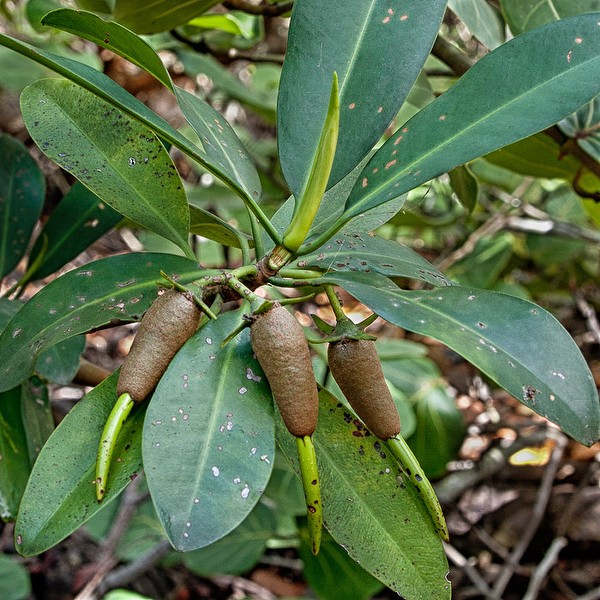
Green pencil-shaped Red Mangrove babies (embryos) protruding from the brown fruits. All photos today by JB.

Nothing is more boring than botanical embryology, but we’re going there anyhow.  So grin and bear it, because native plant enthusiasts are duty bound to understand those wacky Red Mangrove youngsters.  They look like big pointy green beans protruding from the much-shorter brown fruits.

To discuss wackiness we first must establish baseline normality. A normal seed is a space capsule where the seed coat surrounds a baby plant (the embryo).  The mother plant packs baby formula called endosperm into the seed and then sends it off to college with no further ado.  The meat and milk in a coconut are examples of endosperm.

Consistent with sociological trends of today, however, the Red Mangrove offspring stays home after college, deriving direct support from the mother plant, just like Kathy Bates doing the laundry for 35-year-old Matthew McConaughey.

In a human family that’s easy enough to arrange, but plants are not designed for extended parental support.  A normal seedling has no way to reach back to the mother plant for supplemental cash.  I mean, the mother plant packs an allotment of endosperm food into the seed, wishes the youngster good luck, and sends it off to fend for itself.  End of connection, end of story.

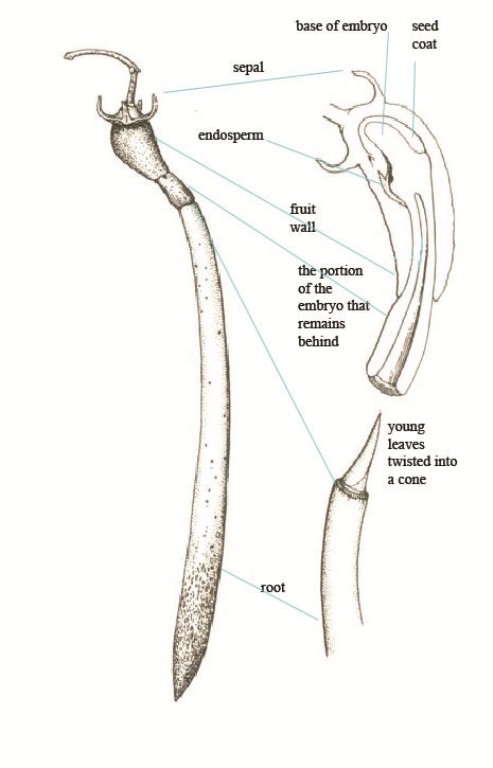
But not so in a Red Mangrove.  The seed germinates while still inside the fruit, this still suspended from the mother plant.  The germinated youngster (the embryo) grows 8 inches long, requiring vastly more nutrition than the original endosperm.  Here is the weird part: The mother tree conveys sustenance through the fruit into that growing green youngster as it pokes forth from the fruit and enlarges to the size and shape of a pencil.  But how does the maternal nutrition cross the generational barrier?  (Technically, two generations are crossed but who needs pesky details?)  The endosperm is the key.

The endosperm does something amazing, it spills forth from the top of the seed and surrounds the portion of the embryo encased in the fruit as the other end protrudes and elongates.  That is, the endosperm does not function as stored food like it should, but rather reorganizes and becomes a conduit from mother to baby, an umbilical cord.  To display my ignorance as usual, I’m not aware of any other case of this among the flowering plants.

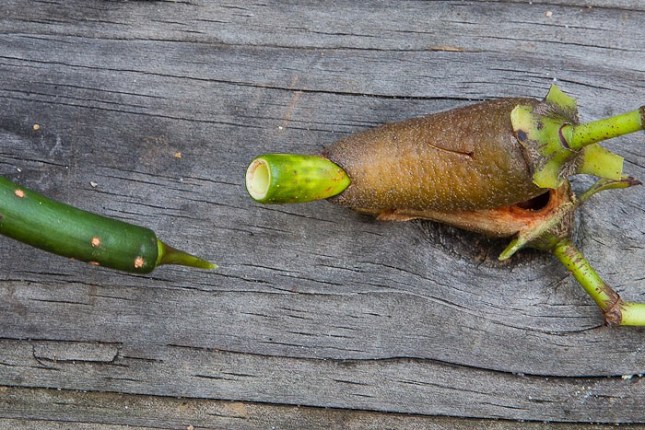
When launch time rolls around, the big green rooty-tooty embryo snaps into two components like the two stages of a Mars-bound rocket.  The fruit-end of the embryo stays behind discarded and embedded in the fruit. The long outer end of the embryo snaps off and drops onto those Fiddler Crabs for tidal dissemination of Rhizophora mangle.  At the breakage point on the dropped embryo portion you see the young leaves twisted into a tight little cone, which had been sheathed in a matching cavity before the break-up.

The part of the embryo that drops free is green on the left, with its pointy conical leaf cluster at the tip. On the right: the green throwaway portion of the embryo (like the hollow cap from a Bic pen) is jutting from the brown fruit. You can see the cavity in the throwaway portion where the conical leaf cluster had been covered before the snap-off.

Who ever heard of endosperm leaving a seed and becoming an umbilical cord?  Who ever heard of a two-stage embryo where one end is abandoned after the other end snaps free?   You have.  Then the next time you tiptoe through the tidal mud you can slice one and know the inside story.

[Notes: For interested readers, the portion of the embryo remaining abandoned in the fruit is the modified pair of cotyledons. The drawing is by Dorothy Marsh, published by S.A. Graham in The Jour. of the Arnold Arboretum 45: 288. 1964.]

][

 
6 Comments

Posted by on August 12, 2012 in Red Mangroves


Tags: , ,

Goldenrods and Dandelions—Weeds Are The Future!

Goldenrod

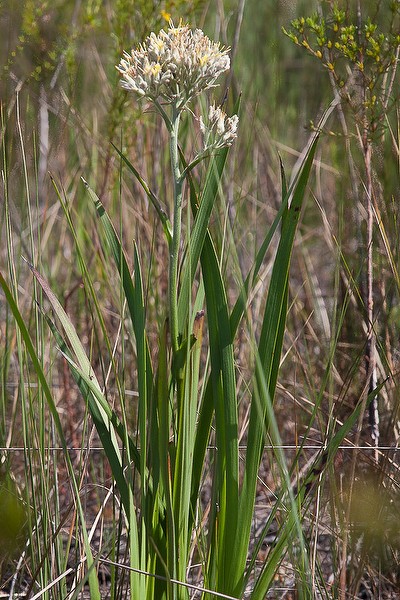
Solidago fistulosa

Asteraceae

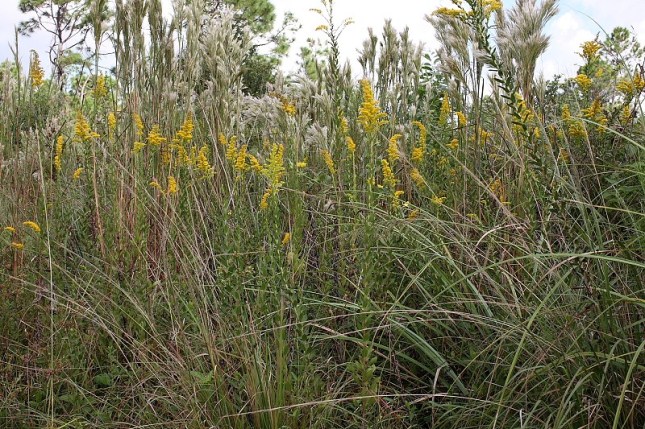
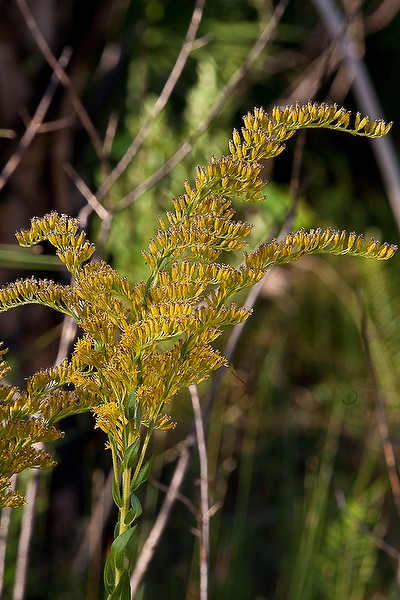
John and George botani-snooped Halpatioke Park in Stuart today, always a source of photogenic plant diversity.  Unlike previous weeks, the park was awash in the odd little annual grass Steinchisma laxa, which seems to have popped up in response to some cue.  The other domineering presence, Goldenrods (Solidago species), take their cue from lengthening nights after the summer solstice.   There exist about a hundred species, mostly in North America.  Pinebarren Goldenrod, Solidago fistulosa, was the main showoff here and now.

Solidago fistulosa (by JB)

What does everyone know about Goldenrods?  Allergies, although it is probably a bum rap.  The big sticky insect-borne pollen grains are not likely to wind up often in your snoot if you don’t sniff bugs, although flower arrangers know Goldenrods to irritate the skin

Bees are the main pollinators, and additional insects visit.  Today Soldier Beetles resembling lightning bugs without the flashlights were on duty.  Often associated with Goldenrod, they lurk among the blossoms catching other insects, mating, and eating those pollen grains.

The name Solidago means “becoming whole,” as in healing.  There are too many medicinal applications to list, and most are boring.  However, there’s probably validity to some of the historical uses.  The plants are bioactive, including a handy ability to suppress soil pathogens (and human pathogens?) via root exudates.  And Goldenrods produce natural pre-emergent herbicides to throttle germination of competing seeds, at least in the lab.  Some folks like Goldenrod Tea, but why blithely consume any bioactive plant?  I’ll stick with Winn Dixie tea. Goldenrods have touched automotive history too:

Thomas Edison, Harvey Firestone, and Henry Ford shared an endeavor in the early 20th Century. Around WWI time they fretted about rubber running low.  Ford tried Rubber Tree (Hevea brasiliensis in the Euphorb Family) plantations in the Amazon.  Firestone went for Liberia.  Double failure, yet cars were proliferating nationwide like Goldenrods sprouting across the meadow.  The Captains of Industry realized that many plants other than the proper (Para) Rubber Tree make latex, including Ficus elastica and the Palay Rubbervine.  The former graces waiting rooms nationwide.  The latter is a showy weed in hot-climate America from its introduction as an attempted rubber plant.  Most importantly for today, also giving up latex are many species of the Aster Family, including the much-touted Guayule, Dandelions, and Goldenrods. You can farm these.

Solidago fistulosa (by JB)

And now comes a big Florida connection.  Brainstorming Goldenrods took place at Edison’s Ft. Meyers compound along with Florida-oriented botanist John Kunkel Small and University of Miami botanist Walter M. Buswell. Interesting how the elite of that era got together.  Even distant Luther Burbank had a hand in the doings.

Edison had found 2000 ways not to make a light bulb.  That was just a warm-up for selecting a plant to cultivate for latex. Edison (a tired assistant) ground through 17,000 dud species, until Solidago leavenworthii emerged with 12% latex content.  This species ranges throughout Florida.  The Solidago rubber worked; prototype tires were made and driven.  So Edison thought he had it nailed by the late 1920s, and Goldenrod Rubber went forth with fanfare.   Altogether not too shabby, but too little too late, as synthetic rubber nudged all 17,0001 species aside.  Gasoline did the same to the electric car battery under development at roughly the same time.

A hundred years later, the electric car battery and bio-based rubber have bounced back.  Several corporations are developing tires and other rubber products based on biomass, plant-oils, “waste” animal fats, and sugars with the help of bacterial enzymes.  Reliving Edison’s brief triumph a century ago modern engineers have made prototype green tires, which may be on your electric car by 2015.

Goldenrod’s cousin Dandelion (especially a Russian species) has come into contention as an industrial rubber source for its milky latex, just as in Goldenrod.  CLICK  and  CLICK AGAIN   Remarkably, the process involves genetically engineered viruses if you can get your mind around those.  If Dandelions work it would be no huge stretch for related and similar Goldenrod to resurface too, so Goldenrod tires are still conceivable.

Let’s exit Tomorrowland and finish up back in Halpatioke.  We saw more galls on plants today than perhaps any other time or any other place.  This seems to be the summer of the galls, at least in Stuart.  Most were on oaks, but Goldenrods are gall favorites too.  A study around Gainesville showed 122 species of insects to attack Goldenrods in some capacity or another.   The best-known Goldenrod gall-makers are gall flies of the genus Eurosta.  Long ago and far away I used to enjoy cross country skiing in Michigan.  At that time the Goldenrod galls on dead stems above the snow were sufficiently conspicuous and odd to be memorable now.  The fly larvae lodged in the galls persist long after stalk death to emerge the following spring—after bitter cold and/or life-sucking dryness, depending on the locale.  Noting this, biologists have studied the larvae as examples of bizarre adaptation to extreme conditions. How can a little worm in a pod get through 10 degrees below zero or months of desiccation and pop forth smiling?

[Special thanks to my tire-expert engineer son Martin for a heads-up on new bio-tires, especially the Russian Dandelion.]

 
8 Comments

Posted by on August 7, 2012 in Godenrod


Tags: , , , , , ,

Prickly Pears

Photo by JB

Prickly Pears

Opuntia species

Cactaceae

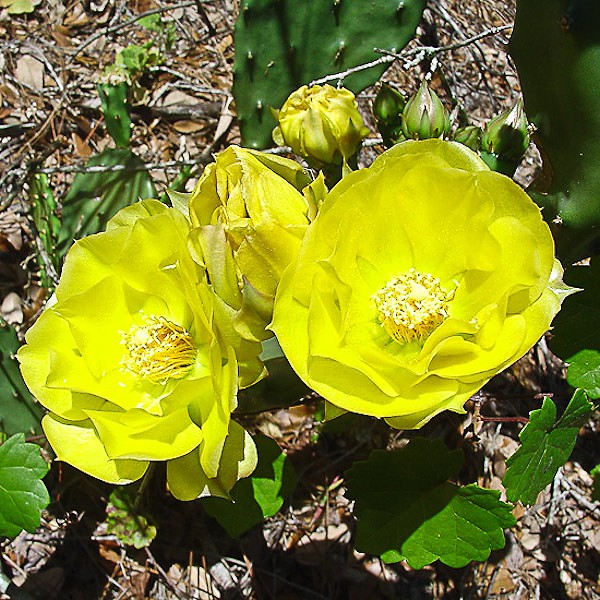
Florida is home to several species of Prickly Pear Cacti of the genus Opuntia, some native, others cultivated.   In the area of “Treasure Coast Natives” we have Opuntia humifusa and Opuntia stricta.  The former differs from O. stricta by having glossy (vs. flat-tone) stems, on average smaller pads (but they overlap in size), and spine clusters with usually just 1-3 major spines (as opposed to usually more, up to around 10).

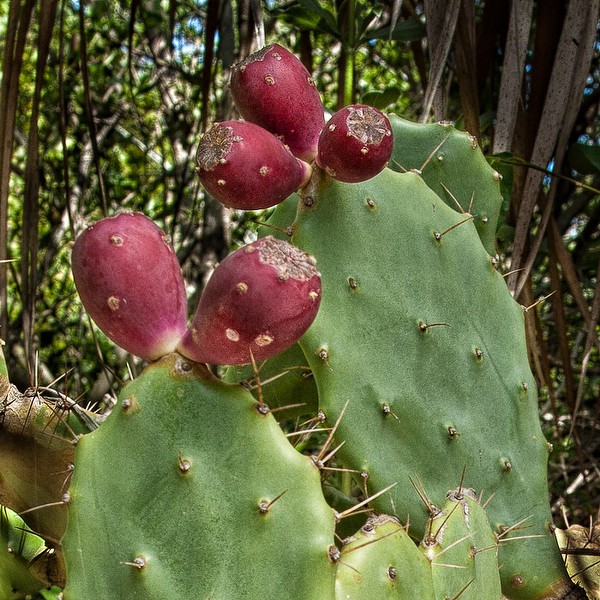
A third species a person might see hereabouts, and not native, is the red (vs. yellow) -flowered Opuntia cochenillifera.  This cultivated species has spineless pads, which are eaten as “nopales,” as are other Opuntia species which usually have to be peeled to get past the spines.  Opuntia fruits, tunas, are red and tasty, but handle them gingerly, because the nearly-microscopic hairs called glochids burrow in your skin and keep you awake later.  More interestingly, the name cochenillifera means cochineal-bearing, which brings us to an important point.

Cochineal Bugs resemble scale insects in their ability to make a waxy “nest” for the females to colonize and suck out the plant juice.  The bugs squish bright red-purple and were the basis for the historical international carmine dye industry originally based in Mexico and spread eventually to other regions.  Carmine dye is a bright red fabric colorant, “the roadcoats are coming,” serving also in foods and cosmetics, sometimes as “dye E120.”   Use in edibles and cosmetics has fallen off, in part due to concerns with toxicity.  There are cochineal farms in South America and Mexico.  Ounce per ounce cochineal extract is  worth more than gold (at least at outdated gold prices).  (Investment advice: if you are worried about hyper-inflation don’t bury gold under the doghouse; instead, move to the dunes and plant prickly pears.)

Tunas by JB

An effort to start a carmine dye industry in Australia failed but resulted in American Opuntia stricta becoming our revenge for their Melaleuca.

This is all leading up to the fact that Cochineal Bugs have variably spread to and been imported to Prickly Pear populations far and wide, including here in Florida.  Walking in the scrub it is a frequent experience to see unhealthy looking Opuntias with the tell-tale cochineal wax.   Embedded in the wax are the bugs.  If you can get one out, perhaps on a knife tip, without pricking your finger and mash it, you’ll have a purple-red fingertip tattoo thanks to natural dye E120.

 
2 Comments

Posted by on August 1, 2012 in Prickly Pear


Tags: , ,

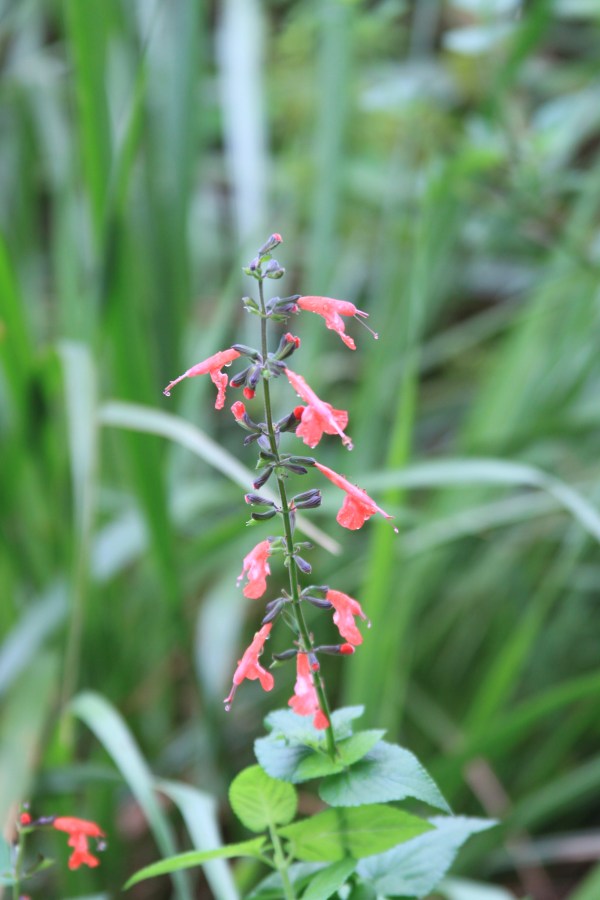
Scarlet Sage is No Money Tree, But It Does Have Leverage

Scarlet Sage
Salvia coccinea
Lamiaceae

Billy is in North Carolina. John is vacationing in Maryland, thus the momentary dip in photo quality. That left me all lonesome to go visit Green Cay Wetlands CLICK in Delray Beach, home of the friendliest water birds in town and huge native aquatic plants on steroids, well actually on reclaimed sewer water. (Come to think of it, sewer water does contain steroids, but this is a nice blog so we’ll just forget about that.)


Very few plants at Green Cay are wild, but it is a terrific venue to see swampy-marshy natives from the comfort of an elevated boardwalk. Alligator Flag, Pickerel Weed, Arrow Arum, Water Lilies, and Sagittaria galore. Sedges in sedge heaven. A special treat yesterday was Scarlet Hibiscus puttin’ on the ritz, and frankly Scarlet, there’salso  a pretty planting of Scarlet Sage, today’s highlight.

There’s something special about the Mint Family, the Lamiaceae (aka Labiatae). Maybe it’s the square stems, or the minty essences, or the culinary herbs, or those two-lipped flowers. That’s all obvious. Something else about the Mint Family you seldom see are the weird little ovaries which become the fruits. Each flower produces four “nutlets” surrounding what’s called a gynobasic style—the style extends to the floor of the flower between the nutlets. The style and four-nutlet ovary look like a four eggs on a saucer with a straw pushed down between them to the saucer. (You can see this in the diagram below with two of the four nutlets visible.) Spot that and you will end all argument as to whether a plant belongs to the Mint Family, at least in a traditional sense.

Salvis coccinea, unfortunately not by JB

Salvia is a jumbo genus of maybe 800 species, give or take, with some Salvia familiar to almost everybody as culinary sage, or as garden flowers, or as wildflowers, or as something to smoke. The Mexican hallucinogenic Salvia divinorum has been sending people on trips for a long time; it may be a human-influenced hybrid or cultigen. But back to Florida!

Salvia coccinea is a lovely wildflower popular in wild places, restored places, and in cultivation. The flowers are mostly scarlet, although cultivars exist with pink blossoms and white ones. We think of it as a native annual or perennial wildflower that pleases gardeners by attracting hummingbirds, tolerating shade, and by self-seeding, but it is an invasive exotic elsewhere, such as Madagascar.

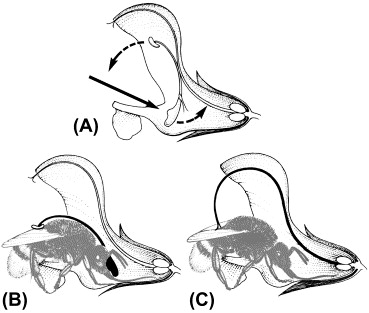
The Salvia lever system at work. This diagram is not Salvia coccinea, although the system in S. coccinea is the same (but not worked by bees). Credit for diagram is given at end of post.

The fun thing to know about Salvias is their tippy pollination mechanism, which no doubt has something to do with their diversification into so many species, with the system “adjusted” for different pollinators in different species. The floral lever system looks like an upside-down teeter-totter with the fulcrum attached to the roof of the flower tube. The lever is a stamen. The anther is at one end of the lever, held above the floral entrance vestibule. The other end of the lever is deep within the flower blocking access to the nectar. When the correct pollinator enters or pushes its beak inward, the inner end of the lever is shoved upward, bringing the outer anther-end downward into contact with the visitor, patting it with pollen.

Next time you get around a Salvia, and you will, open the flower and find the lever.

Credit for the diagram: The staminal lever mechanism in Salvia L. (Lamiaceae): a key innovation for adaptive radiation? Regine Classen-Bockhoff et al. Organisms, Diversity & Evolution 4(3): 189. 2004.

George’s wife-on-steroids Donna and friend

 
4 Comments

Posted by on July 23, 2012 in Scarlet Sage


Tags: , ,

Rubbervine Among the Mangroves

Rubbervine

Rhabdadenia biflora

Apocynaceae

Peck’s Lake, which is a part of the Intracoastal between Hobe Sound and Stuart is a popular fishing hole, and on the shore is a boardwalk providing comfy passage through swamp then mangrove jungle, past a shell midden, and onward to the salty shore with an observation dek to watch the boats go by. The species along that transect are plentiful, including magnolias, mangroves, and mastics. And porpoises, said hello as we stood on shore. All three mangrove species along with their friend Buttonwood were in flower.

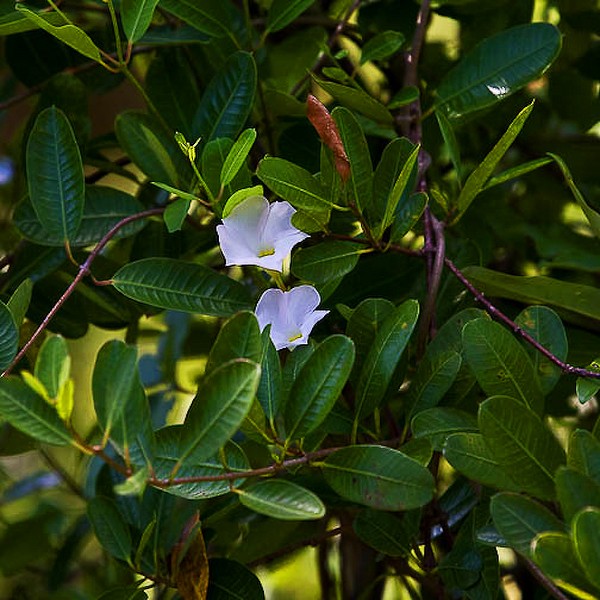
Rubbervine at Peck’s Lake, Florida. (This and all photos today by John Bradford.)

The showpiece was the pretty Rubbervine, or Mangrove Vine, with its large white blossoms scattered all through the White Mangrove zone and spilling over onto the boardwalk.

Why a vine would select mangrove stands as its main domicile is a question to ponder. Perhaps that’s a select opportunity for the “right” vine where the brackish conditions suppress competing twiners and climbers.
OKAY then, why can this particular species thrive there in the brineland? As a broad speculative possibility, it is a member of the tough Dogbane Family, the Apocynaceae, which tend often to tolerate harsh living, thin nasty soils, blazing sun, and, probably most importantly, dryness. But a mangrove stand isn’t dry, is it? Well, yea, physiologically dry, with a saline soil. Osmosis you know. So maybe standing up to that sun and salt is in the vine’s family tree. The flesh drips white milk when broken. The toxic latex is generally regarded as a feeding deterrent, but I’ve always wondered if the latex, found commonly in Apocynaceae, also helps with all that dryness we’ve been fretting.

Rubbervine and other Apocynaceae are larval host to various sphinx (hawk) moths, who drink themselves nasty on the poisonous plant sap. They proclaim their toxicity with bright warning coloration.

The blossoms are showy, the fruits are mildly weird, and the seeds are even weirder. Starting with the flowers, they are presumably pollinated by sphinx moths, given that they are standard “moth” flowers, white with a long narrow tube penetrable by little other than the long mothy proboscis.

The gate at the flower throat.

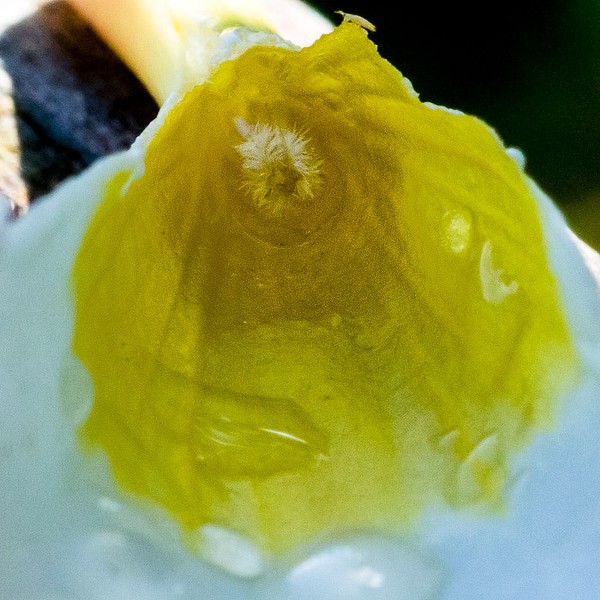
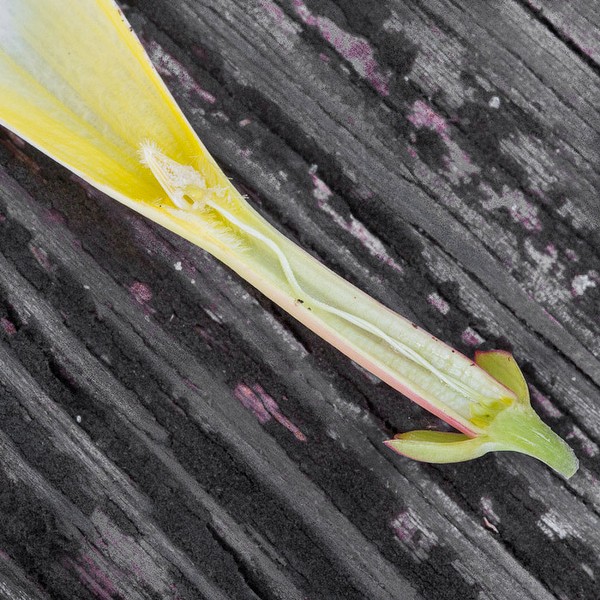
Being members of the Apocynaceae, the flowers have a particularly noteworthy family characteristic. They are more or less funnel-shaped, and just at the point where the funnel narrows a “cap” made of five anthers pressed together edge-to-edge blocks the way. (A little reminiscent of a folded paper cootie-catcher if you are old enough to know what the heck I’m talking about.) You need a long fine needle to get between those anthers and poke deeper into the flower, a great gatekeeper for allowing a proboscis probe while thwarting “nectar thieves.”

It gets weirder. The stigma (pollen receptive surface) sits immediately under the anther- cap. The stigma is in the shape of a can on a stick (the stick is the style, a narrow stalk). The business part of the can-shaped stigma is the underside of the can, the bottom end. When a proboscis probes the flower, pollen is scraped off during proboscis removal, as it slides out. The Apocynaceae are the only plants I know with scrape-pollination on the bottom of the stigma.

Flower slit open to show the anther cap (the cone) at the throat. The stigma hides under the cap. The long thread is the style.

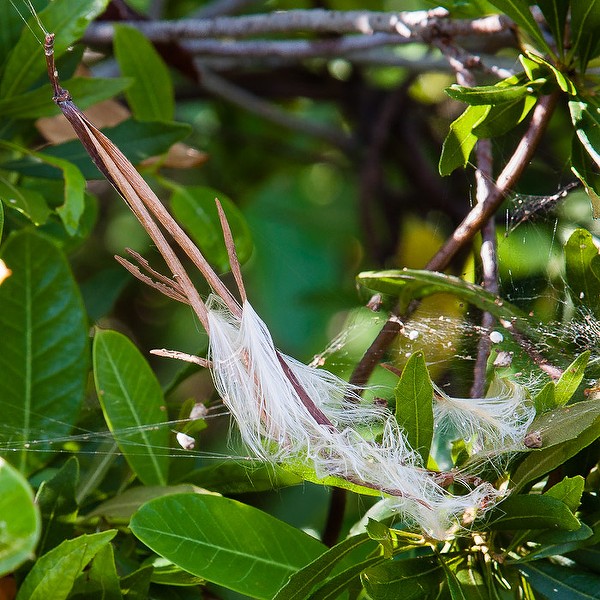
Then come the fruits resembling perky paired beans. Apocynaceae fruits generally come as twins, like bunny ears. Some readers may have observed this in Frangipani or Madagascar Periwinkle. The pods open to release seeds that look like quill pens. Each seed is two inches long counting the poofy quill. The body of the seed is a long (maybe an inch) heavy torpedo, which open landing penetrates the thick mangrove stand vegetation all the way down to the mud. How many wind-dispersed species do you find in mangrove stands? It’s a pretty good system, allowing the vine to spread through any given stand and to hop to another. It would not be hard to imagine the silky parachute clinging to the landing gear of a bird for those long hops.

Pod releasing seeds

 
1 Comment

Posted by on July 17, 2012 in Rubbervine


Tags: , , , ,

Achoo, Sniffle, Ragweed

Ragweed

Ambrosia artemisiifolia

Asteraceae

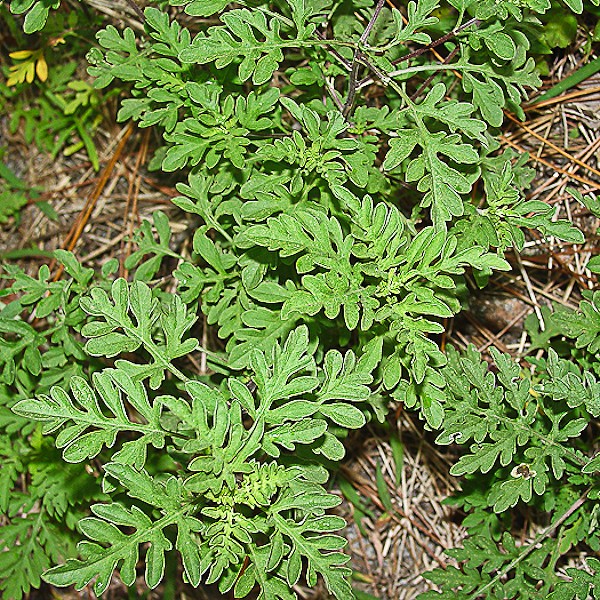
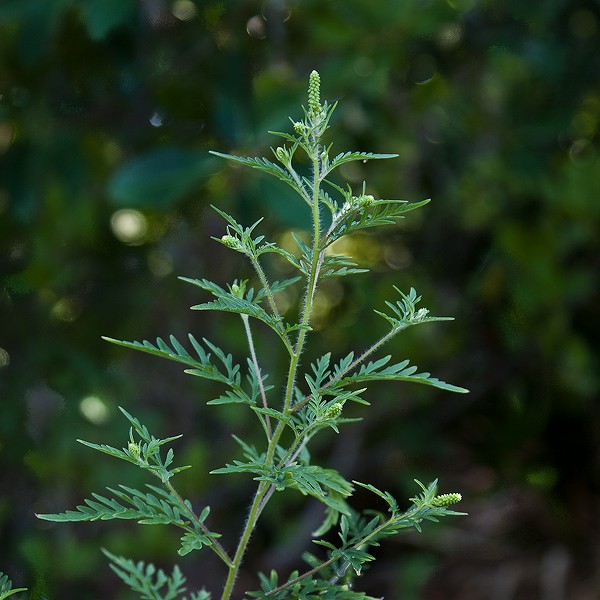
Isn’t “ambrosia” food of the gods, incarnate here on earth as that marshmallow-coconut-jello salad?  What was Linnaeus thinking when he named Ragweed that!?

[On the off-topic of Linnaeus as a naming nut, it amuses me that in the native-plants-in-the-landscape classic, “Going Native,” Richard Workman questioned Linnaeus’s handle “cynophallophora” (dog-you-know-what-bearing) for Jamaican Caper.  “Considering all the beautiful and attractive characteristics of this plant, I can’t help wondering a little about Linnaeus and his motivation.”  That’s wimpy by Linnaean standards.  That D.O.M. was not fit for polite society.]

Ragweed in Cypress Creek (by JB)

It’s not exactly divine, but Ragweed is a native weed distributed, get this (!) from Alaska to Florida, and from there globally as an invasive exotic.  It loves disturbance.  Have you ever seen how Ragweed monopolizes freshly excavated dirt?  Among other adaptations, the seeds (achenes) are tiny burrs no doubt carried by anything that moves.  And more interestingly, the seeds accumulate in the soil with varied germination times.  Some sprout lickety-split, others slumber for decades, just waiting for that road grader.  John and George this week hiked the Cypress Creek Natural Area near Jupiter Farms and, after passing by all the pretty photogenic wildflowers, focused on the dominant species.  The spoil banks along the graded road are  ribbons of Ragweed.

In a fun little book, “My Weeds,” garden writer Sara Stein described a classroom activity called “Magic Dirt” where the children go outside and fill a flowerpot with nice “clean” soil, and place their pot on the classroom windowsill to witness awakening weeds.  I LIKE it!  The Cypress Creek road banks are Magic Dirt on a macro-scale.  Food of the gods for a mile.   How long have some of those seeds been banked in the soil?   Perhaps their parents caused sneezing at the Battle of the Loxahatchee on more or less the same ground in 1838.

Ragweed babies aplenty (by JB)

That’s the thing we all know about Ragweed, Gesundheit!  The plant releases pollen like a fiend.  Let’s linger on that a moment, because wanton wind pollination is unusual in the mostly straight-laced insect-pollinated Aster Family.

Have you ever know a human family where one generation builds up a tightly run business, only to have a sloppy subsequent generation let it all go to seed?  (This occurred with a vengeance, perhaps literally, in my own family.)  Ragweed is the hippie cousin.  Most members of the Aster Family have elaborate little flowers with a hyper-specialized pollen-presentation system where first the style pushes a tiny dollop of pollen out of a tube formed by the anthers, and then the style delicately rises and becomes pollen-receptive, all very precise,  proper, and timed.  In “good” members of the Aster Family those  tiny flowers cluster cooperatively into those showy false-flowers of Asters, Chrysanthemums, Dahlias, Daisies, and  Sunflowers.    So organized, so controlled.

Photo by JB

Ragweed says bah!  Ragweed shuns showy flower heads.  It spurns elaborate pollen presentation.  It repudiates insect pollinators, nectar, and perfumed scents.  It scorned Brooks Brothers,  put on torn bluejeans,  and chose a different path:  wind pollination.  It thinks it is a grass.

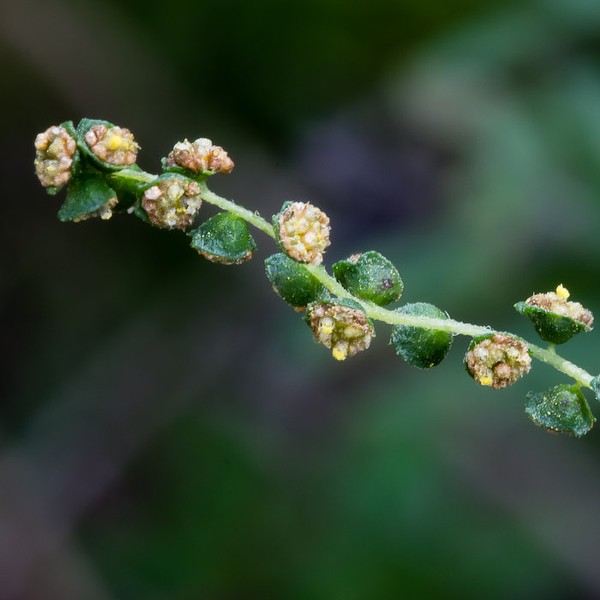
The small Ragweed flower heads look like single flowers, and are arranged in catkins (linear clusters), as in many wind-pollinated plants.  The pollen-producing (“male”) flowers are separate from the seed-making (“female”) flowers on the same plant.  (Yes, self-pollination can occur on one plant; that way, a single seed can pioneer a whole new population.)

Male flower heads (by JB)

The female flowers are little more than an ovary with two big stigmas jutting out like antennae to catch wind-borne pollen. The male flowers are nothing more than pollen bags.

And that is why Ragweed is so sneezy… it lives to pollute the air.  I’ve read that one plant can generate a billion grains.  Who’s counting?

And why is air-borne pollen so allergenic?  Did you ever wonder how a flower knows which pollen to let fertilize its seeds, and which to thwart?  I mean, a female cat knows a male cat, and a female turtle probably knows a male turtle.  But flowers are different.  The stigma (pollen-receptive surface) has built-in pollen recognition ability.  A pollen grain landing on a stigma can release proteins  that ask the stigma, “am I on the right stigma”?  The stigma can then allow the pollen to perform its function, or kill it.  As I suppose speculatively,  when pollen catches in our moist sinuses, it releases its recognition proteins (and it has plenty of additional  proteins) and asks, “am I on a stigma?”   Our immune system recognizes that foreign protein as an antigen.

Linnaeus (stolen from the Internet)

 
5 Comments

Posted by on July 11, 2012 in Ragweed


Tags: , , ,

Why is the Redroot Red?

Carolina Redroot

Lachnanthes caroliana

Haemodoraceae

Halpatioke Park in Stuart was where John and George got lost yesterday, but the advantage of getting lost is extended exploration, and in the depth of our despair took comfort in Marshallia tenuifolia (Barbara’s Buttons) putting on a fancy show.  We traipsed also through a Hypericum marsh full of the odd annual grass Steinchisma laxa which seems to relocate from year to year as the wind blows.  But enough of this pointless chatter:  we are here for Carolina Redroot (Lachnanthese caroliana).

Carolina Redroot (by JB)

Carolina Redroot looks vegetatively like an Iris, and like one of those, it prefers wet places and shallow water.  What’s woolly on the outside and yellow on the inside?  The Cowardly Lion?  No, Lachnanthes blossoms.  In class we talk about butterfly-pollinated flowers resembling upside-down witch hats, which occur more often in Dicots than in Monocots, such as today’s pretty Monocot.  Butterflies do visit, but not just butterflies.  Yesterday the dominant floral visitors were  big scary-looking bees (or bee posers).

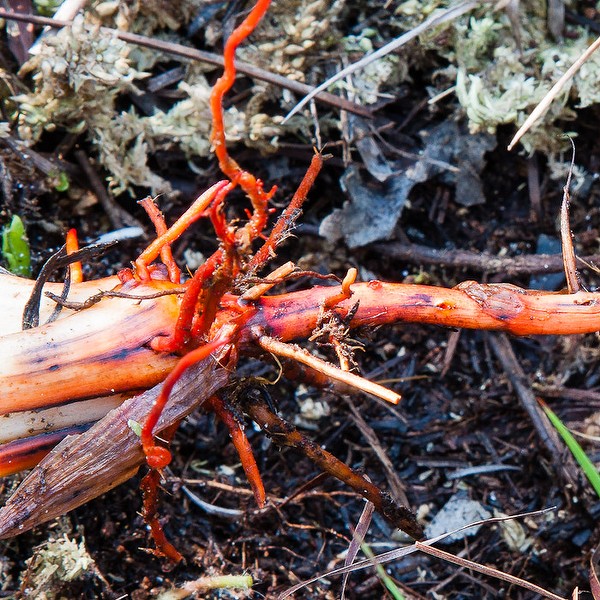
The term redroot is apt, as the subterranean underpinnings are bloody.  The red bleeds readily into oils and ethanol, meaning that people have used the stuff easily.   William Bartram and other 18th Century observers encountered Native Americans using an oil extract as tinted hair oil.  (I’ve had students who look like they do too.)  The red serves also as fabric dye, which I could have discovered personally, as my right thumbnail remains red long after handling the roots.  Easily extracted plant products have a way of winding up in homeopathy, which is true of our plant.

Bad for white pigs but okay for black ones? What do the feral hogs think? (By JB)

Why would a plant pack its roots with red stuff?  I do not know how important the actual coloration is.  It could be a  sort of warning coloration—“hey, pigs don’t  munch these poison roots.”  The plants are reputedly tough on livestock, including a much-repeated, but unsubstantiated, report that the roots poison white pigs but not black ones.  It turns their bones red!  There could actually be something to it, because there are hints of the toxins causing photosensitivity, so maybe black pigs have natural sunscreen.  Or then again this is all coming from some iffy sources and may be hogwash.  (I’d love to know the dietary attitude of feral piggies to Redroot roots.)

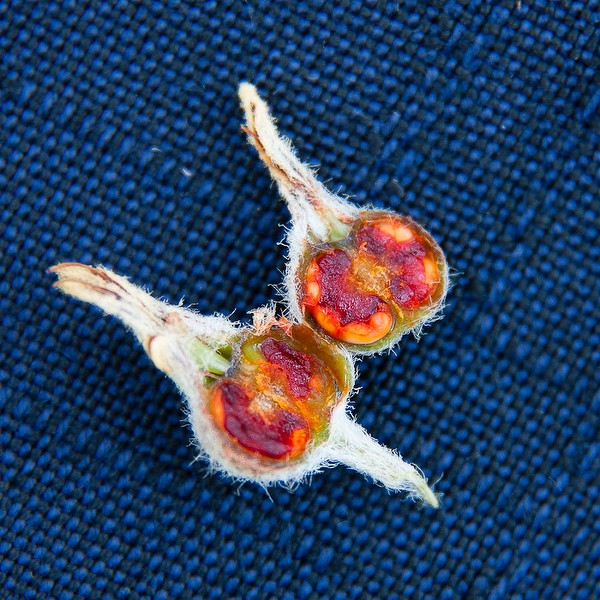
What is more fascinating about the red material, which seems to be a chemical blend, is that the other big concentration is in the young fruit.  What does the young fruit have in common with the root?  Both are starchy regions the plant may defend from hungry varmints.  Cut across an immature capsule and it glows red like rubies.  Really, try it.  (You will get red fingers.)  The red part is not the seeds,  but rather a massive swollen exaggerated placenta, which is the organ to which seeds are attached.  (Technically, a portion of the seed attachment itself may contribute to the red mass.)  Mammal placentas are big and red, but why would a plant have such a thing?  I think the placenta is a big red poison pill.  The main compound reported from it is a toxin called lachnanthocarpone.  As the fruit ripens the redness fades.  The mature fruits are ugly dry capsules crowned with persistent sepal tips.

The young fruit is a box of rubies. The red part is (mostly) the placenta. The seeds are yellowish. (By JB)

Evidence that dispersal is mostly by flotation, at least in some regions, is that in northern portions of the range Redroot spreads through physically interconnected water systems yet is absent from apparently suitable habitats without flotation access.

Speaking of the distribution, the range is bizarre, from Cuba to Nova Scotia.  Despite what I just said about floating, a spotty linear north-south range implicates migrating waterfowl as translatitudinal movers and shakers.

Redroot is not prominent garden-wise, but it is cultivated occasionally, including in Europe, with an eye to its wetland proclivities.  Commercial availability is low, although the Florida Wildflower Growers Cooperative offers the seeds.  CLICK

 
1 Comment

Posted by on July 3, 2012 in Carolina Redroot


Tags: , , ,

Water Lilies are Ungrateful

White Water Lily

Nymphaea odorata

Nymphaeaceae

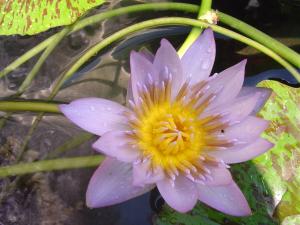
Billy, John, and George hit the Haney Creek trail in Stuart for a third time in three weeks, and this week’s featured species is selected on the basis of smellin’ good: White Water Lily.   And it is as pretty as it smells.    Everybody has spotted this beauty at times in pondy places.

Before going on, it is relevant re. our recent blogs to re-mention hybridization.  Our species reportedly hybridizes with the native yellow “Mexican Water Lily,” Nymphaea mexicana.  Most of the garden Water Lilies are in fact hybrids.  Criss-crossing Nymphaeas was an institutional project of the Missouri Botanical Garden in St. Louis for decades.

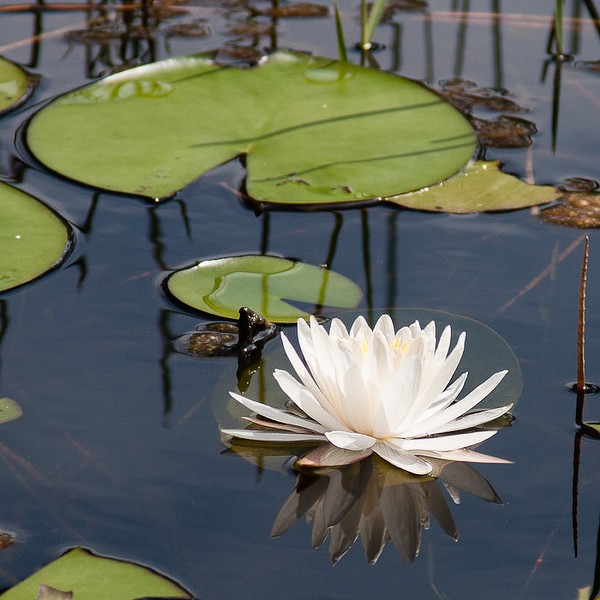
Water Lily at Haney Creek this week by John Bradford

These are primitive flowering plants by certain measures.   Many plant enthusiasts are familiar with the split partitioning most flowering plants into two huge subgroups, the Monocots and Dicots.   The Water Lilies predate that fork in the road, and thus are neither Monocot nor Dicot.  Those big blossoms have leafy-looking parts, and they are the only flowers I know to commit pollinatoricide.  They kill their pollinators?  Sad but true.

When a Nymphaea flower opens it has at its center a pool of liquid surrounded by a wall of vertical stamens, like a backyard pool with childproof fence.  The stigma waits at the bottom of the pool.  An insect visitor splashes in and perishes, the pollen washing off its body sinking onto the stigma.  After that, the  stamens bend inward, covering the pool and releasing pollen.  At this point a different visitor is merely dusted with pollen and spared to fly away dusted pollen-wise and go plunk into  the pool of a different flower in its open-pool gotcha phase.  Nature is cruel.

Our examples of open-pool and closed-pool flowers are not actual Nymphaea odorata, but they play one in our blog.  It was either wade out there and shoot the real thing or use a nice dry hybrid substitute. We are wimps.

Proxy hybrid Nymphaea in the deadly open-pool phase.

After pollination, the twisty floral stalk retracts, pulling the fertilized flower down below harm’s way for the fruit to mature. The weirdness continues: inside the fruit the seeds become encased in an aril (extra seed-cover).   Apparently (and I am not certain) the aril is a temporary float, causing the seeds to surface and drift away to sink out of the competitive radius of the parent plant.

Nymphaea classification is difficult.  Beyond hybridization, environmental conditions influence the sizes and forms of the plants.  Several dubious and controversial varieties of Nymphaea odorata have thus had their moments in Florida floristics.  The overall distribution of the species is from Newfoundland to Texas.  One big widespread plastic variable species.

Nymphaeas have huge roles in ethnobotany.  It is intriguing when a species or set of related species with similar bioactivity turn up having the same uses in geographically separate cultures.  Nymphaeas are psychoactive (with a little controversy on that point), as well as sources of edible starch, and had probable narcotic applications at least in ancient Egypt and in pre-European Mayan culture.  The period artwork from both civilizations is eerily similar with respect to Water Lilies.  If you watch the History Channel, of course you realize how aliens with a penchant for intergalactic species introductions shared the cosmic gifts with both Earth-civilizations while out universe-hopping.   Take us to your pollinator!

Proxy hybrid in the pool-closed pollen-releasing phase.

 
5 Comments

Posted by on June 27, 2012 in White Water Lily


Tags: , , ,

Sabatia grandiflora, about as pretty as they come

Rose-Gentian

Sabatia grandiflora

Gentianaceae

Yesterday Billy, John and George visited the Haney Creek Trail near Stuart.  The site is a scrub-lover’s (and dog-walker’s) delight enhanced aquatically with borrow pits, ponds, marshes, creeks, and mystery regions to reconnoiter.

We squished through a flowery marsh which reinforced an old perception.   Now please understand that this perception is a figment of my imagination.  Sometimes wildflowers seem to cluster by color.  A person could make up a reason:  maybe if certain pollinators in a habitat naturally prefer or become “trained” to the color of the predominant flower, other flower species horn in on the action by mimicry.  As a comparable retail scenario,  everybody knows what a Coca Cola can looks like.  Some coke knock-offs use a similar color scheme and fancy-curvy script.  (It would take a little contortion to “floral color mimicry” in terms of evolutionary adaptation but it could be done in a more rigorous blog.)

Floral color mimics (photo borrowed from the Internet)


Possibly different species with similar rose-colored petals add up to a big collective pinkish attraction for pollinators who prefer that color, just as several shoe stores in a mall collectively draw those shoppers seeking footwear.   Who knows?  This is my daydream so I can imagine whatever I dang well please.  Yesterday the wet center of the marsh was all yellow:  Elliott’s Xyris, Yellow Polygalas, St. Johnsworts.  (Okay, the Carolina Redroot flowers don’t quite qualify as yellow but it has a lot of yellow in it.)

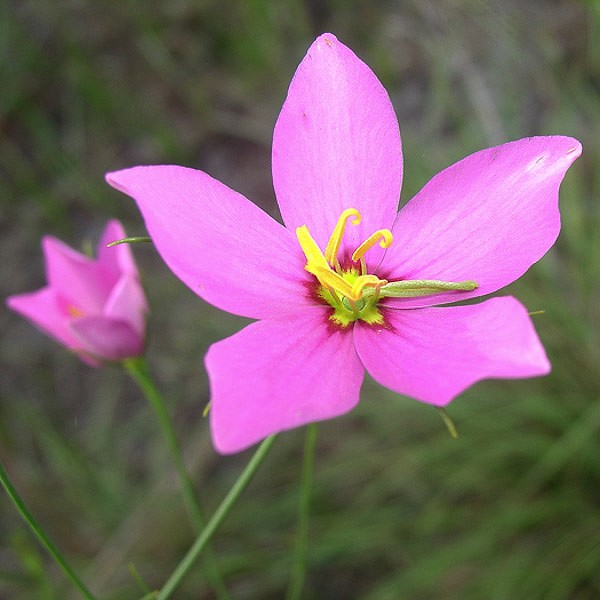
Sabatia grandiflora. The bright yellow pollen-bearing anthers are in the flower center. The two green stigmas are twisted together temporarily sidelined on the right. The flower will need that yellow eye to still imply “yellow pollen” when the yellow anthers fall away as the flower shifts to its female phase. (Photo by JB)


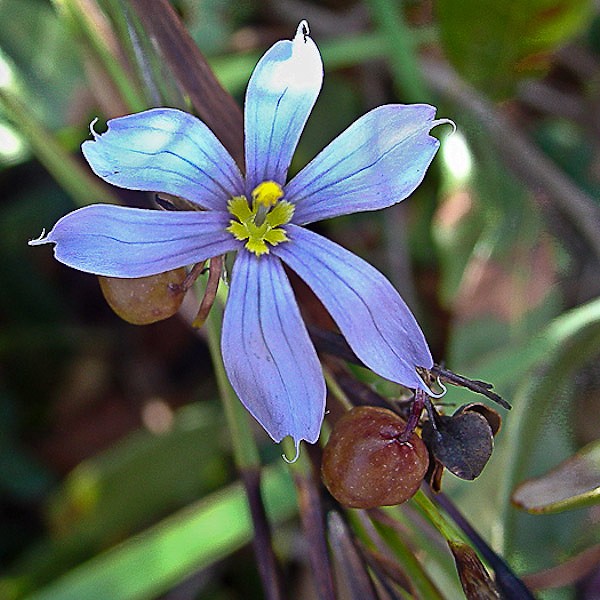
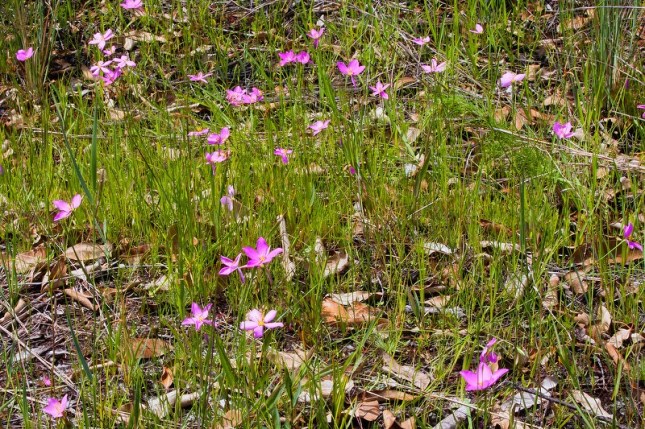
By contrast, the marsh fringe was predominantly pinkish-rosyish:  Meadowbeauties,  Rosy Camphorweed,  Rosegentians (also called Marsh-Pinks).   The last-mentioned were the stars of the show.  These shocking  pinkies (Sabatia grandiflora) were so abundant and crowded they looked like a flower garden, but better, being wild, natural, un-tended, and un-intended.  The petals are power-pink with a jagged yellow central eye rimmed with red.  To linger annoyingly on my daydream of  “floral color mimicry,”  similar starry yellow eyes peep from unrelated flowers.  For instance,  enjoy John’s photo of Sisyrinchium xerophyllum.

Sisyrhinchium xerophyllum (by JB)


Floral beauty runs in the Gentian Family,  with several species of Sabatia and other Gentians in Florida.  Our Sabatia is so purty can you cultivate it in the garden?   Not so readily.  This is a wetland annual.

Another question, how do you pronounce the name?  Some pronounce it as “seh-BAISH-ah.”   Let me suggest, contrarily, saw-BAT-ee-ah, given that the namesake is Italian botanist Libertus Sabbati, not a dermatological cyst.

That today’s species is an annual fits its shallow water lifestyle.  It scatters tiny seeds (with pitted surfaces, as in many wetland species), setting the stage for seedling opportunism where the moisture level and other critical factors may be hospitable at the moment.  A perennial lifestyle would less nimble keeping up with rising and falling waters.   If there was nothing else to do, I’d map the position of the Sabatia patches (and associated pinkish flowers) around a marsh relative to water levels one year and then repeat that comparatively  in following years.   But then again, the boss wouldn’t regard Sabatia mapping as a priority.  (Meetings are such a fruitful use of time.)

Sabatia changes sex dramatically.  The flowers are male first.  Look at John’s beautiful picture of the male phase with the stamens all yellow and assertive;  the stigmas bend off to the side twisted together demurely out of action.   Soon, however, the anthers fall way and the stigmas separate, rise, and take charge.

 
4 Comments

Posted by on June 20, 2012 in Rose-Gentian


Tags: , , , , ,