
Catbriars
Smilax species
Smilacaceae
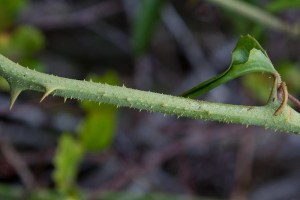
Ouch! (by JB)
How did it get to be back-to-school time? Clanging schoolbells thwarted this week’s Friday botanizing. Before the rude interruption John and I were tangled up in Smilax (Catbriars). You don’t get far in a Florida natural area before discovering these. The late garden writer Sara Stein, in “My Weeds” displayed a negative attitude toward them:
“How can I explain how horrible catbriar is? It trips the feet and rips the skin…Its rhizomes are like steel cables. They can’t be pulled up…Some pieces have been six-footers, and yet both ends were broken from the mother rhizome I will never reach.”
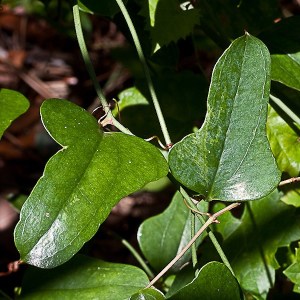
Smilax auriculata by JB
That mother rhizome can be as big as your arm, a real whopper. No typhoon or fire is going to discourage that nugget of life. But how about hungry hogs? One of our species, Smilax bona-nox reportedly has prickles on the rhizome (at least sometimes—the species is variable). This adaptation possibly evolved in the natural range of wild peccaries and thus was pre-adapted to deter feral hogs, perhaps. It would be fascinating to know if the prickly rhizome has affected the distribution and abundance of S. bona-nox relative to the piggy-wiggies who root and snoot hereabouts. To repeat for emphasis, however, the prevalence of prickly rhizomes in S. bona–nox is unclear—not the sort of thing botanist observe often.
Sara Stein didn’t like Smilax, but thirsty cowboys did when they passed on the whiskey in favor of a nice refreshing sarsaparilla. Maybe those cowboys needed it for personal reasons: one of the early uses of sarsaparilla was to treat syphilis. Different species of Smilax historically have wound up on dinner tables quite a bit: the rhizomes as pseudo-spuds, as flour, as a natural jello, and as stand-in for asparagus.
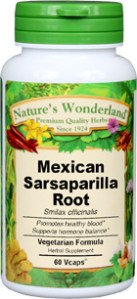
Is munching Smilax is a good idea? That the genus has a history in medicine is a sign of bioactivity, and bioactivity is a sign of potential consequences. Smilax is sufficiently neurotoxic to be a potential treatment for seizures. As sarsaparilla it served to alleviate rheumatism. Some species yield steroid precursors. So when we go walk the garden path, please don’t hand me a Smilax tendril to nibble (unless I’m having a seizure).
Botanist John Mitchell provides recipe for Smilax aphrodisiac some readers may wish to try:
- Smilax roots
- One white hot nail
- Coatimundi penis
Chill the mixture for a week and take a teaspoon a day. (Let me know how it works.)
Smilax is the Monocot twin to Dicot grapes, right down to the tendrils and fruit clusters. They are related to Lilies, and the flowers look like tiny Lily flowers. They don’t smell so great though — an older name for the genus is Coprosmanthus, meaning “dung-smelling flower.” Of the dozen species in Florida, those encountered in the area of TC Natives are Smilax auriculata (very common, leaf blades usually with basal lobes, the leaf margins not bony, the midvein beneath the leaf jutting out similarly to the side veins, the female flowers with 2-3 stigmas), S. bona-nox (mnemonic: bona-nox has bony leaf margins), S. laurifolia (leaf usually narrow with the base unlobed, the midvein beneath the more prominent than the side veins, the female flowers with just one stigma), and S. tamnoides (bottom half of leaf margin with prickly little teeth). Good luck! The leaf shapes are dismayingly diverse within species.
Note: The cartoon is by Ding Darling.

 John Bradford
 George Rogers
 George Rogers
 Dee Staley
 Treasure Coast Natives