RSS

Tag Archives: Peck’s Lake

Christmasberry, Wolfberry, Goji Berries

Lycium carolinianum

Solanaceae

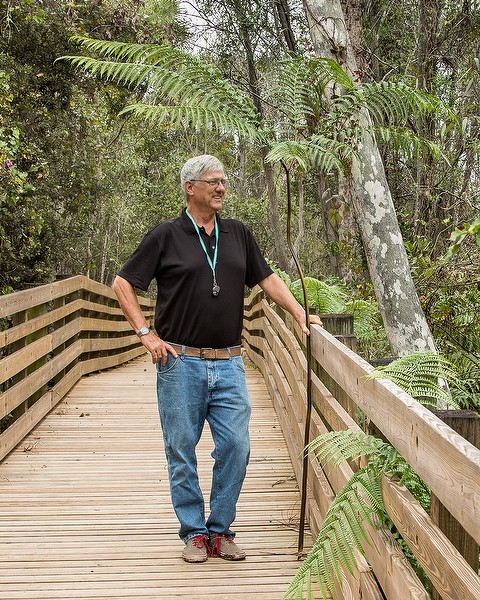
Friday John and George swatted mosquitoes in the mangrove swamp by Peck’s Lake near Hobe Sound, FL. We celebrated the season with Christmasberry in one of its favorite habitats, the smelly briny mangrove marl. The Mangrove Tree Crabs enjoyed the rain, scampering up and down the branches like mouse-sized nightmare spiders.  An invasive fern the size of a human, Giant Brake (Pteris tripartita) looks primitive in the swamp.
pteris

This fern is an oversized weed. It looks much like Bracken Fern. (By John Bradford)

That Christmasberry grows in wet saltwater habitats is interesting, given that its relatives, some 80 species of Lycium, tend toward dry deserty lands all around the world.   Salty is “dry” in a physiological sense, thus not a big jump from arid to mangrove swamp. Another “dryland” plant, a standard in Florida scrub, skipping to mangrove habitats is Hogplum, Ximenia americana.
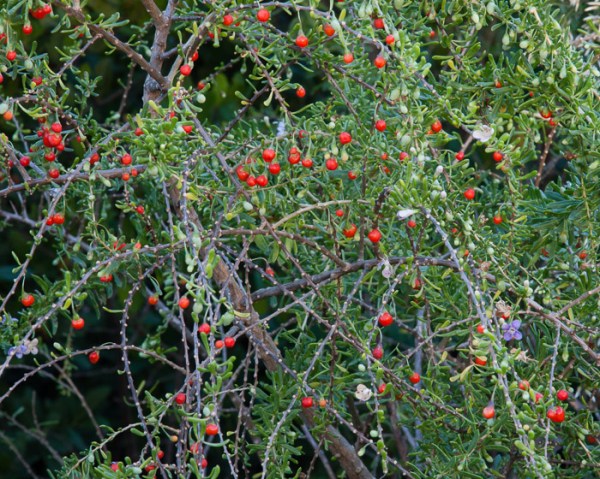
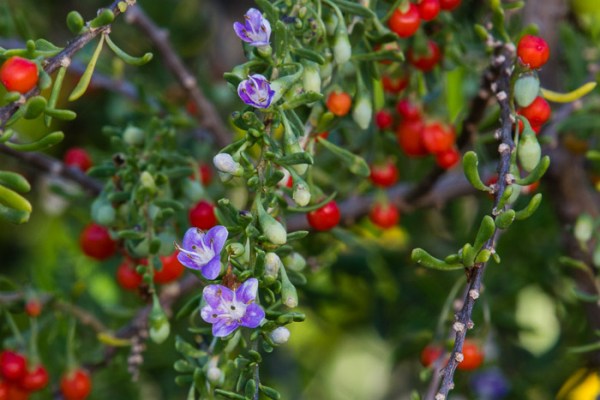
Christmasberry (this and the close-up below by John Bradford)

Christmasberry (this and the close-up below by John Bradford)

Useful plants comfortable in saline soils raise eyebrows as potential crops in a hungry world with rising soil salinities.   Christmasberry crops you say?

Lycium species have bushels of uses, none of them blockbusters, yet worth a second look. Some benefits are ancient, some maybe in the future, and some here and now. Gogi berries from Asian Lycium species are a dietary-health fad. Goji history goes back just about forever, in teas, foods, and medicines.

I dislike enjoying nature by eating it!   Love that yummy blackened scrub jay with goji sauce! Are Christmasberries edible? Yes, no, maybe so.   They have been on the menu for a few thousand years.   At the same time, Lycium represents the druggy Potato Family, related to deadly nightshade, datura, henbane, and other witch’s delights. Reports of Lycium poisoning exist.   So please don’t eat the Christmasberry, even if other web sites urge us onward. Not much of a temptation, really, because they taste bad. The berries contain bioactive alkaloids to help explain Lyciums in ethno-remedies.

Looking into the ethnobotany of Lycium, applications against toothache are repeated abundantly and transcontinentally. Lending some credence to that, the Potato Family has long comforted civilization with pain-reducing extracts. So if Mr. Toothache visits, mash a soothing Christmasberry into the cavity, and e-mail me the result.
lycium 2

Maybe the greatest Christmas gift is to wildlife.   As the human-nutritional literature attests, goji berries bear good things for life, including fatty acids which may explain their service as dried fruit on a string.    Fatty fruits are power-packed fuel for migratory birds, and Christmasberry propels some of the biggest, longest-distance migrators of all, cranes, including our friendly Sand Hill Cranes. Far more-studied, Christmasberries can sometimes account for over half the early-winter energy budget for Whooping Cranes in South Texas, “snowbirds” down from as far yonder as the Yukon, arguably the rarest, most charismatic, magnificent and iconic endangered birds in North America. These avian jumbo jets with 7-foot wingspans need a lot of fuel.

 
8 Comments

Posted by on December 19, 2015 in Uncategorized


Tags: , ,

Orange-ya Glad for Wasps, Bats, and Potatoes?

Two Leaf Nightshade (Twin Leaf Solanum)

Solanum diphyllum (FL Exotic Pest Pant Council Cat. II invasive exotic)

Solanaceae

Today John and George enjoyed the mangrove swamp at Peck’s Lake near Hobe Sound, a short boardwalk long on biodiversity, including wasps.  We had one of those wasp experiences I sorta like—wasps can be our pals.   (Stockholm Syndrome.)  We somehow riled up the hive, and 133 (I counted) wasps stormed out with gusto and buzzed our heads in a friendly but earnest warning.   We took the hint with equal gusto, and nobody got hurt.

All plant photos today are Solanum diphyllum by John Bradford.

All plant photos today are Solanum diphyllum by John Bradford.

As I arrived at the parking lot, John was already photographing the plant of the day…Two Leaf Nightshade, a member of the genus Solanum, with several additional species in Florida, including spuds.  With odd mismatched leaf pairs and highway-worker-vest orange fruits in pretty clusters, Solanum diphyllum gathers a lot of “likes” on its Facebook page.  You could spot those clustered little oranges from a helicopter.

John was shooting this photo as I arrived on the scene, July 18 at Pecks Lake.

John was shooting this photo as I arrived on the scene, July 18 at Pecks Lake.

The species is native to Mexico and Central America, and like a good weed (and as a garden species) it is scattered elsewhere in the warm climate world, maybe with a helping hand from Global Warming and gardeners in addition to wild creatures.  Today’s invasive exotic decorates the shores of the Intracoastal in Hobe Sound and likewise decorates the shores of the Nile in Egypt, where it fascinated Egyptian biologist Fatma Hamada of the South Valley University  as much as it fascinates us.  Hamada’s 2013 doctoral dissertation is a monograph on Solanum diphyllum, looking into everything from its beautiful internal anatomy to its cytotoxicity against human cancer cell lines. (so, no, those fruits are not for us to eat).

The "orange blossoms"

The “orange blossoms”

One of her findings was particularly intriguing.  Many plants of arid or salty places protect themselves from drought and salinity by accumulating extra dissolved materials in their tissues.  This is true of our Solanum, and here’s the good part: adjustably.  Apparently, and in need for more research, the plant build ups anti-drying compounds when dry, and later secretes the stuff from the leaves when dry times abate.  Maybe.  Another “maybe” is what seem to be patches of natural “sunblock” embedded in the leaf surface.  This little weed has some stuff goin’ on!   Now back to those fruits oranger than an orange.  Univ. of Miami bat expert Dr. Theodore Fleming described (citing earlier work in South American tropical forest) bird-dispersed fruits to be mostly white, black, red, blue, or purple in contrast with mammal-dispersed fruits predominantly orange, yellow, brown or green.  (Please no e-mails:  These are broad perceived trends—with overlaps and exceptions.)

So is Solanum diphyllum mainly a mammal berry?   Probably, although its dispersal in Florida with almost no fruit-eating bats implicates helpful birds and maybe a quadruped or two.  Research in the shrub’s native Mexico proves fruit eating bats to carry the seeds, not necessarily to the exclusion of birds or others of course.  Quibblers may raise a hand, and say, “bats are blind as a bat, so ixnay on the orange uit-frays.”  But recent research reveals increasingly sophisticated vision in bats, including living color.  Here is a quote (2001) from bat biologists Jorge Ortega and Ivan Castro-Arvellano on the Jamaican Fruit Bat widespread in the native haunts of the Two Leaf Nightshade:  “A. jamaicensis uses vision and olfaction to find fruits with brilliant colors and strong odors.”  By the way, bats don’t like getting tangled in twigs at night.  Note how the fruit clusters are presented for EZ access. Now back to Egypt, where as we already know, the Nightshade grows up and down the Nile.   Guess what was first discovered at the Great Pyramid of Giza, and flutters nocturnally up and down the Nile (and far beyond).   The Egyptian Fruit Bat.   Could it be that the corresponding Nile distributions of the Solanum and the bat are mere coincidence?   A connection might seem tempting to contemplate if Egyptian Fruit Bats go for orange-colored fruits.  Who knows?

Egyptian Fruit Bats at the midnight buffet. (From animal.memozee.com)

Egyptian Fruit Bats at the midnight buffet. (From animal.memozee.com)

 
15 Comments

Posted by on July 19, 2014 in Two Leaf Nightshade


Tags: , , ,

Rubbervine Among the Mangroves

Rubbervine

Rhabdadenia biflora

Apocynaceae

Peck’s Lake, which is a part of the Intracoastal between Hobe Sound and Stuart is a popular fishing hole, and on the shore is a boardwalk providing comfy passage through swamp then mangrove jungle, past a shell midden, and onward to the salty shore with an observation dek to watch the boats go by. The species along that transect are plentiful, including magnolias, mangroves, and mastics. And porpoises, said hello as we stood on shore. All three mangrove species along with their friend Buttonwood were in flower.

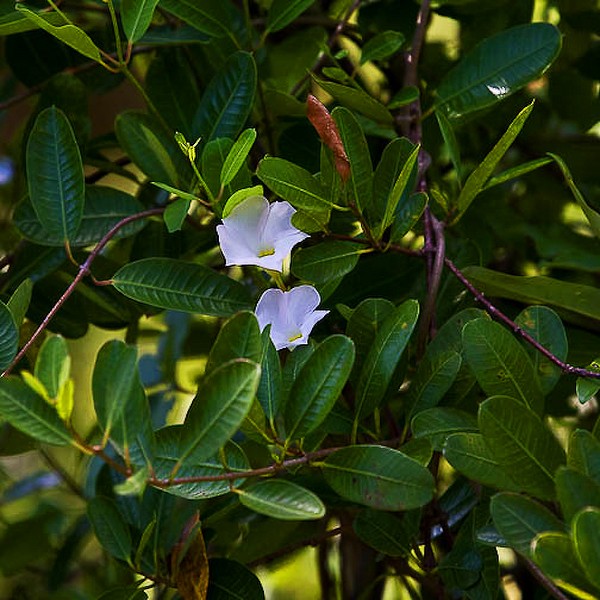
Rubbervine at Peck’s Lake, Florida. (This and all photos today by John Bradford.)

The showpiece was the pretty Rubbervine, or Mangrove Vine, with its large white blossoms scattered all through the White Mangrove zone and spilling over onto the boardwalk.

Why a vine would select mangrove stands as its main domicile is a question to ponder. Perhaps that’s a select opportunity for the “right” vine where the brackish conditions suppress competing twiners and climbers.
OKAY then, why can this particular species thrive there in the brineland? As a broad speculative possibility, it is a member of the tough Dogbane Family, the Apocynaceae, which tend often to tolerate harsh living, thin nasty soils, blazing sun, and, probably most importantly, dryness. But a mangrove stand isn’t dry, is it? Well, yea, physiologically dry, with a saline soil. Osmosis you know. So maybe standing up to that sun and salt is in the vine’s family tree. The flesh drips white milk when broken. The toxic latex is generally regarded as a feeding deterrent, but I’ve always wondered if the latex, found commonly in Apocynaceae, also helps with all that dryness we’ve been fretting.

Rubbervine and other Apocynaceae are larval host to various sphinx (hawk) moths, who drink themselves nasty on the poisonous plant sap. They proclaim their toxicity with bright warning coloration.

The blossoms are showy, the fruits are mildly weird, and the seeds are even weirder. Starting with the flowers, they are presumably pollinated by sphinx moths, given that they are standard “moth” flowers, white with a long narrow tube penetrable by little other than the long mothy proboscis.

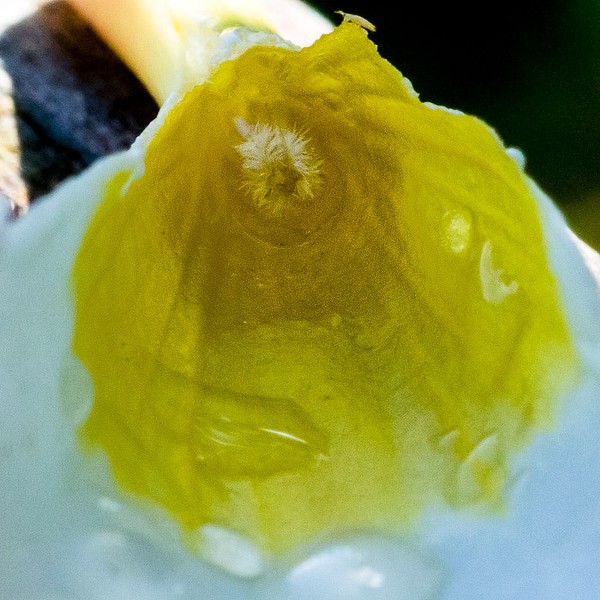
The gate at the flower throat.

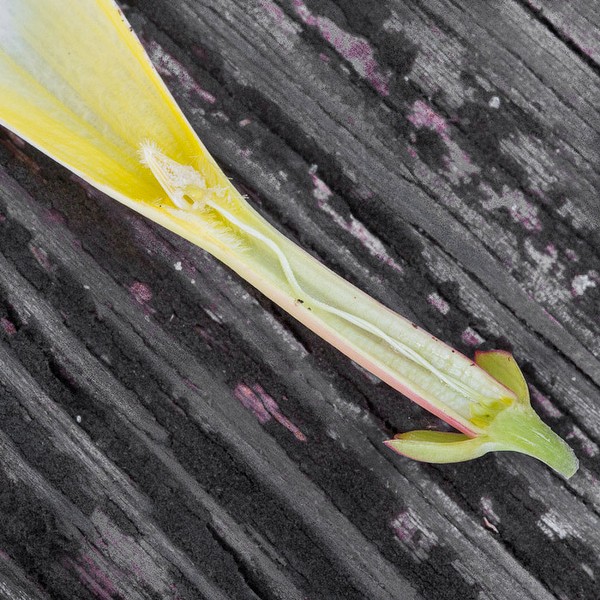
Being members of the Apocynaceae, the flowers have a particularly noteworthy family characteristic. They are more or less funnel-shaped, and just at the point where the funnel narrows a “cap” made of five anthers pressed together edge-to-edge blocks the way. (A little reminiscent of a folded paper cootie-catcher if you are old enough to know what the heck I’m talking about.) You need a long fine needle to get between those anthers and poke deeper into the flower, a great gatekeeper for allowing a proboscis probe while thwarting “nectar thieves.”

It gets weirder. The stigma (pollen receptive surface) sits immediately under the anther- cap. The stigma is in the shape of a can on a stick (the stick is the style, a narrow stalk). The business part of the can-shaped stigma is the underside of the can, the bottom end. When a proboscis probes the flower, pollen is scraped off during proboscis removal, as it slides out. The Apocynaceae are the only plants I know with scrape-pollination on the bottom of the stigma.

Flower slit open to show the anther cap (the cone) at the throat. The stigma hides under the cap. The long thread is the style.

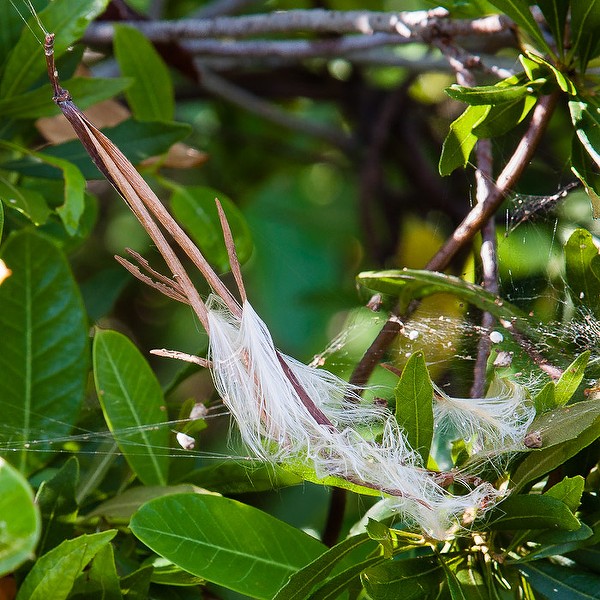
Then come the fruits resembling perky paired beans. Apocynaceae fruits generally come as twins, like bunny ears. Some readers may have observed this in Frangipani or Madagascar Periwinkle. The pods open to release seeds that look like quill pens. Each seed is two inches long counting the poofy quill. The body of the seed is a long (maybe an inch) heavy torpedo, which open landing penetrates the thick mangrove stand vegetation all the way down to the mud. How many wind-dispersed species do you find in mangrove stands? It’s a pretty good system, allowing the vine to spread through any given stand and to hop to another. It would not be hard to imagine the silky parachute clinging to the landing gear of a bird for those long hops.

Pod releasing seeds

 
1 Comment

Posted by on July 17, 2012 in Rubbervine


Tags: , , , ,