Lycium carolinianum
Solanaceae
Friday John and George swatted mosquitoes in the mangrove swamp by Peck’s Lake near Hobe Sound, FL. We celebrated the season with Christmasberry in one of its favorite habitats, the smelly briny mangrove marl. The Mangrove Tree Crabs enjoyed the rain, scampering up and down the branches like mouse-sized nightmare spiders. An invasive fern the size of a human, Giant Brake (Pteris tripartita) looks primitive in the swamp.

This fern is an oversized weed. It looks much like Bracken Fern. (By John Bradford)
That Christmasberry grows in wet saltwater habitats is interesting, given that its relatives, some 80 species of Lycium, tend toward dry deserty lands all around the world. Salty is “dry” in a physiological sense, thus not a big jump from arid to mangrove swamp. Another “dryland” plant, a standard in Florida scrub, skipping to mangrove habitats is Hogplum, Ximenia americana.
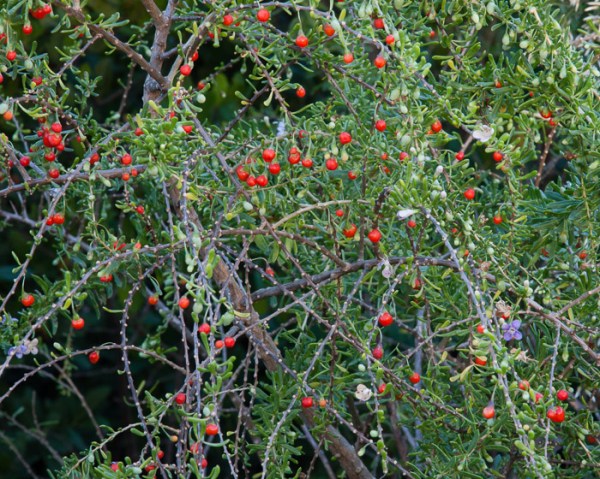
Christmasberry (this and the close-up below by John Bradford)
Useful plants comfortable in saline soils raise eyebrows as potential crops in a hungry world with rising soil salinities. Christmasberry crops you say?
Lycium species have bushels of uses, none of them blockbusters, yet worth a second look. Some benefits are ancient, some maybe in the future, and some here and now. Gogi berries from Asian Lycium species are a dietary-health fad. Goji history goes back just about forever, in teas, foods, and medicines.
I dislike enjoying nature by eating it! Love that yummy blackened scrub jay with goji sauce! Are Christmasberries edible? Yes, no, maybe so. They have been on the menu for a few thousand years. At the same time, Lycium represents the druggy Potato Family, related to deadly nightshade, datura, henbane, and other witch’s delights. Reports of Lycium poisoning exist. So please don’t eat the Christmasberry, even if other web sites urge us onward. Not much of a temptation, really, because they taste bad. The berries contain bioactive alkaloids to help explain Lyciums in ethno-remedies.
Looking into the ethnobotany of Lycium, applications against toothache are repeated abundantly and transcontinentally. Lending some credence to that, the Potato Family has long comforted civilization with pain-reducing extracts. So if Mr. Toothache visits, mash a soothing Christmasberry into the cavity, and e-mail me the result.
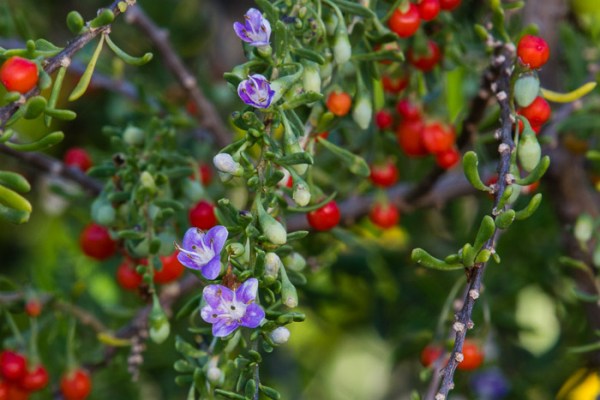
Maybe the greatest Christmas gift is to wildlife. As the human-nutritional literature attests, goji berries bear good things for life, including fatty acids which may explain their service as dried fruit on a string. Fatty fruits are power-packed fuel for migratory birds, and Christmasberry propels some of the biggest, longest-distance migrators of all, cranes, including our friendly Sand Hill Cranes. Far more-studied, Christmasberries can sometimes account for over half the early-winter energy budget for Whooping Cranes in South Texas, “snowbirds” down from as far yonder as the Yukon, arguably the rarest, most charismatic, magnificent and iconic endangered birds in North America. These avian jumbo jets with 7-foot wingspans need a lot of fuel.
 John Bradford
 George Rogers
 George Rogers
 Dee Staley
 Treasure Coast Natives