Ragweed
Ambrosia artemisiifolia
Asteraceae
Isn’t “ambrosia” food of the gods, incarnate here on earth as that marshmallow-coconut-jello salad? What was Linnaeus thinking when he named Ragweed that!?
[On the off-topic of Linnaeus as a naming nut, it amuses me that in the native-plants-in-the-landscape classic, “Going Native,” Richard Workman questioned Linnaeus’s handle “cynophallophora” (dog-you-know-what-bearing) for Jamaican Caper. “Considering all the beautiful and attractive characteristics of this plant, I can’t help wondering a little about Linnaeus and his motivation.” That’s wimpy by Linnaean standards. That D.O.M. was not fit for polite society.]
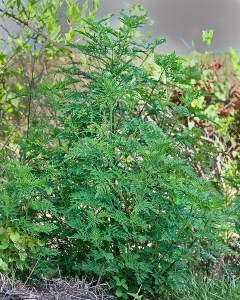
Ragweed in Cypress Creek (by JB)
It’s not exactly divine, but Ragweed is a native weed distributed, get this (!) from Alaska to Florida, and from there globally as an invasive exotic. It loves disturbance. Have you ever seen how Ragweed monopolizes freshly excavated dirt? Among other adaptations, the seeds (achenes) are tiny burrs no doubt carried by anything that moves. And more interestingly, the seeds accumulate in the soil with varied germination times. Some sprout lickety-split, others slumber for decades, just waiting for that road grader. John and George this week hiked the Cypress Creek Natural Area near Jupiter Farms and, after passing by all the pretty photogenic wildflowers, focused on the dominant species. The spoil banks along the graded road are ribbons of Ragweed.
In a fun little book, “My Weeds,” garden writer Sara Stein described a classroom activity called “Magic Dirt” where the children go outside and fill a flowerpot with nice “clean” soil, and place their pot on the classroom windowsill to witness awakening weeds. I LIKE it! The Cypress Creek road banks are Magic Dirt on a macro-scale. Food of the gods for a mile. How long have some of those seeds been banked in the soil? Perhaps their parents caused sneezing at the Battle of the Loxahatchee on more or less the same ground in 1838.
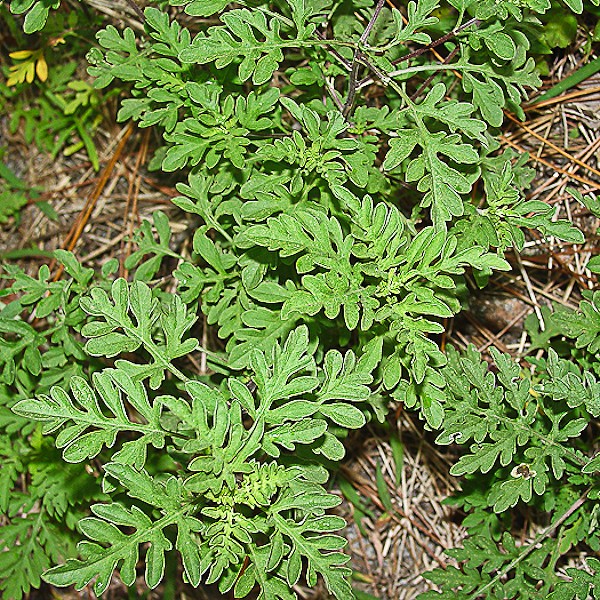
Ragweed babies aplenty (by JB)
That’s the thing we all know about Ragweed, Gesundheit! The plant releases pollen like a fiend. Let’s linger on that a moment, because wanton wind pollination is unusual in the mostly straight-laced insect-pollinated Aster Family.
Have you ever know a human family where one generation builds up a tightly run business, only to have a sloppy subsequent generation let it all go to seed? (This occurred with a vengeance, perhaps literally, in my own family.) Ragweed is the hippie cousin. Most members of the Aster Family have elaborate little flowers with a hyper-specialized pollen-presentation system where first the style pushes a tiny dollop of pollen out of a tube formed by the anthers, and then the style delicately rises and becomes pollen-receptive, all very precise, proper, and timed. In “good” members of the Aster Family those tiny flowers cluster cooperatively into those showy false-flowers of Asters, Chrysanthemums, Dahlias, Daisies, and Sunflowers. So organized, so controlled.
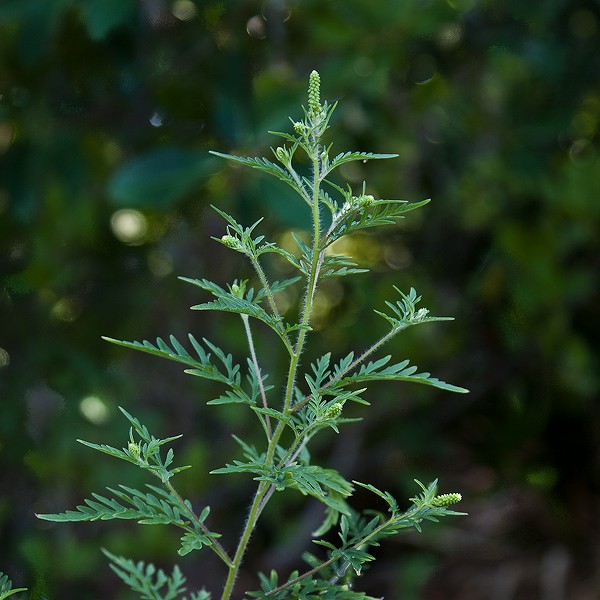
Photo by JB
Ragweed says bah! Ragweed shuns showy flower heads. It spurns elaborate pollen presentation. It repudiates insect pollinators, nectar, and perfumed scents. It scorned Brooks Brothers, put on torn bluejeans, and chose a different path: wind pollination. It thinks it is a grass.
The small Ragweed flower heads look like single flowers, and are arranged in catkins (linear clusters), as in many wind-pollinated plants. The pollen-producing (“male”) flowers are separate from the seed-making (“female”) flowers on the same plant. (Yes, self-pollination can occur on one plant; that way, a single seed can pioneer a whole new population.)
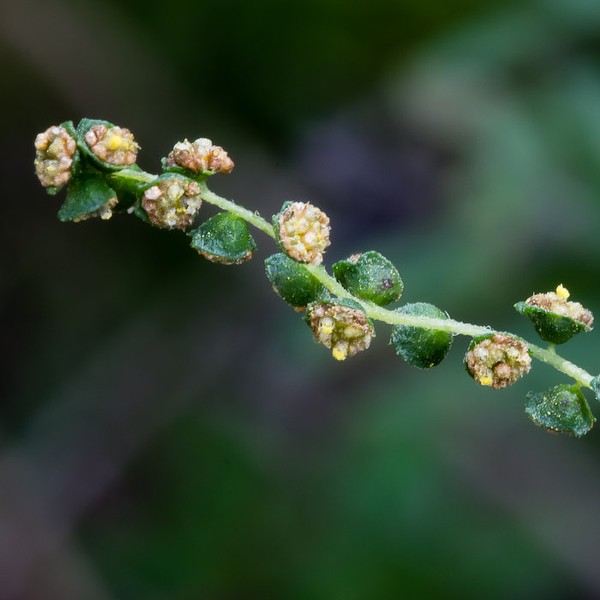
Male flower heads (by JB)
The female flowers are little more than an ovary with two big stigmas jutting out like antennae to catch wind-borne pollen. The male flowers are nothing more than pollen bags.
And that is why Ragweed is so sneezy… it lives to pollute the air. I’ve read that one plant can generate a billion grains. Who’s counting?
And why is air-borne pollen so allergenic? Did you ever wonder how a flower knows which pollen to let fertilize its seeds, and which to thwart? I mean, a female cat knows a male cat, and a female turtle probably knows a male turtle. But flowers are different. The stigma (pollen-receptive surface) has built-in pollen recognition ability. A pollen grain landing on a stigma can release proteins that ask the stigma, “am I on the right stigma”? The stigma can then allow the pollen to perform its function, or kill it. As I suppose speculatively, when pollen catches in our moist sinuses, it releases its recognition proteins (and it has plenty of additional proteins) and asks, “am I on a stigma?” Our immune system recognizes that foreign protein as an antigen.

Linnaeus (stolen from the Internet)
 John Bradford
 George Rogers
 George Rogers
 Dee Staley
 Treasure Coast Natives