RSS

Tag Archives: Kiplinger

Willy and the Dangerous Doodlebug

An Existential Kiplinger Tale

If you wanted to pinpoint something in nature to undermine the theory of evolution, I’d suggest the Doodlebug,  one improbable piece of creation.      As a biologist firmly marinated in evolution, I still scratch my head over how an insect larva could evolve the practice of digging a death pit, sitting in the bottom waiting for ants to tumble in, and then flinging sand on the victims to knock them down into the fatal funnel   I mean come on now, flinging sand!?   I’d like to see the incremental series of evolutionary steps leading to that!  (Do not get me wrong, it happened, and the fact is, today’s insects belong to the large Lacewing Family, with a fierce menagerie of predatory larvae.)

Doodlebugs owe their old-fashioned name to their squiggly wiggle lines in the sand.   They are be better known these days as ant lions, such an apt name.

We did not want to dig one up to its peril, so it was more lion-friendly to provide a link so you can view the hideous microbeast extracted from its conical pit.  CLICK  (And no, we did not plop an ant into a lion’s den.  All events today were purely observational.)   Those jabberwock jaws chomp with injection needles on the inner surfaces to shoot poison into the prey, and to suck out its vital juices.

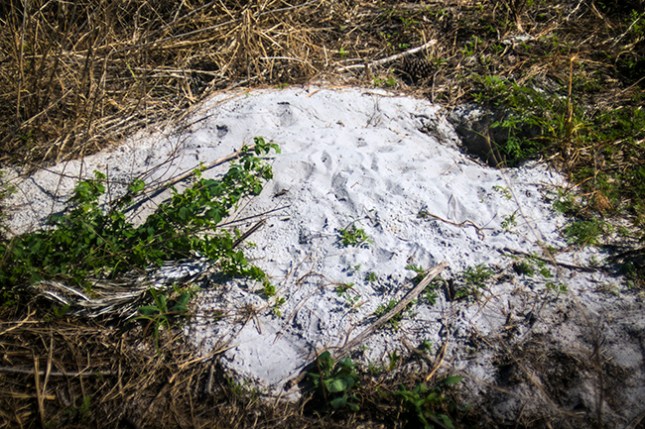
Everyone in a warm dry place has seen the little cones of uncertainty, depending on the species, say an inch deep and 2 inches in diameter in dry sand, often but not necessarily under an overhang.   Surprisingly, the species are quite varied, over 20 in Florida and vastly more globally.
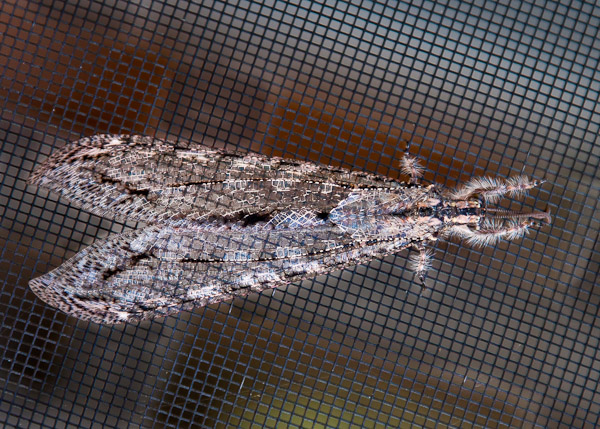
ant-lion-lacewing-vella-americana-small

Adult on John’s screen, by John Bradford

After lurking in a hellhole for months the larvae form spherical cocoons to soon emerge as gorgeous lace-winged adults whose job is to mate and lay eggs in a brief multi-week sexcapades.   They hook up on trees, with pheromones implicated as their match.com.  The adults are nocturnal and go to light,  perhaps drawn collectively to translucent leaves in the gloaming or to moonbeam love beacons?   The light-attraction is key to human-ant lion encounters, as they flutter onto  screens blocking access to the wonderful lights just beyond.

What a pity we don’t sit on screen porches any longer.    We miss a lot of good bugs and all the  nocturnal froggie and katydid audio, not to mention evening porch conversation with trains in the distance. This summer camping in Michigan, the lightning bugs were magical deja vu glimmers of summers before Comcast.

You can now watch the lion-ant battle to the finish John and I witnessed today in Kiplinger.  DOODLE HERE for the action.


5 Comments

Posted by on November 18, 2016 in Ant Lion, Uncategorized


Tags:

Balsam-Pear, Balsam-Apple, Cerasee

Momordica charantia

(“Momordica” comes from Latin for bitten because the seeds look chewed.   Charantia is  perhaps an old name for this anciently cultivated species?)

Cucurbitaceae, the Gourd Family

Friday.   Cool. Sunny. Breezy.  Time to relax and enjoy the Kiplinger Natural Area.  Or cyber-enjoy it thanks to John’s evolving photo-study.   CLICK

A weedy alien vine in Kiplinger has quite a history.   Part of the reason it surfaced as interesting today is a patch by the entrance to a subterranean Gopher Tortoise burrow.   Gopher’s like tasty fruits, such as, well, Gopher-Apple, so today’s “apple” looks like gopher fare to me.  Now I have no evidence that Bilbo Baggins Tortoise put the seeds by his front door of his dugout bungalow.   But the alternative explanation, chance, is no fun, and being an election year, you can choose the truth you like.    I chose the tortoise deposited the seeds in the dooryard.

momoedica-tortoise-burrow

Momordica vine to the left.  Tortoise hobbit hole to the right.

Living in the Caribbean, I came to know it as Cerasee as a valued medicinal tea.   The plant generates nearly every category of plant chemical WMDs, from alkaloids to steroids.   That ties in with ancient and sundry medicinal uses from its original Africa spreading to to India, Tropical Asia and beyond.  Med-apps are far too many to list, although they feature treating diabetes, plus such contradictory extra benefits as aphrodisia and induction of vomiting, hopefully not on the same evening.

Drug-loaded species attract research  attention, in this case in multiple connections including for antibiotics, anti-cancer compounds, and steroidal precursors.  Bitter principles in the fruit confer pest resistance, raising the eyebrows of agriculturists wondering if such defense may be bred or engineered into more vulnerable crops.

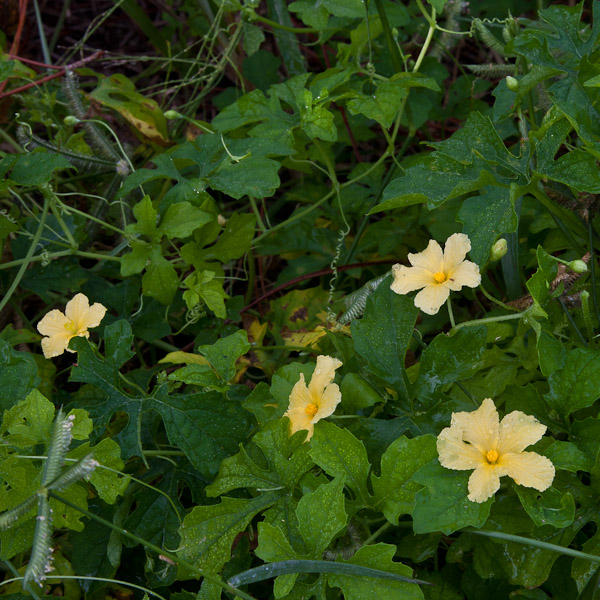
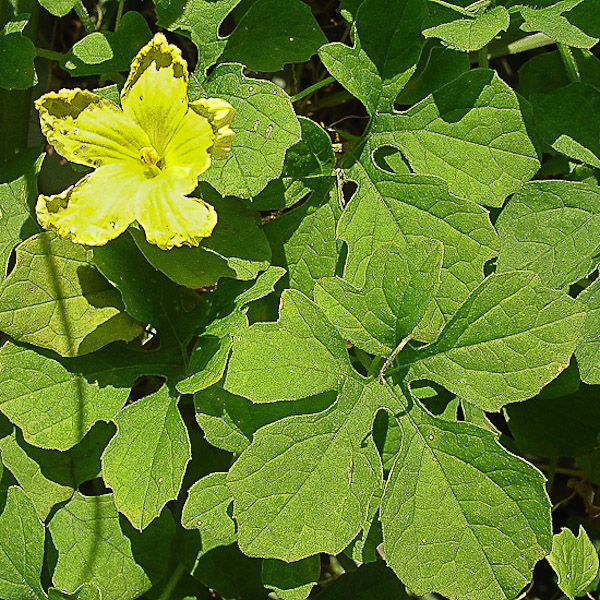
momordica-charantia-4

The flowers.  Todays plant pictures by John Bradford.

So obviously,  do not harvest and consume it.   Rule of this blog:  never eat wild plants.

Cerasee has been a food in the Old World for hundreds or thousands (?) of years.   That may seem odd, given the toxins,  but then again,  as with many anciently cultivated species, folks long ago developed domesticated strains.  The Bitter Melon Karala from India  is an example, and there are several edible Asian cultivars.  The cultivated fruits vary in shape, flavor, and colors from near white or greenish to orange or red.  They range from a  couple inches long as in Florida, to about 18 inches in one or more cultivar(s).   According to research dating to 2004, evidence indicates a single domestication event followed by diversification and dispersal.   All of the cultivated strains differ genetically together from the wild(ish) species.

Sierra Exif JPEG

Remember, the Balsam-Pear encountered growing wild in Florida is not one of the garden types.   How did it get here?  Probably from Africa during the slave trade.  Once on this side of the sea, the red-coated seeds allowed secondary dispersal by animals.  And by people too.

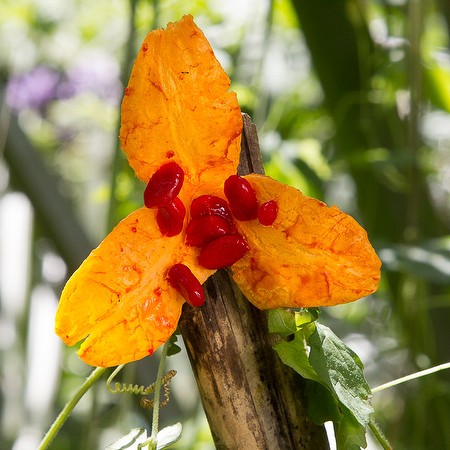
The bitterness of the fruit rind protects the seeds until they are ripe.  Then the noxious fruit opens to reveal the seeds rendered tasty and attractive by a red coating called an aril.

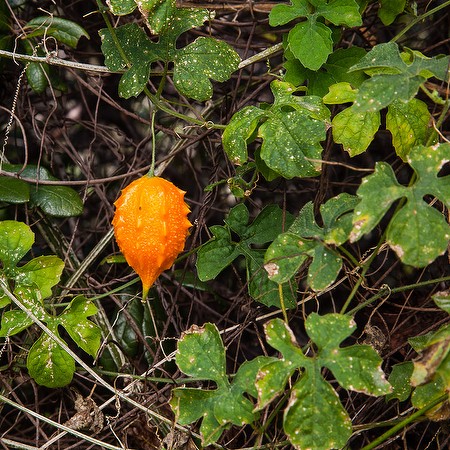
momordica-charantia-5

The orange pod with its bitter rind.

The flowers are unisexual, both sexes on the same vine.  Apparently because the male flowers on the vine can pollinate the females on the same vine, the male flowers mature about two weeks before the females to encourage crossing with other vines before the opportunity for the extreme inbreeding of self-pollination.
momordica-charantia-4-1

The fruit opens to reveal bird-dispersed (and tortoise-dispersed?) seeds with a fleshy red coating (the aril).

So then, back to the tortoise.  They have, I think, a lifespan similar to a human so they need Medicare pharmacy benefits too.   Maybe the tortoise in Kiplinger needed a little tonic tea, or maybe even a little turtle aphrodisia, bringing a few seeds to his sandy Hobbit-tat.

 
8 Comments

Posted by on November 11, 2016 in Balsam-Pear, Uncategorized


Tags:

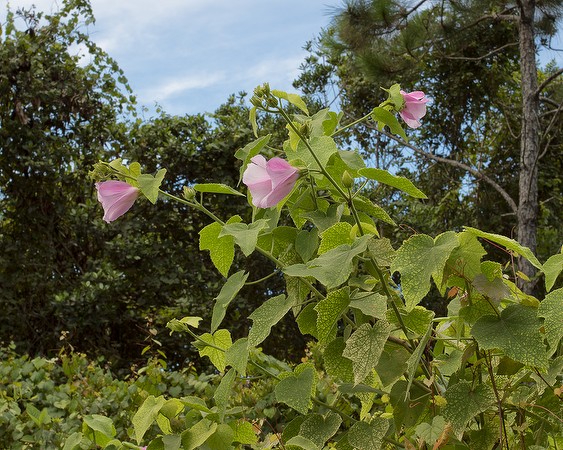
Linden Leaf Hibiscus, Two Species in One Shrub

Hibiscus furcellatus

(Hibiscus is an ancient plant name.  Furcellatus means forked, in reference to the forked “antlers” at the flower base.)

Malvaceae

hibiscus-furcellatus-8

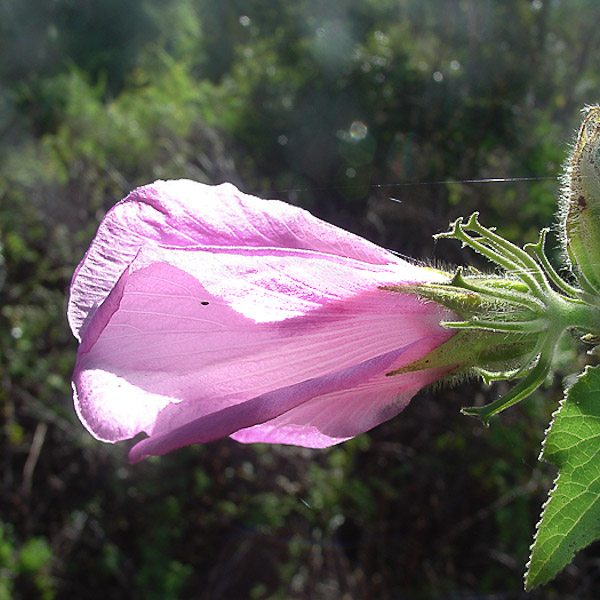
All photos are H. furcellatus, by John Bradford.

One of the showier flowering shrubs around Southeast and South-Central Florida is the Linden Leaf Hibiscus, growing fast, and standing tall with big shocking very-pink blossoms all showy and decorative. The species is almost as ornamental as any garden-variety Hibiscus, and in Hawaii Hibiscus furcellatus is a garden flower, as well as one of the cluster of Hawaiian native Hibiscus species.   It once was widespread in Hawaiian lowlands just as it decorates wet soil Florida.

Linden Leaf Hibiscus has ancient history in Hawaii as a laxative, a nice example of an island culture finding the same use for a species distant mainlanders did, that is, Hibiscus species are sources of laxatives in other cultures.

hibiscus-furcellstus-2

Note the barricaded flower base.  No sneaking in from the south flank!

Native to Florida, and native to Hawaii?  Isn’t that odd?   Yes, but then again the native Hawaiian flora didn’t flow forth from volcanoes.   Hawaiian botanists suspect Hibiscus furcellatus to have arrived by seed drifting on the ocean, probably from Central America.   How far from, oh say, Panama to Hawaii?  Wonder how long that floating pioneer seed was in the brine.

If a seed floated up onto a Hawaiian beach, it would have grown into one lonely plant.    Being solo, there would have been no mate to pollinate it, nor were its natural pollinators handy, but no worries.   Hibiscus species tend toward a self-pollination mechanism as back-up system.  They make vast seed crops in Florida, littering disturbed mud with countless seedlings.    The flowers “look” like they are fundamentally hummingbird adapted, but hummingbirds are sparse locally, so those profuse seedlings must come from bee-visitation, and/or from that self-pollination capability.

hibiscus-furcellstus-6-big

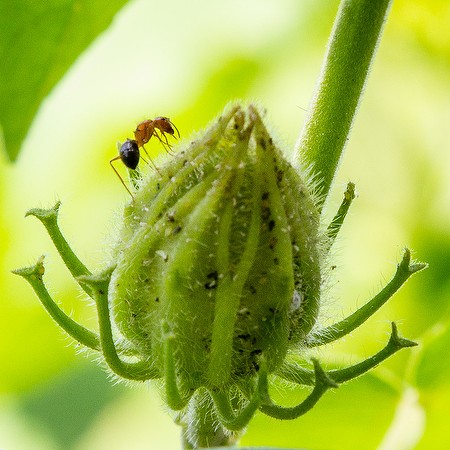
Ant(lers).  Do the barricades protect the bud, or the ant, or the ant food?


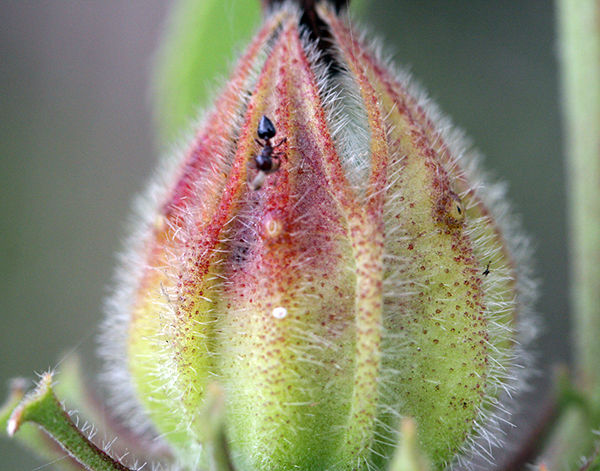
,The flower owes its name “furcellatus” to forked antlers (modified bracts) surrounding the nectar-rich flower base in this and related species.    The antlers look like they block nectar thieves from side-stepping the front and center proper entrance.   And if the branched barricade is not discouraging enough to flank attacks, the outside base of the flower feeds guardian ants from “extrafloral” nectaries.

hibiscus-furcellatus-ant-at-h-furcellatus-gland-3

Ant headed to nectary on flower bud

The early origins of Hibiscus furcellatus are a mystery to ponder.  Our species seems to be an ancient hybrid of two other species, having two different sets of chromosomes, one full set from each of its parents.  That would be like me having a full set of human chromosomes AND a full set of chimpanzee chromosomes.  One Hibiscus furcellatus chromosome set (called G) probably originated in Africa, as tough as that may be to imagine.  There remain on Earth other species having the G chromosome set uncombined with others.   The second chromosome set (called P) probably originated in the New World where there exist a total of four species having the same ancient GP combo, despite the absence of any known extant species with P alone.   Maybe some bored future genetic engineer will separate the two chromosome sets and re-constitute the two ancestral species.

hibiscus-furcellatus-7

Seed capsules

 
5 Comments

Posted by on November 4, 2016 in Linden Leaf Hibiscus, Uncategorized


Tags:

Saltbush

Baccharis halimifolia and local relatives

(Baccharis comes somehow from Bacchus, the god of wine.  Halimifolia refers to a different plant with similar leaves.)

Asteraceaeae


Working in the Kiplinger Natural Area  in Stuart, Florida, today, John and George enjoyed a dozen wildflowers in peak display, so beautiful:   White-Snakeroot,  Bluecurls, Liatris, Coin-Vine, and so many more.     In the garden of native delights is a fall-flowering species with curious attributes,   Saltbush, Baccharis halimifolia.    In our area we have also Baccharis glomeruliflora (flowers in tight clusters) and B. angustifolia (narrow untoothed leaves), representing a widespread genus of over 350 species.

ageratina-jucunda-5

Hammock Snakeroot by John Bradford

For starters,  the distribution of Baccharis halimifolia is odd, with a population in eastern Canada, then a gap of over 400 km to New England, down the U.S., into the Caribbean and Mexico.    This is one widespread plant.   And then some:  it has escaped cultivation or otherwise invaded around the globe, even in the Mediterranean and in Australia, where it is a pest battled with a destructive rust fungus.   The species is not welcome in many places because it accumulates in pastures and is fatally cardiotoxic to some grazers.  I don’t know where the poisons reside, but the leaves have secretory glands probably responsible for protective secretions.

baccharis-haliminfolia-2

Saltbush in bloom  by JB

The individuals are separate males and females (proper term,  dioecious, die-EE-shus).  That’s no biggie,  but the odd thing is, how many dioecious plants have male-female differences other than the flowers?   That is rare in my experience.  According to a USDA publication, the males have longer shoots, softer leaves, faster growth, and earlier seasonal senescence than the females.   Sounds like maybe the males are more “designed” to reach out and scatter pollen, in contrast with females who need more sturdiness and an extended season to make fruits.  Pollination is by wind and by insects.  The small wind-dispersed fruits are on parachutes.

baccharis-haliminfolia-3

Female flower clusters by JB

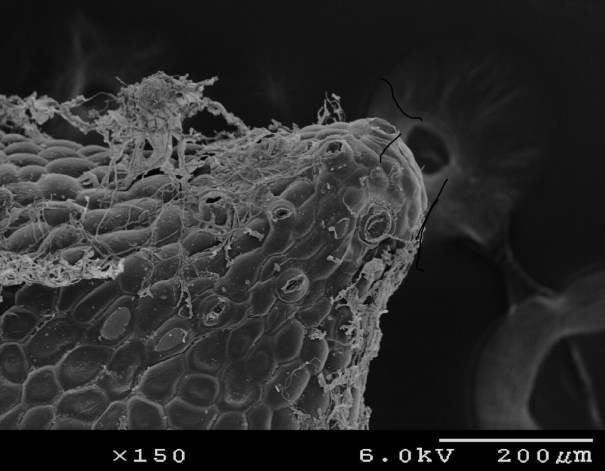
Species of Baccharis have an adaptation sometimes associated with salt-tolerance…water-emitting valves called hydathodes at vein tips.   Hydathodes resemble the drip-emitters used in irrigation, flushing out water and anything in it such as excess salt.

baccharis-hydathode

Baccharis hydathode by Dr.  Bob Wise, Univ. of WI Oshkosh, with permission. Scanning electron microscope view.
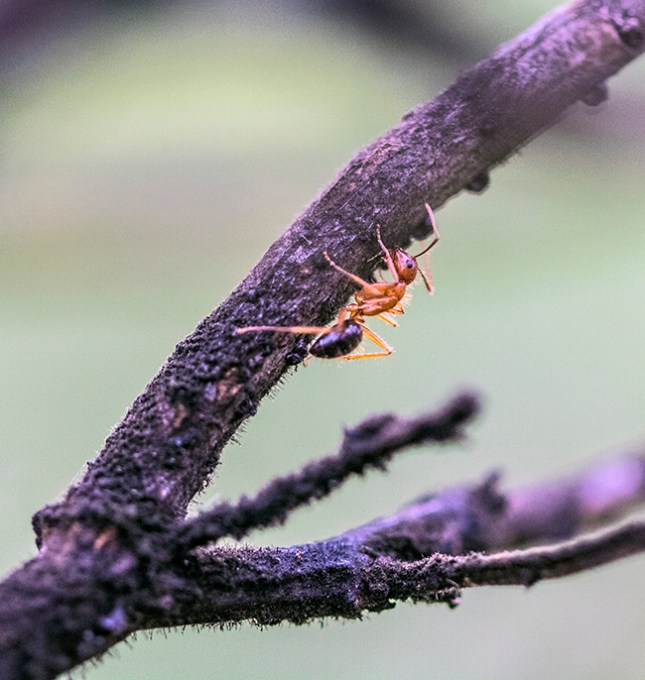
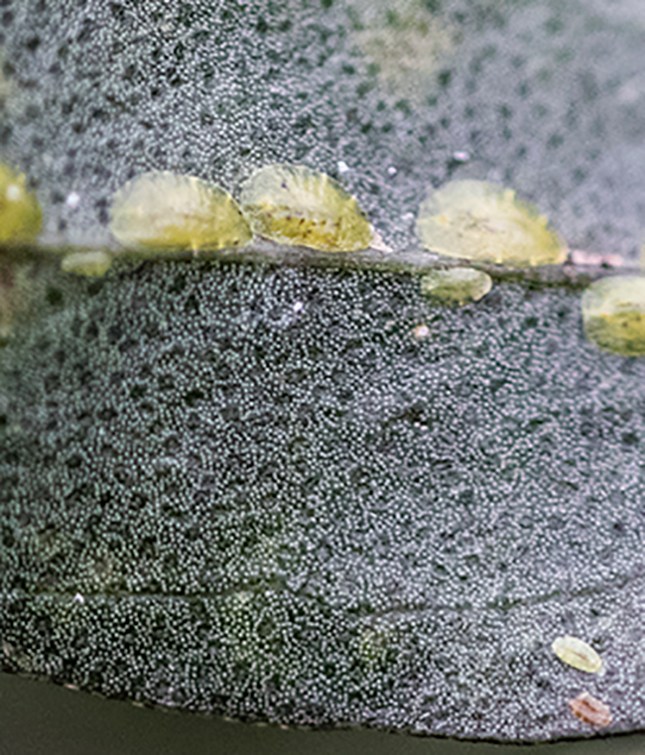
John and I have been watching ants scramble around the Saltbush.  The ants come marching two by two to tend sucking insects.    The sucking insects we’ve seen are aphids and perhaps two species of scale insects.  (Baccharis is the main Florida host for Green Scale.)  Such insects “suck” sugary sap from the host plant.   The sugary goo passes through the lil’ sucker to drip forth from the other end as “honey dew.”   The honeydew can spread and grow black fungi called sooty mold, and some of it follows a more interesting path as ant food.

baccharis-halimifolia-ant

Ant on Saltbush today.  With scale insects and sooty mold.

baccharis-scale-2

Green Scale on the leaf today

That ants crave honeydew and tend its makers like farmers tending cows is well studied, producing conversations about three-way symbiosis: win-win-win.  The plant gains armed guards.   The ants get sweet treats.  And the sucking insects, well, if they are not merely exploited, might get help in dispersal and might be under the protection of their creepy little shepherds.

CLICK to see a similar symbiosis, of all things, on the inside the stem of a different plant.

 
4 Comments

Posted by on October 28, 2016 in Saltbush, Uncategorized


Tags:

Saw Palmetto Needs Its Saw Sharpened

Serenoa repens

(Sereno Watson was an American botanist.   Repens means lying down.)

Arecaceae

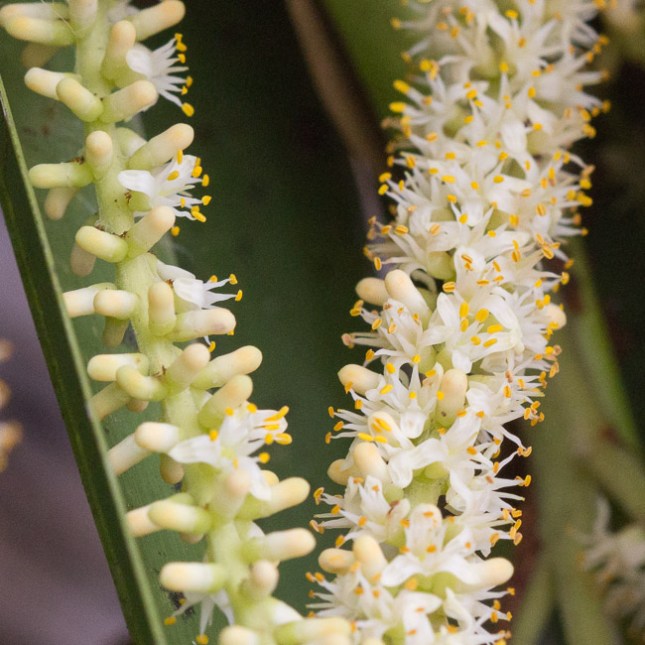
serenoa-leaf-in-sun-copy-2

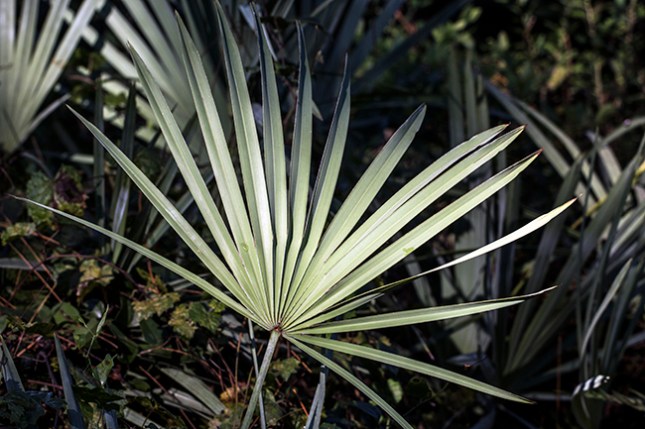
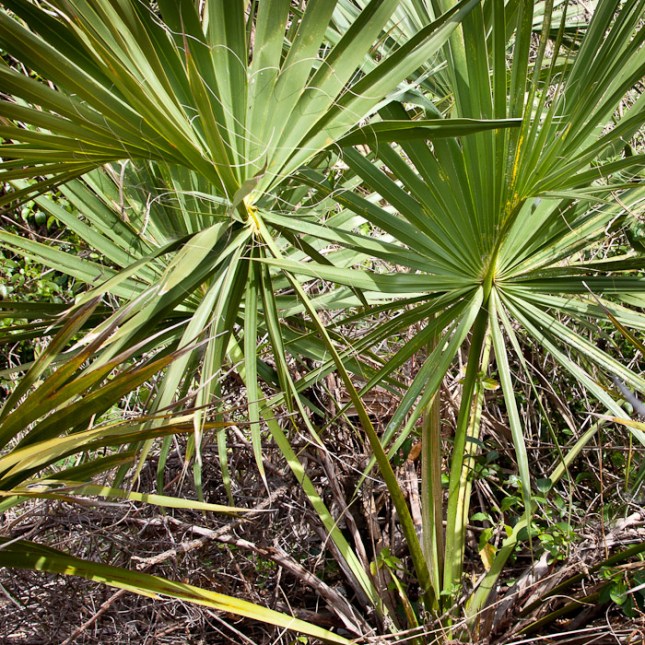
Today’s sweaty trek was a lap of the Kiplinger Natural Area in Stuart with Beautyberries in purple splendor and species of Chaffheads putting on the purple as well.    The sun flecks through the pines lit up the Saw Palmetto fronds like stage lights, so what the heck, today it’ll be the dominant species around here, Saw Palmetto.

sabal-etonia-4

Sabal etonia, Scrub Palmetto, is similar but toothless.  By John Bradford.

Being everywhere and familiar to all, Saw Palmetto is festooned with Google-ish info and some mis-info.    We’ll knock off the uber-documented facts expediently,  knowing you can explore further on the Internet, and then ponder a couple less-obvious palmetto puzzlers.

serenoa-wax

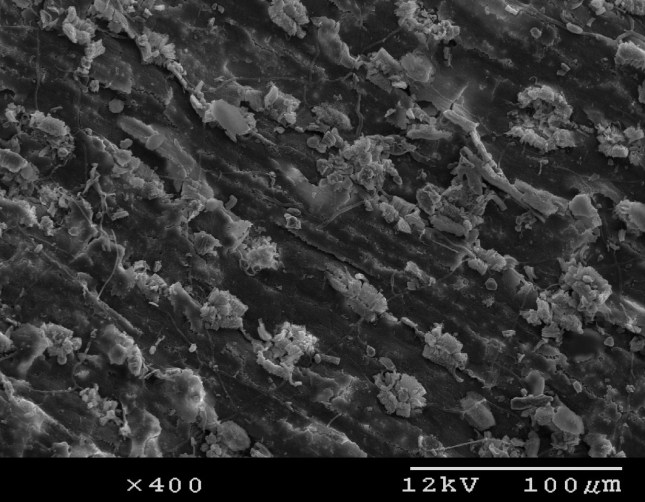
Palmetto leaf wax, electron microscope image, by Dr. Bob Wise, Univ. WI

Well Known Stuff:

  1. Saw Palmettos come in silver and in green. The silver comes from wax granules making the leaf reflective and sun-tolerant.   Green individuals have less sunscreen.  The species grows in habitats ranging from full sun to shaded, so it makes sense to have populations mixed for this character.   Some sunny types,  some shady characters. Diversify, or at least that’s how I see it.  The wavy covering can become discolored with black  Meliola fungi, or from sooty mold.
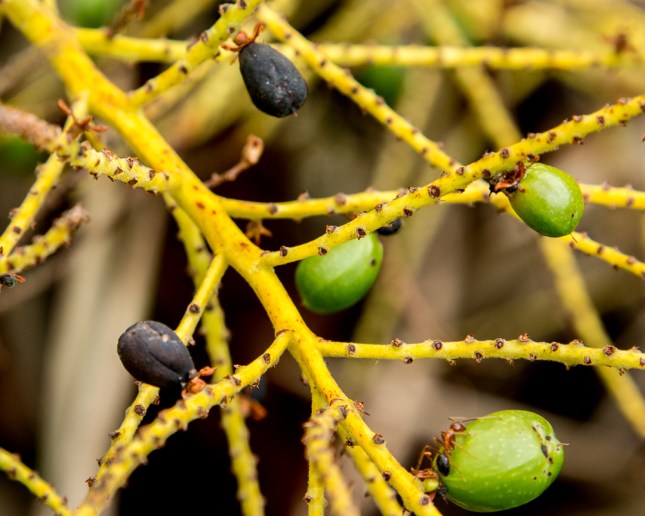
  2. The so-called berries (drupes) are an industry in Florida amounting to a harvest of over 7 million kg/year.  There’s a long-standing history of application for prostate health.    Formal scientific studies seem to fail to confirm benefits, although the market abounds.


serenoa-repens-11-fruit-copy

Fruits and ant, by John Bradford

Saw Palmetto “prunes” must have been good for Jonathan Dickinson, shipwrecked at Jupiter in 1696 and surviving with a small group of castaways partly on dried Saw Palmetto fruits while traveling under life-threatening conditions (five died) up the coast to St. Augustine.   It must have been good for JD’s prostate, because he went on to become Mayor of Philadelphia.

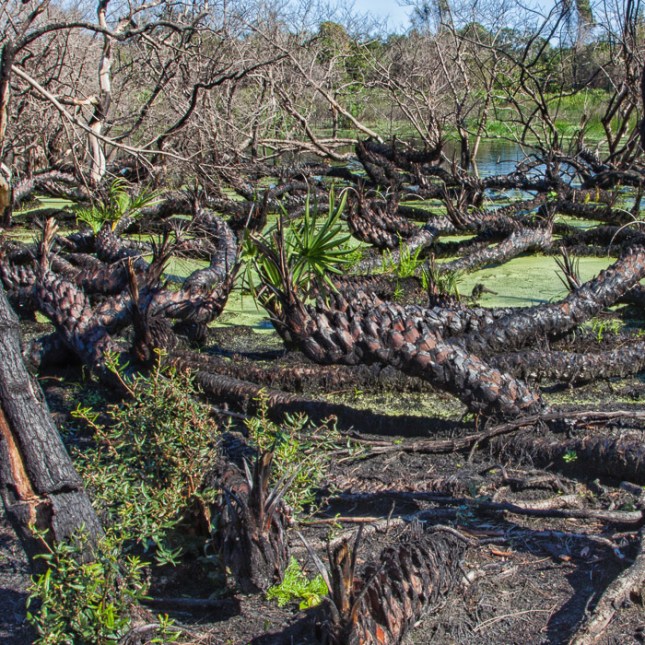
  1. Saw Palmettos cook happily in fire, and recover in a jiffy.
  2. You can make cool darts and dart launchers from the leaf stalks, but that is beyond the scope of today.
serenoa-repens-8-burn-copy-2

Scorched, and on the mend, by John Bradford

Weirder Stuff:

  1. Saw Palmetto clones can live a long time by rhizomatous spreading and branching, even if individual above-ground shoots perish or burn. Take a guess.   Botanist Mizuki Takahashi and collaborators recently compiled evidence suggesting maybe 10,000 years.  That’s almost back to the Pleistocene Epoch.    I could eat Saw Palmetto fruits from the same clone as Jonathan Dickinson, but I don’t want to.   He and I agree they are revolting. I’d rather eat a pickled prostate.
  1. The roots have air channels, hollow pipes conducting air who knows how deep into the underground. Down-bound air channels are common in marsh plant in suffocating waterlogged soil.  Perhaps my ignorance is showing, but Saw-Palmetto is the only example of rooty air ducts I know in a scrub-dweller.   The species, however, is not restricted to scrub.   Maybe the air ducts allow the roots to go extra-deep in the seasonally soggy-to-waterlogged pine woods soils where Saw Palmetto rules.    The roots need study by somebody with a shovel and a strong back

    serenoa-repens-10-gperts-copy-copy

    Flowers by JB

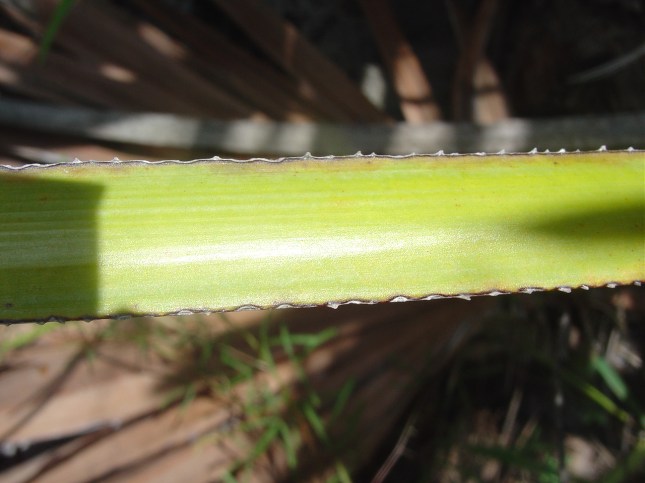
  1. The leaf stalks (petioles) have saw teeth. Duh, everyone knows that.  That’s why it’s called Saw Palmetto.   But why the teeth?   The obvious answer is to protect the palms from animals who might eat it, or might climb into it to eat unripe fruit or flowers,  or might trample it.    Perhaps, although to my outlook it is hard to imagine any animals being a big threat now or earlier in the plant’s evolution, even those giant Pleistocene herbivores mashing around.   But you never know.   In any case to go a bit beyond, any other potential benefits from the dentition?   Maybe:

Although I’ve never heard it said about Saw Palmetto (perhaps missed it), I have seen speculation that the Saw-Grass saw blades blow in the wind to slice and dice competing plants.   Makes sense for Saw Palmetto.  The leaves last 3-3.5 years, too long to tolerate pesky vines encroaching.     Look out across a stand of Saw Palmetto.  Even when the non-Palmetto plants are all entangled, the Palmetto tends to be relatively free.

Saw Palmeto is most closely related to the Paurotis Palm, which has big petiole teeth.   Those on Saw Palmetto may be more or less vestigial from big-tooth predecessors.

serenoa-repens-copy-copy

Prickles by JB

The teeth come in varied shapes, the biggest and best hooking back.   The leaf blade is a big sail attached to a long flexible petiole with those recurved teeth.  With its blade twerking in the wind, the sawtooth petiole would almost have to snag and yank any vines it contacts.

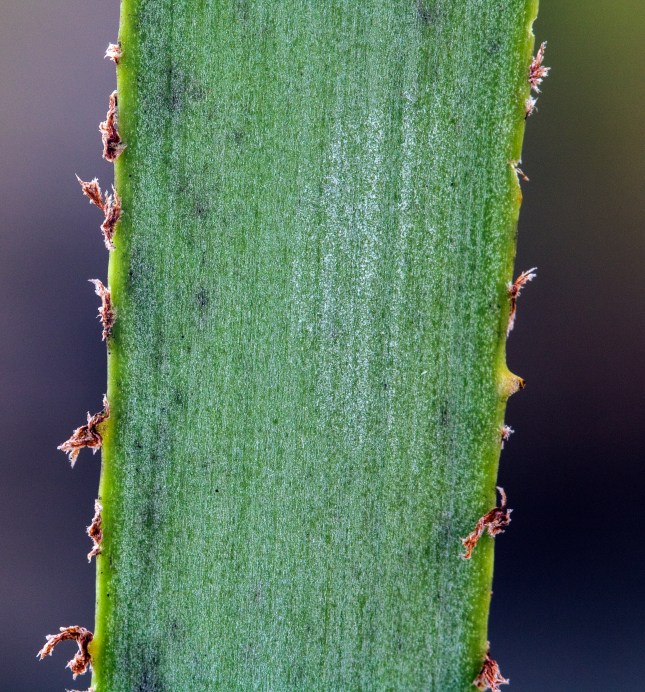
serenoa-teeth-frayed-2-copy

Why are these prickles so tatty?

Evidence that that might (repeat, might) be true comes from a magnified peep at the teeth, especially near the tops of the petioles, where the teeth tips sometimes appear abraded and frazzled as though worn out.  A dull saw, perhaps?

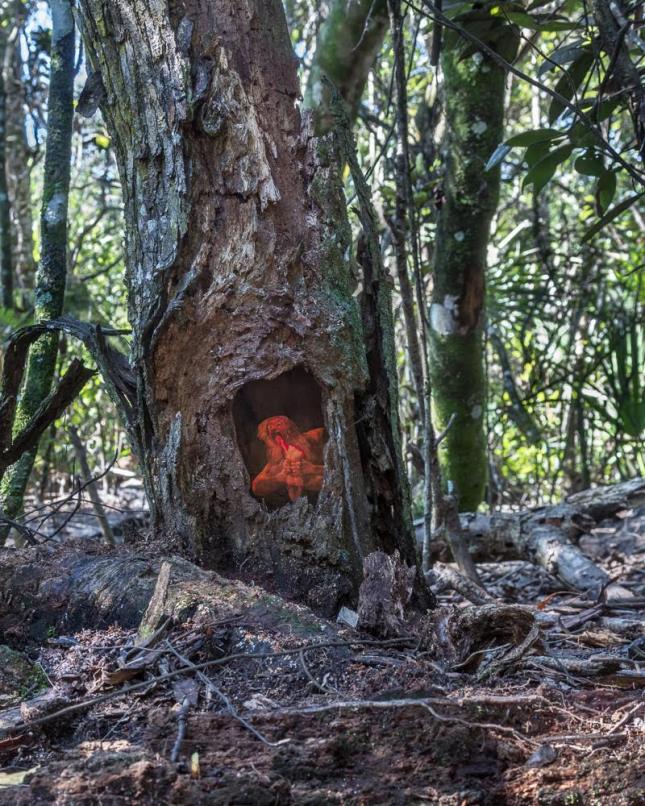
slothy

The rare Kiplinger prostativore, snapped by JB


Tags:

Fiddler Crabs, Mangroves, and Leather Ferns Getting Along Famously

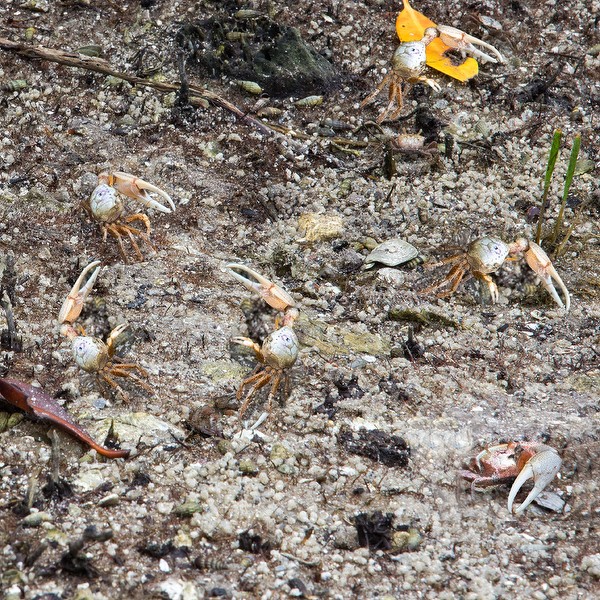
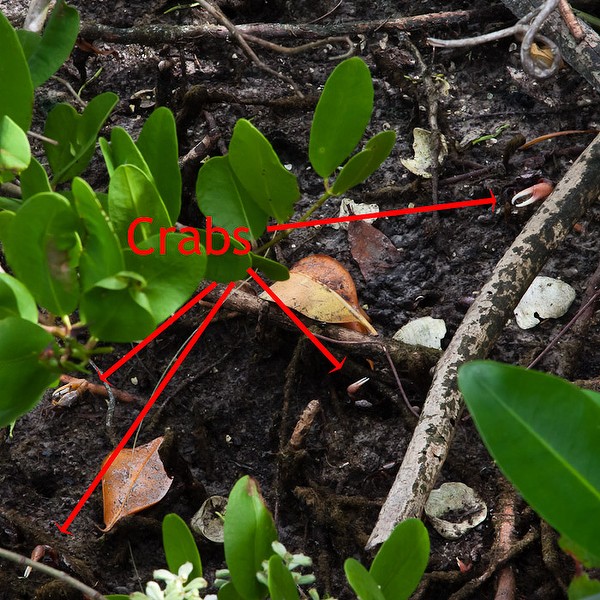
Today, John, lichen-student Bill Grow, and I enjoyed  Kiplinger Natural Area in Stuart, Florida.   That is, until a startling thunderclap sent us scurrying like three comical crabs.   Bill’s lichens engendered a symbiotic frame of mind, and a hoppin’ symbiosis  this afternoon involved a trio of salty species.  Delighted we were to encounter the crabs still fiddling a happy tune along the algae-poisoned St. Lucie River.  The crabs were crab-walking, burrowing, and waving their massive claws like a homecoming queen in a convertible, wearing a giant foam finger.

Fiddler crabs

Crab party by John Bradford

And that’s good for the mangroves.   Biologists have repeatedly noticed, in different terms with different points of emphasis, the mutual benefits of Fiddler Crabs and salt-loving plants.  Anyone who visits a mangrove swamp can attest to Fiddler Crabs too numerous to ignore.   Crowds of burrowing scavengers in the root zone of a tree in a marginal habitat must matter, and they do, apparently overall for the better.

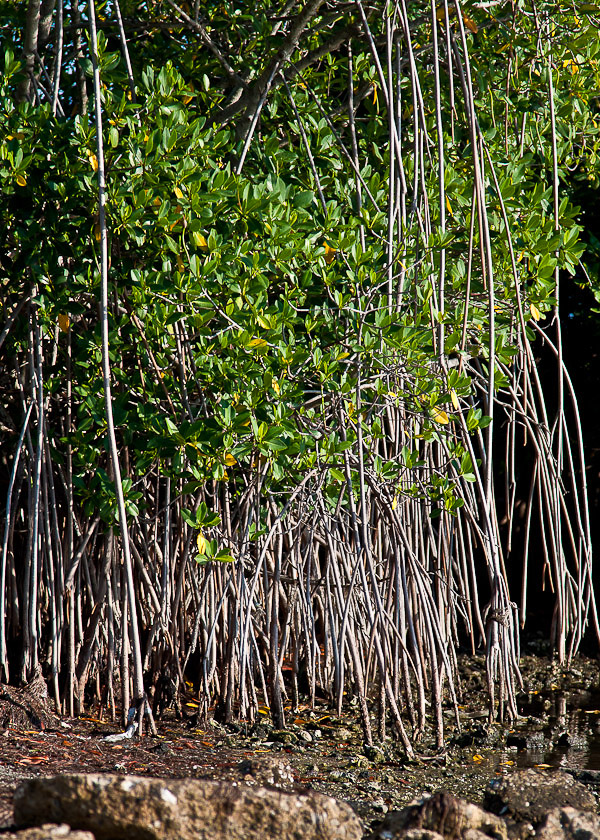
Rhizophora mangle 1

Crab habitat by JB

That tidal mud is suffocating to roots. No problem, the crabs are natural rototillers, and their burrows interconnect into subterranean duct systems.   The soil is salty, yet the reticulated tunnels allow tidal fluxes and rainwater to flush out the salts and toxins.

That soil is nutrient-poor, so thank you crabs for gathering, depositing, spreading, churning, and becoming fertilizer.  Research by biologist Nancy Smith and collaborators documented  enhanced White Mangrove growth in the company of crabs vs. crabless losers.

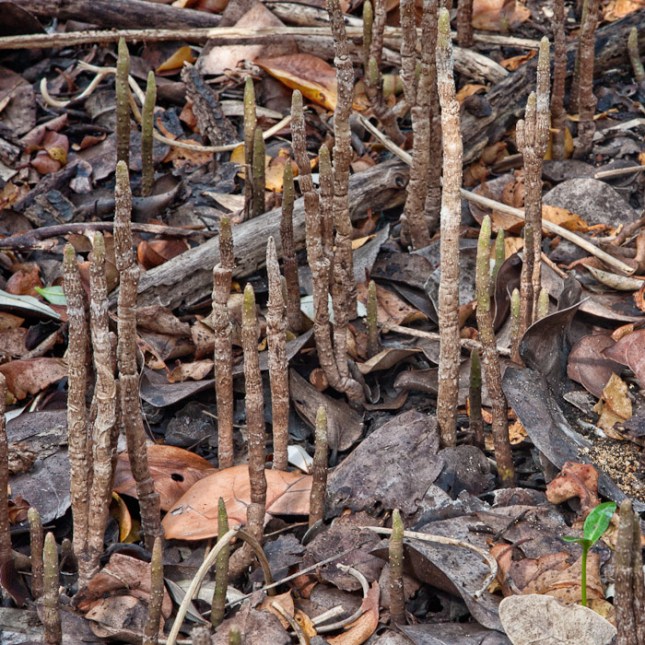
Avicennia germinans 8

Dead man’s fingers by JB

Researchers Erik Kristensen and Daniel Alongi showed the Gray Mangrove (west coast Avicennia marina) to grow leafier seedlings and more “dead man’s fingers” where fiddlers roam.  There’s a hint the Avicennia contributes to the active crab lifestyle beyond the presumed benefit of roots bracing the crab burrows against moving water.  Materials from the happy roots seems to favor microbial growth beneficial for the crab diet of algae and small organic miscellany.

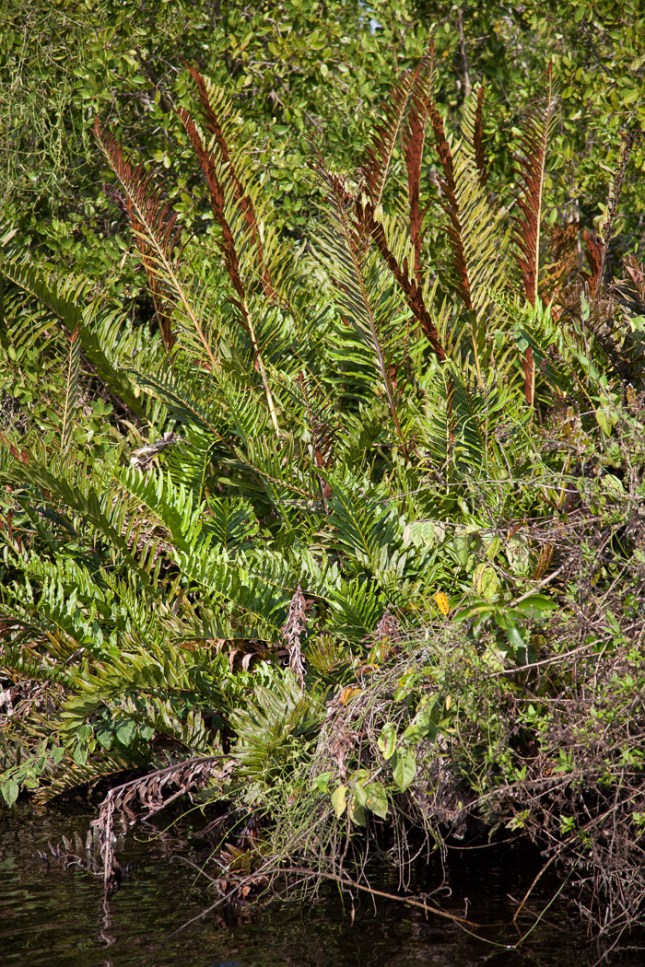
Acrostichum danaeifolium 3

Leather Fern by JB

The mangrove swamp along the St. Lucie River  hosts huge Leather Ferns.  According to biologist Peter Hogarth, the crabs have a hand (or a claw) in this too, their enriched mine tailings are “planting mounds” for baby ferns otherwise in  existential peril if not elevated above the brine.

 
8 Comments

Posted by on August 26, 2016 in Uncategorized


Tags:

Trumpet Creeper Cheats a Bit

Campsis radicans (Campsis means curved, perhaps the stamens.  Radicans means rooty.)

Bignoniaceae

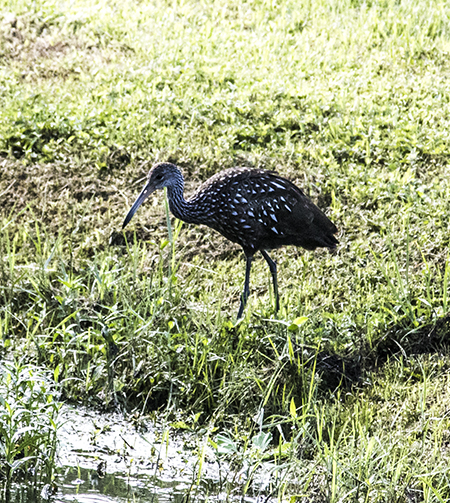
John and I today continued exploring of the Kiplinger Natural Area in Stuart, visited by a curious Limpkin.

Campsis limpkin - Copy

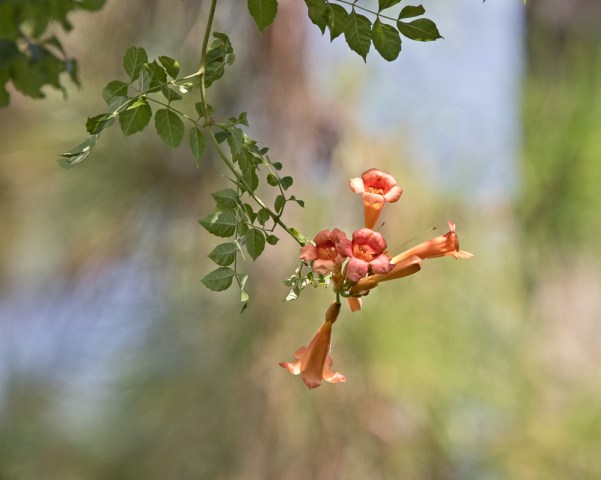
It must be August, with the Goldenrod evoking the summer meadows of childhood.   Among the botanical treats in bloom now is the colorful Trumpet Creeper vine, so showy and “exotic” for a native species.  Those orange trumpets look like something out of a TV special on the Amazon.  Trumpet-Creeper is in the same family as many garden selections, such as African-Tuliptree,  Tabebuias, and Garlic-Vines.
Campsis radicans 4 cluster - Copy

TC by JB

We’re near the southern end of its range which covers most of the eastern U.S., as well as westward and north into Canada perhaps due to human activity.   There are only two Campsis species on Earth,  one in Kiplinger, the other limited to eastern Asia and almost identical to ours.   That’s all there is, there ain’t no more.    Such eastern-North America/eastern-Asia sister-species splits are well known in biology, exemplified  most dramatically by another pair:  American Alligators and Chinese Alligators.

Gardeners please note:  the vine is aggressive, high-climbing, toxic, and irritating to the skin.
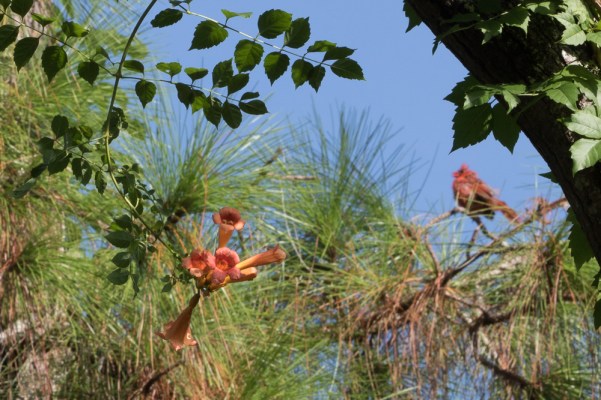
Campsis radicans 7 cardinal - Copy - Copy

By John Bradford

Trumpet Creeper is uncommon in South Florida outside of cultivation, and the reason may be our shortage of hummingbirds, the main pollinators.   Extra visitors include bees and butterflies, but studies have shown a threshold of about 400 pollen grains to cause fruit formation, and pollen from the same plant does not work.    In short, a job for a big hungry hummingbird, not a little lightweight bee or butterfly.
Although tough to pollinate, Trumpet Creeper is easy to propagate.  At Palm Beach State College, we grow it from segments of roots.  Thus in nature the vine can probably establish wherever root pieces go, a useful trick in, say, a floodplain where the ground can break apart and float away.

Campsis radicans 6 butterfly - Copy

Hey, I can’t reach the nectar!  (JB)

The stems are odd in structure.    Resembling Poison Ivy, they climb a host tree using tiny clinging roots like centipede feet.    Trumpet Creeper is a structural parasite, reaching great heights freed of the need to make strong supportive wood.     Many readers know that normal woody plants have a green cambium just under the bark to expand the girth of the stem by making strong new wood to the inside as well as new bark to the outside.    Trumpet Creeper, by contrast, makes extra sugar-conducting tissue at the inner core of the stem where there would be wood in a self-supporting species.    In other words, stealing outside support allows the selfish vine to concentrate on fueling rapid growth rather than holding itself up.   (Know anybody like that?)

Campsis radicans 1 close - Copy

By JB

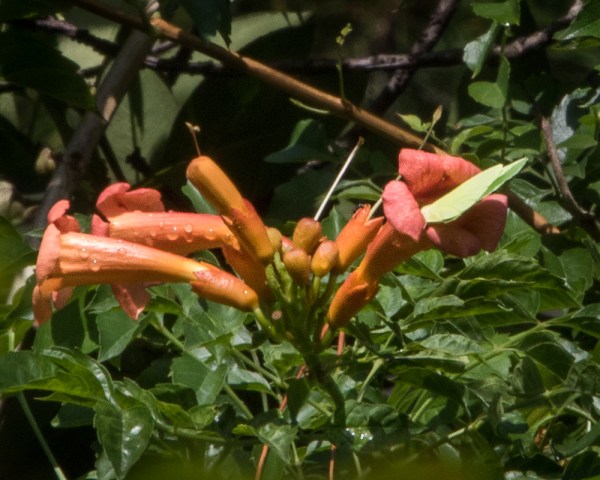
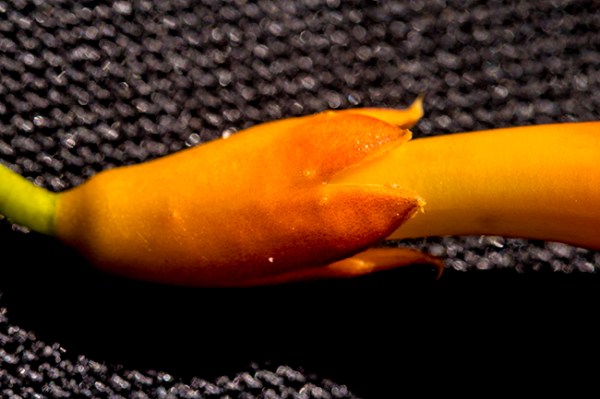
The flowers make enough nectar to feed a bird.   Everybody likes nectar.   Those blossoms are to nectar thieves what a bank is to bandits.  Banks need tough guards.  Trumpet Creeper has armed guards too.   To pay its sentries the flowers have nectaries on the outside at the base (on the calyx).  They look like blisters, and feed belligerent ants who presumably protect the nectar-laden floral base from any varmint that may nip a hole and swipe the sweets.

Campsis glands glands - Copy

Little ant-feeder blister glands on the outside of the flower base

 
15 Comments

Posted by on August 12, 2016 in Uncategorized


Tags:

Ecological Pairs (And Why Boll Weevils Favor Vanilla Ice Cream)

Chrysobalanus icaco and more Chrysobalanus icaco

Cuscuta pentagona and Smicronyx quadrifer

Vanilla mexicana and nobody

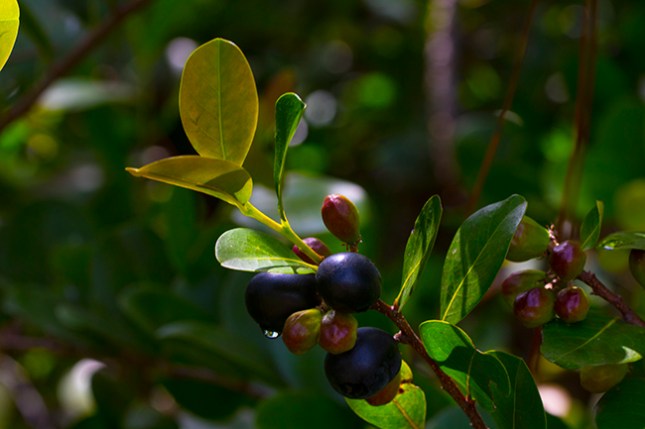
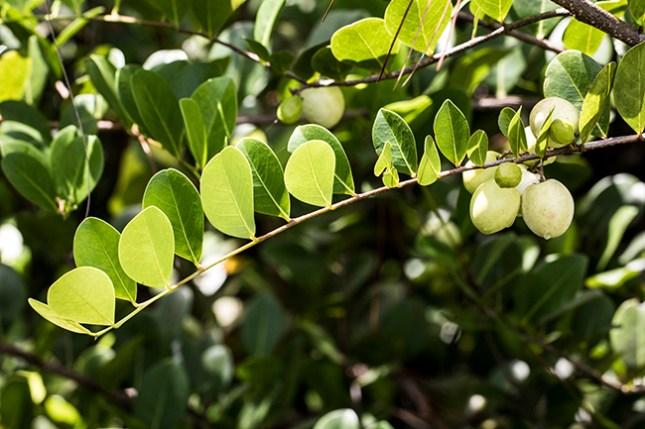
Any veteran of third grade knows how in ecology everything is connected to everything in one pulsating web of life.  Well, yea, sorta, okay, maybe, sometimes, but what’s been glimmering this week in John’s and my botany have been species pairs more than ecological networks.  So today is the day of twosomes, like these purple cocoplums and white cocoplums immediately side by side with intertwined branches  in the Kiplinger Natural Area in Stuart, Florida.   Interestingly, the purple-fruited individuals have reddish young leaves in contrast with the absence of reddish foliar hues in the white-fruited individual.  I wonder if the white-fruited individuals are marginally less resistant to sun injury.

Chrysobalanus red

Cocoplum with purple fruit.  Young leaves with reddish tint.

Chrysobalanus white better

No purple in the fruit, no red in the young leaves

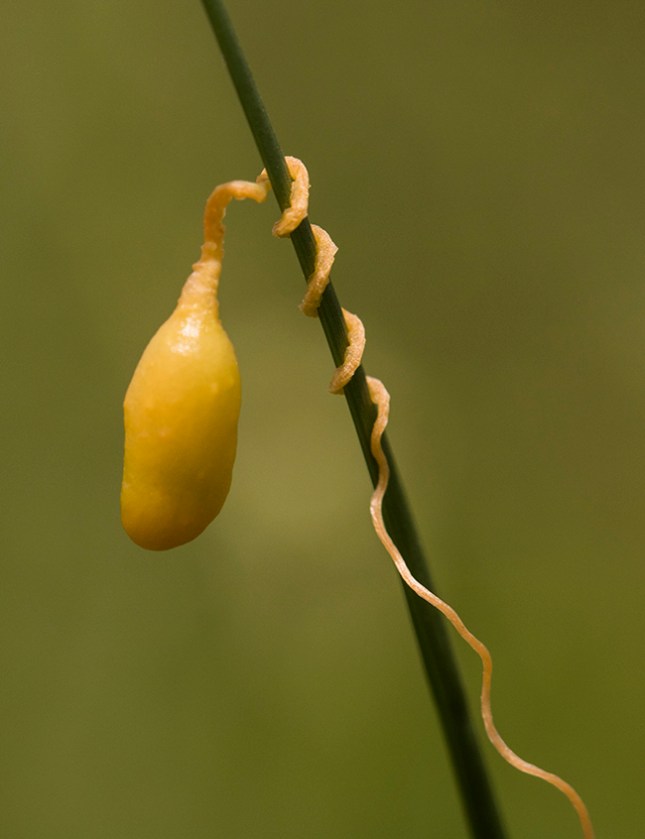
Pretty, but pairs are boring without dynamics.    When it comes to parasites, for example, it takes two to tango.   Or, in the case of parasitic Five-Angled Dodder, we should say it takes three.   The Dodder  sucks the victim’s life juices.   But it gets a taste of its own medicine, as there’s a parasite on the parasite.    The golden dangler in the photo below is not the Dodder fruit, which is a dry capsule.    That dangling pod is the home of the Dodder Weevil.

Cuscuta pentagona (1)

Dodder on a victim, with Dodder Weevil gall

Dodder is apparently a stingy host, being yellow, stringy, and nutrient-poor, so the weevil larvae migrate from the Dodder into the plant the Dodder is parasitizing to add insult to injury.

Dodder exists in scattered patches, locally not  abundant.   So how does the Weevil find it?    Of course nobody knows exactly, and “the” answer lies in a complex tapestry of signaling and sensing.    So let’s do like the politicians and pick one thread out of the intricate mesh and pretend it is the whole truth.

Now we shall oversimplify, extrapolate, and speculate with wild abandon.

Cuscuta pentagona (2)

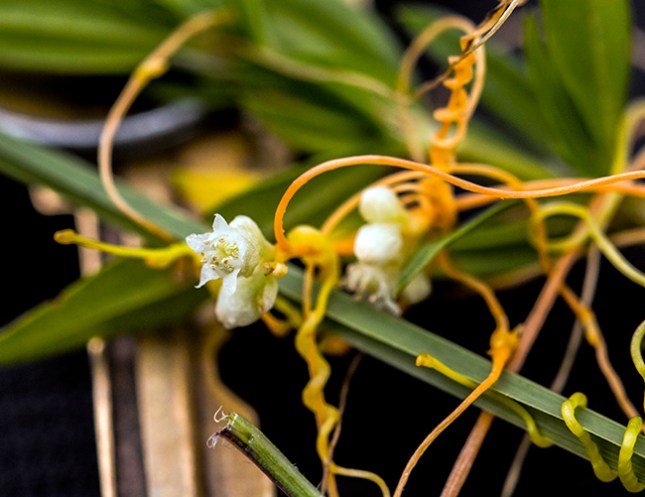
Dodder in flower

The Dodder Weevil is not a prominent topic of research.   Perhaps, however, we can glean a hint of insight from a better-studied Weevil, such as the Boll Weevil.   What draws Mr. Boll Weevil to the Cotton?   Apparently a complex of chemical signals, one being vanillin.

Vanillin as in a vanilla ice cream cone?  Yes. Vanillin is best known for coming from the Vanilla Orchid, but the chemical is widespread in the plant world, being related chemically to an amino acid and being a breakdown product of  plant tissues, especially wood.   Among other signals, pesky bugs use vanillin to find distressed plants, studied most famously in Bark Beetles finding Elm Trees, as well as other insects and their plant “partners.”   Vanillin may be useful in insect scent traps.

If vanillin comes from deteriorating wood, why don’t I manufacture the flavor from wood scraps rather than  nurturing those pesky Vanilla Orchids?   Oh rats, they beat me to it:  commercial vanillin flavoring has come, on large or small scales, from various forest and pulp byproducts and even from animal manure already partly broken down thanks to digestion.  You could get milk and vanillin for the ice cream from the same cow.

John and I were Weevils this week lured to Vanilla, to a Vanilla Orchid that is.   Martin County Ecosystem Project Manager and erstwhile hockey goon Mike Yustin showed us Vanilla mexicana flowering and fruiting in a swamp whose location should not be disclosed.  (Ugly people go steal pretty orchids.)   This is not the commercial Vanilla species, although there’s resemblance.

Vanilla mexicana 1

Vanilla mexicana by John Bradford

Vanilla mexicana ranges naturally from South America to Mexico and the Caribbean.   So is it a Florida native?   Sources differ, and this is not a very interesting question,  given that we’re dealing with a widespread species having microscopic wind-blown seeds.  So, sure, probably Vanilla mexicana seeds dust Florida trees.

A more interesting question is, “if Vanilla mexicana is an outlier at the chilly margin of its distribution far from its tropical population center,”  and if “Orchids tend toward specialized pollinators,”   does this species have a pollinator partner way up north here in Florida?  (Remember, today’s theme is ecological pairs.)

Vanilla mexicana 8

Vanilla mexicana, by John Badford


Possible answers include, maybe the Orchid is pollinated by a generalized pollinator (not likely, nor much fun to discuss);  or perhaps its own special pollinator companion came with it (that would be remarkable); or….in this case other botanists have revealed the probable answer.   In 2015 Masters Degree Student R. Narinda showed V. mexicana to be self-pollinated.   Partner-free and self-sufficient, this unattached species can roam wherever its seeds might blow and not freeze.    The “not freeze” part makes Martin County a reasonable northern margin, at least during some decades.


IMG_2317

Amazing hybrid,  by John “Luther Burbank” Bradford


Good link sent by Pat Bowman

 
7 Comments

Posted by on August 5, 2016 in Uncategorized, Vanilla


Tags:

What Does Florida Have in Common with Ireland? Blue-Eyed Grass and Palms

Blue-Eyed Grass
Sisyrinchium species
Iridaceae

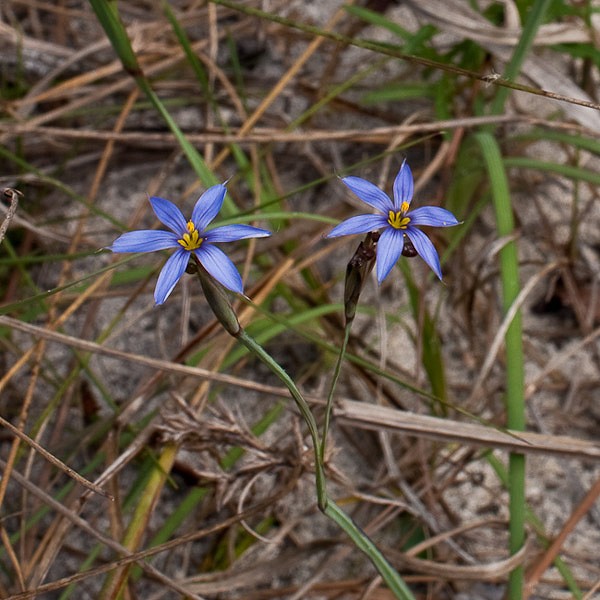
Last Friday John and George visited the Kiplinger Natural Area in Stuart.  (See John’s latest Halpatioke Trail photos: CLICK)  There’s always something botanical to enjoy at Kiplinger, and a treat this week was Blue-Eyed Grass, Sisyrinchium angustifolium (base not fibrous, moist habitats).  Also locally we have Sisyrinchium nashii (base fibrous, leaf blade < 4 mm wide, capsule < 5 mm long), and in scrubby dry sites Sisyrinchium xerophyllum (base fibrous, leaf blade usually > 4 mm wide, capsule to 8 mm long).

Well, maybe.  Sisyrinchium species are in the eye of the beholder, controversial and weakly defined in many cases.  If you don’t believe that, select a geographic area and compare the Sisyrinchium species definitions and nomenclature in a couple of botanical references, but I don’t really want to go there.

Taken by John Bradford.  In Bermuda? In Ireland? In Kiplinger?  You decide.

Taken by John Bradford. In Bermuda? In Ireland? In Kiplinger? You decide.

Where I do want to go is Ireland, Bermuda, and Greenland.  The natural distribution of Sisyrinchium, with about 80 species, is almost entirely in the Americas, but go off-shore and it gets interesting, and go all the way to Ireland and it gets weird.  When I first learned of allegedly natural Sisyrinchium occurring in northern North America, and Greenland, and Ireland I imagined Vikings relocating pretty Blue-Eyed Grasses between pillages and plunders.  No dice.  More credibly, botanists have implicated migrating geese as the perps, but the honkers went down in the botanical literature.

And that brings us to today’s mystery.  And here it is: Sisyrinchium bermudiana is the (unofficial) National Flower of Bermuda.  But hold the phone:  The Irish species is Sisyrinchium bermudiana. [ A two-island natural distribution Bermuda and Ireland?  Geese and Vikings didn’t do that!  BTW, it’s been documented in both places since the 19th Century.

Before we go on, may it please the court stipulate a few facts:  First of all, remember what I said about the wobbly status of Sisyrinchium species.  Second, we in this blog are not the first people to notice this odd pattern, and others have “resolved” it by decree and edict.  You can find various statements “settling” the case…but the verdicts disagree.  A crime has occurred but the jury is hung.  Figuring out the irrefutable relationships of those dual island populations is a problem for DNA analysis, and if that’s been done I’m not aware of it.  [Plausible scenario: a doctoral student doing this somewhere now has the computer set to snag all on-line mention of Sisyrinchium.  This blog pops up much to their disgust and annoyance.  If that is you, hi there, send me an e-mail.]  There’s ever-so-much I’m not aware of, and our purpose here is not to resolve the mystery but merely to savor it.  Just like OJ, who really wants to know?  We’ll leave resolution to smart people in hi-tech labs.

Let’s visit Bermuda first.  With dissidents, there’s a sense among even contemporary authorities that the (unofficial) national flower of Bermuda is Sisyrinchium bermudiana.  Who could be more authoritative on this than the Bermuda Botanical Society?  As recently as their most recent (Fall 2012) Newsletter they have a manifesto asserting the validity of Sisyrinchium bermudiana.  For your enjoyment that article is plagiarized in its entirety below.  Take that, Ireland.

Just like CNN, fair and balanced reporting now requires input from the Emerald Isle:

Can Sisyrinchium bermudiana actually occur in Ireland, and natively?  Leprechauns as well as stodgy botanical references think it’s not malarkey.  The venerable Flora Europaea is thumbs up.  Ditto (as”probably native”) for the Ecological Flora of the British Isles.  Even better, CLICK HERE  to see Irish endorsement with details. The plant is an official Priority Threatened Species listed with the no-nonsense International Union for the Conservation of Nature.  The habitats are shores, wet spots, and moist grasslands.

So here we have either the world’s wackiest plant distribution, or serial errors by serious authorities.  Who cares?  As Kahlil Gibran spake with profundity, “Say not I have discovered the truth, but rather I have discovered a truth.”

——————————————————————————-

From the Fall 2012 Newsletter of the Bermuda Botanical Society:
ENDEMIC PERENNIAL – BERMUDIANA
(Sisyrinchium bermudiana)

The Bermudiana is one of the few endemic
species left in Bermuda and is part of the
Iridaceae family.  It is a small herbaceous
perennial and is the unofficial national
flower of Bermuda.  The leaves grow from
six to nine inches long and its flowers have
six purple petals and are yellow at the base,
which gives the plant a beautiful yellow
glow.  (Flora, 2005; Forbes 2005).

Also known as Bermuda iris (or blue-eyed
grass), for many years before botanists knew
of more continental species of Sisyrinchium,
the Bermuda variety was considered as a
North American type.  It was thought that
our Bermudian species does not grow in the
wild anywhere else in the world, as pointed
out by Hemsley in 1884 (Journ. Bot. 22:
108-110).  It is interesting to note that plants
which were taken to the New York
Botanical Gardens grew easily and flowered
well when grown under glass. (Flora of
Bermuda, 1865).

Although this pretty little blue Iris is found
growing in the wild in dry sunny places all
over Bermuda, there is also a place for it in a
cultivated home garden.  It has typical Iris
shaped leaves, and flowers throughout the
month of April and sometimes even longer.

Sisyrinchium bermudiana will flourish in
any open, sunny position and is propagated
by seed. The seed is produced in the pods
on top of the plant after the end of its
flowering period. (Whitney, 1955).  The
seeds can be sown directly in the ground in
early spring.

 
8 Comments

Posted by on January 15, 2013 in Blue-Eyed Grass


Tags: , ,

Red Mangrove Youngsters — Failure to Launch

Red Mangroves

Rhizophora mangle

Rhizophoraceae

Today John and George sweated like jungle explorers through the Kiplinger Natural Area in Stuart, with distant thunder.  Worth the steambath though, with the blooming Loblolly Bays resembling a Camellia garden.  Even better, Red Mangrove babies were dropping from their mama mangroves onto the crabby Fiddler Crabs brandishing their big claws in the tidal mud.

CLICK to see a nice Mangrove gigapan by John Bradford

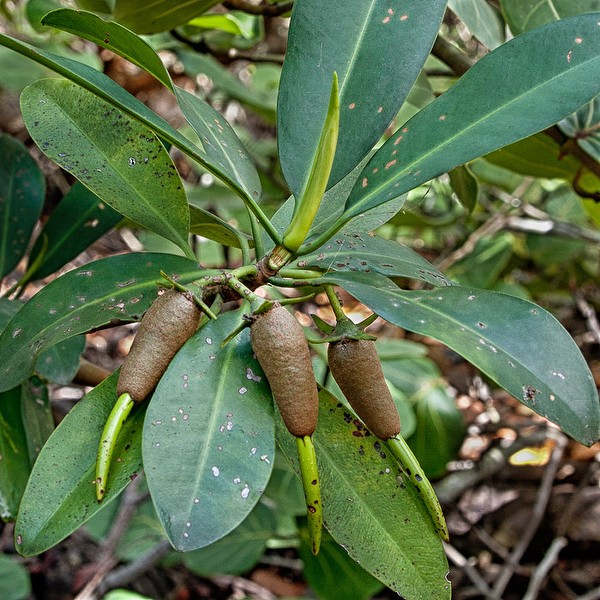
Green pencil-shaped Red Mangrove babies (embryos) protruding from the brown fruits. All photos today by JB.

Nothing is more boring than botanical embryology, but we’re going there anyhow.  So grin and bear it, because native plant enthusiasts are duty bound to understand those wacky Red Mangrove youngsters.  They look like big pointy green beans protruding from the much-shorter brown fruits.

To discuss wackiness we first must establish baseline normality. A normal seed is a space capsule where the seed coat surrounds a baby plant (the embryo).  The mother plant packs baby formula called endosperm into the seed and then sends it off to college with no further ado.  The meat and milk in a coconut are examples of endosperm.

Consistent with sociological trends of today, however, the Red Mangrove offspring stays home after college, deriving direct support from the mother plant, just like Kathy Bates doing the laundry for 35-year-old Matthew McConaughey.

In a human family that’s easy enough to arrange, but plants are not designed for extended parental support.  A normal seedling has no way to reach back to the mother plant for supplemental cash.  I mean, the mother plant packs an allotment of endosperm food into the seed, wishes the youngster good luck, and sends it off to fend for itself.  End of connection, end of story.

But not so in a Red Mangrove.  The seed germinates while still inside the fruit, this still suspended from the mother plant.  The germinated youngster (the embryo) grows 8 inches long, requiring vastly more nutrition than the original endosperm.  Here is the weird part: The mother tree conveys sustenance through the fruit into that growing green youngster as it pokes forth from the fruit and enlarges to the size and shape of a pencil.  But how does the maternal nutrition cross the generational barrier?  (Technically, two generations are crossed but who needs pesky details?)  The endosperm is the key.

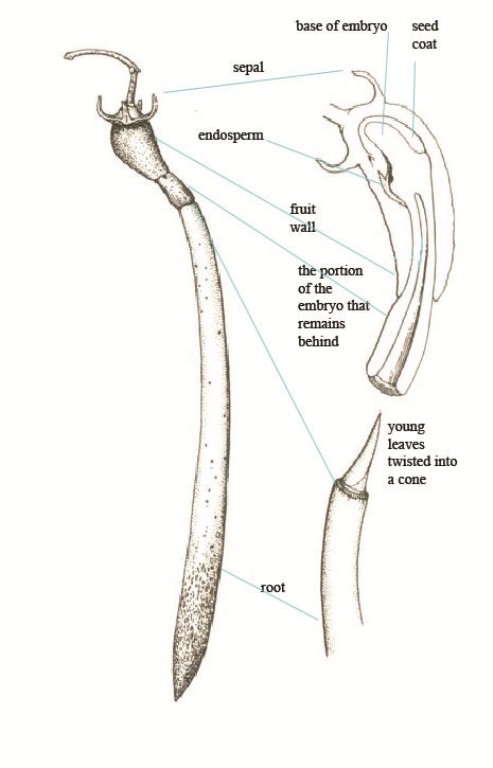
The endosperm does something amazing, it spills forth from the top of the seed and surrounds the portion of the embryo encased in the fruit as the other end protrudes and elongates.  That is, the endosperm does not function as stored food like it should, but rather reorganizes and becomes a conduit from mother to baby, an umbilical cord.  To display my ignorance as usual, I’m not aware of any other case of this among the flowering plants.

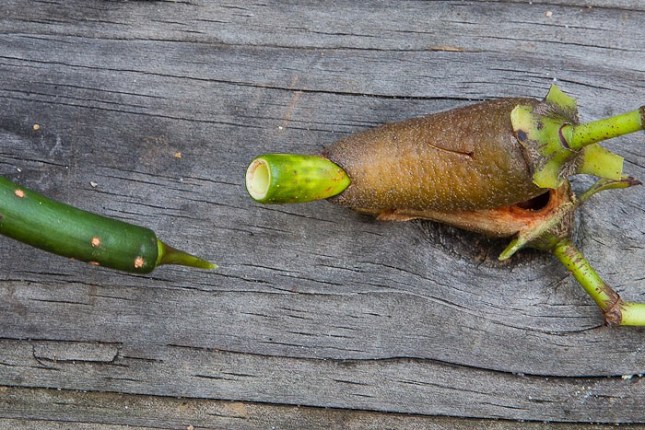
When launch time rolls around, the big green rooty-tooty embryo snaps into two components like the two stages of a Mars-bound rocket.  The fruit-end of the embryo stays behind discarded and embedded in the fruit. The long outer end of the embryo snaps off and drops onto those Fiddler Crabs for tidal dissemination of Rhizophora mangle.  At the breakage point on the dropped embryo portion you see the young leaves twisted into a tight little cone, which had been sheathed in a matching cavity before the break-up.

The part of the embryo that drops free is green on the left, with its pointy conical leaf cluster at the tip. On the right: the green throwaway portion of the embryo (like the hollow cap from a Bic pen) is jutting from the brown fruit. You can see the cavity in the throwaway portion where the conical leaf cluster had been covered before the snap-off.

Who ever heard of endosperm leaving a seed and becoming an umbilical cord?  Who ever heard of a two-stage embryo where one end is abandoned after the other end snaps free?   You have.  Then the next time you tiptoe through the tidal mud you can slice one and know the inside story.

[Notes: For interested readers, the portion of the embryo remaining abandoned in the fruit is the modified pair of cotyledons. The drawing is by Dorothy Marsh, published by S.A. Graham in The Jour. of the Arnold Arboretum 45: 288. 1964.]

][

 
6 Comments

Posted by on August 12, 2012 in Red Mangroves


Tags: , ,