Blue-Eyed Grass
Sisyrinchium species
Iridaceae
Last Friday John and George visited the Kiplinger Natural Area in Stuart. (See John’s latest Halpatioke Trail photos: CLICK) There’s always something botanical to enjoy at Kiplinger, and a treat this week was Blue-Eyed Grass, Sisyrinchium angustifolium (base not fibrous, moist habitats). Also locally we have Sisyrinchium nashii (base fibrous, leaf blade < 4 mm wide, capsule < 5 mm long), and in scrubby dry sites Sisyrinchium xerophyllum (base fibrous, leaf blade usually > 4 mm wide, capsule to 8 mm long).
Well, maybe. Sisyrinchium species are in the eye of the beholder, controversial and weakly defined in many cases. If you don’t believe that, select a geographic area and compare the Sisyrinchium species definitions and nomenclature in a couple of botanical references, but I don’t really want to go there.
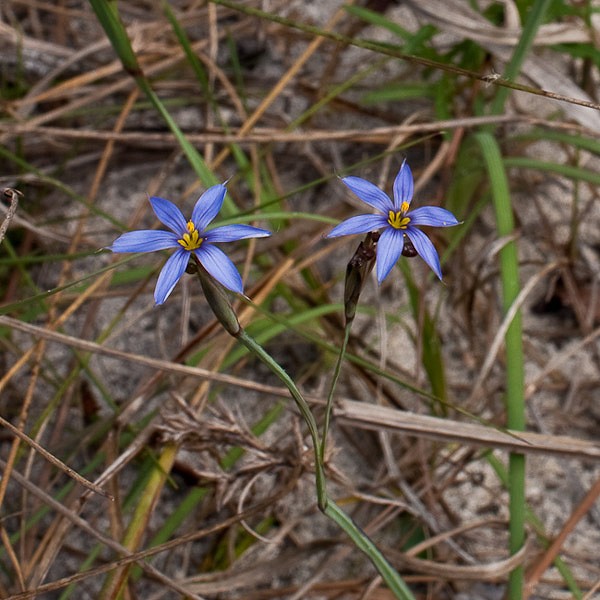
Taken by John Bradford. In Bermuda? In Ireland? In Kiplinger? You decide.
Where I do want to go is Ireland, Bermuda, and Greenland. The natural distribution of Sisyrinchium, with about 80 species, is almost entirely in the Americas, but go off-shore and it gets interesting, and go all the way to Ireland and it gets weird. When I first learned of allegedly natural Sisyrinchium occurring in northern North America, and Greenland, and Ireland I imagined Vikings relocating pretty Blue-Eyed Grasses between pillages and plunders. No dice. More credibly, botanists have implicated migrating geese as the perps, but the honkers went down in the botanical literature.
And that brings us to today’s mystery. And here it is: Sisyrinchium bermudiana is the (unofficial) National Flower of Bermuda. But hold the phone: The Irish species is Sisyrinchium bermudiana. [ A two-island natural distribution Bermuda and Ireland? Geese and Vikings didn’t do that! BTW, it’s been documented in both places since the 19th Century.
Before we go on, may it please the court stipulate a few facts: First of all, remember what I said about the wobbly status of Sisyrinchium species. Second, we in this blog are not the first people to notice this odd pattern, and others have “resolved” it by decree and edict. You can find various statements “settling” the case…but the verdicts disagree. A crime has occurred but the jury is hung. Figuring out the irrefutable relationships of those dual island populations is a problem for DNA analysis, and if that’s been done I’m not aware of it. [Plausible scenario: a doctoral student doing this somewhere now has the computer set to snag all on-line mention of Sisyrinchium. This blog pops up much to their disgust and annoyance. If that is you, hi there, send me an e-mail.] There’s ever-so-much I’m not aware of, and our purpose here is not to resolve the mystery but merely to savor it. Just like OJ, who really wants to know? We’ll leave resolution to smart people in hi-tech labs.
Let’s visit Bermuda first. With dissidents, there’s a sense among even contemporary authorities that the (unofficial) national flower of Bermuda is Sisyrinchium bermudiana. Who could be more authoritative on this than the Bermuda Botanical Society? As recently as their most recent (Fall 2012) Newsletter they have a manifesto asserting the validity of Sisyrinchium bermudiana. For your enjoyment that article is plagiarized in its entirety below. Take that, Ireland.
Just like CNN, fair and balanced reporting now requires input from the Emerald Isle:
Can Sisyrinchium bermudiana actually occur in Ireland, and natively? Leprechauns as well as stodgy botanical references think it’s not malarkey. The venerable Flora Europaea is thumbs up. Ditto (as”probably native”) for the Ecological Flora of the British Isles. Even better, CLICK HERE to see Irish endorsement with details. The plant is an official Priority Threatened Species listed with the no-nonsense International Union for the Conservation of Nature. The habitats are shores, wet spots, and moist grasslands.
So here we have either the world’s wackiest plant distribution, or serial errors by serious authorities. Who cares? As Kahlil Gibran spake with profundity, “Say not I have discovered the truth, but rather I have discovered a truth.”
——————————————————————————-
From the Fall 2012 Newsletter of the Bermuda Botanical Society:
ENDEMIC PERENNIAL – BERMUDIANA
(Sisyrinchium bermudiana)
The Bermudiana is one of the few endemic
species left in Bermuda and is part of the
Iridaceae family. It is a small herbaceous
perennial and is the unofficial national
flower of Bermuda. The leaves grow from
six to nine inches long and its flowers have
six purple petals and are yellow at the base,
which gives the plant a beautiful yellow
glow. (Flora, 2005; Forbes 2005).
Also known as Bermuda iris (or blue-eyed
grass), for many years before botanists knew
of more continental species of Sisyrinchium,
the Bermuda variety was considered as a
North American type. It was thought that
our Bermudian species does not grow in the
wild anywhere else in the world, as pointed
out by Hemsley in 1884 (Journ. Bot. 22:
108-110). It is interesting to note that plants
which were taken to the New York
Botanical Gardens grew easily and flowered
well when grown under glass. (Flora of
Bermuda, 1865).
Although this pretty little blue Iris is found
growing in the wild in dry sunny places all
over Bermuda, there is also a place for it in a
cultivated home garden. It has typical Iris
shaped leaves, and flowers throughout the
month of April and sometimes even longer.
Sisyrinchium bermudiana will flourish in
any open, sunny position and is propagated
by seed. The seed is produced in the pods
on top of the plant after the end of its
flowering period. (Whitney, 1955). The
seeds can be sown directly in the ground in
early spring.
 John Bradford
 George Rogers
 George Rogers
 Dee Staley
 Treasure Coast Natives