RSS

Tag Archives: Water Lily

Great News for Sufferers from Sexual Irritability!

Spatterdock (Spadderdock)

Nuphar advena

Nymphaeceae

Visited Grassy Waters Preserve off of Northlake Blvd. this week, and the Spatterdock water lilies made the trip as pretty as a picture.  So did seeing ripening persimmons on the trees.  There are plenty of persimmon trees around, but it has not been my common experience to see the almost-mature fruits.

Everyone has seen these lovely “lilies.”  The leaves float, or may rise from the water surface, and the flowers are yolk-golden and cup-shaped.  These and Pickerelweeds take me back to childhood fishing trips  and boat trip picnics.
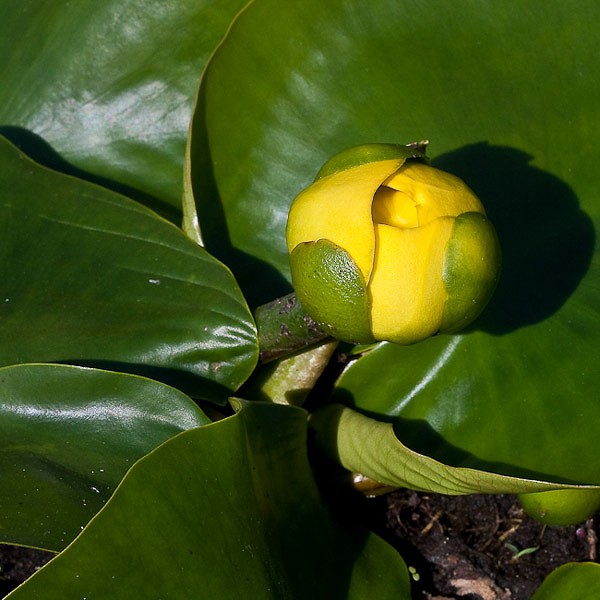
Young flower with the triangle door.  Careful it might slam behind you.  (All photos by JB)

Young flower with the triangle door. Careful it might slam behind you. (All photos by JB)

Scattered in the plant world are flowers known to imprison their pollinators temporarily,  then parole the buggy inmates to continue their symbiotic services.  Such flowers include some Orchids, Aristolochias, Aroids, and today’s Spatterdocks.  When the Spatterdock flower is young, the stigma is pollen-receptive and the pollen-making  stamens are inactive.  The young flower is closed except for a triangular opening between the petals;  insect visitors can enter the triangular portal and dust any pollen they carry off onto the stigma, which they touch upon entry.  The triangular opening closes at night, trapping the pollinators until the hole reopens the next day.  By then the stamens have released pollen, re-dusting the visitor.  This repeats over a series of days until the flower becomes fully open.  Pollination is by beetles, bees, flies, and (if you can believe it) reportedly aphids.  Aphids?  Maybe they are drawn to easily available sap in the nectar-producing petals.

Nuphar (Click for more photos)

As an  odd tidbit, the fruits float and disperse the sinking seeds, like zeppelins dropping bombs.  The sunken seeds have a problem—mature plants have floating or emergent leaves at the water surface.  This is similar to a problem of the young stages of a tree-top vine’s seedling on the ground.  In Nuphar, the first leaf is strap-shaped, the second leaf is expanded, and it is not until the 4th or 5th leaf that the foliage looks proper.

The plants make big starchy rhizomes.  These along with fruits and seeds were food to Native Americans.  But not so fast!  The plants also make alkaloid drugs, so the rhizome-eaters must have known what to do about that, just as ancient peoples in the Old World knew how to brew an intoxicating beverage from the flowers.  The alkaloids are of modern interest to destroy various cancer cells and an ability to cause apoptosis (programmed cell death relevant to cancer treatments).  More curiously, a reported use for Nuphar root tea to treat “sexual irritability.”  Not exactly sure what that is, but I have a lively imagination, so let’s cure S.I. in our lifetime!

Victims of S.I. (identities disguised for privacy)

Note:  Some of the info here comes from a 2007 Monograph of Nuphar by botanist Donald Padgett.
 
5 Comments

Posted by on July 18, 2013 in Spatterdock


Tags: , ,

Water Lilies are Ungrateful

White Water Lily

Nymphaea odorata

Nymphaeaceae

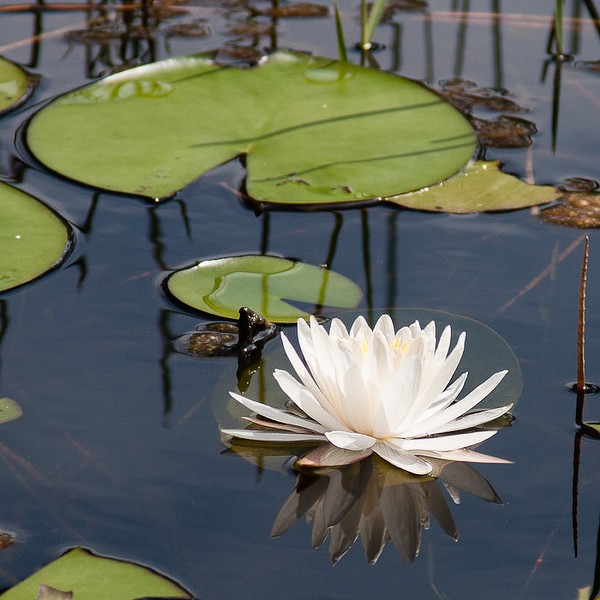
Billy, John, and George hit the Haney Creek trail in Stuart for a third time in three weeks, and this week’s featured species is selected on the basis of smellin’ good: White Water Lily.   And it is as pretty as it smells.    Everybody has spotted this beauty at times in pondy places.

Before going on, it is relevant re. our recent blogs to re-mention hybridization.  Our species reportedly hybridizes with the native yellow “Mexican Water Lily,” Nymphaea mexicana.  Most of the garden Water Lilies are in fact hybrids.  Criss-crossing Nymphaeas was an institutional project of the Missouri Botanical Garden in St. Louis for decades.

Water Lily at Haney Creek this week by John Bradford

These are primitive flowering plants by certain measures.   Many plant enthusiasts are familiar with the split partitioning most flowering plants into two huge subgroups, the Monocots and Dicots.   The Water Lilies predate that fork in the road, and thus are neither Monocot nor Dicot.  Those big blossoms have leafy-looking parts, and they are the only flowers I know to commit pollinatoricide.  They kill their pollinators?  Sad but true.

When a Nymphaea flower opens it has at its center a pool of liquid surrounded by a wall of vertical stamens, like a backyard pool with childproof fence.  The stigma waits at the bottom of the pool.  An insect visitor splashes in and perishes, the pollen washing off its body sinking onto the stigma.  After that, the  stamens bend inward, covering the pool and releasing pollen.  At this point a different visitor is merely dusted with pollen and spared to fly away dusted pollen-wise and go plunk into  the pool of a different flower in its open-pool gotcha phase.  Nature is cruel.

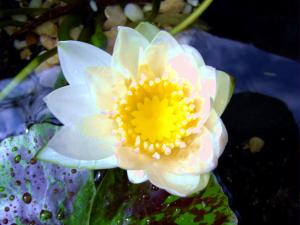
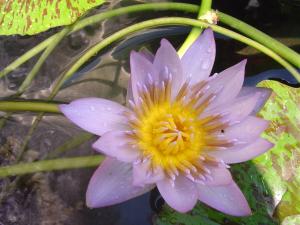
Our examples of open-pool and closed-pool flowers are not actual Nymphaea odorata, but they play one in our blog.  It was either wade out there and shoot the real thing or use a nice dry hybrid substitute. We are wimps.

Proxy hybrid Nymphaea in the deadly open-pool phase.

After pollination, the twisty floral stalk retracts, pulling the fertilized flower down below harm’s way for the fruit to mature. The weirdness continues: inside the fruit the seeds become encased in an aril (extra seed-cover).   Apparently (and I am not certain) the aril is a temporary float, causing the seeds to surface and drift away to sink out of the competitive radius of the parent plant.

Nymphaea classification is difficult.  Beyond hybridization, environmental conditions influence the sizes and forms of the plants.  Several dubious and controversial varieties of Nymphaea odorata have thus had their moments in Florida floristics.  The overall distribution of the species is from Newfoundland to Texas.  One big widespread plastic variable species.

Nymphaeas have huge roles in ethnobotany.  It is intriguing when a species or set of related species with similar bioactivity turn up having the same uses in geographically separate cultures.  Nymphaeas are psychoactive (with a little controversy on that point), as well as sources of edible starch, and had probable narcotic applications at least in ancient Egypt and in pre-European Mayan culture.  The period artwork from both civilizations is eerily similar with respect to Water Lilies.  If you watch the History Channel, of course you realize how aliens with a penchant for intergalactic species introductions shared the cosmic gifts with both Earth-civilizations while out universe-hopping.   Take us to your pollinator!

Proxy hybrid in the pool-closed pollen-releasing phase.

 
5 Comments

Posted by on June 27, 2012 in White Water Lily


Tags: , , ,