The last-standing Cabbage Palm suffers no angst if you chainsaw the rest of the forest. Slash Pines take their slashing without complaint. And a Willow takes no notice of a caterpillar munching its neighbor (or does it?).
There’s a vague yet strong movement in the air these days to attribute plants with some ill-defined intelligence, feelings, or mysterious abilities, depending on whose article you read, and what you read between the lines. Pesky authors often hover around the edges of science, monitor scientific journals, and then “reveal” the more dismaying discoveries out of context in an aura of exaggerated mysticism. Modern-day wizards. This sort of exploitation of science has always bugged me, and a new wave is going around. A book published this year by Michael Marder claims botany to be experiencing a “Copernican Revolution” based on “plant thinking.” A paradigm shift! Isn’t it fun and attention-getting to be the priest of a paradigm shift!?
You know it’s hot stuff when the New Yorker magazine (Dec. 23 this week) has an article on “The Intelligent Plant.” Academics are getting themselves into the news with reports of corn plants communicating via root clicks, and sensitive plants learning to recognize false-alarms.
Even as authors deny it, there’s an anthropomorphic smell to the excited books, articles, and blogs. The implications of plant sentience are precisely what make it newsworthy and exciting, despite a few “aw shucks, I’m not really saying…” The anthropomorphism is a pity, because anyone who knows anything of the birds and the bees already appreciates the beautiful complexity and fine-tuning wrought by hundreds of millions of years of plant evolution. Plants have excited observers without paradigm shifts for centuries.
Botany is not experiencing revolution. I think molecular biology is becoming increasingly sophisticated, revealing at ever-finer resolution marvelous complexity and interconnectedness among “lower life forms.” Call it the increasing refinement of science, not mystical and magical “intelligence.”
That plants “do things” in response to stimulation is no big news. Think of flowers closing by night and opening by day, or of a Bladderwort in a Florida marsh “sensing” and slurping a tiny creature into the plant’s underwater suck-trap. A subtle plant action I’ve always liked in the Bignoniaceae Family is that after pollination the two flaplike stigmas clasp together like hands in prayer, encasing the newly arrived pollen and protecting the stigmatic surfaces. Eerily animal-like.
“Communication” among plants is big news these days. But really not so new at all. It has long been known that a function of aspirin (more precisely salicylic acid) is to act as an airborne “Paul Revere” hormone—“pestilence is coming!” The chemical alarm signal allows the plant under attack to induce defensive mechanisms (which are complex in their own right) in other blissfully complacent neighbors. A botanical call to arms. The growing list of airborne plant-to-plant warning signals will enrich the plant physiology textbooks. The scent of newly cut grass is probably loaded with bad news.
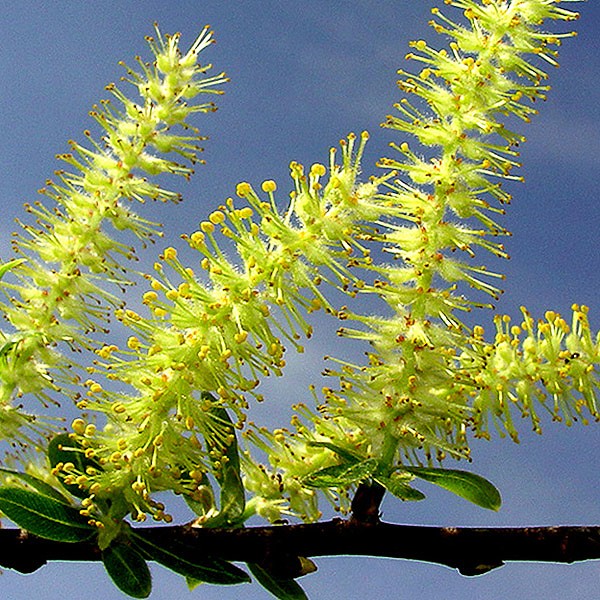
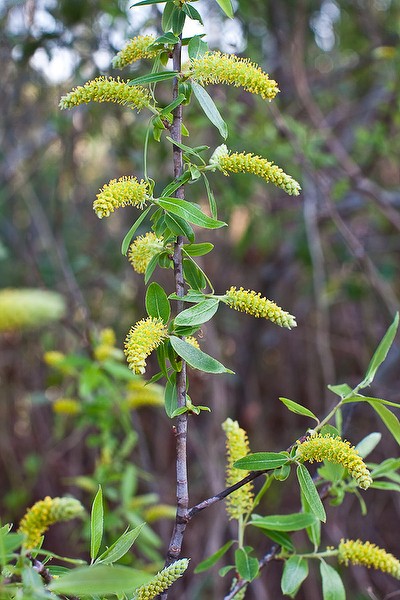
Salicylic acid is named for the Willow genus, Salix, here portrayed in bloom by John.
Folks who dig “plant intelligence” a little too much tend to see such plant communication as generous and aware. But signaling is not some sort of conscious plant-generosity, but rather probably a reflection of the well-established evolutionary principle that if you help those related to you genetically you are promoting survival of your own genes. And if you participate in a collective defensive mechanism, such as buffalo in a circle, that protects you too. Chemical signaling within living organisms is standard, unthinking, and well known. Any botany student can rattle off a list of plant hormones. Chemical signaling from animal-to-animal or insect-to-insect is commonplace. So finding chemical signaling from plant to plant is a wonder of nature, yet not really that surprising, and unrelated to “intelligence” by any distorted definition.
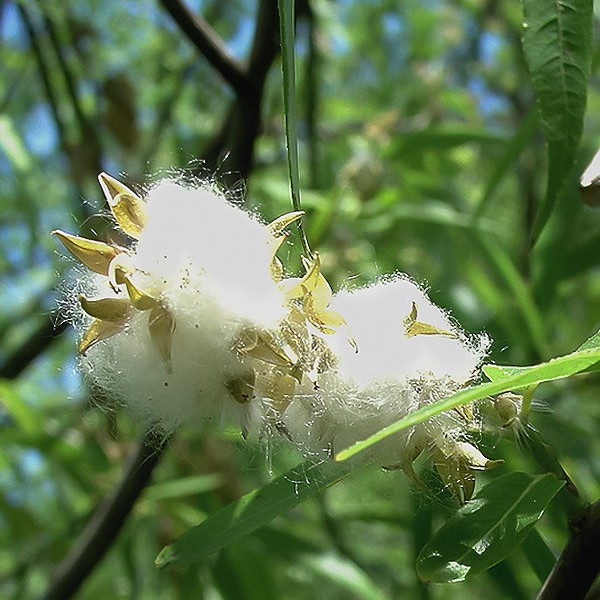
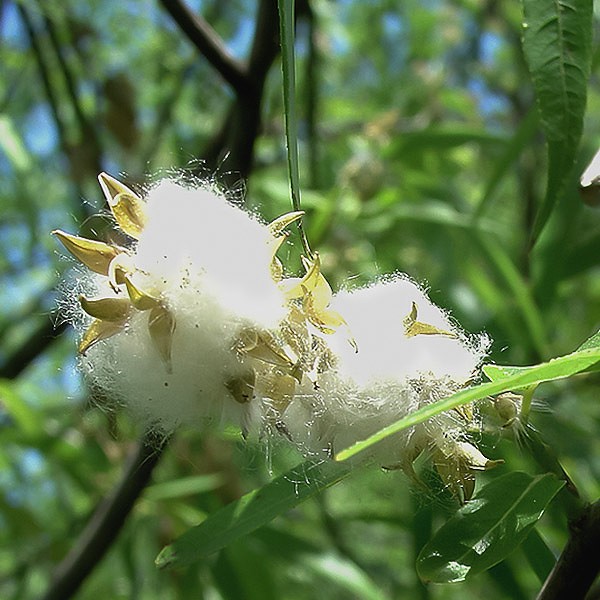
Willow fruit opening (JB)
Speaking of plant communication, you have seen the TV commercial where the tree falling in the forest does make a sound? “A little help here.” Funny-right? Forester Suzanne Simard may not think it’s all so comical. She studies mycorrhizae, the fungal threads that extend out of roots into the soil, helping the root secure phosphorus and other nutrients. She sees mycorrhizae not as extensions of individual trees, but as the LinkedIn of the forest tree community. Dr. Simard sees the fungal symbionts as a shared subterranean network interlinking the trees in an internet of communication and nutrient exchange, even passing nutrients from that tree “falling in the forest” to the younger trees in need of a boost. A “mother” tree may help sustain its progeny via fungal connections, like a mother human depositing funds in her college student son’s bank account. There’s probably a good bit “going on down there” in the fungal-root realm. Sorting it out will be fun for researchers to come. Hear it straight from the source: CLICK
A remarkable article in the prestigious journal Science this Spring made the news CLICK, echoing into the popular press. The obvious role of plant-produced drugs is as natural pesticides. But a non-obvious role for caffeine turned up…to give the pollinating bees a buzz, as one author put it. In Citrus flowers, caffeine in the nectar helps a bee remember the flower, and thus return for another sip of nectar, or for a cup o’ joe.
Who will discover tobacco plants addicting bird-pollinators to nicotine?
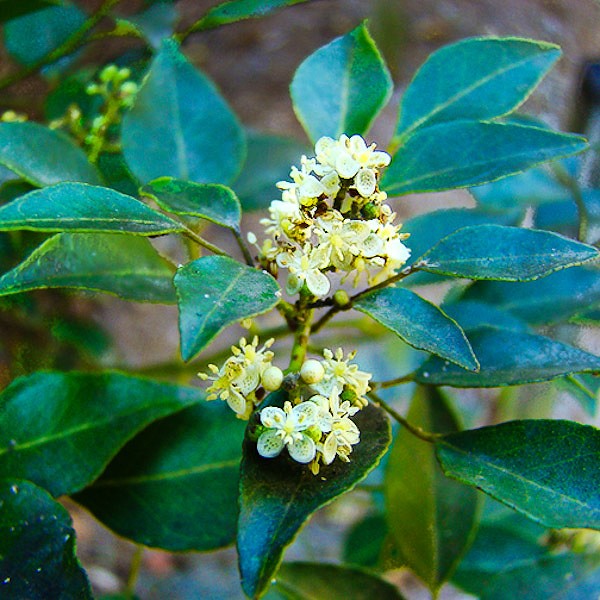
Amyris is a locally native Citrus. Any caffeine in that sweet nectar? (JB)
 John Bradford
 George Rogers
 George Rogers
 Dee Staley
 Treasure Coast Natives