Carolina Willow
Salix caroliniana
Salicaceae
Willows grow everywhere from the Wind in the Willows to the Bible to our own back yards. Long ago I ventured as a young botanist from Michigan to Brazil, expecting the Amazon to look like the pictures in National Geographic, only to be a little disappointed to find Willows just like Michigan along the first shores I saw. But then again, just like disappointing people, Willows are not disappointing if you give them a chance, and we have plenty in South Florida wetlands. There are 450 species worldwide. In South Florida there’s one.
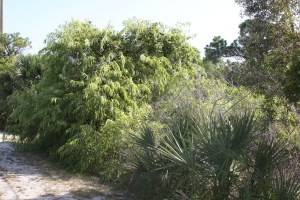
Carolina Willow
Carolina Willow (Salix caroliniana) ranges from Pennsylvania to Guatemala, making it one of those oddball species found in winter ice and in the steamy tropics. Beyond Carolina Willow there are one or two mis-named “Willows” around (Itea, Ludwigia, etc.), and there are additional true Willows (Salix) native and cultivated in Florida generally in the Panhandle and northern Peninsula.
In Florida Carolina Willow is larval host for two lovely lepidopterans: Io Moth caterpillars (green, bristly, and OUCH!!) and Viceroy Butterfly caterpillars (bird dropping posers). Willows tend to be buggy and are prone to stem galls, leaf galls, and various other attacks at the six hands of gall wasps, sawflies (including the “Willow Sawfly”), beetles (notably native and invasive Willow Leaf Beetles), the Cottonwood Borer Skeleton Beetle, and others.
Today’s trees make straight lithe branches to the benefit of archers and basket-weavers. Since prehistoric times, they have been used in making fences, canastas, fishtraps, willow-wattle fences, arrows, switches, and more. Land managers like Willows because they flourish in reclaimed wetlands. (Others dislike willows because they can be invasive, including into sewer lines.) The plants tend to be easy to propagate from cuttings, being adapted to fragment in floods and root downstream. They also make great rootstocks and scions for practice grafting. We maintain some in the PBSC nursery for that purpose.
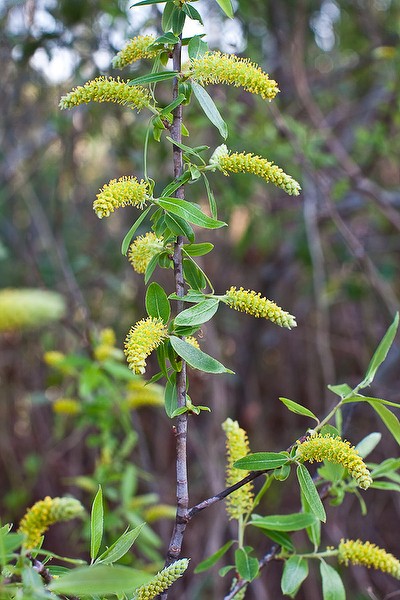
Willow catkins (by JB)
More notably, headache-suffers around the world have discovered multiculturally that preparations from Willow bark relieve pain. Aspirin is salicylic acid, named for the generic name Salix, although the distribution of salicylic acid (to apply the name loosely to a family of related compounds) is broad in the plant world. Aspirin was historically extracted from Willows and from other plants; now it is synthetic.
Now for the good part: Why do plants make salicylic acid to begin with? Not to dull our pain. The compound is a plant hormone able to arouse the plant’s “immune system” in the event of pathogenic invasion. In recent years there has emerged a literature on the more subtle submicroscopic-biochemical side of plant self-defense and the role of salicylic acid in sounding the alarm. The hormone has the fascinating ability to spread the word like Paul Revere through the air to other plants in the same population. Willows can grow in massive stands as a monoculture. Is this why they generate apparently exceptionally high levels of salicylic acid?
Willow flowers come forth early in the Spring, attracting pollinating bees before there’s much competition. The flowers are in separate male and female catkins, which are elongate clusters of small individual unisexual flowers. They are the pussys in Pussy-willows.
Most plants with catkins are pollinated by wind. But Willows may have turned the beat around, reverting from wind pollination to insects. Pollinator insects require compensation, and the Willow offers nectar, but from an unsual source, from highly modified petals and or sepals. These organs somewhere in evolutionary history lost their showy functions in favor of becoming nectar glands, as though Willows “reinvented the wheel” (well, the nectary) long ago and far away. Then come the seeds on silky parachutes: birdy delights for lining the nest.
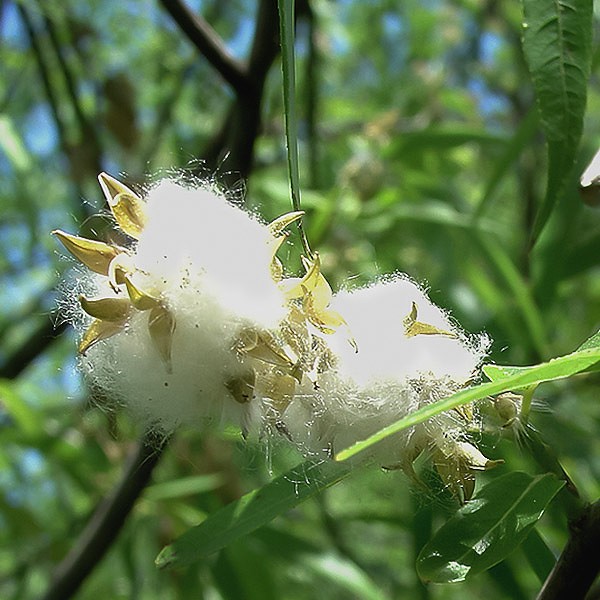
Use these seeds to cushion your nestegg (by JB).
 John Bradford
 George Rogers
 George Rogers
 Dee Staley
 Treasure Coast Natives