Canna
Canna flaccida
Cannaceae
[Posting off-schedule this week due to travel plans.]
There aren’t many wildflowers showier than Cannas (pronounced CAN-ahs, not CAIN-ahs). Our native species, Canna flaccida, is in some books dubbed “Bandana of the Everglades,” which fails to fit a species distributed from the Carolinas to South America, not to mention a silly mouthful. “Gander yonder Mortimer, methinks a Bandana of the Everglades.” One thing for sure, Canna “Lily” is a misnomer; Cannas are gingers in a broad (ok, overstretched) sense. How about a simple “Wild Canna”?
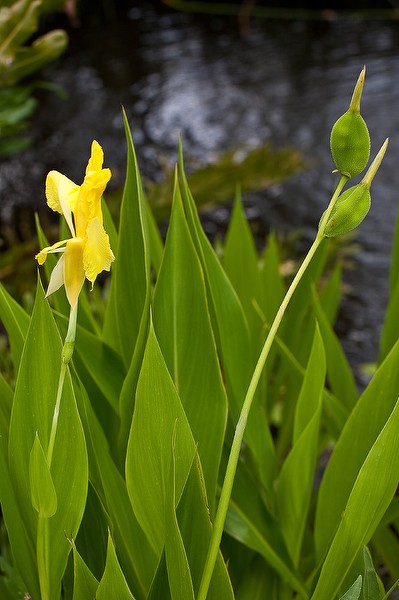
Some escape cultivation in Florida. Most notably, Indian Shot (Canna indica) is a skinny red-flowered species. Canna glauca can hybridize with Indian Shot. Canna glauca resembles C. flaccida by having yellow flowers but differs by having erect (vs. drooping) petals. And most of those those big reddish-orangish garden Cannas belong to a hybrid complex known as Canna Xgeneralis. These crossed with our native Canna flaccida give an old line of garden hybrids called Canna Xorchiodes.
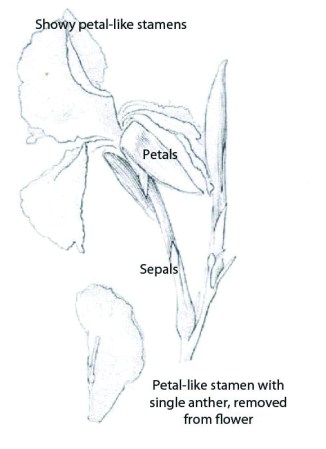
More interesting is the unusual way Canna flowers and those of some related families (especially the Ginger Family) are built. The showy parts are modified stamens with no anthers (except for a half-anther on one of those showy stamens). Go find a Canna flower and pluck it outside-in. First come three sepals—they look normal. Then come three puny petals. And then proceeding inward you find all the big showy parts that look like petals; these are stamens. Find the one with the half-anther.
Wild Canna occupies marshes and shores, and has landscaping and restoration uses in wet settings. We’ve grown it in the PBSC Plant Nursery and encountered a couple headaches. They can be a little fussy. Cannas are caterpillar food, especially for two species of “Canna Leaf Roller” caterpillars. Try B.t., or better, drop the anthropocentric gardener mindset and switch to a more biophilic outlook and say supportively, “Canna flaccida is larval host to the brown-gold-and speckled Brazilian Skipper Butterfly and to the Lesser Canna Leafroller moth.” Additionally, the plants can host an ugly Rust fungus.
The fragrant short-lived flowers look best at dusk, and dawn (I hear), and presumably are pollinated by hawkmoths.
In addition to decorating our world, Cannas serve humanity in their own odd ways. Canna indica (including “C. edulis“) has an edible rhizome cultivated as one of multiple sources of “arrowroot” starch. The seeds look like rosary beads or buckshot, depending on your standpoint, and have served for prayer and mayhem. A seed from a 600-year-old rattle in an Argentinian grave sprouted just fine. The plants are grow-your-own mosquito coils burned to bug the bugs, and the foliage is a cheap locally produced snail killer to control the slimy varmints that carry the parasitic disease Schistosomiasis.
 John Bradford
 George Rogers
 George Rogers
 Dee Staley
 Treasure Coast Natives