Skyblue Lupine
Lupinus diffusus
Fabaceae
[Fertilizer 101: In descending order of abundance, plants need mostly nitrogen, much phosphorus, potassium, and several “minor” and “micro” nutrients, including prominently iron. Nitrogen is abundant in the air, but microbes must convert that nitrogen gas to the nitrate and ammonium plants use. Plants often have trouble acquiring phosphorus, because it does not flow in with water as nitrogen does. The plant root or fungi associated with the root have to “go get” phosphorus. Plants in scrub sand have automatic nutrient challenges in that ultra-poor soil.]
Out seeking eagles today, John jumped about 5 feet into the air, mumbling something about “red touches yellow.”
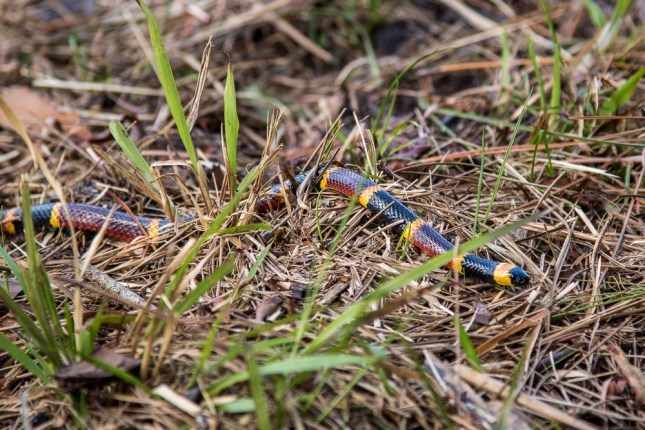
Something yellow, something black sneaking up behind your back. (Except where indicated differently, today’s photos by John Bradford.)
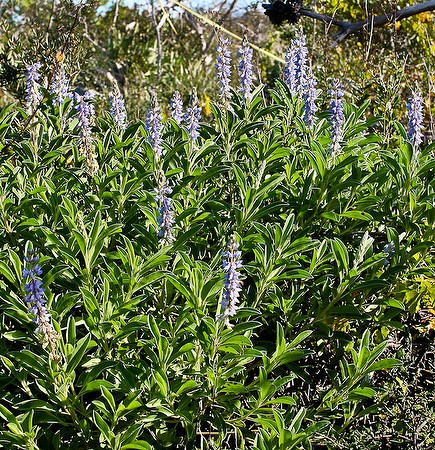
Near the sneaky snake we found the pretty plant of the day…Skyblue Lupine. And here is its mystery: out in the sugar sand scrub most plants look like they belong growing in a sun-cooked nutrient-deficient sandbox. They tend to have tough demeanors. Their gnarly adaptations are what make scrub fun to photo. But Lupines, by contrast, look robust, green, lush, and perky. How does the Lupine do it? How does a Lupine on the sterile sand look like a Garden Club flower out of a nice fertilized flower pot?
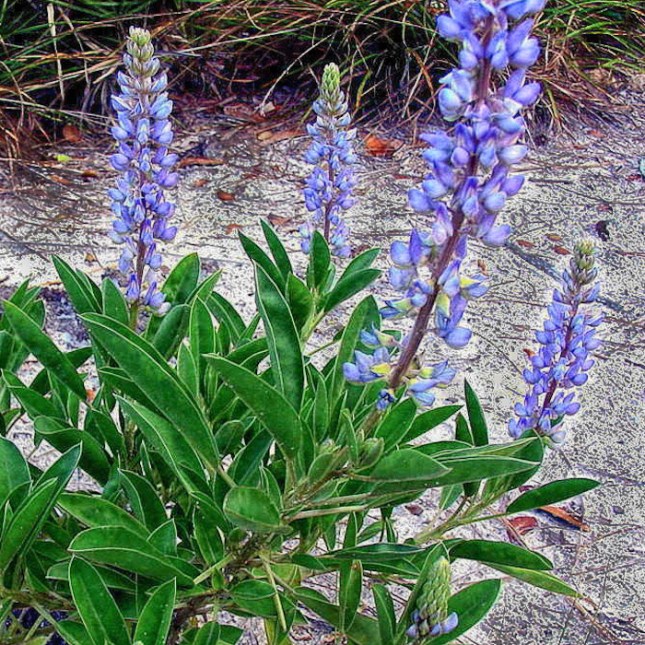
Too spunky for a scrub plant!
There may be an answer or two. It is a Legume, and Legumes have nitrogen-fixing bacterial root nodules to capture that atmospheric nitrogen Nitrogen problem solved. True and nice, but just the first chapter in a better story. How bout the second-most limiting nutrient, phosphorus?
Here we must turn to other Lupine species and extrapolate speculatively. Multiple hundred Lupinus species color the world, including the length of North and South America along the Rocky Mountains and Andes, and much more. A handful decorate Florida, some native. Only one is indigenous to South Florida, L. diffusus. Now back to phosphorus.
Students from my classes, I hope might say, “symbiotic fungi help plants get phosphorus by digesting soil organic matter and sharing the booty with their host roots.” But oh yea….that scrub soil has no organic matter, and Lupines do not have (or not much) helpful root fungi. By the way, Lupines collectively are famous for tolerating terrible soils. In their sterile ground they need a plan-B to get their P:
Back in the 80s botanists caught on to what were called “Proteoid Roots,” discovered first in the plant family Proteaceae. Since then such roots have turned up in additional plants, making the newer name “Cluster Roots” better. Cluster Roots look like a bottlebrush. Guess what stimulates their formation? Low phosphorus. Guess what plants outside of Proteaceae can form them to counter low P? Some Lupines, although as far as I know, L. diffusus remains unchecked, and we can’t dig it in a state park to see!
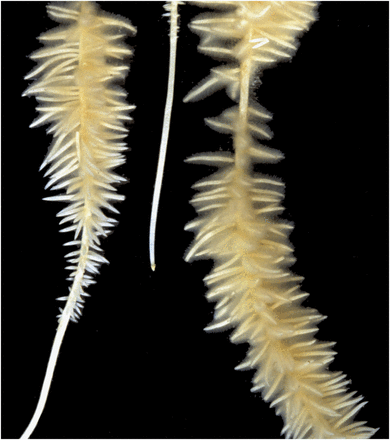
Lupine Cluster Roots (Michael Shane, Am. Jour. Bot. 100: 263. 2013)
Cluster Roots are not mere brushes. They are dynamic chemical factories. The sorts of chemical activities associated with Cluster Roots occur as expected in Lupines with Cluster Roots. And a little surprisingly, the “Cluster Root functions” turn up also in Lupines where Cluster Roots are unknown. What are those magic functions?
First and foremost, they secrete citric acid (aka citrate) and similar compounds able to displace phosphorus from soil particles, busting P loose for the plant. Reportedly as much as 1/3 of the photosynthetic product of some Lupines winds up as excreted citric acid. And it gets better: Citric acid can free inorganic phosphorus, that is, from soil minerals themselves, not just from (that absent) decaying organic matter.
Lupine roots release supplemental enzymes called phosphatases that liberate even more phosphorus while additional secretions adjust the soil acidity, probably to support the phosphatase enzymes and/or to help bring in iron, which is sensitive to soil acidity. But there’s a problem:
Soil microbes digest citric acid. No worries, Lupines put out soil antibiotics to thwart the little pests. That’s doubly useful because citric acid helps chaperone iron into roots. Citric acid helps so much with iron and phosphorus uptake, some commercial fertilizers include it as an ingredient, sometimes hand-in-hand with potassium as potassium citrate.
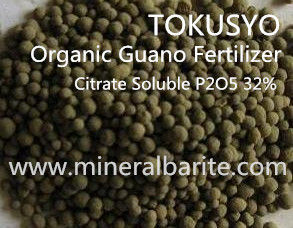
Factories put citrate (citric acid) in the bag along with P (the P2O5 on the label above). Lupines make their own citrate, and borrow their P from the soil directly.
That’s a lot on nutrients. So here’s the upshot. All this helps explain something old, something new, something borrowed, and something blue.
Something old:
Lupines as crops date back thousands of years, valued for growth on poor soils. Explained!
Something new:
Lupines are future crops precious in a starving world with poor soils to farm and phosphorus fertilizers becoming expensive.
Something borrowed:
Phosphorus fertilizers are pollutants. But Lupines merely borrow P from the soil, then give it back when plowed under, even helping support other crops. No polluting P added!
Something blue:
How many blue wildflowers are there? (Few)
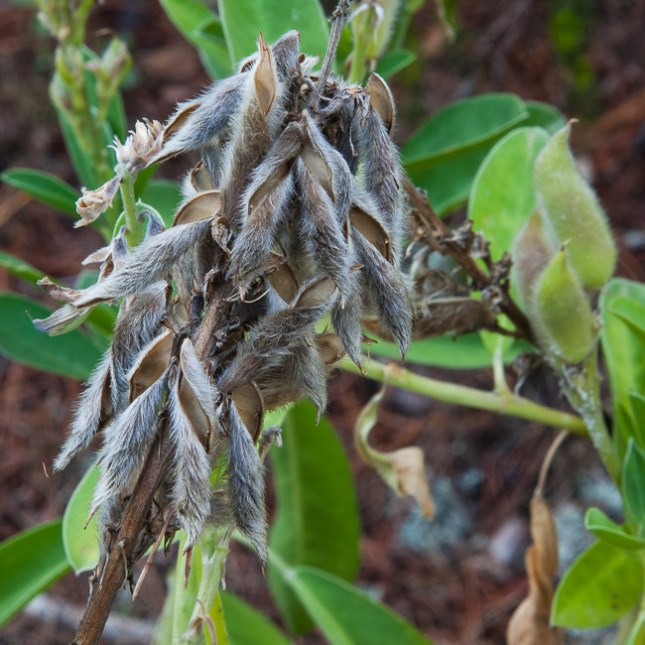
The pods are woolly.
 John Bradford
 George Rogers
 George Rogers
 Dee Staley
 Treasure Coast Natives