RSS

Achoo, Sniffle, Ragweed

Ragweed

Ambrosia artemisiifolia

Asteraceae

Isn’t “ambrosia” food of the gods, incarnate here on earth as that marshmallow-coconut-jello salad?  What was Linnaeus thinking when he named Ragweed that!?

[On the off-topic of Linnaeus as a naming nut, it amuses me that in the native-plants-in-the-landscape classic, “Going Native,” Richard Workman questioned Linnaeus’s handle “cynophallophora” (dog-you-know-what-bearing) for Jamaican Caper.  “Considering all the beautiful and attractive characteristics of this plant, I can’t help wondering a little about Linnaeus and his motivation.”  That’s wimpy by Linnaean standards.  That D.O.M. was not fit for polite society.]
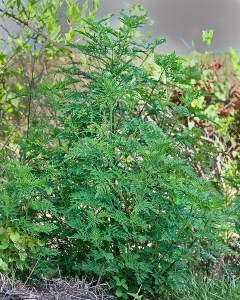
Ragweed in Cypress Creek (by JB)

It’s not exactly divine, but Ragweed is a native weed distributed, get this (!) from Alaska to Florida, and from there globally as an invasive exotic.  It loves disturbance.  Have you ever seen how Ragweed monopolizes freshly excavated dirt?  Among other adaptations, the seeds (achenes) are tiny burrs no doubt carried by anything that moves.  And more interestingly, the seeds accumulate in the soil with varied germination times.  Some sprout lickety-split, others slumber for decades, just waiting for that road grader.  John and George this week hiked the Cypress Creek Natural Area near Jupiter Farms and, after passing by all the pretty photogenic wildflowers, focused on the dominant species.  The spoil banks along the graded road are  ribbons of Ragweed.

In a fun little book, “My Weeds,” garden writer Sara Stein described a classroom activity called “Magic Dirt” where the children go outside and fill a flowerpot with nice “clean” soil, and place their pot on the classroom windowsill to witness awakening weeds.  I LIKE it!  The Cypress Creek road banks are Magic Dirt on a macro-scale.  Food of the gods for a mile.   How long have some of those seeds been banked in the soil?   Perhaps their parents caused sneezing at the Battle of the Loxahatchee on more or less the same ground in 1838.
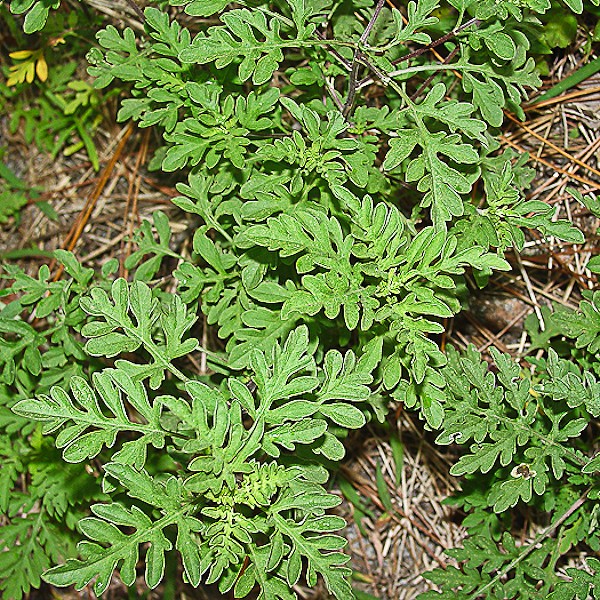
Ragweed babies aplenty (by JB)

That’s the thing we all know about Ragweed, Gesundheit!  The plant releases pollen like a fiend.  Let’s linger on that a moment, because wanton wind pollination is unusual in the mostly straight-laced insect-pollinated Aster Family.

Have you ever know a human family where one generation builds up a tightly run business, only to have a sloppy subsequent generation let it all go to seed?  (This occurred with a vengeance, perhaps literally, in my own family.)  Ragweed is the hippie cousin.  Most members of the Aster Family have elaborate little flowers with a hyper-specialized pollen-presentation system where first the style pushes a tiny dollop of pollen out of a tube formed by the anthers, and then the style delicately rises and becomes pollen-receptive, all very precise,  proper, and timed.  In “good” members of the Aster Family those  tiny flowers cluster cooperatively into those showy false-flowers of Asters, Chrysanthemums, Dahlias, Daisies, and  Sunflowers.    So organized, so controlled.
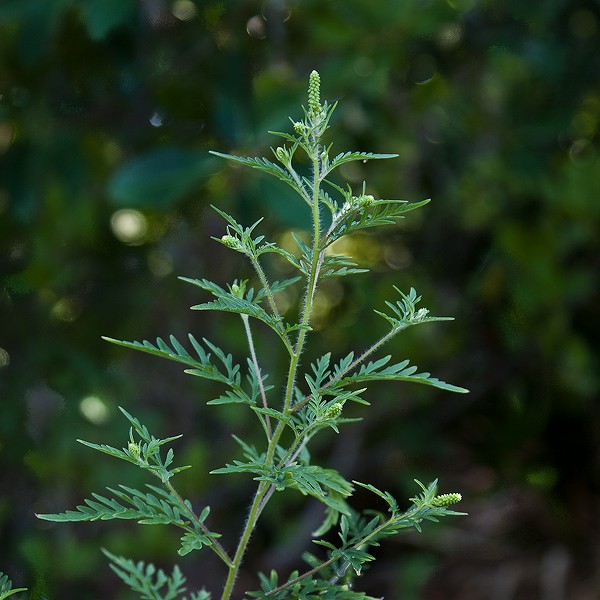
Photo by JB

Ragweed says bah!  Ragweed shuns showy flower heads.  It spurns elaborate pollen presentation.  It repudiates insect pollinators, nectar, and perfumed scents.  It scorned Brooks Brothers,  put on torn bluejeans,  and chose a different path:  wind pollination.  It thinks it is a grass.

The small Ragweed flower heads look like single flowers, and are arranged in catkins (linear clusters), as in many wind-pollinated plants.  The pollen-producing (“male”) flowers are separate from the seed-making (“female”) flowers on the same plant.  (Yes, self-pollination can occur on one plant; that way, a single seed can pioneer a whole new population.)
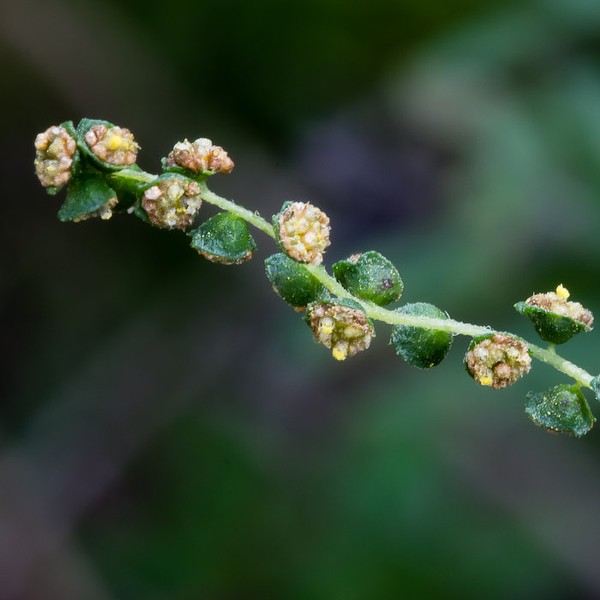
Male flower heads (by JB)

The female flowers are little more than an ovary with two big stigmas jutting out like antennae to catch wind-borne pollen. The male flowers are nothing more than pollen bags.

And that is why Ragweed is so sneezy… it lives to pollute the air.  I’ve read that one plant can generate a billion grains.  Who’s counting?

And why is air-borne pollen so allergenic?  Did you ever wonder how a flower knows which pollen to let fertilize its seeds, and which to thwart?  I mean, a female cat knows a male cat, and a female turtle probably knows a male turtle.  But flowers are different.  The stigma (pollen-receptive surface) has built-in pollen recognition ability.  A pollen grain landing on a stigma can release proteins  that ask the stigma, “am I on the right stigma”?  The stigma can then allow the pollen to perform its function, or kill it.  As I suppose speculatively,  when pollen catches in our moist sinuses, it releases its recognition proteins (and it has plenty of additional  proteins) and asks, “am I on a stigma?”   Our immune system recognizes that foreign protein as an antigen.

Linnaeus (stolen from the Internet)
 
5 Comments

Posted by on July 11, 2012 in Ragweed


Tags: , , ,

Why is the Redroot Red?

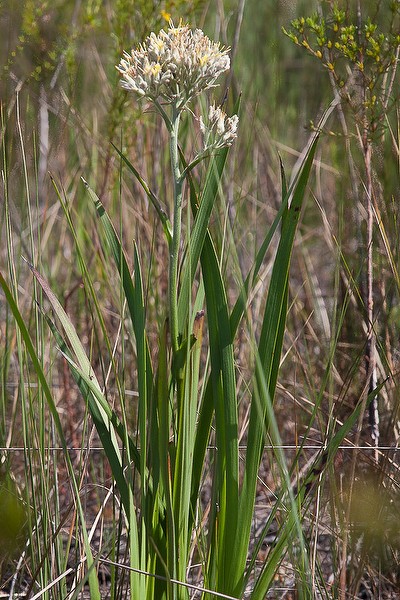
Carolina Redroot

Lachnanthes caroliana

Haemodoraceae

Halpatioke Park in Stuart was where John and George got lost yesterday, but the advantage of getting lost is extended exploration, and in the depth of our despair took comfort in Marshallia tenuifolia (Barbara’s Buttons) putting on a fancy show.  We traipsed also through a Hypericum marsh full of the odd annual grass Steinchisma laxa which seems to relocate from year to year as the wind blows.  But enough of this pointless chatter:  we are here for Carolina Redroot (Lachnanthese caroliana).

Carolina Redroot (by JB)

Carolina Redroot looks vegetatively like an Iris, and like one of those, it prefers wet places and shallow water.  What’s woolly on the outside and yellow on the inside?  The Cowardly Lion?  No, Lachnanthes blossoms.  In class we talk about butterfly-pollinated flowers resembling upside-down witch hats, which occur more often in Dicots than in Monocots, such as today’s pretty Monocot.  Butterflies do visit, but not just butterflies.  Yesterday the dominant floral visitors were  big scary-looking bees (or bee posers).

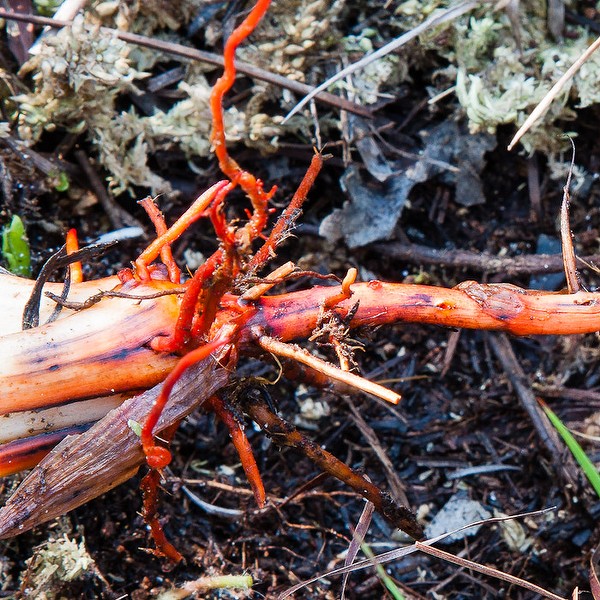
The term redroot is apt, as the subterranean underpinnings are bloody.  The red bleeds readily into oils and ethanol, meaning that people have used the stuff easily.   William Bartram and other 18th Century observers encountered Native Americans using an oil extract as tinted hair oil.  (I’ve had students who look like they do too.)  The red serves also as fabric dye, which I could have discovered personally, as my right thumbnail remains red long after handling the roots.  Easily extracted plant products have a way of winding up in homeopathy, which is true of our plant.

Bad for white pigs but okay for black ones? What do the feral hogs think? (By JB)

Why would a plant pack its roots with red stuff?  I do not know how important the actual coloration is.  It could be a  sort of warning coloration—“hey, pigs don’t  munch these poison roots.”  The plants are reputedly tough on livestock, including a much-repeated, but unsubstantiated, report that the roots poison white pigs but not black ones.  It turns their bones red!  There could actually be something to it, because there are hints of the toxins causing photosensitivity, so maybe black pigs have natural sunscreen.  Or then again this is all coming from some iffy sources and may be hogwash.  (I’d love to know the dietary attitude of feral piggies to Redroot roots.)

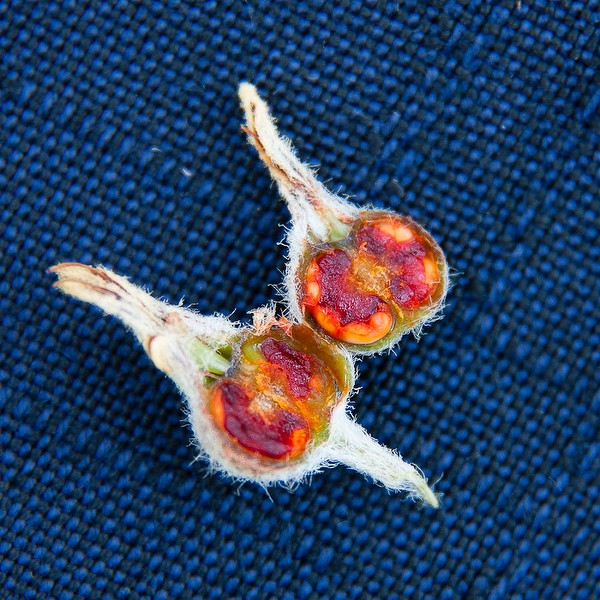
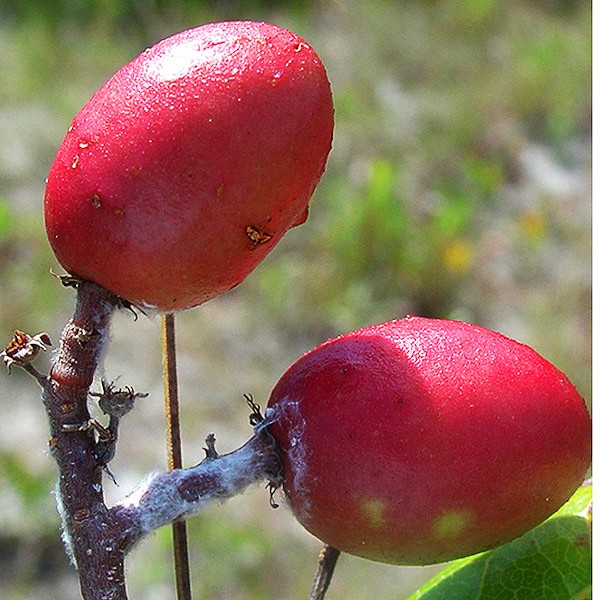
What is more fascinating about the red material, which seems to be a chemical blend, is that the other big concentration is in the young fruit.  What does the young fruit have in common with the root?  Both are starchy regions the plant may defend from hungry varmints.  Cut across an immature capsule and it glows red like rubies.  Really, try it.  (You will get red fingers.)  The red part is not the seeds,  but rather a massive swollen exaggerated placenta, which is the organ to which seeds are attached.  (Technically, a portion of the seed attachment itself may contribute to the red mass.)  Mammal placentas are big and red, but why would a plant have such a thing?  I think the placenta is a big red poison pill.  The main compound reported from it is a toxin called lachnanthocarpone.  As the fruit ripens the redness fades.  The mature fruits are ugly dry capsules crowned with persistent sepal tips.

The young fruit is a box of rubies. The red part is (mostly) the placenta. The seeds are yellowish. (By JB)

Evidence that dispersal is mostly by flotation, at least in some regions, is that in northern portions of the range Redroot spreads through physically interconnected water systems yet is absent from apparently suitable habitats without flotation access.

Speaking of the distribution, the range is bizarre, from Cuba to Nova Scotia.  Despite what I just said about floating, a spotty linear north-south range implicates migrating waterfowl as translatitudinal movers and shakers.

Redroot is not prominent garden-wise, but it is cultivated occasionally, including in Europe, with an eye to its wetland proclivities.  Commercial availability is low, although the Florida Wildflower Growers Cooperative offers the seeds.  CLICK

 
1 Comment

Posted by on July 3, 2012 in Carolina Redroot


Tags: , , ,

Water Lilies are Ungrateful

White Water Lily

Nymphaea odorata

Nymphaeaceae

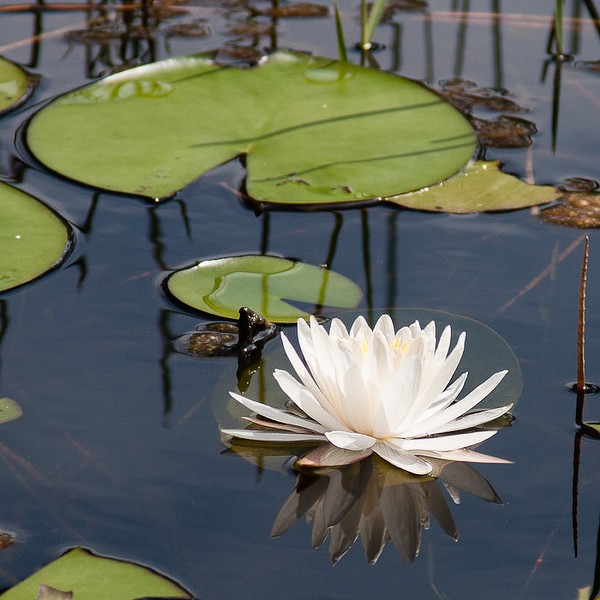
Billy, John, and George hit the Haney Creek trail in Stuart for a third time in three weeks, and this week’s featured species is selected on the basis of smellin’ good: White Water Lily.   And it is as pretty as it smells.    Everybody has spotted this beauty at times in pondy places.

Before going on, it is relevant re. our recent blogs to re-mention hybridization.  Our species reportedly hybridizes with the native yellow “Mexican Water Lily,” Nymphaea mexicana.  Most of the garden Water Lilies are in fact hybrids.  Criss-crossing Nymphaeas was an institutional project of the Missouri Botanical Garden in St. Louis for decades.

Water Lily at Haney Creek this week by John Bradford

These are primitive flowering plants by certain measures.   Many plant enthusiasts are familiar with the split partitioning most flowering plants into two huge subgroups, the Monocots and Dicots.   The Water Lilies predate that fork in the road, and thus are neither Monocot nor Dicot.  Those big blossoms have leafy-looking parts, and they are the only flowers I know to commit pollinatoricide.  They kill their pollinators?  Sad but true.

When a Nymphaea flower opens it has at its center a pool of liquid surrounded by a wall of vertical stamens, like a backyard pool with childproof fence.  The stigma waits at the bottom of the pool.  An insect visitor splashes in and perishes, the pollen washing off its body sinking onto the stigma.  After that, the  stamens bend inward, covering the pool and releasing pollen.  At this point a different visitor is merely dusted with pollen and spared to fly away dusted pollen-wise and go plunk into  the pool of a different flower in its open-pool gotcha phase.  Nature is cruel.

Our examples of open-pool and closed-pool flowers are not actual Nymphaea odorata, but they play one in our blog.  It was either wade out there and shoot the real thing or use a nice dry hybrid substitute. We are wimps.

Proxy hybrid Nymphaea in the deadly open-pool phase.

After pollination, the twisty floral stalk retracts, pulling the fertilized flower down below harm’s way for the fruit to mature. The weirdness continues: inside the fruit the seeds become encased in an aril (extra seed-cover).   Apparently (and I am not certain) the aril is a temporary float, causing the seeds to surface and drift away to sink out of the competitive radius of the parent plant.

Nymphaea classification is difficult.  Beyond hybridization, environmental conditions influence the sizes and forms of the plants.  Several dubious and controversial varieties of Nymphaea odorata have thus had their moments in Florida floristics.  The overall distribution of the species is from Newfoundland to Texas.  One big widespread plastic variable species.

Nymphaeas have huge roles in ethnobotany.  It is intriguing when a species or set of related species with similar bioactivity turn up having the same uses in geographically separate cultures.  Nymphaeas are psychoactive (with a little controversy on that point), as well as sources of edible starch, and had probable narcotic applications at least in ancient Egypt and in pre-European Mayan culture.  The period artwork from both civilizations is eerily similar with respect to Water Lilies.  If you watch the History Channel, of course you realize how aliens with a penchant for intergalactic species introductions shared the cosmic gifts with both Earth-civilizations while out universe-hopping.   Take us to your pollinator!

Proxy hybrid in the pool-closed pollen-releasing phase.

 
5 Comments

Posted by on June 27, 2012 in White Water Lily


Tags: , , ,

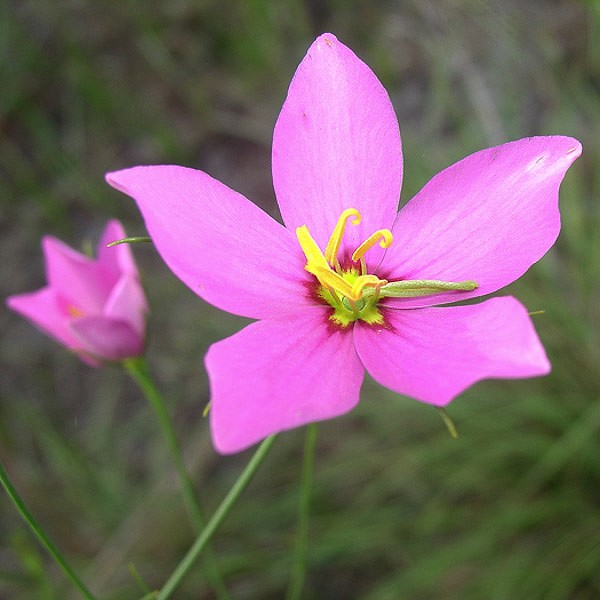
Sabatia grandiflora, about as pretty as they come

Rose-Gentian

Sabatia grandiflora

Gentianaceae

Yesterday Billy, John and George visited the Haney Creek Trail near Stuart.  The site is a scrub-lover’s (and dog-walker’s) delight enhanced aquatically with borrow pits, ponds, marshes, creeks, and mystery regions to reconnoiter.

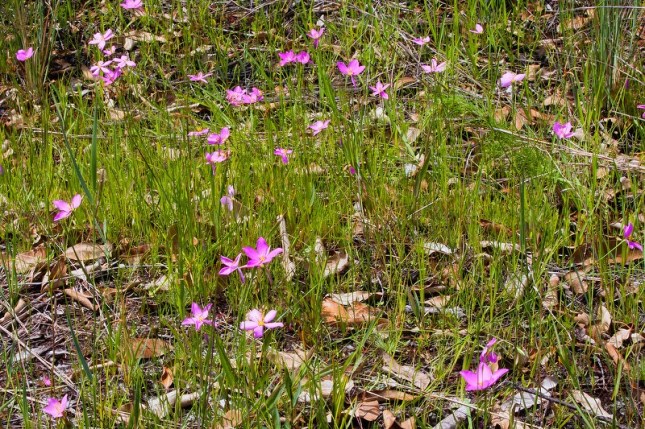
We squished through a flowery marsh which reinforced an old perception.   Now please understand that this perception is a figment of my imagination.  Sometimes wildflowers seem to cluster by color.  A person could make up a reason:  maybe if certain pollinators in a habitat naturally prefer or become “trained” to the color of the predominant flower, other flower species horn in on the action by mimicry.  As a comparable retail scenario,  everybody knows what a Coca Cola can looks like.  Some coke knock-offs use a similar color scheme and fancy-curvy script.  (It would take a little contortion to “floral color mimicry” in terms of evolutionary adaptation but it could be done in a more rigorous blog.)

Floral color mimics (photo borrowed from the Internet)
 

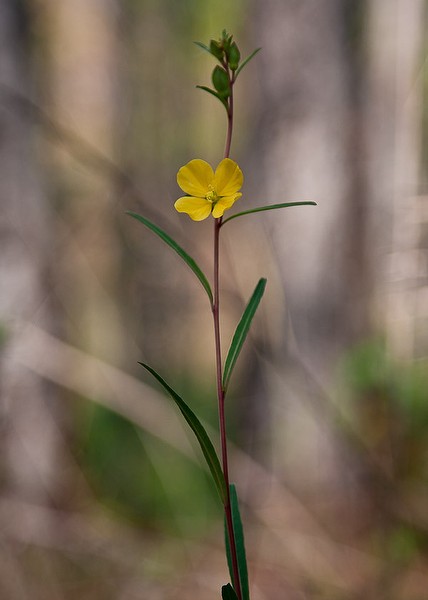
Possibly different species with similar rose-colored petals add up to a big collective pinkish attraction for pollinators who prefer that color, just as several shoe stores in a mall collectively draw those shoppers seeking footwear.   Who knows?  This is my daydream so I can imagine whatever I dang well please.  Yesterday the wet center of the marsh was all yellow:  Elliott’s Xyris, Yellow Polygalas, St. Johnsworts.  (Okay, the Carolina Redroot flowers don’t quite qualify as yellow but it has a lot of yellow in it.)

Sabatia grandiflora. The bright yellow pollen-bearing anthers are in the flower center. The two green stigmas are twisted together temporarily sidelined on the right. The flower will need that yellow eye to still imply “yellow pollen” when the yellow anthers fall away as the flower shifts to its female phase. (Photo by JB)


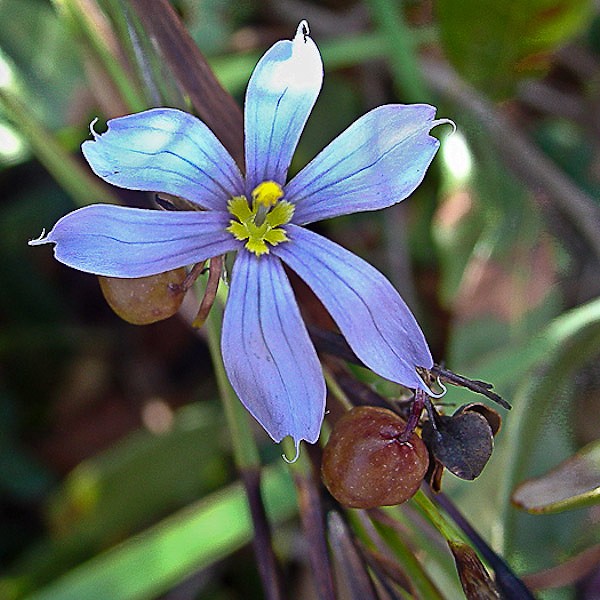
By contrast, the marsh fringe was predominantly pinkish-rosyish:  Meadowbeauties,  Rosy Camphorweed,  Rosegentians (also called Marsh-Pinks).   The last-mentioned were the stars of the show.  These shocking  pinkies (Sabatia grandiflora) were so abundant and crowded they looked like a flower garden, but better, being wild, natural, un-tended, and un-intended.  The petals are power-pink with a jagged yellow central eye rimmed with red.  To linger annoyingly on my daydream of  “floral color mimicry,”  similar starry yellow eyes peep from unrelated flowers.  For instance,  enjoy John’s photo of Sisyrinchium xerophyllum.

Sisyrhinchium xerophyllum (by JB)


Floral beauty runs in the Gentian Family,  with several species of Sabatia and other Gentians in Florida.  Our Sabatia is so purty can you cultivate it in the garden?   Not so readily.  This is a wetland annual.

Another question, how do you pronounce the name?  Some pronounce it as “seh-BAISH-ah.”   Let me suggest, contrarily, saw-BAT-ee-ah, given that the namesake is Italian botanist Libertus Sabbati, not a dermatological cyst.

That today’s species is an annual fits its shallow water lifestyle.  It scatters tiny seeds (with pitted surfaces, as in many wetland species), setting the stage for seedling opportunism where the moisture level and other critical factors may be hospitable at the moment.  A perennial lifestyle would less nimble keeping up with rising and falling waters.   If there was nothing else to do, I’d map the position of the Sabatia patches (and associated pinkish flowers) around a marsh relative to water levels one year and then repeat that comparatively  in following years.   But then again, the boss wouldn’t regard Sabatia mapping as a priority.  (Meetings are such a fruitful use of time.)

Sabatia changes sex dramatically.  The flowers are male first.  Look at John’s beautiful picture of the male phase with the stamens all yellow and assertive;  the stigmas bend off to the side twisted together demurely out of action.   Soon, however, the anthers fall way and the stigmas separate, rise, and take charge.

 
4 Comments

Posted by on June 20, 2012 in Rose-Gentian


Tags: , , , , ,

Ludwigia –What a Tangled Web We Perceive When at First We Practice to Use Our Keys

Ludwigia

Onagraceae

Last Friday Billy, John and George survived a thunder squall on the Haney Creek Trail in (or near) Jensen Beach.  Beautiful site, but too much lightning and too many Ludwigias, aka Primrose-Willows.

Have you ever hurt your head attempting to key out a plant species only to find the glove don’t fit so you must acquit?  Did you pause and wonder:  is the problem the dumb key writer?  Or is it me overlooking something?  Or is it the plant?  The problem may be you or a goofy key writer, but sometimes the plant really truly does not fit.  Plants do not know we will them to fit into a stilted 18th Century system of classification.

Ludwigia maritima (by JB) (It has two chromosome sets, so does John.)

Look at it this way.  Einstein figured out there’s no such thing as space and time. They’re human concepts.  I never really understood that, but I do understand sometimes there’s no such thing as species.  They’re human concepts.  What is amazing is how often plants do sort themselves out into species, but not always.

That all begs a big question: what is a species?  Well (somewhat animal-o-centrically) we’d like it to be a lineage of organisms that all look very much alike and breed readily with each other but with nobody else.  We’d like a species to be fairly widespread and ancient.  Nobody told all the plants about this, however.

There are groups of plants whose classification has never been resolved for the simple reason that their patterns of breeding, histories, and visible differences do not resolve into traditional species.   Ludwigia is a prime example, because its pattern of variation is nutty.  Hold this thought a moment as I set the stage with a little context.

Ludwigia consists of about 82 species around the world with North and South America points of concentration. Florida has about 28 species, some of them invasive exotics and others of questionable provenance.   Our immediate blog area has about 16 species.  That’s plenty.

Ludwigia peruviana (by JB)

Florida Ludwigias range in size from little floating or mud-creeping weeds to shrubs taller than you are.  Some have big yellow buttercup flowers; several have no petals at all.   The fruits shapes are all over the map from cigarettes to dice,  the leaves can be opposite or alternate (and extremely variable even on single  individuals),  and the plants range from shaggy to bare.  In short, they are diverse, although you usually know one when you see one, like dogs.

Ludwigias are master weeds globally, including American species behaving badly overseas.   The distributions are so expansive that it is often impossible to pinpoint the exact regions of origin.  As an example,  L. octovalvis is a Florida wildflower and an Australian wildflower.  Some have moved around and have hybridized as aquarium plants, escaping when the aquarium gets dumped.  Peruvian Primrose-Willow (L. peruviana)  can reach 12 feet tall, and you could scarcely design a better wetland invader.  This South American exotic roots from floating stem fragments, and it makes seeds in massive numbers carried by water currents, birds, and anything that moves.  Needless to say, it can form monospecific stands along shores.  Yet others have restricted distributions.  Ludwigia stricta is Cuban and nada mas.

Now back to the species screwiness.  We need a quick lesson on chromosomes and hybrids.  Chromosomes usually come in pairs.  You and I have 23 pairs.  In any given pair, one member arrived from Dad in the sperm, the other from Mom in the egg.  The two chromosomes sets came together (in Rochester in 1952) and paired up in the fertilized egg that grew into me.   Many hybrids are sterile because chromosomes from the sperm of one species and the egg of a different species don’t pair up properly in the fertilized egg.  It would be like sending two kids to run through Beall’s Outlet and each toss 5 shoes into a bag.  Mismatched “pairs” will result The mismatch may prevent  the hybrid from developing or functioning fully, or perhaps from making is own viable sperms and eggs.  A mule.

But plants often do something weird — many double their chromosomes, the equivalent of a person having 92 chromosomes instead of 46.   Or the equivalent of taking that bag full of Beall’s shoes back through the store and adding in the matched shoe for each one the kids tossed in, doubling the shoe total in the bag.

Chromosomal doubling is rare but happens, creating a bizarre but true circumstance.  If a hybrid suffering from mismatched chromosomes has its chromosome number doubled,  then each chromosome has a matched  partner.  This allows plants to form stable fertile hybrids with novel chromosome numbers, having four, six, eight or more chromosome sets.   Bread wheat has six sets. Strawberries have eight.  Multiple chromosomes sets or the plants having them are called polyploids. All of this happens in Ludwigia, and many of the “species” are really stabilized hybrids with differing levels of polyploidy.  Ludwigia maritima has two sets of chromosomes (8 chromosomes in each set for a total of 16).  By contrast, L. peruviana reportedly has 12 sets of chromosomes.  A dozen!

Several of the Ludwigia species in the Southeastern U.S. belong to an odd complex mix of four chromosome sets, or six.  Those with four sets cross freely, a process aided by human disturbance which creates unnatural intermixing.

Making matters worse, the plants reproduce clonally by fragments, stolons, and by self-fertilization, so  any given hybrid can spread.  When you try to identify a Ludwigia, are you holding a “species,” or some sort of hybrid resulting from free mixing and clonal propagation ?

Here are some selected examples to underscore the screwiness:

Ludwigia linearis and L. linifolia are similar with linear leaves and a single chromosome pair.  They differ because a fragment of one chromosome has flipped within the chromosome. They cross to make fertile offspring.

Ludwigia alata is apparently a stabilized hybrid with six sets of chromosomes between L. lanceolata (four sets of chromosomes) and L. microcarpa (with two sets)

Ludwigia curtissii has eight sets of chromosomes, suggesting that is a stable hybrid of perhaps four other species.

Are you confused?  If so, good, my work here is done.  The point being that sometimes plants mix and match in ways that don’t represent slowly evolving, evenly branching evolutionary trees.  The take-home lesson is that:  if the identification key and nature don’t match, maybe the problem is nature and not you (but it is probably you).  On a serious note, nature does as nature does, and there are limitations to our taxonomic system.   You can’t capture all variation with families, genera, and species any more than you can capture all people with a chart of personality types.

——————————————

Here is a mini-guide to selected local Ludwigias from a booklet John and I threw together back in 2007. Don’t bet the farm on it.

Leaves opposite: creeping (or floating) weed of wet shores…Ludwigia repens

Leaves alternate:

Petals absent:

Flowers in a tight spike:  Ludwigia suffruticosa

Flowers not in a spike:

Fruit < 2 mm long: L. microcarpa

Fruit 2-3 mm long: L. curtisii

Fruit 3-4 mm long, plant hairless, stem winged: L. alata

Fruit 3-4 mm long; plant hairy: L. pilosa

Petals 4 in number:

Stamens 4:

Capsule round, longer than wide:  L. linifolia

Capsule square, as wide as long: L. maritima

Stamens 8:

Petals 4-5 mm long: L. erecta

Petals 10-30 mm, plant not very hairy:  L. octovalvis

Petals 25 mm, plant fuzzy: L. peruviana

Petals 5 in number:

Stem shaggy with long hairs: L. leptocarpa

Stem hairless or with short hairs, usually floating: L. peploides

 
11 Comments

Posted by on June 13, 2012 in Ludwigia


Tags: ,

Loblolly Bay – Who Says Natives Don’t Have Showy Flowers?

Loblolly Bay

Gordonia lasianthus

Theaceae

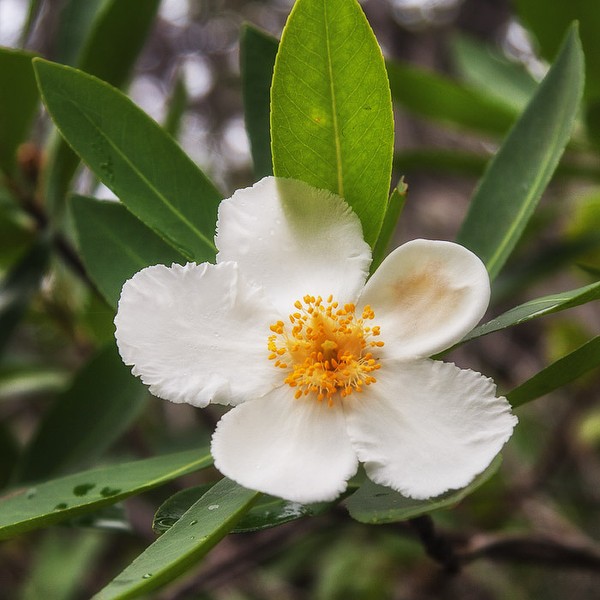
What do tea, camellias, Franklinia, and Loblolly Bay have in common?  They all belong to the Tea Family, and their saucer-shaped flowers look the same.  In the Southeastern U.S. we have (oops, had) three stunning native Camellia relatives.  Stewartia malacodendron, Silky-Camellia, in Florida is restricted to the Panhandle.  Stewartia ovata, Mountain-Camellia, is in the Southeast although probably not naturally in Florida except for minor cultivation.  Franklinia is long gone, since 1803 from its sole known natural site in Georgia, and the fascinating story of this species is unfortunately beyond the scope of our mission.   (CLICK)  Its discoverer, William Bartram called the shrub Gordonia pubescens due to its resemblance to today’s Gordonia, and even some modern taxonomists have upheld classifying Gordonia and Franklinia together in Gordonia, a contention supported by their willingness to hybridize, although the progeny may be sterile like a mule.  There are multiple border disputes around the genus Gordonia.  The resemblance connecting Franklinia and Loblolly Bay extends to the names:  pubescens means hairy, and lasianthus means shaggy-flower.  Franklinia and Gordonia have shaggy flowers.

Gordonia flower (by JB)

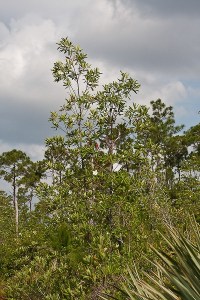
Loblolly Bay (Gordonia lasianthus) is an exquisite shrub or tree in wet habitats from North Carolina to Mississippi to Florida.  The southern limit, at least near the Florida eastern coast, is pretty sharp.  In Palm Beach County Loblolly Bay is scarce and spotty at best, but hop in a car and drive 20 minutes to Stuart, and the species is robust and plentiful.  We hopped in the car last Friday and went to Stuart.

Billy Cunningham, a charter member of our flower-peeping posse, was away in North Carolina for several months and has now returned.   He, John, George, and a gregarious white cat marched across Billy’s land near Stuart and gawked at the Crinum Lilies, Yellow Bidens, millions of Elliott’s Xyris, Carolina Redroot, and Loblolly Bay all in competition for “best in show.”

Why is Loblolly Bay abundant north of a line between Stuart and Jupiter, and rare below that line?  I do not know.  It prefers acid soil, but that doesn’t seem at first blush to be the key.  More intriguingly the Loblolly line resembles the ill-defined border between horticultural hardiness zones 9 and 10, although the mixed opinion in a sampler of horticultural write-ups fails to show a strict need to chill the seeds.  We have grown it south of the border at Palm Beach State College in Palm Beach Gardens, although the specimen was not enthusiastic.

The Loblolly Bays are blooming now with white blossoms the size of teacup saucers, having a yellow center.   You could mistake them for a Camellia, but, unlike those garden favorites, the Loblolly Bay belongs right here.   The flowers are wide open, fragrant, and inviting.   For pollination they seem to welcome everybody.  Beetles and/or bees are probably the main pollinators, and additional recorded floral visitors include hummingbirds, flies, and thrips (anyone with a microscope knows thrips often say peek-a-boo from flowers under dissection).  (Common exclamation in Botany class:  “there’s a bug in my flower!”)

Gordonia tree near Stuart (by JB)

Being so splendid, why is the species not cultivated more?  It is cultivated but has a reputation as challenging,  probably due to its fussy preference for wet fertile acid soils and for protection from excessive exposure.   Moreover the tree has shallow roots and (just guessing) perhaps favorite mycorrhizae.  Growth is slow.  Nematodes, borers, and other insects attack stressed specimens.  But don’t let me throw cold water on it.  My problem is merely living too far south.  Early Florida horticultural honcho Henry Nehrling extolled at length the charms and successes of Loblolly Bay transplanted from the wild into his garden near Orlando.  Exceptional specimens can exceed 80 feet tall.  Fifty feet is a more realistic, and those around Stuart within my experience are mostly about 20 feet.   A columnar silhouette is common.  Fires knock it back, and the tree resurrects via basal suckers.

The good looks are not limited to the flowers.  The fruit is a handsome capsule, opening to release winged seeds.  The foliage reddens as autumn sets in, bringing fall color to places otherwise deprived.

 
4 Comments

Posted by on June 6, 2012 in Loblolly Bay


Tags: ,

Autograph Trees – Who Needs The Guys?

Autograph Tree, Pitch-Apple, Rose-Apple

Clusia rosea

Clusiaceae

Image

The Autograph Tree (Clusia rosea), also called Pitch-Apple or Rose-Apple, is presumably native from the Keys, more or less, to South America.   It may seem a stretch at first glance, but this tree is kin to the yellow weeds known as St. Johnsworts, which are sold in health food stores as natural antidepressants, and which cause dermatological ailments in cows.  First paragraph, and we’re off-topic already.

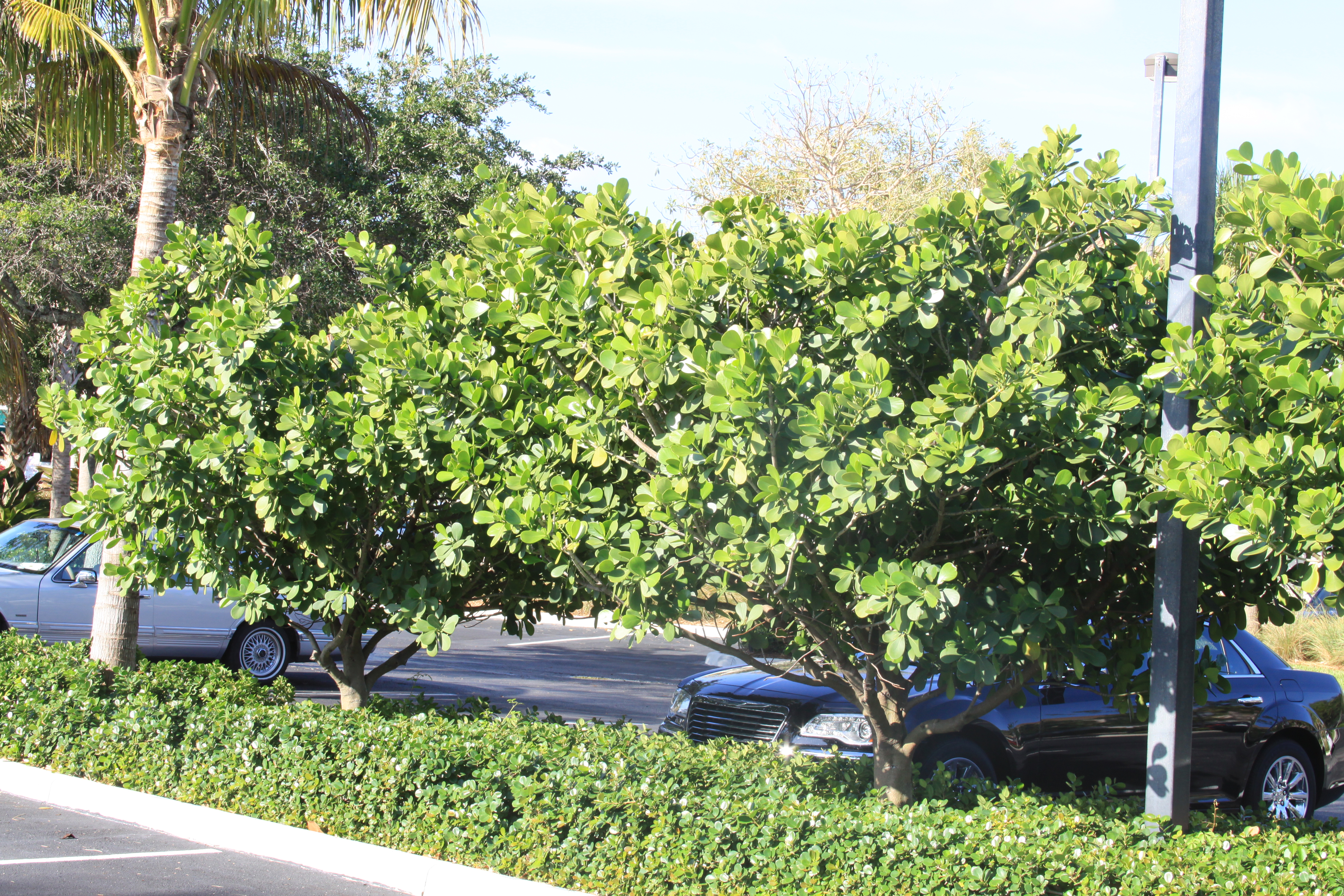
Back to Autograph Tree, and a little descriptive info to get us all on the same leaf.  Today’s species can become a substantial tree, let’s say 35 feet tall with a hunky trunk.  One in my yard went from a potted plant to about 20 feet tall in a decade.  The foliage is full, thick, and utterly opaque, forming a dense screen against peekaboo, noisy neighbors, and wind.  The canopy snags the wind maybe too much; a big branch at my house busted this summer in a thunderstorm.  The paired leaves are thicker than leather, almost succulent, and the flowers are big and round, white and blushed variably with a rose.

The species is a player in landscaping.  It is attractive as well as rugged and forgiving, easy to grow.   Sunshine is best.  It thrives despite drought (but prefers adequate water), harsh life, thin poor soils, alkaline dirt, and salty breezes.  Bug and disease problems are few, except maybe for some scale insects.  It is almost idiotproof.  Good parking lot tree.

Image

Still better for the landscaper, Autograph Tree sneers at damage and pruning, making it an option for large hedges, given its opacity and its tendency for low, multi-trunked growth.  Alternatively, training can yield a conventional single-trunked tree.

Authors are fond of pointing out similarity to the Seven-Year Apple. Casasia clusiifolia, in the Coffee Family.  There is no relationship, and Casasia differs by having thinner leaves with stipules.

The name “Autograph” Tree comes from the persistence of the leaves.  You can scratch your initials and those of your sweetie onto them, and that Pepe Le Pew vandalism may linger longer than your beloved.  The “pitch” in the name refers to the gooey sap with uses overlapping pine pitch, such as gunky boat caulking.   The “apple” is the toxic fleshy fruit.   It opens like a shady guy at the bus station selling watches from inside an overcoat, to display seeds with orange-red arils.  Arils are appendages on seeds useful in dispersal, in this case by birds. The arils are rich in fats, to the point that some Clusia-relatives have edible arils served in the kitchen.  (Forget it.)

Now that we’re past all the boring stuff, let’s look at what makes the tree interesting.  They look just a little like Strangler Figs, and likewise can start life perched on another tree and then drop roots to the ground, eventually engulfing the helpful host tree.  Autograph Trees can sometimes wind up with stilts looking much like a Strangler Fig from the distance.

The extent to which wild Autograph Trees persist in Florida is debatable, probably just some in the Keys.  The wild(ish) individuals are reportedly all female, but no worries:  Those female trees form mature fruits and seeds without benefit of male pollination. The offspring are clones of the mother, and there can be more than one embryo per seed.  Here we have a species perfectly adapted to island-hopping.  A single bird delivering a single seed can bring to an island multiple potential baby trees, each capable of reproducing more clones without benefit of males.  Perhaps the entire Florida population is a sorority descended from a single dispersal event.

Those female flowers do develop token male stamens, but the stamens form no pollen.  Instead, they ooze resin.  Bees use the resin for caulking their nests, a rather unique floral reward.


Tags: , , , ,

Tall Pinebarren Milkwort

Tall Pinebarren Milkwort

Polygala cymosa

Polygalaceae

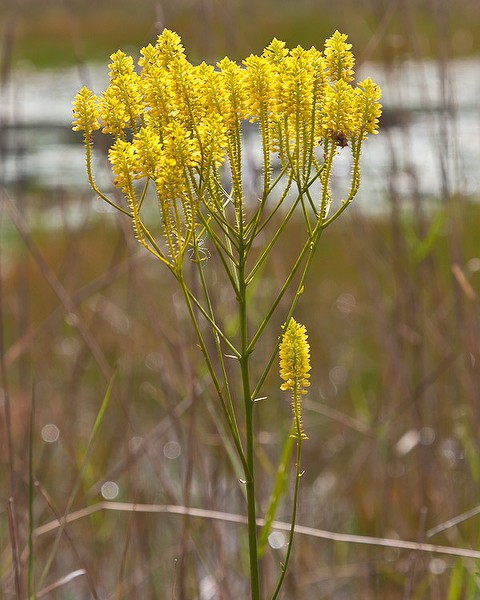
Today John and George walked Jonathan Dickinson State Park near Hobe Sound and decided unanimously that a  wildflower may enter our blog for sheer floral performance.  Today’s star was Tall Pinebarren Milkwort forming a galaxy of countless waist-high lemon yellow wands along the shallow marshy shores.  The wands extending ever-smaller toward the horizon are an artist’s lesson in perspective.  You could scarcely find a happier wildflower, except maybe its doppelganger, the Low Pinebarren Milkwort (P. ramosa) which differs by having broad (vs. nearly linear) leaves in its disappearing basal rosette.  These species are biennials or probably sometimes annuals.

Yellow wand (by JB)

That floral showcase has to attract somebody.  Who knows what list of insects stop by?  Recorded in the literature is a leafcutter bee (Megachile brevis pseudobrevis).  The bee, interestingly, can make its cylindric home cells of cut leaf pieces in grassy places, such as the marsh occupied by the TPBMW, in contrast with the woody haunts of most leafcutters.  Of course the bee and the flower have broader social circles than each other.

Why are Milkworts called Milkworts?  Wort is an old name for an herbaceous plant, but why the milk?  Do they lactate when fractured?  No. The botanical name Polygala translates loosely from Greek  “mega moojuice,” and reflects an ancient belief in the ability of Polygala to keep the cows drippy.

The cow connection may tie in somehow with root aromas associated with many Polygala species, although apparently not our swampy P. cymosa.   Polygala is a a huge worldwide genus, and some species have roots smelling of wintergreen, this  probably explaining the name “candyroot” applied to some.  That wintergreen fragrance comes from a derivative of salicylic acid, more or less aspirin, and this in turn partly explains the popularity of Polygala root in traditional medicines, especially in Asia, where among other benefits, you can use root extracts to quit smoking.  (Don’t try it— they contain toxic saponins and who knows what other forms of bioactivity?)  The point here is, if you want a genus where the roots have served to treat just about everything, here it is.

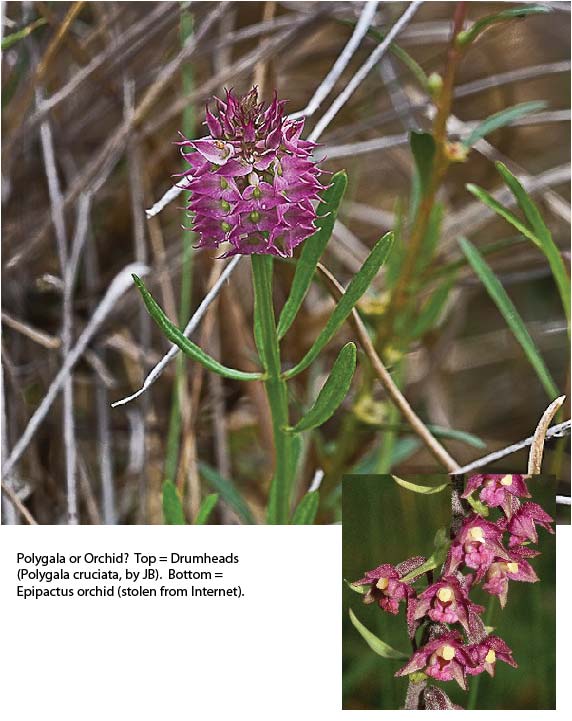
Another stellar quality of Polygala is its diversity in floral colors and arrangements.  They are the perfect classroom examples of diversification in a genus.  The floral colors can be purple, rose, yellow, yellower, orange, white, and more. The flowers can be solitary, in cylindric drums, in narrow spikes, in globes,  in candelabras, and so forth and so on.

They are reminiscent of Orchid flowers, and sometimes of Orchid flower arrangements.  The resemblance to Orchids (or the other way around to be less Orchid-o-centric) includes the overall shapes of the blossoms, especially their horizontal lip, this differing from the other petals and sepals, and textured or patterned.   We have overheard observers mistake Polygalas for Orchids. We scoff in derision.

Polygala seeds demonstrate an occasional wildflower adaptation—they have a small ant-snack called an aril (or eliaosome, or caruncle) attached.  The ants drag the seeds to the ant nest, which from the seed’s standpoint is a tilled, enriched, weeded, and guarded garden.  The aril in Polygala cymosa is small, however, perhaps because the species is semi-aquatic and not in prime ant habitat.  It may tilt more toward distribution tricks characteristic of such water-neighbors as Sagittaria, Echinodorus, and Alisma.  These have tiny seedlike fruits with raised surface patterns.  The similar small P. cymosa seed likewise has a waffle surface pattern.  It has been speculated that such “treads” might help small wetland fruits and seeds cling to the muddy feet of waterfowl helping the plants jump to new ponds.

 
6 Comments

Posted by on May 24, 2012 in Tall Pinebarren Milkwort


Tags: , ,

Gopher Apple

Gopher Apple

Licania michauxii

Chrysobalanaceae

 CLICK

To set the stage, enjoy a trip to Jonathan Dickinson State Park and cyber-visit the Gopher Apple in John’s Gigapan Image.  You can zoom in and out, and move around.  This shows GA’s at their correct size, 1 foot tall.

Do Gopher tortoises really eat Gopher Apples?  Yes, although the tortoises do have a broader varied diet, and the “apples” have a broader varied consumership.  Perhaps significantly, however, the range of the plant and the range of its armored namesake are similar.  Do the “seeds” (endocarps) have to pass through a tortoise to sprout? UF Prof. Sandra Wilson and collaborators report good germination after mere extended soaking in water.  Kinda disappointing in a fashion.

GA-eater, photo by JB

When you see a Gopher Apple you often see a few hundred in a mass, as in John’s Gigapan.  Those are probably all one big clone, spreading by thickened subterranean stems, the perfect way to survive in the fire-prone habitats favored by the species.

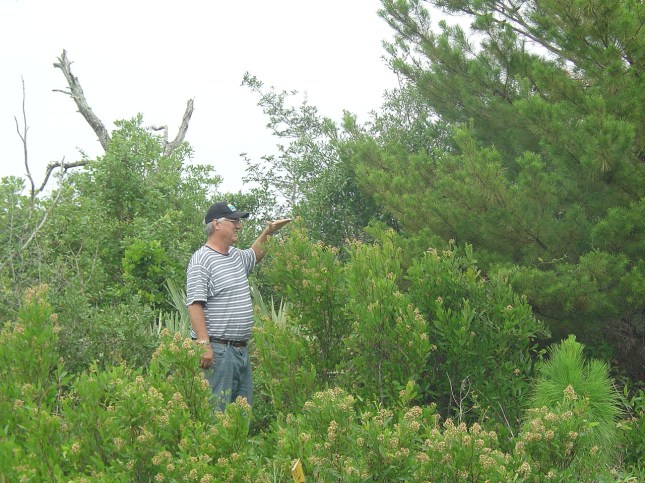
What would happen if there were no fires to keep knocking the GA’s down?  Recently John and I noticed a 5-foot shrub in Jonathan Dickenson Park near the RR tacks close to the site of the Gigapan, and from the distance the species seemed unfamiliar.   Upon closer examination, it turned out to be a shrub-sized GA on steroids with a trunk.  There’s a population there of numerous individuals of mixed sizes, from knee-high to eye-level plus.

At the time our conversation drifted to ascribing the freak size to RR herbicide spray.  (The common herbicide 2,4-D is a hormone mimic and causes funny things to happen.)  Another thought, perhaps proximity to the tracks saved the shrubs from burning, or perhaps not.  We’re not sure.  Further investigation showed us not to be alone we were not alone in our encounter with gigantism.  Daniel Ward and Walter Taylor reported similar unburned oversized Gopher Apples  on Merritt Island.  (Castanea  64: 263-265. 1999.)

Flowers and fruits by JB

Big Gopher Apples are  nice, but what would really get the camera clicking would be the matching 4-foot gopher tortoises.  But seriously now, Licania is a large tropical genus with shrubs and trees, so our little fire-adapted species probably has “grow-big” genes in its DNA, suppressed but not that suppressed (according to my unsubstantiated speculation).  Sort of like people have grow-a-tail genes in our DNA, suppressed, but not always.

Look at the picture of the GA fruit.  Does it resemble the Cocoplum hedge outside your house?  The two are closely related, and earlier taxonomists joined them as the same genus.  Gopher Apples and Cocoplums are our two local reps of the large tropical family Chrysobalanaceae, which is traditionally regarded as related to the Rose Family, hints of which you can see in the pretty white Gopher Apple flowers.  DNA study shows the relationship not to be so close, however.

The Big Apple. These Gopher Apples are up to about 5 feet tall in full bloom, just steps away from the Gigapan site, but a different clump.

 
6 Comments

Posted by on May 16, 2012 in Gopher Apple


Tags: , ,

Canna

Canna

Canna flaccida

Cannaceae

[Posting off-schedule this week due to travel plans.]

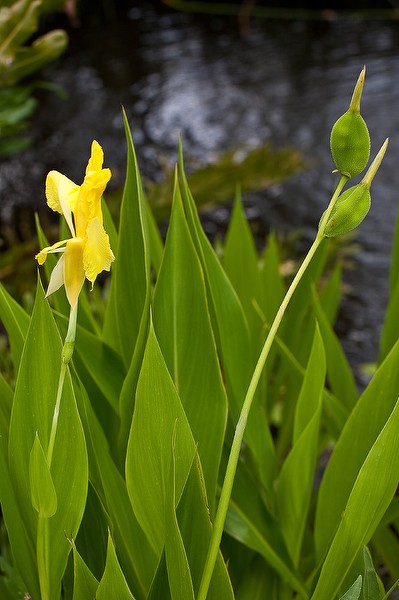
There aren’t many wildflowers showier than Cannas (pronounced CAN-ahs, not CAIN-ahs).   Our native species, Canna flaccida, is in some books dubbed “Bandana of the Everglades,” which fails to fit a species distributed from the Carolinas to South America, not to mention a silly mouthful.   “Gander yonder Mortimer,  methinks a Bandana of the Everglades.”  One thing for sure, Canna “Lily” is a misnomer;  Cannas are gingers in a broad (ok, overstretched) sense.  How about a simple “Wild Canna”?

Some escape cultivation in Florida.  Most notably, Indian Shot (Canna indica) is a skinny red-flowered  species.  Canna glauca can hybridize with Indian Shot.  Canna glauca resembles C. flaccida by having yellow flowers but differs by having erect (vs. drooping) petals.  And most of those those big reddish-orangish garden Cannas belong to a hybrid complex known as Canna Xgeneralis.  These crossed with our native Canna flaccida give an old line of garden hybrids called Canna Xorchiodes.

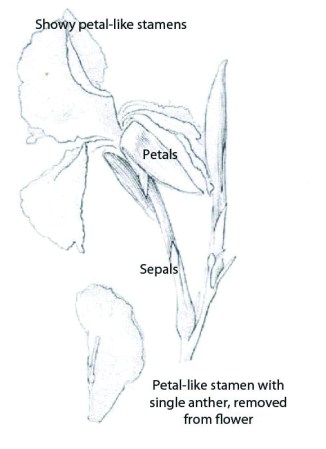
More interesting is the unusual way Canna flowers and those of some related families (especially the Ginger Family) are built.  The showy parts are modified stamens with no anthers (except for a half-anther on one of those showy stamens).  Go find a Canna flower and pluck it outside-in.  First come three sepals—they look normal.  Then come three puny petals.   And then proceeding inward you find all the big showy parts that look like petals; these are stamens.  Find the one with the half-anther.

Wild Canna occupies marshes and shores, and has landscaping and restoration uses in wet settings.  We’ve grown it in the PBSC Plant Nursery and encountered  a couple headaches.  They can be a little fussy.  Cannas are caterpillar food, especially for two species of “Canna Leaf Roller” caterpillars.  Try B.t., or better, drop the anthropocentric gardener mindset and switch to a more  biophilic outlook and say supportively, “Canna flaccida is larval host to the  brown-gold-and speckled Brazilian Skipper Butterfly  and to the Lesser Canna Leafroller moth.”  Additionally, the plants can host an ugly Rust fungus.

The fragrant short-lived flowers look best at dusk, and dawn (I hear), and presumably are pollinated by hawkmoths.

In addition to decorating our world, Cannas serve humanity in their own odd ways.  Canna indica (including “C. edulis“) has an edible rhizome cultivated as one of multiple sources of “arrowroot” starch.  The seeds look like rosary beads or buckshot, depending on your standpoint, and have served for prayer and mayhem.  A seed from a 600-year-old rattle in an Argentinian grave sprouted just fine.  The plants are grow-your-own mosquito coils burned to bug the bugs, and the foliage is a cheap locally produced snail killer to control the slimy varmints that carry the parasitic disease Schistosomiasis.

 
4 Comments

Posted by on May 8, 2012 in Canna


Tags: , ,