RSS

Sweetbay Magnolia

Sweetbay Magnolia

Magnolia virginiana

Magnoliaceae

The Sweetbay Natural Area near the Palm Beach North County Airport is native plant paradise on a beautiful day.  Yesterday was such a day, and the PBSC Native plants class encountered the namesake tree in full sweet bloom.  The overall tree shape and foliage are as beautiful as the blossoms.  They stand out even from some distance as potentially (but not often locally) large, straight-trunked, and with assertive up-tilted branches.  The leaves flutter in the wind revealing white undersides.  Crush them and enjoy the “bay” fragrance.  The branch tips have enormous buds, each covered with a cone-shaped stipule looking like a lopsided dunce cap made by a dunce.

The foliage doesn’t usually show much insect damage.   There are (at least) two natural insecticidal compounds in the leaves, which discourage most herbivores except for the pretty yellow Sweetbay Silkmoth, which tolerates the poison and uses the tree as its larval host.

An old traditional view is that Magnolias have primitive flowers, although modern research has shown that notion to be overstated. The presumed primitiveness manifests as an overall lack of apparent specialization, especially possession of numerous, comparatively leafy-looking floral parts all separate from each other.    Additionally, the pollen, wood, and additional features are interpretable as more or less primitive.  Not many flowers have numerous separate pistils (seed-producing female units) as Magnolias do.  The resulting fruit is a collection of separate units (technically, follicles).  Each unit looks like a tiny leaf wrapped around two bright red seeds.  The gaudy seeds come loose and dangle to entice birds and other hungry agents of dispersal.

What they dangle on is a little interesting.   The water conducting cells in plants are dead, and in some cases they have spiral thickenings allowing them to stretch during growth.  Think of a slinky.  The seeds dangle on the remains of their umbilical cords, stretched slinky-shaped dead cells.

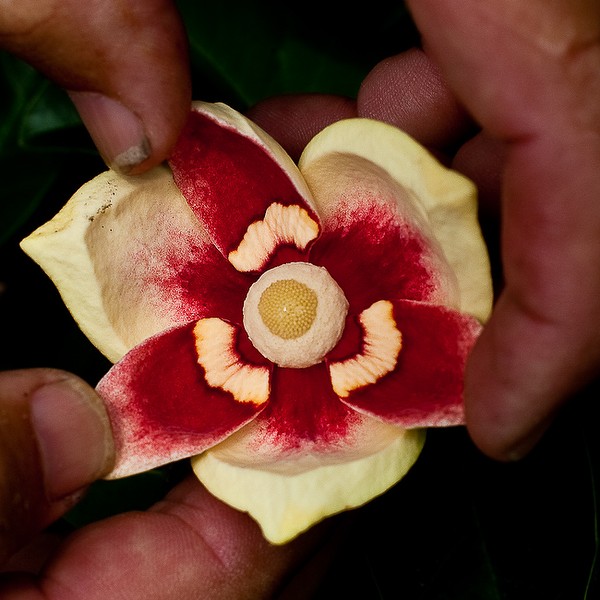
Back to the blossom.  It is big, white, perfumed, and pollinated by an array of beetle species.  Referring to Magnolias in general, the beetles sometimes enter the flower while it is still in bud while those still-closed petals block the “wrong” visitors.  The flowers are female and pollen-receptive at this juncture, with the consequence that they receive the correct pollen by beetle Fed-Ex.   After that, the flowers turn male releasing pollen and open fully.
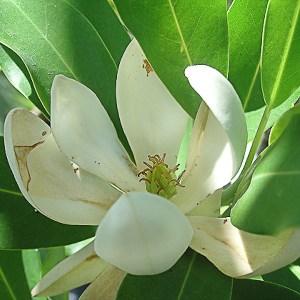
Sweetbay flower (by JB)

The seeds behave in a way associated with mature or climax forests. Species adapted to mature forests, as opposed to early-succession pioneer species,  tend to have fewer seeds more equipped for shade-tolerance, that is, loaded with food reserves allowing the seedlings to live off of their parents trust fund (food packed into the seed)  until large enough to compete on their own.  Sweetbay seeds tolerate shade, to a point even “preferring ” it according to one study.  Shade favors first-year establishment, although bright light enhances subsequent growth.  In the first year the seedlings can rise two feet in a quest for the light.

Sweetbay Magnolias reach their largest most striking development in undisturbed and unburned wet places.    Yet they get back on their feet aggressively after being knocked down.  They regrow all spunky from fallen trunks, from stump sprouts, and from root sprouts after hurricanes and fires.

After trouble, they tend to reappear in clumps from stump bases, and that may relate to an odd adaptation called a lignotuber, which is vaguely reported for Sweetbay Magnolia without much corroboration (known to me at least).  Lignotubers are specialized survival-zones  at the trunk base.  These have starches and other carbs and nutrients, as well as dormant buds, all ready for post-apocalyptic repopulation.  A more-documented local lignotuber repopulator is the invasive exotic Australian-Pine.
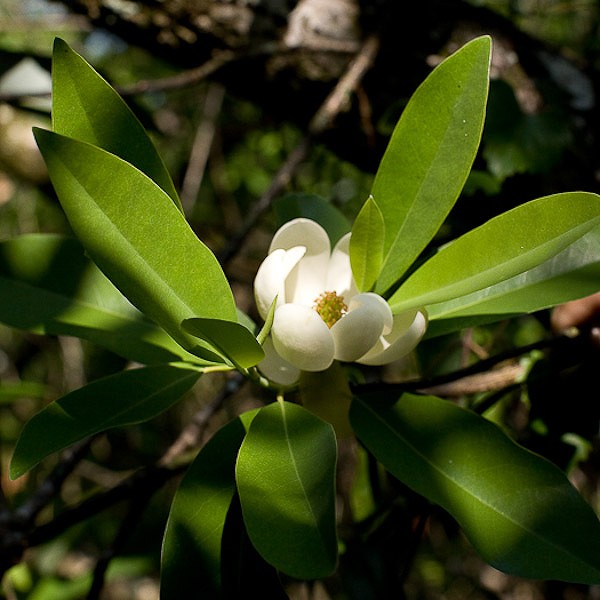
Photo by JB

What about Sweetbays in landscaping?   This might be a topic to start an unwanted argument.   As background,  it might help to know the species is distributed from New England to South Florida and Texas, mostly in wet swampy habitats.  On one hand, there are beautiful examples in cultivation, and the species is abundant in the nursery trade with several names cultivars.  We had a fairly nice one on the PBSC campus, destroyed in a hurricane and a small one there now.  In cultivation, although the tree can flourish in a “normal” residential setting,  I’ve always felt that the specimens at PBSC were never as robust as you might like, probably due to being a little too high, dry, and in one case wind-swept with respect to their natural swampy inclinations.  UF IFAS Fact sheet SF-384 has little reservation about suggesting the species, listed an expected size to be 40-50′ X 15′-25′ good for limited spaces.   The authors hint at issues with “urban tolerance,”  so perhaps a guiding principle on using this species in the landscape is to not duplicate, but at least respect the acid-swampy, semi-shaded origins of this lovely species.
 
Leave a comment

Posted by on May 3, 2012 in Sweetbay Magnolia


Tags: ,

Wild Coffee FAQ: Can You Make Coffee with Wild Coffee? (No)

Wild Coffee

Psychotria nervosa

Rubiaceae

Answer:  I’d like to get my mitts on the numbskull who made up the English names for the plants of the world.    The only connection between the Wild Coffees and Starbucks is joint membership in the Coffee Family, the Rubiaceae, along with 12,999 other close relatives.  There is a little visual similarity between a Wild Coffee and Coffea arabica, but chalk that up to broad family resemblance.  The genus of Wild Coffees, Psychotria, with some 2000 species, is one of the largest genera of woody plants.

Wild Coffee (by JB)

Would you make a cup of  “coffee” from Psychotria?  No, unless maybe you are a Shaman, and few Shamans read WordPress blogs.  The traditional uses of Psychotria include ayahuasca.  Ayahuasca  is a variable mind-altering Amazonian ceremonial concoction where the main psychoactive ingredient comes from the Banisteriopsis Vine in the Malpighiaceae (represented in south Florida by weedy Hiptage, garden flowers, and native Locust-Berry (Byrsonima lucida—another day another blog).

Psychotria adds kick to the ayahuasca with a drug known as dimethyltriptamine (DMT).  So, then again, maybe Starbucks should take a second look.  Psych-otria and psych-adelic come from the same Greek word psyche for mind and soul.  Psychotria extracts serve also in arrow poisons as well as fish and vermin-killers.  So please don’t make “wild” coffee unless you are a licensed shaman.

Psychotria punctata (by GR)

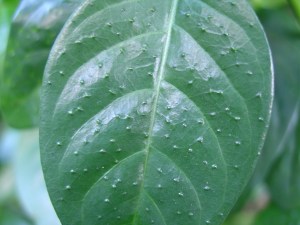
Two thousand species worldwide, four in Florida, three native.  The non-native species, Psychotria punctata from southern Africa is cultivated a bit in southernmost Florida and apparently escaped a little. Its claim to fame is foliage punctuated with translucent bacterial nodules (see the photo).   But this is a native plants blog, so back on-task.  Our three natives are:

1.   Bahama-Coffee is Psychotria ligustrifolia (P. bahamensis) on limestone in Miami-Dade and Monroe counties, in the Bahamas, and on other Caribbean islands.  It differs from P. sulzneri by having glossy (vs. dull) leaves, and differs from P. nervosa by having smaller more compact form and smaller leaves with less-impressed veins.  The compactness, overall good looks, and shade-tolerance give Bahama Coffee a role in native plant landscaping.  A tough and beautiful planting has graced the Palm Beach State College campus for many years in serious shade and with little to no irrigation.

2.  Dull Leaf Coffee, aka Sulzner’s Dull Coffee (or other variations on similar names), P. sulzneri , is a pretty  shrub with flat-toned leaves having  a velvety sheen. (More on this species at (http://wp.me/p1H7HW-b3).    It is a hammock dweller from southern peninsular Florida to Costa Rica.

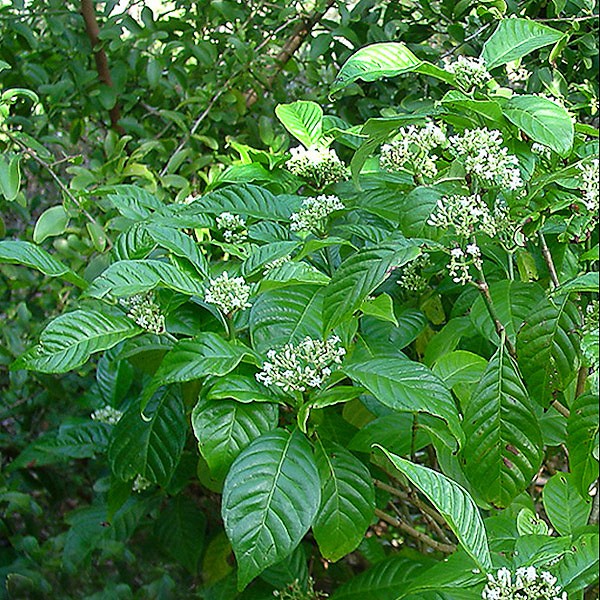
3. The most-cultivated Wild Coffee is Psychotria nervosa.  The “nervosa” does not refer to a state of mind, but rather more mundanely to the leaf veins (nerves) which are deeply grooved.  This species (and Bahama Coffee) have domatia beneath the leaves.  Psychotria nervosa differs from the other two by having tiny calyx teeth (sepals).  It ranges naturally from Jacksonville to South America.

Wild Coffees are prime examples of an odd biological phenomenon, heterostyly (HET-er-oh-style-ee), that is, having styles of different lengths.  Flower vocabulary refresher:  the style is the elongated part of the female unit at the flower center.  It is tipped by the pollen-receptive stigma, and its base is the ovary where seeds develop.  This is important, so remember that the stigma is the pollen-receptive tippy top of the style.   Stamens make pollen at their own tips.

Many Rubiaceae are heterostylous (het-er-oh-STYLE-us), including such Florida native “coffees” as Mitchella, Morinda, Guettarda, and others.  (To lllustrate, I’m going to use Guettarda (Velvetseed) for the convenient reason I have good pictures.   Psychotria is the same for present purposes. )

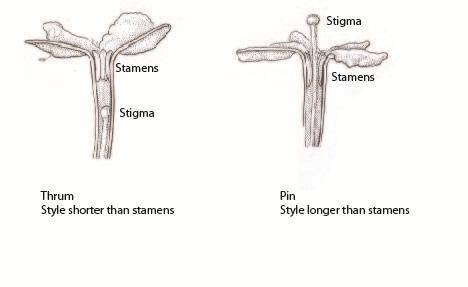
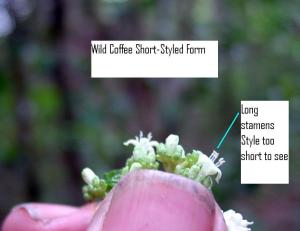
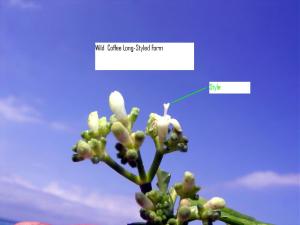
Heterostyly (using Velvetseed as a similar example)  Image credit in text.

Heterostyly is an adaptation to force flowers to cross-pollinate.  In heterostylous species there are two breeding strains, and each is forced to cross exclusively with the other strain.  Here is how it works.

In one strain, the flowers have long styles (with those pollen-receiving stigmas at the tips) and short pollen-making stamens.  These long-styled flowers are called “pin” flowers.  Think of the long style as a pin.

The other strain has the reverse:  short styles and long stamens .  (“Thrum” flowers.  Thrum sounds like Tom Thumb and he was short.)

Thrum. five stamens protruding, andshort  style hidden.

Psychotria nervosa pin flower.  Style is protruding, and stamens are hidden in the flower.

Think of the pollinating bee as a dipstick probed into a flower with the bee’s nose going in deep and the bee’s knees remaining out near the entrance to the flower.  (This is oversimplified using nose and knees to make a schematic point. The actual touchpoints vary among species.)

In a pin flower the bee’s nose touches the short stamens while the bee’s knees touch the pollen-receptive stigma on the tip of that long style.  Flip-flopped, in a thrum flower, the bee’s nose touches the short stigma and the bee’s knees touch the long stamens.

So then, when the bee visits a pin flower, the short stamens powder its nose with pollen.  If it flies to another pin flower the pollen-dusty nose is not aligned for pollen-drop-off.  For this bee to drop off its pollen, it must switch to a thrum flower where the nose can pollen-dust the short stigma.  In Psychotria you can distinguish pin and thrum flowers with a hand lens.  (You can tell the styles from the stamens because each flower has one style but five stamens.)

[Drawings by Karen Stoutsenberger, from Rogers, G. K. The Genera of Rubiaceae in the S.E. U.S. Harvard Papers in Bot. 10: 42. 2005.]

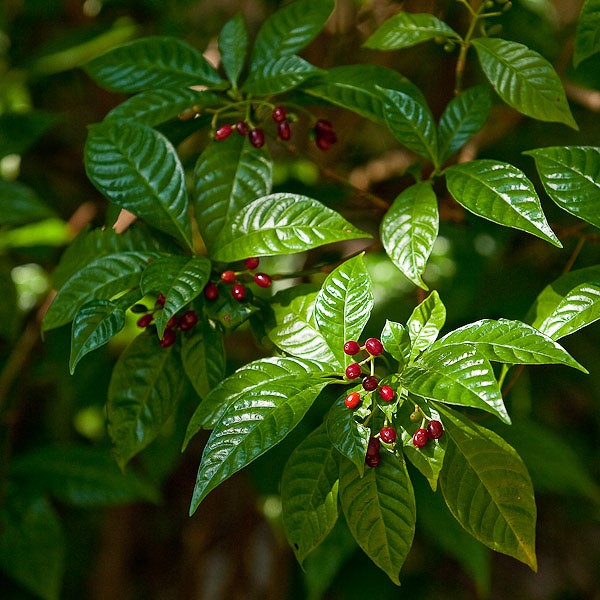
Wild coffee (by JB)

 
5 Comments

Posted by on April 26, 2012 in Wild Coffee


Tags: , ,

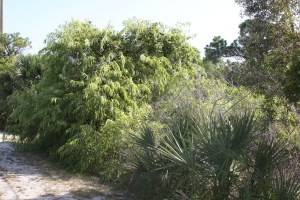
Have a Headache? Go Chew a (Willow) Stick

Carolina Willow

Salix caroliniana

Salicaceae

Willows grow everywhere from the Wind in the Willows to the Bible to our own back yards.  Long ago I ventured as a young botanist from Michigan to Brazil, expecting the Amazon to look like the pictures in National Geographic, only to be a little disappointed to find Willows just like Michigan along the first shores I saw.  But then again, just like disappointing people, Willows are not disappointing if you give them a chance, and we have plenty in South Florida wetlands.  There are 450 species worldwide.  In South Florida there’s one.

Carolina Willow

Carolina Willow (Salix caroliniana) ranges from Pennsylvania to Guatemala, making it one of those oddball species found in winter ice and in the steamy tropics.  Beyond Carolina Willow there are one or two mis-named “Willows” around (Itea, Ludwigia, etc.), and there are additional true Willows (Salix) native and cultivated in Florida generally in the Panhandle and northern Peninsula.

In Florida Carolina Willow is larval host for two lovely lepidopterans:  Io Moth caterpillars (green, bristly, and OUCH!!) and Viceroy Butterfly caterpillars (bird dropping posers).   Willows tend to be buggy and are prone to stem galls, leaf galls, and various other attacks at the six hands of gall wasps, sawflies (including the “Willow Sawfly”), beetles (notably native and invasive Willow Leaf Beetles), the Cottonwood Borer Skeleton Beetle, and others.

Today’s trees make straight lithe branches to the benefit of archers and basket-weavers.  Since prehistoric times, they have been used in making fences, canastas, fishtraps, willow-wattle fences, arrows, switches, and more.   Land managers like Willows because they flourish in reclaimed  wetlands.  (Others dislike willows because they can be invasive, including into sewer lines.)   The plants tend to be easy to propagate from cuttings, being  adapted to fragment in floods and root downstream.  They also make great rootstocks and scions for practice grafting.  We maintain some in the PBSC nursery for that purpose.

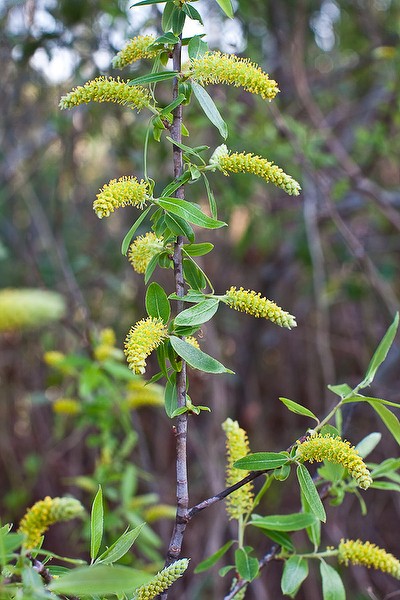
Willow catkins (by JB)

More notably, headache-suffers around the world have discovered  multiculturally that preparations from Willow bark relieve pain.  Aspirin is salicylic acid, named for the generic name Salix, although the distribution of salicylic acid (to apply the name loosely to a family of related compounds) is broad in the plant world.  Aspirin was historically extracted from Willows and from other plants; now it is synthetic.

Now for the good part:  Why do plants make salicylic acid to begin with?  Not to dull our pain.  The compound is a plant hormone able to arouse the plant’s “immune system” in the event of pathogenic invasion.  In recent years there has emerged a literature on the more subtle submicroscopic-biochemical side of plant self-defense and the role of salicylic acid in sounding the alarm.  The hormone has the fascinating ability to spread the word like Paul Revere through the air to other plants in the same population.  Willows can grow in massive stands as a monoculture.  Is this why they generate apparently exceptionally high levels of salicylic acid?

Willow flowers come forth early in the Spring, attracting pollinating bees before there’s much competition.   The flowers are in separate male and female catkins, which are elongate clusters of small individual unisexual flowers.  They are the pussys in Pussy-willows.

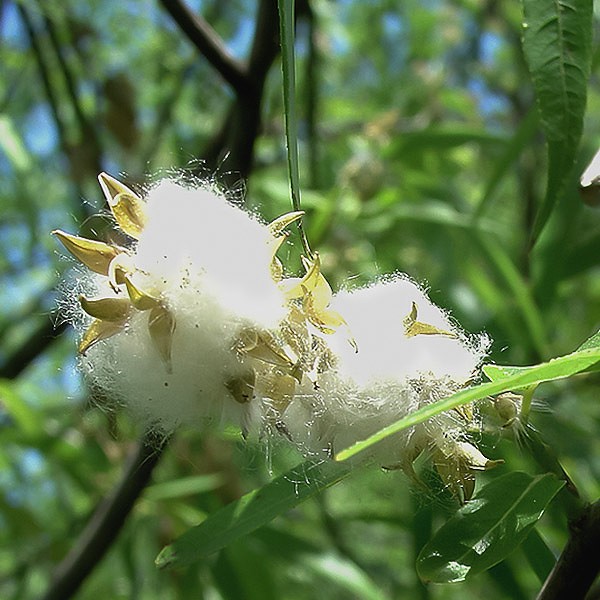
Most plants with catkins are pollinated by wind.  But Willows may have turned the beat around, reverting from wind pollination to insects.  Pollinator insects require compensation, and the Willow offers nectar, but from an unsual source, from highly modified petals and or sepals.  These organs somewhere in evolutionary history lost their showy functions in favor of becoming nectar glands, as though Willows “reinvented the wheel” (well, the nectary) long ago and far away. Then come the seeds on silky parachutes:  birdy delights for lining the nest.

Use these seeds to cushion your nestegg (by JB).

 
8 Comments

Posted by on April 19, 2012 in Carolina Willow


Tags: , , ,

April Showers Bring Pond Apple Flowers

Pond Apple

Annona glabra

Annonaceae

How many beetle-pollinated flowers do you know?  Among a few, Pond Apple and Sweetbay Magnolia, both in flower now.

What I really like about Pond Apple lives primarily in my imagination and in old photos, especially ones taken a century ago by botanist John Kunkel Small.  Back in the day, as they say on Pawn Stars, Pond Apple was debatably “the”  broadleaf tree of the Everglades Area, especially the southern rim of Lake Okeechobee where it formed a Pond Apple forest, also an arboreal force to reckon with bordering Biscayne Bay.   Back then and there the PA’s became jungle trees to maybe 60′ tall, festooned with epiphytes and birds, and complete with buttress roots. Today we encounter the trees mostly as modest-sized individuals in wet habitats, or in cultivated landscapes.

Pond Apple by JK Small, 1917.

The primitive flowers have six thick fleshy petals, vanilla-yellow-white with reddish markings at the base.  There’s a huge number of stamens and a hundred separate carpels (female units), each with just one seed.  The female pollen-receiving stigmas become sticky and receptive before the flower enters its male phase.  The carpels fuse later into the “apple.”

The floral visitors are varied species of beetles drawn by the scent.  The flower tends to form a chamber that shelters the beetles and keeps them happy munching the succulent petals and perhaps mating during the flower’s passage from the female phase through pollen release.  The strongest fragrance emerges in the evening, which is also the time the pollen comes free to dust the critters.  The flower gets pollinated by providing a beetle rumpus room.

Most flowers serve nectar as a reward for insect visitors.  But Pond Apple provides a pound of petal-flesh as the price to pay for reproduction. (Similar to paying college tuition for human pondapples.)   If you think beetle pollination is weird, other Annona species rely on thrips, cockroaches, and probably sometimes flies to do the job.

Pond Apples range from Florida to South America, and to Africa.  Is the tree actually native in Africa?  I don’t know, probably not. The tree has become an invasive exotic nuisance in additional tropical regions such as Southeast Asia and especially in Australia, where it represents our revenge for the Melaleuca. (And its cousin the Bottlebrush getting pesky.)

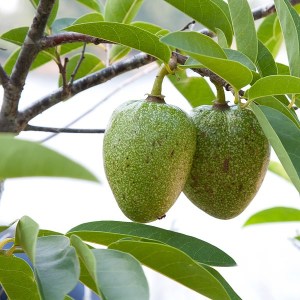
Pond Apple is in the same family as Pawpaws, which have similar flowers.  I ate a pawpaw once maybe a trifle unripe.  It knocked me out cold and I woke up vomitoria.  Closer kin is in the same genus are much-better-tasting fruits:  Atemoyas, Cherimoyas, Custard-Apples, Soursops, and Sweetsops.  Pond Apple serves as a locally adapted grafting rootstock for some of these, and has been hybridized with some of the tasty species.   Pond Apple fruits are yucky to humans, but raccoons savor the flavor.   Raccoon scat sometimes looks like PA seed conglomerate.  Pigs like them too, a fact well known to land managers where Pond Apple is an invasive pest.  So do iguanas and some monkeys.

Beetle party place (by JB). The white ring near the middle is a mass of stamens. The greenish-yellow center is a cluster of carpels (female units, which become the "apple").

The trees produce bioactive principles and have too  many historical medicinal uses to start listing.   Most interestingly, modern research has shown anti-cancer properties from the seeds.

Any good in the landscape?  Sure.  The PBSC Campus has several very purty specimens, and there’s a good-looking individual in my yard.   Although wet places are the natural home, the species fares well under normal residential conditions, even unwatered or only lightly assisted after establishment.  Sun or reasonable shade are okay.  The upside is general prettiness, fast growth, and curious flowers.  The downsides are fast growth,  low branching, unwieldy watersprouts, messy fruits, reportedly  toxic seeds, and seasonal leafdrop.   The seeds are easy to sprout, and yes, I’ve tried them plucked out of raccoon poop—works fine but really no need to go stalk a racoon.

 
7 Comments

Posted by on April 12, 2012 in Pond Apple


Tags: , ,

Why Do Figs Taste Crunchy?

Strangler Fig

Ficus aurea

Moraceae

As a kid on Florida vacations I found it scary that a malevolent tree strangles innocent others like the living garrote of the Green World.  A more mature perspective is less ghastly, and of course the Ficus (Fig) does not actually strangle anything; it merely exploits its host tree for a cheap perch in the sun, eventually growing over and around the host, competing for light and eventually root space.  I’ll bet the host generally lives a long and prosperous life despite its hitchhiker.

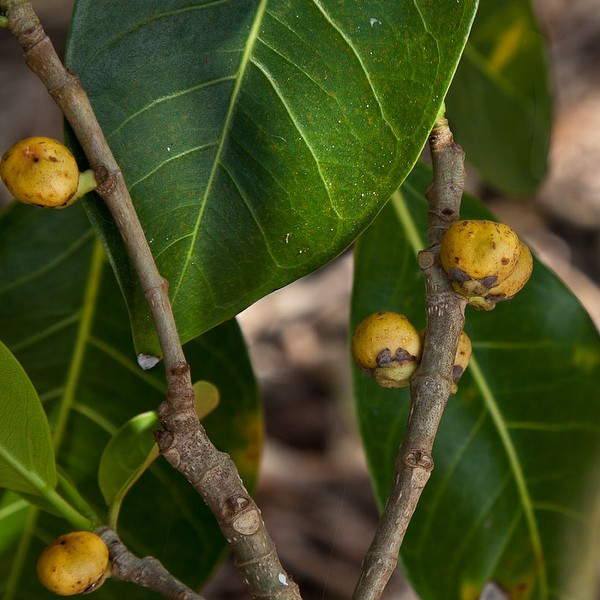
Figs on Ficus aurea (by JB)

In a recent blog Mistletoe was cast as a smart parasite for supporting its host.  Strangler Figs, by contrast, can be indifferent to host’s fate because in time the Stranglers stand on their own two feet.  Sorta like the guy whose wife works in Wal Mart to pay for his Med School until he graduates and runs off with a nurse.

The young Strangler Fig sitting in a tree sometimes looks like a parasitic Mistletoe early on, and some observers have attributed the Ficus with a propensity for parasitism.  However, tree biologist Peter Tomlinson emphasizes the exploitation to be merely epiphytic.  But when the host dies does the strangler benefit nutritionally from the host’s decay?  (Probably not)

Forest tree babies struggle for light under taller canopy trees, so each forest tree species needs a coping adaptation to survive its shaded youth.  Many evolve large food-filled nuts to sustain the sapling until it rises high enough to compete effectively or until  a canopy gap opens.  Figs have a different plan:  they form lots of tiny bird-dispersed “seeds” (technically achenes) carried by birds to lodge in nooks and crannies high and bright on matrue trees.  Then they grow bassakwards from canopy downward to the ground.  Many additional Ficus species have similar tendencies.

Strangler Figs are Ficus aurea, one of 750 Ficus species worldwide.    The other Florida native is the Bearded Fig (Ficus citrifolia) almost restricted to the southern tip of Florida and the Caribbean.  Its whiskerish dangleroots reputedly account for the island name Barbados, translated as “bearded.”  Florida is home to numerous cultivated Figs, some of them escaped nuisances.   These garden Figs include the Banyan, Bo Tree, Counciltree, Cuban Laurel Fig,  Edible Fig, India Rubbertree, and more.

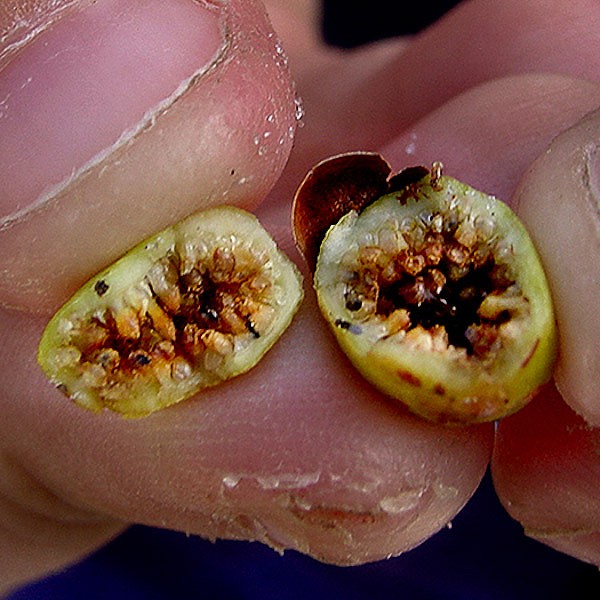
The “fruit” (the fig) is a swollen stem with a hollow cave inside. The cave is lined with tiny male and female flowers followed by seedlike fruits.  Pollination is by itsy bitsie teenie weenie wasps who enter through a portal at the end of the fig.  Stranger Fig has just one species of pollinating wasp (Pegoscapus mexicanus), which is perhaps why it does not (or not often) hybridize with Bearded Fig, which has its own wasp pollinator.

With variation among species, the general pattern is that female wasps enter the fig “fruit” and lay their eggs into the ovaries of specialized female flowers.  Male wasps hatch forth from the eggs inside those flower ovaries and proceed to fertilize the immature female wasps while the girls are still confined within their Fig flowers.  How do they do that?  The motivated guys chew their way through the flower ovary wall to the females, who later use those chew-holes to escape.

Upon exiting its flower-ovary but still inside the fig chamber, the pregnant female wasp packs pollen into a specialized pocket on her body.  Then she flies out to go a different fig to transfer pollen and lay eggs.  She must deliver pollen reliably because no pollen = no flower ovary growth, and no ovary = no nursery for her babies. Something to try: Bust open Ficus aurea “fruits” and find the little wasps inside.

One or more interloper wasp species use Stranger Figs as brood chambers without contributing to pollination.   One such sneaky pete  (Anidarnes bicolor) injects its eggs from the outside of the fig, positioning them to mature on the inside relying upon successful pollination by the proper pollinating wasp.

Have you ever seen a Strangler Fig germinated on the ground?  Yes, but not that often.  The seeds require a sustained moist substrate, most often in Cabbage Palm boots.

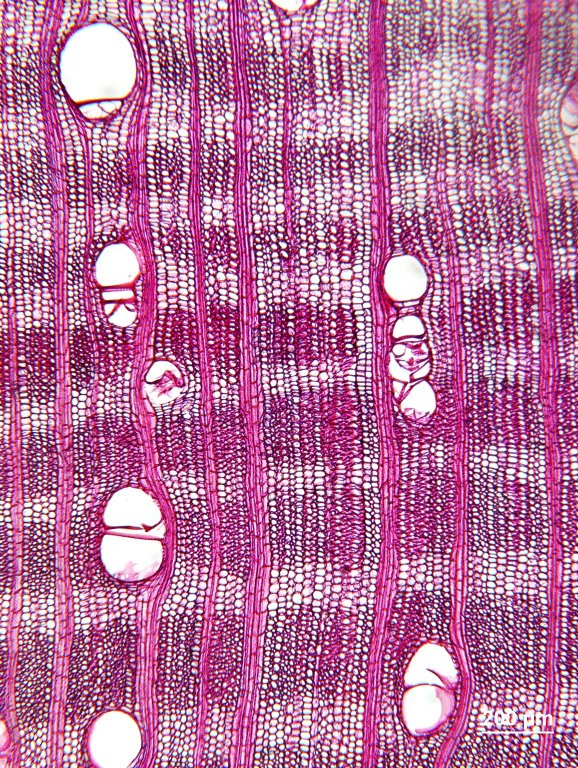
Starting out as epiphytes and living years on high before rooting in the ground, Strangler Figs contort around the host, which is why Bonsai enthusiasts like them.  In this connection Ficus wood structure is unusual.  Now we enter the speculation zone with a visual aid.  The wood photo is a cross section…think of viewing a stump surface through a powerful microscope. (The image comes from the University of North Carolina wood collection.)

Strangler Fig wood with alternating light (storage tissue) and dark (true wood) horizontal bands. (The vertical bands are “wood rays.” The roundish openings are large water-conducting pipes.)

Strangler fig and related species have something unusual:  bands of living storage tissue (axial wood parenchyma) layered in broad bands in the otherwise dead wood.  (Normal wood is predominantly dead water-pipe and support cells.)   The oddly abundant living storage tissue is conspicuous as those light-colored horizontal bands alternating with the darker bands of proper dead wood.  The living bands sequester water and starch, not a normal wood function in other plants.  Why do they do this?

Most epiphytes face a “dry” life trapped above the ground using their roots to cling to the host instead of accessing groundwater and storing starch like conventional roots.   Epiphytes throughout the plant world consequently develop diverse coping adaptations:  succulence, animal symbioses, suspended animation, the expandable pseudobulbs and sponge-covered roots of orchids, the tanks of epiphytes, elaborate scales and hairs, and more.   The weird and plentiful storage tissue seems to be the Ficus answer to the basic epiphyte lifestyle challenge.  There’s just a wee bit of “cactus” built in.

Open fig from Ficus aurea, showing tiny orange “seeds’ (which are technically the fruits. The entire fig is technically a hollow open stem. The hollow seed-lined space is the “cave’ mentioned in the text. You can find dead wasps in there. (Photo by JB, fingers Evan Rogers, Evan Rogers by GR)

 
6 Comments

Posted by on April 5, 2012 in Strangler Fig


Tags: ,

Alligator Flag is a Snappy Wildflower

Alligator Flag

Thalia geniculata

Marantaceae

Which wildflowers have the most complex awesome magnificent pollination mechanisms?  Orchids?  Naw.  Orchids are okay if you like Nero Wolfe, but the truly cool flowers around here belong to Alligator Flag (Thalia geniculata), one of the only two members of the Maranta Family (Marantaceae) native to the United States, and possibly the largest native herb.  The similar Powdery Thalia (Thalia dealbata) grows across much of the southern U.S. but not in Florida to my knowledge.

Thus native plant enthusiasts perhaps don’t encounter the Marantaceae often, but warm-climate gardeners  and interiorscapers enjoy Calathea, Maranta, and Stromanthe.  The popular houseplant known as Prayer Plant is a Maranta.  An odd feature Marantaceae share with Cannas, Gingers, and Spiral-Gingers is that the showy parts of the flowers are mostly derived from stamens (staminodes) instead of the petals, which tend to be inconspicuous.  Floral features we’re about to explore for Thalia are shared in part with some of these kin-plants, especially other Marantaceae.

Thalia geniculata ranges broadly from Florida southward to Buenos Aires.   More interesting are three similar “species” in Africa.  Marantaceae expert Dr. Lennart Andersson interpreted the African representatives to be invasive exotic descendants of American Thalia geniculata relocated to Africa hundreds of years ago, possibly on slave ships.  Although not offered by anyone as an explanation for the boat ride, Florida plant icon Julia Morton mentioned edibility of the boiled rhizome.  An abundant edible “root” in the areas of slave commerce sounds like a food source for the return trip.  Arrowroot starch comes from cousins in Maranta and Canna.

skipper-on-alligator-flag

The origin of the name “Thalia” is a head-scratcher.  Thalia in Greek mythology was one of the three graces, daughters of Zeuss, and her name came in turn from a similar Greek word for “blooming,” a perfect name for the graceful plants.  But hold on there!   According to unassailable old botanical references, that’s not where Linnaeus got the name, but rather for Johann Thalus a German naturalist killed in an unfortunate carriage mishap.

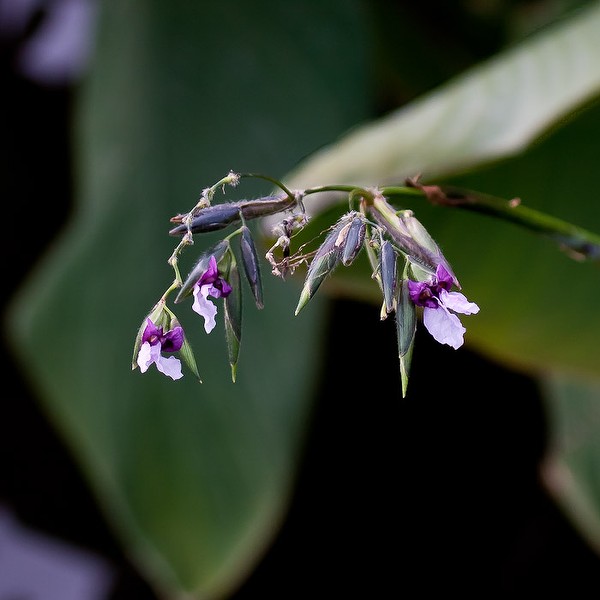
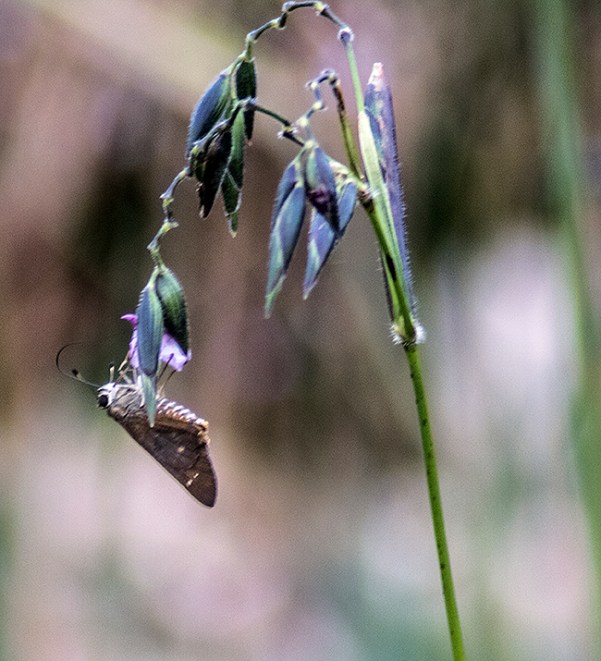
Now for those crazy flowers.  This will take some concentration, so listen up, and next time you see Alligator Flag  growing wild, first look for those flagged gators, then examine the flowers.  As with other Marantaceae,  they are in mirror-image twin pairs.  That’s just plain weird (and pretty).  Second, as already mentioned, the showy parts are predominantly modified stamens posing as petals.  Remember the term staminode.  The real kicker, almost literally from the bee’s perspective, is the rat-trap snap pollination mechanism.  When a carpenter bee probes the flower, the style snaps upward abruptly.  Try poking a pine needle or pencil tip into a blossom—you can snap it too unless a bee beat you to it.

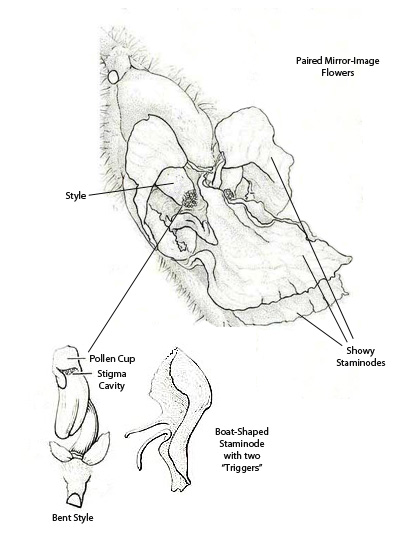
Analyzing every floral organ is beyond the scope of our light and fun blog. (Interested readers can reference the journal article noted below.)  But here is the core of it all.  The style is hairpin-bent with the stigma (pollen-receptive organ) a cavity just beyond the bend.  Exactly at the bend is a little cup where the anther (pollen-producing organ) deposited the pollen while the flower was still in the bud.  That is, the flower uses the style to deliver pollen to the pollinator.

The hairpin style, with its scooplike stigma and its little cup of predoposited pollen, lies like a hotdog in a bun inside of a boat-shaped staminode.  Think of a guy lying in a canoe.  Think of Dracula in a coffin.  The boat-shaped staminode has two fingers rising from its side and wrapping  over the cocked style.  Those two fingers are apparently triggers to unleash the snap.  Before the event, the knuckle with the pollen cup is near the mouth to the flower.

When the carpenter bee or your pine needle disturb the triggers(s), the style pops up and curls inward in a split second.  Think of the guy lying in the canoe suddenly sitting up, or Dracula doing the Transylvania Twist.

When the style snaps up and inward, first the stigma scoop scrapes across the bee’s tummy removing any pollen it has brought from a different flower.  Then a nanosecond later in the same snap the pollen-bearing cup brushes new pollen onto the bee.  The snap no doubt kicks out the dismayed bee, and closes off the entrance to the flower, which has no further need for visitation.

[Notes.  John Bradford took the beautiful photo.  The drawing comes from Rogers, G. The Zingiberales (Cannaceae, Marantaceae, and Zingiberaceae) in the Southeastern United States. J. Arnold Arb. 65: 5-55. 1984.]

 
13 Comments

Posted by on March 29, 2012 in Alligator Flag


Tags: , ,

Win-Win With Mistletoe

Oak Mistletoe

Phoradendron leucarpum (better known as P. serotinum)

Viscaceae

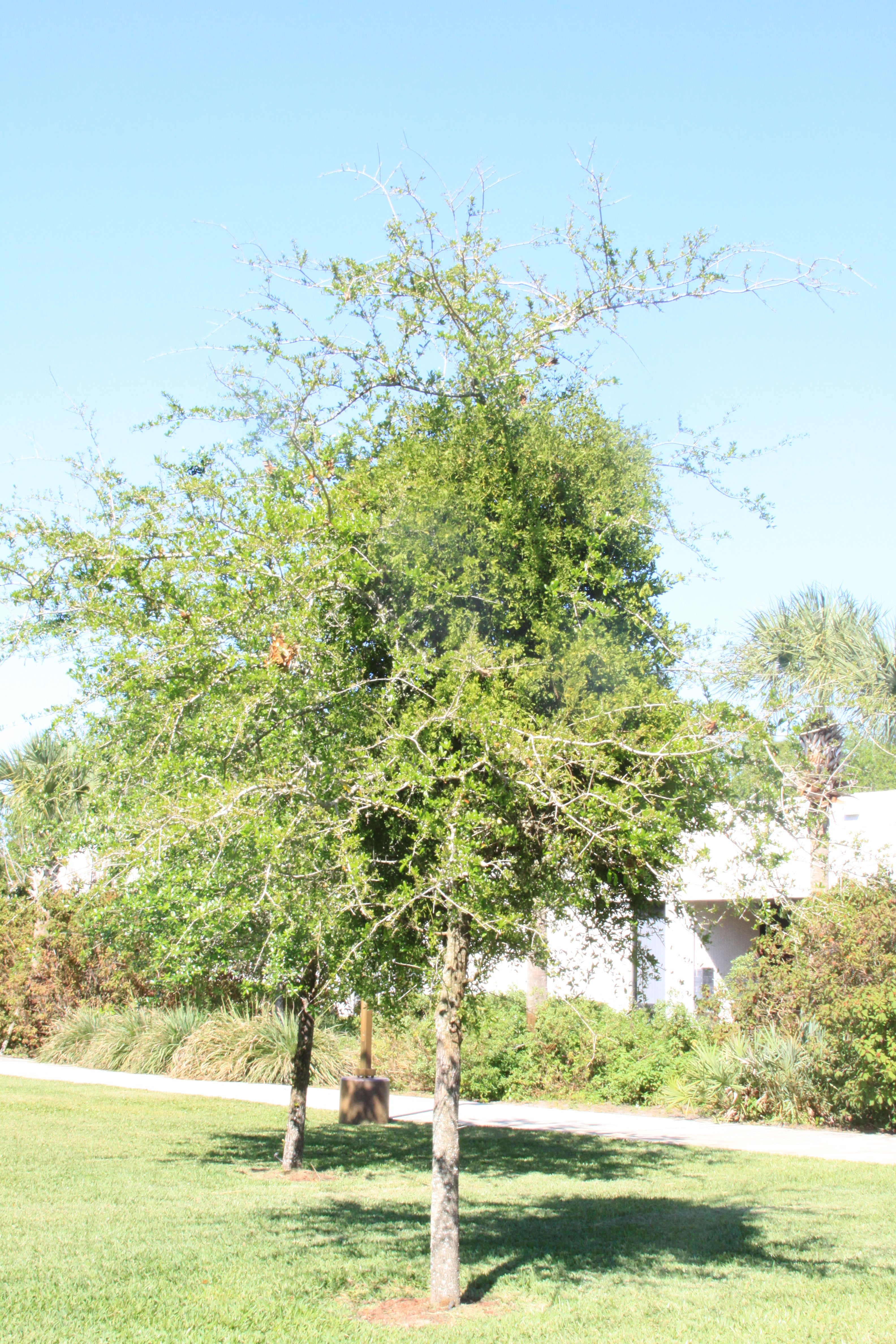
Oak Mistletoe ranges across most of Florida, except for the southernmost counties, with the southern  gap pronounced in the east, so the presence of a large Mistletoe on a small Live Oak literally a stone’s throw from my office in Palm Beach Gardens is surprising.  It doesn’t quite belong here. That the species is “natural” on our campus is less likely than a hitchhike from a distant plant nursery.   But there’s the plant in all its fruiting glory, so it gets attention now.

Image

Above:  Oak with Oak Mistletoe on PBSC campus.  Fifty percent of the biomass in this picture is the Mistletoe.  Is it contributing sugar to the relationship?

Two native Mistletoes grace the state of Florida.  Today’s species, Phoradendron leucarpum, has a checkered history of different definitions by different taxonomists, but long story short, it ranges across much of the southern and south-central U.S.  The other, Phoradendron rubrum, Mahogany Mistletoe, is more at home in the Caribbean with a toehold in the southern tip of Florida.  Its fruits are reddish.  The traditional European speceis Viscum album looks much like our Oak Mistletoe, which is likewise suitable for Happy Holidays smoochin’.   (As recently resubstantiated by Mistletoe expert Justin Bieber. KLICK)

[Oh no,  I hope this blog does not come up when fans search Google for Justin Bieber.  Not much—they would find it among eight million hits.  And if they do, that’ll be good for our hit counter.  If you found this by looking for Justin, hey, broaden your horizons and learn about nature too.]

Mistletoes are reputedly parasites, taking water and inorganic minerals from the host while conducting their own photosynthesis, but hold the fone!  Life is never simple, and here is the fun weird part:

Research has shown Mistletoe to transfer photosynthates (sugars and related compounds) to the host tree.  The Mistletoe and the host are trading commodities.  The relationship appears in truth to be symbiotic, one of those win-win outcomes so beloved by administrators.  A good parasite does not kill its host, and  a sophisticated parasite supports its host!  (Reminds me of contributions to the Sierra Club by big polluters.)

Image

The points of contact between the Mistletoe and its host are remarkable.  The MT makes structures that run along the host bark, like a grass runner running across the surface of the ground.  From the “runners” branch rootlike organs sinking into the host.  The rootlike stuctures come into intimate internal contact with the host in three tissues regions:

1. The growing tissue of the MT is usually embedded in the growing tissue of the host (the cambium under the bark).  Thus they grow together.  Nice trick.

2. The water-conducting cells of the MT join the water-conducting cells of the host within the wood using the same connections the host uses for its own cells.  That is, the water-theft is immediate and direct as though the two were the same plant.  In terms of internal anatomy, they are.

3. Here is the puzzler.  The MT “roots” extend also into the sugar-conducting cells of the host in the young bark.  This is mildly odd since the MT has in the past been regarded, as we know, mainly as a water-parasite.  But, two things:  first, to get to the wood, the MT has to pass through the bark anyhow.   And, second, we already know that when it comes to sugar, the MT seems to give back rather than just take.

Another oddity is the pattern of host specificity in at least Oak Mistletoe.   If you take a broad look at its host species choices it comes across as fairly unpicky, but in portions of its range the species can have favored host species, not always Oaks.  This has led mistletoeologist Dr. Job Kuijt  to speculate on host-specific races within the broader MT species.

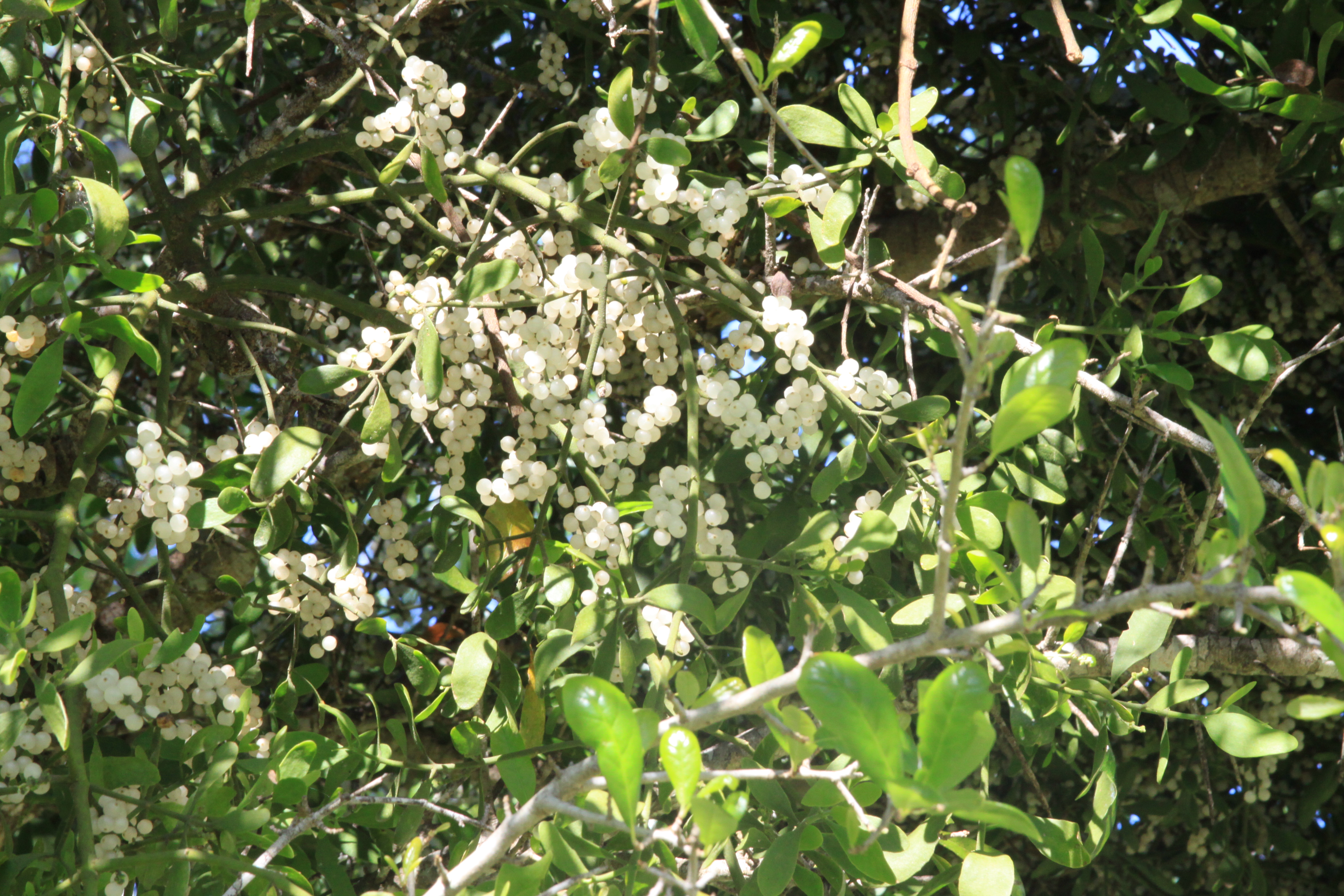
The abundant white berries look tempting, but to people they are poisonous, sometimes fatally.  When squashed they turn to viscous glue, hence the family name Viscaceae.   They are adapted to cling to any body part of any critter coming into pressure contact with them, and I think the stickiness remains functional after passage through a bird. (More research needed on that.  Will use the Muscoy ducks in my yard.)

What a weird name, Mistletoe.  But what does it mean?  Googling turns up controversy, but the best (IMHO) origin comes from ancient English, as explained in detail in my good old desktop dictionary, with the “toe” evolving from “tan,” which means twig.  The Mistle part is more cryptic and controversial, but a cluster of ancient English-Germanic words resembling “missel” relate to urination.  This leads to loose translations of the name as “dung twig,” referring to the way the gummy seeds are deposited on host twigs via birds, including the European “Mistle Thrush,” aka appropriately Turdus viscivorus, the second word meaning mistletoe-eater.

 
6 Comments

Posted by on March 23, 2012 in Mistletoe


Tags: ,

The Secret Life of Spanish Moss

Spanish Moss

Tillandsia usneoides

Bromeliaceae

A fond childhood memory originated when my Lake Alfred grandmother sent a box of Spanish Moss to my home in West Virginia.  Perhaps the Spanish Moss was packing material for something else.  If so, the something else is long gone, and the moss memory lingers.  Amazing exotic stuff for West Virginia kids!  It still amazes me.  All my life I’ve believed the name “Spanish” Moss refers to the beards of the Conquistadors.  Hope that’s correcto.  One thing is sure:  it is not a moss.

Spanish Moss flower (by JB)

Spanish Moss is Tillandsia usneoides, a Bromeliad.  Native plant enthusiasts know that most epiphytic Florida Bromeliads, “airplants” to some, are species of Tillandsia.  Arguably the prettiest is Cardinal Airplant (Tillandsia fasciculata).  Gardeners know a different array of Tillandsias and a much broader family of Bromeliads, from Pitcairnias to Pineapples.

Walking across the PBSC campus this morning, I ducked a tree-beard and noticed it to be in full bloom.  It wants attention, so here we go.

This plant hangs around unrooted, not even enjoying  the obvious tree-top adaptations of other epiphytes, such as the tanks of bigger Bromeliads, the pseudobulbs and specialized roots of Orchids, or the hairy rhizomes of Polypody ferns.  How does Spanish Moss get away with it?   How does it take in water?  How does it photosynthesize up there in the sun without frying?   Does it have a sex life?

On the sex life.   Spanish Moss relocates vegetatively as fragments blow in the wind or cling to birds.   Beyond such cloning there are pretty little greenish flowers, which when pollinated make little capsular fruits releasing tiny little wind-borne fluffy seeds.  Just a guess here, but I’ll bet when those seeds parasail from one tree to another they often  catch in pre-existing Spanish Moss, giving them a soft landing (and a future sex partner).

The water issues.  Spanish Moss and other Tillandsia species get their gray grainy look from a covering of hyper-absorbent scales that trap water and dissolved nutrients from rain, mist, dew, humidity, and bug spit.  You could scarcely design better water-catcher-holders if you tried.  The bases of the scales penetrate the leaf surface and conduct water downward into the plant like reverse roots.  The entire mechanism is refined and effective.  When dry, the winged edges of the mushroom-shaped scales tilt upward, admitting water underneath.  When that occurs, the edges come down, capturing the water and allowing it to absorb into the dead hollow scale cells.  The water passes from the wings to the center of the scale.  The cells at the very center have thick upper walls, which lift when the cells are filled with water.  As the water empties downward through the base of the scale into the leaf the thick upper walls of the central cells pull downward sealing the water in.  Think of water swirling down a drain pulling the drain plug closed.

Leaf scale from Spanish Moss. Top scale is dry. Bottom scale is wet, showing passage of water into the plant. Credit is given in article.

But why doesn’t that skinny little stem dry out in the Florida sun?  In addition to the scaly covering, Spanish Moss has a special ability found   scattered throughout desert plants.  Let’s define the problem:  a plant needs to breathe in carbon dioxide just as we breathe in oxygen.  But, just like us, the cost of “breathing” is water loss.  When the sun is hot and harsh the cost (water loss) can exceed the benefit (breath of life) when the two happen simultaneously, as in people, dogs, and most plants.  But Spanish moss and desert plants have what’s known as CAM photosynthesis.  This is not the place to ponder the anatomical-biochemical mechanisms, but rather to comment superficially that Spanish Moss and other CAM plants breathe in their carbon dioxide during the cool moist night, then store the carbon dioxide for use in photosynthesis during the dry sunny day.

The “usneoides” in the name refer to a lichen, Usnea, which looks and behaves in much the same way despite being unrelated as can be; a lichen is a combination of a fungus and alga.  Lichens have two famous abilities:

1. They can dry out and go into “suspended animation” until rehydrated.  So can Resurrection Ferns, Selaginellas, and Spanish Mosses.

2. They capture radiation and air pollution.  So does Spanish Moss, which is especially prone to capture toxic heavy metals form the foul air.  Pollution accumulation has been suggested as a reason Spanish Moss is rare within New Orleans but abundant in surrounding areas.

                                         Spanish Moss has many uses (Photo stolen from Internet)

Anything as absorbent, plentiful, and soft as Spanish Moss can be assumed to have historical uses.  Those for Spanish moss abound, florists’ wrappings, insulation, bird’s nests, and the one use that just has to be mentioned is flaming arrows.

———————————————————————-

Confessions:  I’m using the same essay for both my blogs this week—they overlap.   The drawing of the leaf-scale comes from Benzing, D. H. Vascular Epiphytes: General Biology and Related Biota. P. 105. 2008.

 
2 Comments

Posted by on March 16, 2012 in Spanish Moss


Tags: ,

Lizard’s Tail

Lizard Tail

Saururus cernuus

Saururuaceae

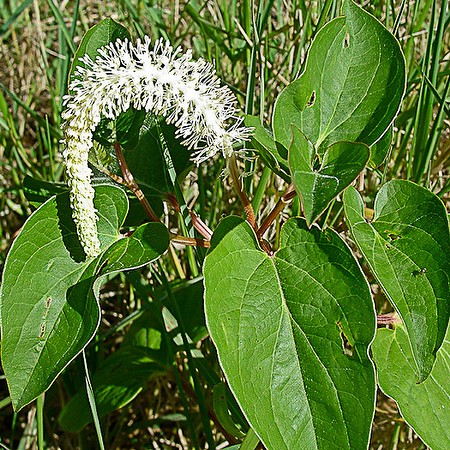
Think of a name having the letter “u” in it 5 times, uuuuuh, not so many.  Saururus cernuus translates as nodding lizard tail, and the arched tapering inflorescence fits the name.  Here’s another annoying question: what do Lizard Tails and alligators have in common?  Yes, they both live in the same habitat as Pogo, and more interestingly they both belong to a two-species genus where one species lives in Eastern North America and the other hangs its hat in eastern Asia.  Divorced couples like that have long fascinated biologists as “Eastern Asian-Eastern North American Disjuncts.”  They are separated relicts from the Miocene Epoch 23-5 million years ago when distributions were more or less contiguous across the Northern Hemisphere.  The primary connection was a Russian-Alaskan land bridge, now the Bering Strait.

Lizards Tail flower spike (by JB)

A colorful species related to Lizard’s Tail and familiar to gardeners is Chameleon Plant Houttuynia cordata. http://hcs.osu.edu/hcs/tmi/plantlist/ho_rdata.html

Readers familiar with Kava Kava may see or smell resemblance to LT in the plant form, leaf shape, inflorescence, and root beer-licorice fragrance upon being crushed.  They are vaguely related.  Kava Kava is a member of the Pepper Family, where Lizard’s Tail has been placed by some taxonomists.  A separate segregate family Saururaceae is the treatment in most contemporary references.  As with Kava Kava, Saururus has a substantial history in traditional medicine.  Not to bore you with a list of every way the plants have assuaged some disgusting ailment, what’s more interesting is applications to treat sores and wounds characterize the American and Chinese species alike.  And as with Kava Kava, Lizard’s Tail is reputed to be sedative.  Also noteworthy are applications to relieve pain, with modern research confirming neurological activity.

That showy white arched inflorescence has specialized insect-adaptations, including UV patterns invisible to mere mortals and floral fragrance.  Yet one study in Louisiana showed most of the pollination to be by wind, at least there and then.  How many species are adapted to insects and to wind?  The flowers are protogynous (= female, then male) and do not self-pollinate much, if at all.  When pollen from the same individual plant is transferred to the stigma, the pollen is recognized as “no good” and is murdered summarily.  The floral spikes are dragon-fly landing platforms, and the big bugs kick up a cloud of pollen.  That might be insect-assisted wind-pollination.

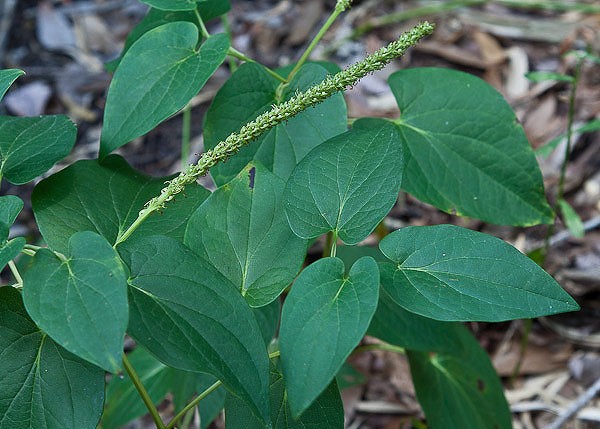
Flowering along the spike proceeds gradually like a burning sparkler, keeping pollination activity going for weeks.  As the spike matures into the fruiting stage, it straightens out and releases tiny “nutlets” resembling the small dry fruits of other aquatic plants, such as Alisma, Echinodorus, Sagittaria, and sedges.  Presumably such little achenes and nutlets cling to or pass through waterfowl.  Of course they float too and root, as do pieces of the extensive rhizome.

The spike straightens in fruit (by JB).

 
2 Comments

Posted by on March 9, 2012 in Lizard's Tail


Tags: ,

Domatia—Anybody Home?

A widespread but inconspicuous feature across the plant world is the presence of domatia on leaves or other organs.  Domatia (doe-MAY-shaw, not doe-MAT-ee-ah) are tiny homes the plant provides, sometimes with food, to varied small critters, often ants, mites, or even  bacteria in symbiotic exchange for services rendered. Among local native species, especially conspicuous domatia decorate the leaves of members of the Combretum Family:  Buttonwood (Conocarpus erectus) and White Mangrove (Laguncularia racemosa); domatia occur also on their locally cultivated and escaped exotic cousin Tropical-Almond (Terminalia catappa).

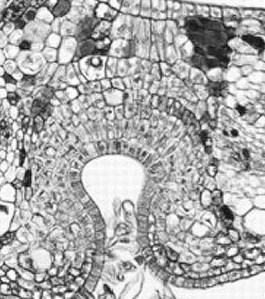
Pit type domatium in cinnamon, microscopic section. From Ann. Bot. 97: 601. 2006

Domatia come in varied sizes and shapes.  Those on leaf blades usually sort into four different categories:  pouchlike (sometimes called marsupiform), hair tufts (as in many oaks), pits, and pockets.  Those of Buttonwood and of White Mangrove appear to be the pit type—tiny cavities in the underside of the leaf.  Their tiny size  begs the question of,  “what micro-creature lives in there, and what can it do for the plants?”

Specific mite data on today’s plants are not in hand, but in general itsy bitsy leaf domatia are thought of as refuges for predatory or fungus-eating mites serving their botanical landlord by eating other mites or pathological foliar fungi.

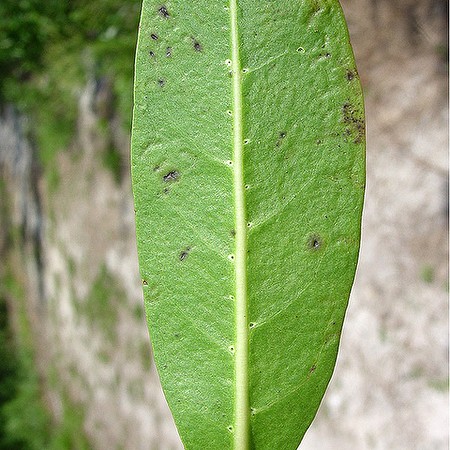
Buttonwood domatia (by JB)

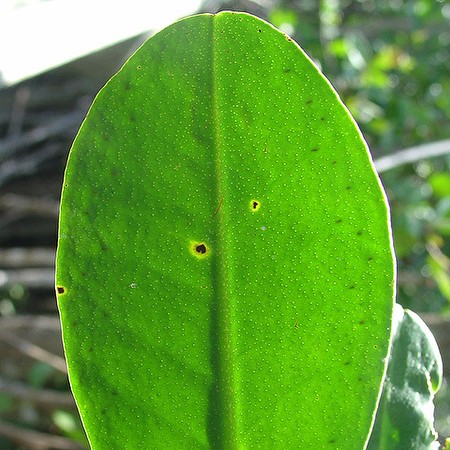
The White Mangrove and Buttonwood domatia are useful for identification.  In Buttonwood (including “Silver Buttonwood”)  flip over the leaf, then look along the central vein; the domatia are in the angles where the secondary veins branch off the main vein, looking like little blackheads.  In White Mangrove they are in a line along both leaf margins, about a quarter inch in from the edge.

White Mangrove. The domatia are dark spots in a row inside the leaf margins. (By JB)

 
1 Comment

Posted by on March 4, 2012 in Domatia


Tags: , , , ,