RSS

Monkey-Oranges, Snakebites, Rat Poison, and Memories of the 60’s

Monkey-Orange

Strychnos spinosa

Loganiaceae

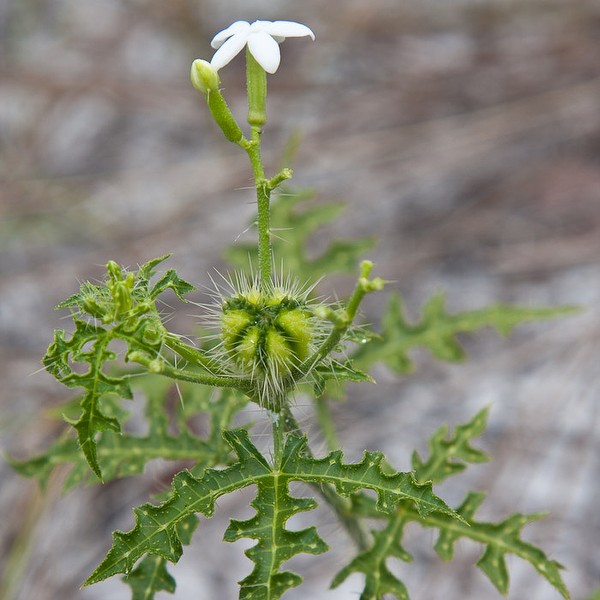
In recent weeks John and George have focused on the beautiful Savannas Preserve State Park and its neighborhood around Jensen Beach, partly in preparation for an upcoming workshop there, partly because  it  beats working.   During all those doings, John, Park Biologist Christopher Vandello, and George teamed up to identify an invasive exotic shrub with croquet-ball fruits.  Christopher has been restoring a lovely sugar sand scrub ridge crossed by an ancient paved road with a simultaneous view of the Intracoastal and the inland “savannas” marsh.   Unfortunately this primo piece of creation is exotically invaded with  the spawn of garden waste dumped long ago:  Sansevieria, feral ornamental bromeliads, Suriname-Cherry,  Callisia, Kalanchoe, and more.  The most striking and spreading unwelcome guest  is a thorny sprawling shrub resembling at first glance Snowberry (Chiococca) but with cannonball fruits the size and shape of grapefruits and rock hard.
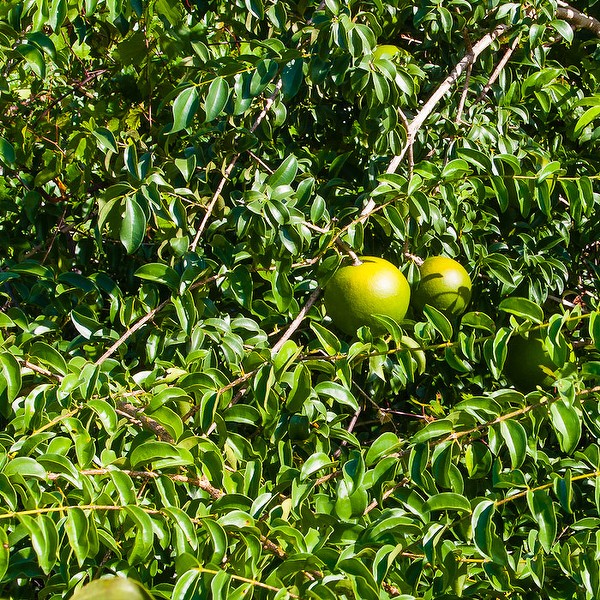
Strychnos spinosa (by JB)

Many species in the world have fruits of that general sort, perfect for throwing, and they’d be fun to step back 50 feet and shoot with a .22.    They look just like the citrus Bael Fruit (Aegle), but the foliage is wrong.   They look like some lemonish citrus, but the foliage is all wrong.  They look like Calabash, but the foliage is all wrong.  We took some prickly branches and vegetable bocce balls back to park headquarters, went to work on the computer,  and they turned out to be “Monkey-Oranges”  (Strychnos spinosa).  Another name is Natal-Oranges, fitting as the site has a meadow of Natal Grass (Melinis).
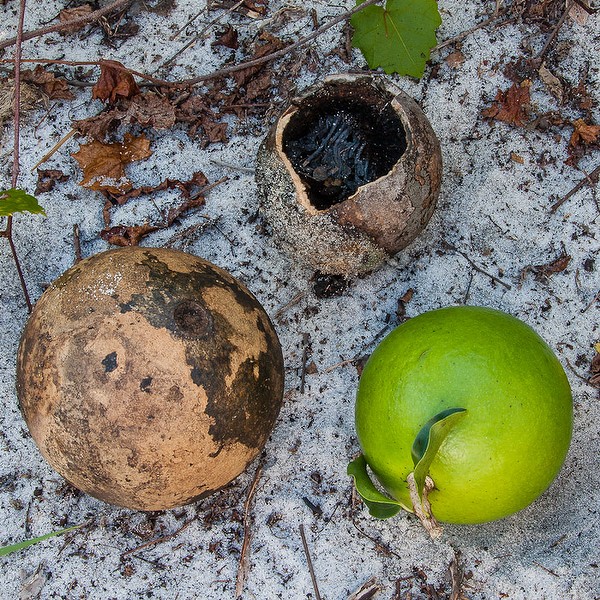
If we were in Africa these would be elephant snacks. People make things out of those hard “gourd” shells. (By JB)

The foliage is distinctive with opposite leaves having long smoothly upcurved veins.  Monkey-Oranges are not even related to Sunkist, but rather are (debatably) in the Loganiaceae, more familiar to Florida native plant enthusiasts  for Spigelia and Mitreola, and (debatably) Polypremum.   This is the family of the super-uber-lethal Carolina-Jessamine (Gelsemium).

That “lethal” part fits Strychnos spinosa.  The genus Strychnos is the source of the alkaloid drug strychnine, mostly (but not entirely) from the species Strychnos nux-vomica.  How does strychnine crop up in everyday life?  Rat poison.  Or if you are roughly of my “Woodstock” age you may recall exhortations from some authorities in the 1960s, “shun the LSD!, it is laced with strychnine.”   Whether or not that was ever true, strychnine is a powerful drug in the alkaloid group along with its friends likewise ending in –ine, such as morphine, codeine, nicotine, atropine, and an alkaloid I’m enjoying now as I type (you guess).   Strychnine inhibits the shut-off mechanism for nerve-muscle signals.  A high dose is a path to boot hill.  Lower controlled doses can be therapeutic, which brings us back to Strychnos spinosa.
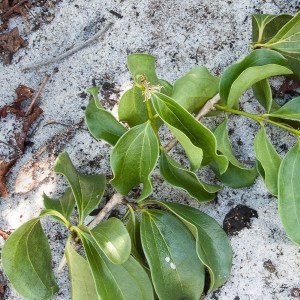
Aging flowers (by JB)

In its native Africa the tree serves as a traditional neurological drug, applied, among other things for snakebites.  Could this be a manifestation of the genuine beneficial potential of strychnine?

The fruits also serve as food, with the extra benefit of coming in a natural “can” (that steel shell) thwarting competing critters (although big animals munch freely), bugs, and decay.   They hold up in storage for months.  I’m not hankering to savor the flavor of strychnine-laced fruits, but cultures who have been doing it for a few millennia have the hang of it.   A little superficial Google research seems to indicate that strychnine is in the seeds and in the green fruits but that ripe ones are probably more or less okay. (Forget it!)

The natural habitats— just like the Savannas State Park scrubby dunes—are desert-ish, although proximity to water seems favorable.  The tolerance for aridity, the indestructible fruits, and easy wood production make Strychnos spinosa a candidate for cultivation in dry lands, such as Israel where the tree is in cultivation.  In this interesting link, see Figures 7 and 8 taken in Israel yet also illustrating the scene in Savannas State Park yesterday.  CLICK
 
Leave a comment

Posted by on September 15, 2012 in Monkey-Oranges


Tags: , ,

Polygonella

Wireweeds, Jointweeds,  Octoberflowers

Polygonella species

Polygonaceae

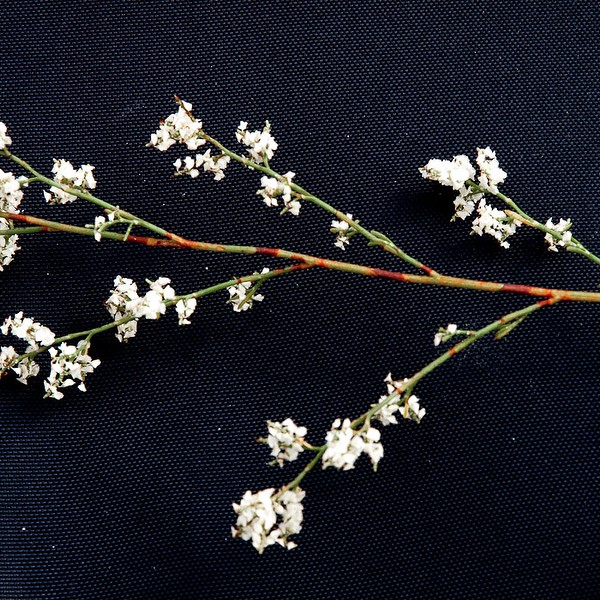
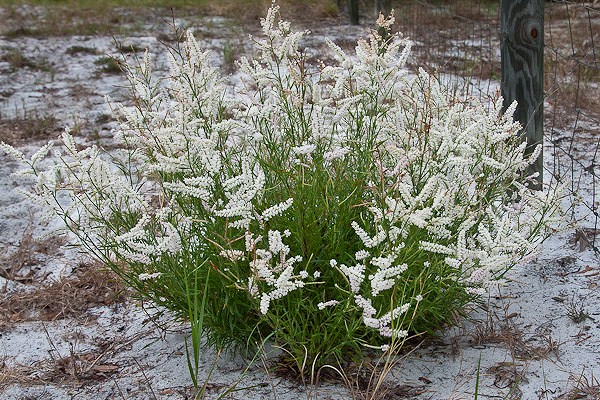
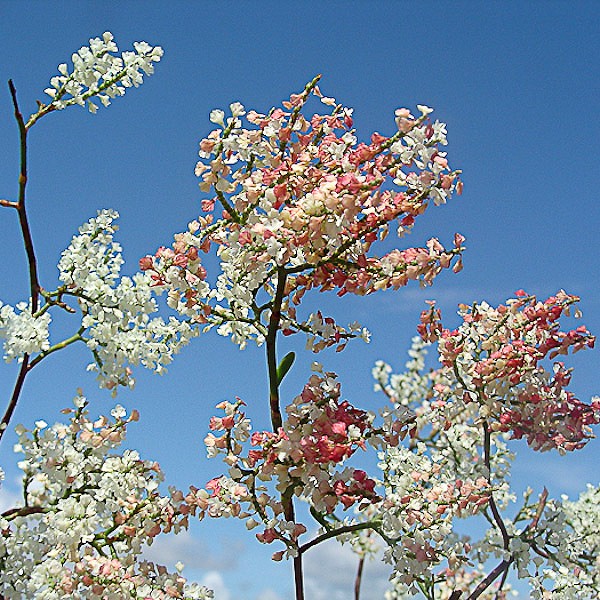
Two weeks ago John and George botanized a morning away in Jonathan Dickinson State Park near Hobe Sound.  The open sand areas looked like foam on the sea thanks to Octoberflower (Polygonella polygama).  This week we had chores in and near  Savannas Preserve State Park at Jensen, where another Polygonella,  Stout Jointweed (P. robusta) made the sugar sand whiter.  It is a Florida endemic or nearly so.  These and additional Polygonellas help keep Florida beautiful with their delicate mostly-white bountiful blossoms, which are on separate male and female plants in Octoberflower, but either bisexual or mixed male and female on single plants in Stout Jointweed.  The flowers of both start out white and turn to pink or rose or deeper shades, creating  impressionistic  color drifts in dense Polygonella meadows.

Octoberflower in September (by JB)

Altogether there are 11 species of Polygonella, all of them in the eastern and southern United States, most represented in Florida.  As a group, they tend to like dry sunny sandy places,  such as open areas in scrub, sometimes sandhills, or disturbed places.

Outside of our usual haunts, Polygonella basiramea and P. myriophylla are federal listed endangered Central Florida scrub endemics.  Polygonella myriophylla maintains a clear zone around itself by emitting natural herbicide(s).  This “allelopathic” ability probably occurs in other species as well, but rare and endangered species attract research.  Our Treasure Coast-ish species have bare zones around them too. Do they poison the competition?  Or do they merely grow the hot bare sand  where others fear to tread?  Or do they take advantage of the allelopathic “moats” of naturally herbicidal third parties, such as Florida-Rosemary?  All that would be fun to study.

Take a close look at a Polygonella…hey, there’s something “wrong” with that plant.  Oh, I know, the branch points are between leaves rather than immediately above the leaf-stem junction as in the rest of the plant world  (The branches originate normally but remain fused in part to the stem giving the illusion of arising midway between leaves.)  Knowing this, now you will never have trouble recognizing a Polygonella.

This shot shows the brown ocreas (cigar bands) at the places where leaves are or were, and the branching oddly spaced between the leaf attachment points. In normal plants bracning happens at the leaf attachment points. (By JB)

Also noteworthy, just above each leaf attachment point a cigar band membrane called an ocrea surrounds the stem.  The ocrea is characteristic of the Polygonaceae Family and turns up also in the big kinfolk:  Sea-Grape and Pigeon-Plum.   In some species., including our Stout Jointweed, the ocrea has long bristles on its top edge.

Faced with the heavenly flora displays of Polygonellas, the question must bas asked, what pollinates those lacey flowers?  Multiple insect species visit, but the interesting one is the Polygonella Bee Perdita polygonellae.  It is a Polygonella specialist, a single insect species dedicated to a genus of plants.  Which came first, the Polygonella or the bee?

White on white, P. robusta this week (by JB)

Kwick Key to the Common Treasure Coast Species

(The English names are inconsistent and messy.)

1. Ocrea with no bristles…2

1. Ocrea with bristles…3

2. Plants essentially leafless when flowering…Slender Wireweed,  Polygonella gracilis

2. Plants with leaves shaped like little canoe paddlesOctoberflower, Polygonella polygama

3.  Leaf blades usually < 1.3 mm wide,  the margins not translucent…Fringed Jointweed, Polygonella ciliata

3. Leaf blades to 2.5 mm wide, the margins translucent…Stout Jointweed, Polygonela robusta

 
7 Comments

Posted by on September 12, 2012 in Jointweed, Octoberflower, Wireweed


Tags:

Nettles, Ankle Biters, and Burning Noses

Urtica, Laportea, and Boehmeria in the Urticaceae

Cnidoscolus and Tragia in the Euphorbiaceae

A prominent memory from fooling around the hills of West Virginia as a kid was, “be careful about jumping down into muddy ravines.”  I can still see in my mind’s eye the standard summertime ravine bottom biological community:  Jewelweed (Impatiens capensis), nettles (species of Urtica and/or Laportea), and yellowjackets (or some sort of hornet with that general appearance).  The yellowjackets were benign, but the nettles would sting the living beejeebers out of exposed epidermis….then you rubbed jewelweed juice on the welts in some vain hope of relief.  We called it “the 15-minute itch.”

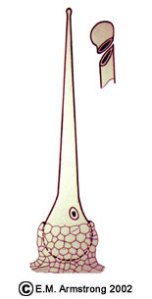
Turkey baster hair of pain. (From Wayne’s World waynesword.palomar.edu)

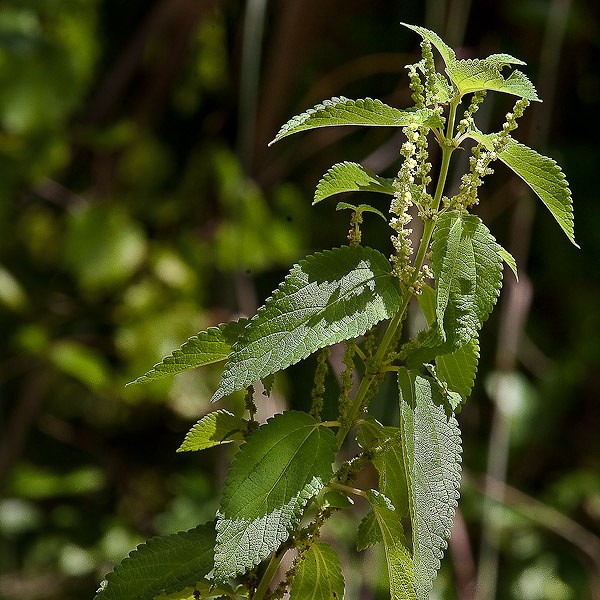
Throughout most of the eastern U.S. the stingers are Laportea canadensis and Urtica dioica (and other Urtica species).  Laportea has alternate leaves, Urtica sports opposite leaves.

Around Palm Beach and Martin counties, Urtica and Laportea are not common, but they are a little here to punish the unwary.  Laportea aestuans (leaves alternate) is probably native to more tropical places, maybe making its way northward aided by Global Warming.  Urtica chamaedroides (leaves opposite) is scattered around Florida.   I have showed students an Urtica, probably this species, in the PBSC plant nursery in Palm Beach Gardens, apparently having hitchhiked on nursery plants.  Given the weediness of Urtica, there would be no earth-shaking amazement in coming across additional species locally.

What is astounding about Urtica and Laportea is their vengeful hairs.  Plants with toxins are a dime a dozen.  Plants with thorns, spines, and prickles are too.  But these little nettle  stinkers smite their foes with an injection of toxin.  The tip of the hair snaps off in your flesh, and movement of the hair squeezes a bulb at the base, sending a little squirt of irritant into the wound.  The whole thing looks and works like a turkey baster. The irritating “venom” seems to contain formic acid, as in ant bites.

The plants are not all bad though. Urtica is grown as a green fertilizer.

The small wind-pollinated flowers have a spring-loaded mechanism to toss their pollen onto the breeze.  The stamen filaments are bent inward as the flower develops, and when the moment of truth arrives, they pop forth explosively flinging the pollen.  How the anthers open coordinated with the springing filaments is a mystery of nature.

Does it bite? Nasty Urtica, or nice Boehmeria? You decide. (By JB)

False-Nettle, Boehmeria cylindrica is abundant around our haunts.  It looks like Urtica but has no stinging hairs.  False-Nettle brings us now to a little ethnobotany.  Members of the Nettle Family have long strong fibers.   Examples include Hemp (Cannabis), Urtica dioica (which has served as a fiber source), and Ramie, which is Boehmeria nivea, an Asian species.   Cannabis persists to this day as a weed in U.S. areas where it was grown historically for hemp.  My Michigan-dwelling brother just told me of encountering Cannabis growing spontaneously near his rural home.  I’m pretty sure that’s no smokin’ weed, but rather left over from Hemp farms once active in the area.  Florida was once a major fiber-growing and fiber-research state, and one fiber plant still with us escaped is Ramie. It differs from False Nettle by having the leaf blades white-hairy beneath and branchy (vs. spike like) flower clusters.

Oh $#%^&!! something just stung my ankle!! (Tread Softly by JB)

Although not related to Urtica and Laportea, another locally prominent nettle, Cnidoscolus stimulosus, is sometimes called Tread Softly, Bull Nettle, or Spurge Nettle.  Usually in dry sunny sandy habitats, Tread Softly is in the Spurge Family and is related to “Cuban-Spinach” (Cnidoscolus chayamansa).  I can attest from recent experience ankle contact with its stinging hairs is an epiphany.  Also related to Tread Softly, likewise in the Spurge Family, and scattered in Florida—even if our own immediate counties have few or none—are the Noseburns, species of Tragia.   They too inject a sting, and the mechanism is extra-special.   Contact with their hairs stabs a dagger of calcium oxalate into your soft skin.   This is the same stuff that puts the dumb in Dumbcanes, but that’s not for today.

To sum it up, just watch your step.

 
8 Comments

Posted by on September 2, 2012 in Nettles


Tags: , , , ,

Cyperus polystachyos a Sedge for All Nations

Manyspike Flatsedge

Cyperus polystachyos

Cyperaceae

This summer John loaned me a book about brouhaha over a fancy species of Orchid from South America.   Entertaining reading about obsession, rivalry, and general silliness…and food for thought.   In a world of a quarter million flowering plants, that much attention to a single species (if you can’t eat it, medicate, or turn it into fuel) is wasted opportunity.  I’m more fascinated with the crummy weeds in my back yard than with one showy big-flowered Orchid. (But then again I dig mutts from the pound.)

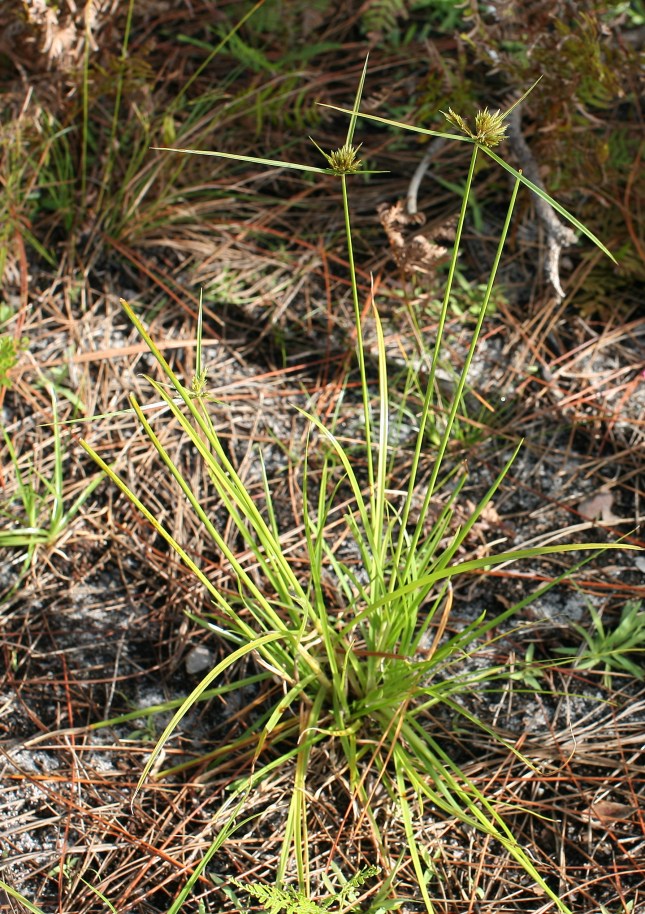
Today’s spotlight is on the so-called Manyspike Flatsedge, Cyperus polystachyos, which perhaps you never heard of — because there is not much to hear.  But you have seen it, and next time you see it you’ll know it. This species is nondescript, unpretentious, and you step on it, but it’ll have the last laugh.

Everyone has seen this! (Photo by JB.)

The weird thing is this species grows everywhere.   Why some species are rare, endangered, and confined to two counties in Florida, while others are taking over the world?   Manyspike Flatsedge covers Florida and ranges southward to South America.  Is it then tropical?  Well, yes, and looking northward it goes all the way to Maine.  The plant is also in Hawaii, Africa, Asia, and Australia. Where did it originate?  Where was it distributed before ships circled the Globe?  Who knows?

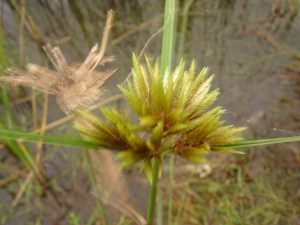
Look how flat the spikes are. (By JB)

When I say grows everywhere, I don’t merely mean on a global scale.  To narrow the focus locally, there is probably one within 200 yards of where you are sitting.    The habitats are just about any:  lake shores, depression ponds, roadside ditches, hammocks, pine woods, weedy roadsides, saltmarsh, shell mounds, burned forest, prairie, sand hills, and scrub.  The sites are often moist, but not necessarily, and the soil is often organically enriched but then again can be acid, alkaline, clay, lava, or sand.

The species is as varied as it is widespread, a challenge to taxonomists who disagree on its definition.  Manyspike Flatsedge can inhabit your mowed lawn, or left alone may be two feet tall.  The inflorescence may be compact or spread out, branched or not, and yellowish or red.

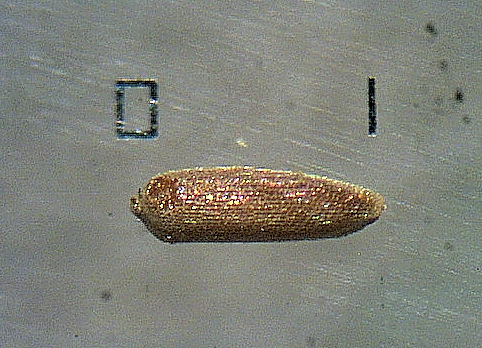
How does a species get around like that?   The fruits are tiny (1 mm long) achenes (fruits that resemble seeds), as is true of the other 599 species of Cyperus.  The achenes clearly float and blow around, and more importantly probably ride in or on birds.  Oh, by the way, several other species of Cyperus are global super-weeds too.  If you are not familiar with Cyperus, think of Papyrus, which is weedy itself.

Intercontinental ballistic achene (by JB)

The surface of the achene is sculptured with bumps and depressions.  And this is common on small seeds and achenes, especially perhaps those in wet habitats.  Why the patterned surface?  The leading thought in my experience is to cling to mud on birds’ feet, like mud sticks to the sculpted pattern of your waffle-stomper  hiking boots.  Another thought you encounter is that a rough irregular surface may catch the wind.  Additional notions are possible and 100% speculation:  maybe passing through a bird’s intestine a little bit of the bird’s intestinal content, natural compost, clings and helps the  achene initiate intimacy with soil mycorrhizae or other microbes,  or remain moist, or experience a tiny boost of nutrition.  Or, much more boringly, maybe the external bumps and valleys are just natural “bubble wrap.”

That this sedge grows on salty places adjacent to the sea probably helps it roam the Seven Seas.  Maybe Isaac moved it around even more.

But how will I know it when I see it?  First off, it looks like a standard “Cyperus” Flatsedge, with leaves clustered at the base and another tuft clustered at the top of a triangular stem.  The flowering spikes are utterly flat, and numerous.  Now here is the easy part:  there are just 2 styles, as opposed to the three in most of our other locally common Cyperus species.  If the styles are two and the spikes are flat, you probably found it. (And to make certain, the spikelet is under 2 mm wide and there is no elongate pointed tip on the spikelet scales.)

What do Florida, New England, Brazil, Morocco, Israel, Thailand, Polynesia, and Australia have in common?    Cyperus polystachyos.  How did that come about?  If by the hand of humans, that is quite a bioinvasion.  If by the hand of Mother Nature, and I hope so, that’s quite a helping hand.

 
10 Comments

Posted by on August 29, 2012 in Manyspike Flatsedge


Tags: ,

Smilax

Catbriars

Smilax species

Smilacaceae

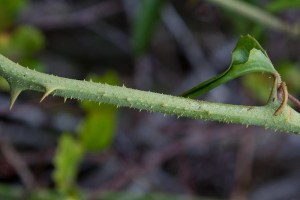
Ouch! (by JB)

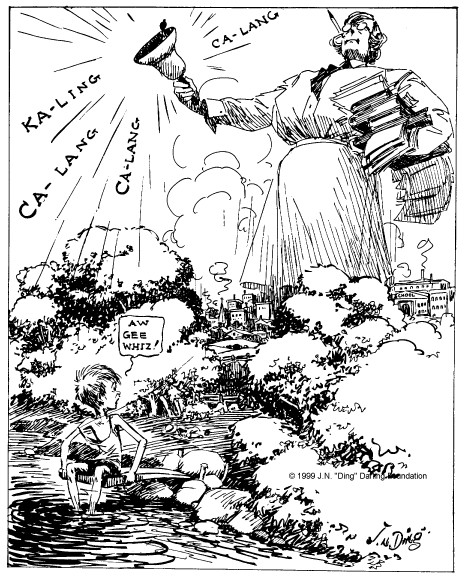
How did it get to be back-to-school time?  Clanging schoolbells thwarted this week’s Friday botanizing.  Before the rude interruption John and I were tangled up in Smilax (Catbriars).  You don’t get far in a Florida natural area before discovering these.  The late garden writer Sara Stein, in “My Weeds” displayed a negative attitude toward them:

“How can I explain how horrible catbriar is? It trips the feet and rips the skin…Its rhizomes are like steel cables.  They can’t be pulled up…Some pieces have been six-footers, and yet both ends were broken from the mother rhizome I will never reach.”

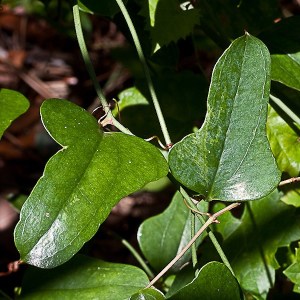
Smilax auriculata by JB

That mother rhizome can be as big as your arm, a real whopper.  No typhoon or fire is going to discourage that nugget of life.  But how about hungry hogs?    One of our species, Smilax bona-nox reportedly has prickles on the rhizome (at least sometimes—the species is variable).  This adaptation possibly evolved in the natural  range of wild peccaries and thus was pre-adapted to deter feral hogs, perhaps.  It would be fascinating to know if the prickly rhizome has affected the distribution and abundance of S. bona-nox relative to the piggy-wiggies who root and snoot hereabouts.  To repeat for emphasis, however,  the prevalence of prickly rhizomes in S. bona–nox is unclear—not the sort of thing botanist observe often.

Sara Stein didn’t like Smilax, but thirsty cowboys did when they passed on the whiskey in favor of a nice refreshing sarsaparilla.  Maybe those cowboys needed it for personal reasons: one of the early uses of sarsaparilla was to treat syphilis.  Different species of Smilax historically have wound up on dinner tables quite a bit:  the rhizomes as pseudo-spuds, as flour, as a natural jello, and as stand-in for asparagus.

Is munching Smilax is a good idea?  That the genus has a history in medicine is a sign of bioactivity, and bioactivity is a sign of potential consequences.  Smilax is sufficiently neurotoxic to be a potential treatment for seizures.  As sarsaparilla it served to alleviate rheumatism.  Some species yield steroid precursors.  So when we go walk the garden path, please don’t hand me a Smilax tendril to nibble (unless I’m having a seizure).

Botanist John Mitchell provides recipe for Smilax aphrodisiac some readers may wish to try:

  • Smilax roots
  • One white hot nail
  • Coatimundi penis

Chill the mixture for a week and take a teaspoon a day. (Let me know how it works.)

Smilax is the Monocot  twin to Dicot grapes, right down to the tendrils and fruit clusters.  They are related to Lilies, and the flowers look like tiny Lily flowers.  They don’t smell so great though — an older name for the genus is Coprosmanthus, meaning “dung-smelling flower.”  Of the dozen species in Florida, those encountered in the area of TC Natives are Smilax auriculata (very common, leaf blades usually with basal lobes, the leaf margins not bony, the midvein beneath the leaf jutting out similarly to the side veins, the female flowers with 2-3 stigmas), S. bona-nox (mnemonic: bona-nox has bony leaf margins), S. laurifolia (leaf usually narrow with the base unlobed, the midvein beneath the more prominent than the side veins, the female flowers with just one stigma), and S. tamnoides (bottom half of leaf margin with prickly little teeth). Good luck!  The leaf shapes are dismayingly diverse within species.

Note: The cartoon is by Ding Darling.

 
5 Comments

Posted by on August 20, 2012 in Catbriars


Tags: , , , ,

Red Mangrove Youngsters — Failure to Launch

Red Mangroves

Rhizophora mangle

Rhizophoraceae

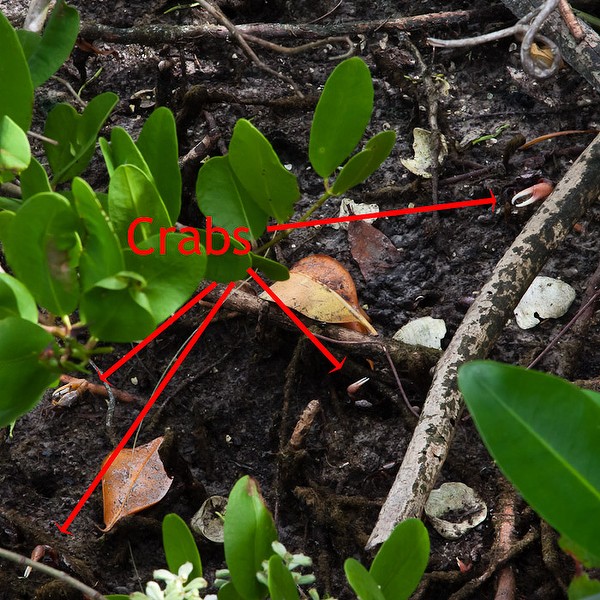
Today John and George sweated like jungle explorers through the Kiplinger Natural Area in Stuart, with distant thunder.  Worth the steambath though, with the blooming Loblolly Bays resembling a Camellia garden.  Even better, Red Mangrove babies were dropping from their mama mangroves onto the crabby Fiddler Crabs brandishing their big claws in the tidal mud.

CLICK to see a nice Mangrove gigapan by John Bradford

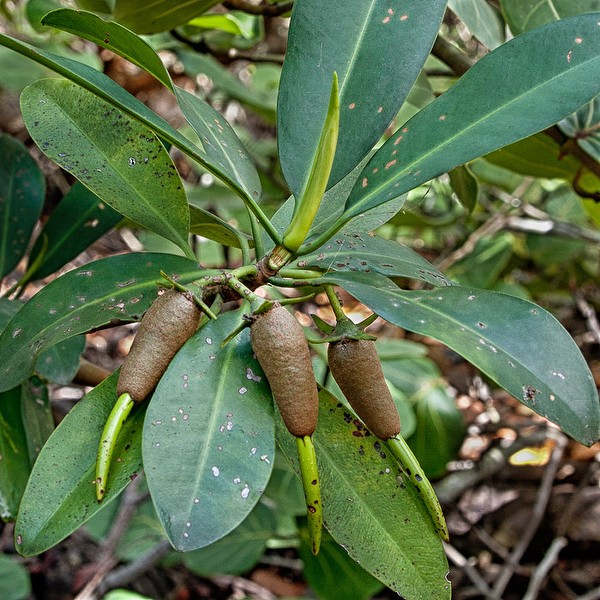
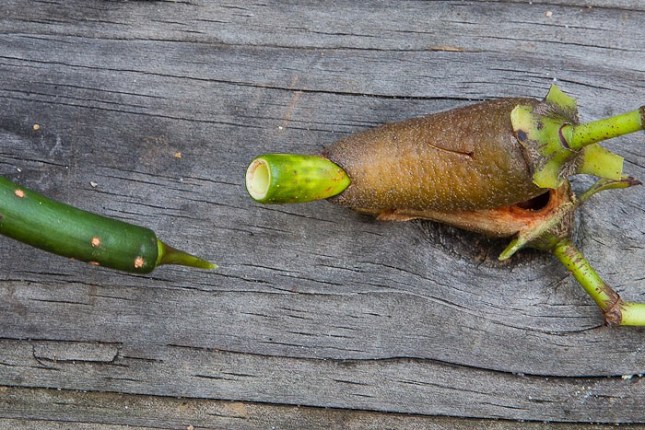
Green pencil-shaped Red Mangrove babies (embryos) protruding from the brown fruits. All photos today by JB.

Nothing is more boring than botanical embryology, but we’re going there anyhow.  So grin and bear it, because native plant enthusiasts are duty bound to understand those wacky Red Mangrove youngsters.  They look like big pointy green beans protruding from the much-shorter brown fruits.

To discuss wackiness we first must establish baseline normality. A normal seed is a space capsule where the seed coat surrounds a baby plant (the embryo).  The mother plant packs baby formula called endosperm into the seed and then sends it off to college with no further ado.  The meat and milk in a coconut are examples of endosperm.

Consistent with sociological trends of today, however, the Red Mangrove offspring stays home after college, deriving direct support from the mother plant, just like Kathy Bates doing the laundry for 35-year-old Matthew McConaughey.

In a human family that’s easy enough to arrange, but plants are not designed for extended parental support.  A normal seedling has no way to reach back to the mother plant for supplemental cash.  I mean, the mother plant packs an allotment of endosperm food into the seed, wishes the youngster good luck, and sends it off to fend for itself.  End of connection, end of story.

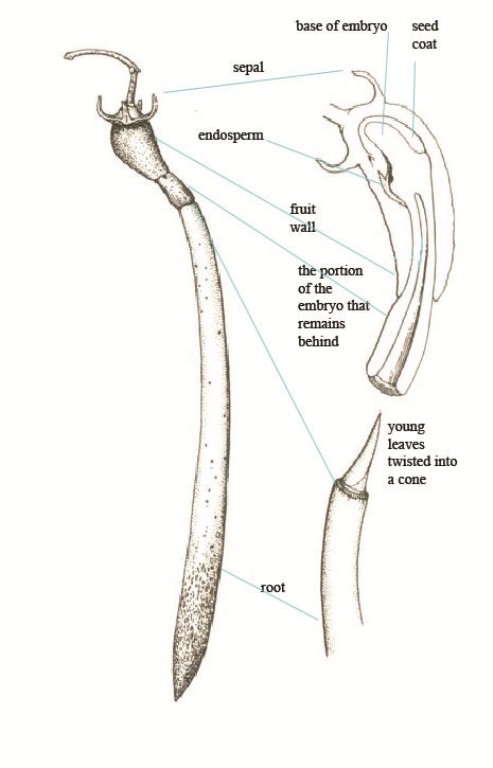
But not so in a Red Mangrove.  The seed germinates while still inside the fruit, this still suspended from the mother plant.  The germinated youngster (the embryo) grows 8 inches long, requiring vastly more nutrition than the original endosperm.  Here is the weird part: The mother tree conveys sustenance through the fruit into that growing green youngster as it pokes forth from the fruit and enlarges to the size and shape of a pencil.  But how does the maternal nutrition cross the generational barrier?  (Technically, two generations are crossed but who needs pesky details?)  The endosperm is the key.

The endosperm does something amazing, it spills forth from the top of the seed and surrounds the portion of the embryo encased in the fruit as the other end protrudes and elongates.  That is, the endosperm does not function as stored food like it should, but rather reorganizes and becomes a conduit from mother to baby, an umbilical cord.  To display my ignorance as usual, I’m not aware of any other case of this among the flowering plants.

When launch time rolls around, the big green rooty-tooty embryo snaps into two components like the two stages of a Mars-bound rocket.  The fruit-end of the embryo stays behind discarded and embedded in the fruit. The long outer end of the embryo snaps off and drops onto those Fiddler Crabs for tidal dissemination of Rhizophora mangle.  At the breakage point on the dropped embryo portion you see the young leaves twisted into a tight little cone, which had been sheathed in a matching cavity before the break-up.

The part of the embryo that drops free is green on the left, with its pointy conical leaf cluster at the tip. On the right: the green throwaway portion of the embryo (like the hollow cap from a Bic pen) is jutting from the brown fruit. You can see the cavity in the throwaway portion where the conical leaf cluster had been covered before the snap-off.

Who ever heard of endosperm leaving a seed and becoming an umbilical cord?  Who ever heard of a two-stage embryo where one end is abandoned after the other end snaps free?   You have.  Then the next time you tiptoe through the tidal mud you can slice one and know the inside story.

[Notes: For interested readers, the portion of the embryo remaining abandoned in the fruit is the modified pair of cotyledons. The drawing is by Dorothy Marsh, published by S.A. Graham in The Jour. of the Arnold Arboretum 45: 288. 1964.]

][

 
6 Comments

Posted by on August 12, 2012 in Red Mangroves


Tags: , ,

Goldenrods and Dandelions—Weeds Are The Future!

Goldenrod

Solidago fistulosa

Asteraceae

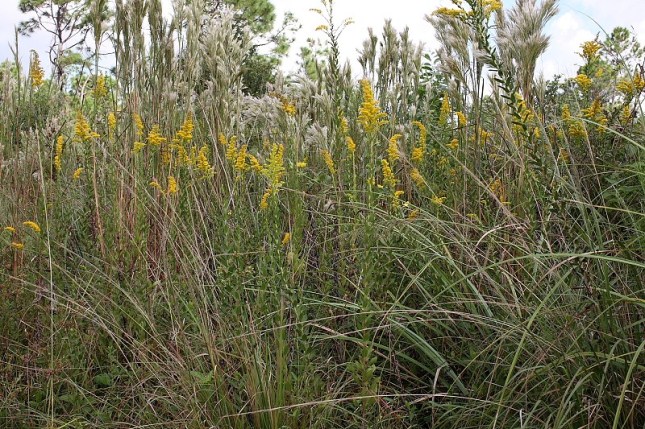
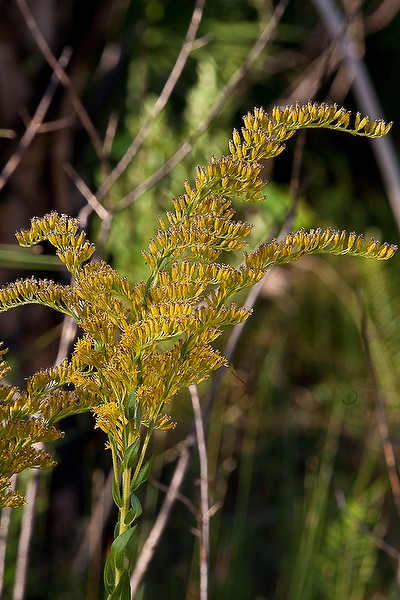
John and George botani-snooped Halpatioke Park in Stuart today, always a source of photogenic plant diversity.  Unlike previous weeks, the park was awash in the odd little annual grass Steinchisma laxa, which seems to have popped up in response to some cue.  The other domineering presence, Goldenrods (Solidago species), take their cue from lengthening nights after the summer solstice.   There exist about a hundred species, mostly in North America.  Pinebarren Goldenrod, Solidago fistulosa, was the main showoff here and now.

Solidago fistulosa (by JB)

What does everyone know about Goldenrods?  Allergies, although it is probably a bum rap.  The big sticky insect-borne pollen grains are not likely to wind up often in your snoot if you don’t sniff bugs, although flower arrangers know Goldenrods to irritate the skin

Bees are the main pollinators, and additional insects visit.  Today Soldier Beetles resembling lightning bugs without the flashlights were on duty.  Often associated with Goldenrod, they lurk among the blossoms catching other insects, mating, and eating those pollen grains.

The name Solidago means “becoming whole,” as in healing.  There are too many medicinal applications to list, and most are boring.  However, there’s probably validity to some of the historical uses.  The plants are bioactive, including a handy ability to suppress soil pathogens (and human pathogens?) via root exudates.  And Goldenrods produce natural pre-emergent herbicides to throttle germination of competing seeds, at least in the lab.  Some folks like Goldenrod Tea, but why blithely consume any bioactive plant?  I’ll stick with Winn Dixie tea. Goldenrods have touched automotive history too:

Thomas Edison, Harvey Firestone, and Henry Ford shared an endeavor in the early 20th Century. Around WWI time they fretted about rubber running low.  Ford tried Rubber Tree (Hevea brasiliensis in the Euphorb Family) plantations in the Amazon.  Firestone went for Liberia.  Double failure, yet cars were proliferating nationwide like Goldenrods sprouting across the meadow.  The Captains of Industry realized that many plants other than the proper (Para) Rubber Tree make latex, including Ficus elastica and the Palay Rubbervine.  The former graces waiting rooms nationwide.  The latter is a showy weed in hot-climate America from its introduction as an attempted rubber plant.  Most importantly for today, also giving up latex are many species of the Aster Family, including the much-touted Guayule, Dandelions, and Goldenrods. You can farm these.

Solidago fistulosa (by JB)

And now comes a big Florida connection.  Brainstorming Goldenrods took place at Edison’s Ft. Meyers compound along with Florida-oriented botanist John Kunkel Small and University of Miami botanist Walter M. Buswell. Interesting how the elite of that era got together.  Even distant Luther Burbank had a hand in the doings.

Edison had found 2000 ways not to make a light bulb.  That was just a warm-up for selecting a plant to cultivate for latex. Edison (a tired assistant) ground through 17,000 dud species, until Solidago leavenworthii emerged with 12% latex content.  This species ranges throughout Florida.  The Solidago rubber worked; prototype tires were made and driven.  So Edison thought he had it nailed by the late 1920s, and Goldenrod Rubber went forth with fanfare.   Altogether not too shabby, but too little too late, as synthetic rubber nudged all 17,0001 species aside.  Gasoline did the same to the electric car battery under development at roughly the same time.

A hundred years later, the electric car battery and bio-based rubber have bounced back.  Several corporations are developing tires and other rubber products based on biomass, plant-oils, “waste” animal fats, and sugars with the help of bacterial enzymes.  Reliving Edison’s brief triumph a century ago modern engineers have made prototype green tires, which may be on your electric car by 2015.

Goldenrod’s cousin Dandelion (especially a Russian species) has come into contention as an industrial rubber source for its milky latex, just as in Goldenrod.  CLICK  and  CLICK AGAIN   Remarkably, the process involves genetically engineered viruses if you can get your mind around those.  If Dandelions work it would be no huge stretch for related and similar Goldenrod to resurface too, so Goldenrod tires are still conceivable.

Let’s exit Tomorrowland and finish up back in Halpatioke.  We saw more galls on plants today than perhaps any other time or any other place.  This seems to be the summer of the galls, at least in Stuart.  Most were on oaks, but Goldenrods are gall favorites too.  A study around Gainesville showed 122 species of insects to attack Goldenrods in some capacity or another.   The best-known Goldenrod gall-makers are gall flies of the genus Eurosta.  Long ago and far away I used to enjoy cross country skiing in Michigan.  At that time the Goldenrod galls on dead stems above the snow were sufficiently conspicuous and odd to be memorable now.  The fly larvae lodged in the galls persist long after stalk death to emerge the following spring—after bitter cold and/or life-sucking dryness, depending on the locale.  Noting this, biologists have studied the larvae as examples of bizarre adaptation to extreme conditions. How can a little worm in a pod get through 10 degrees below zero or months of desiccation and pop forth smiling?

[Special thanks to my tire-expert engineer son Martin for a heads-up on new bio-tires, especially the Russian Dandelion.]

 
8 Comments

Posted by on August 7, 2012 in Godenrod


Tags: , , , , , ,

Prickly Pears

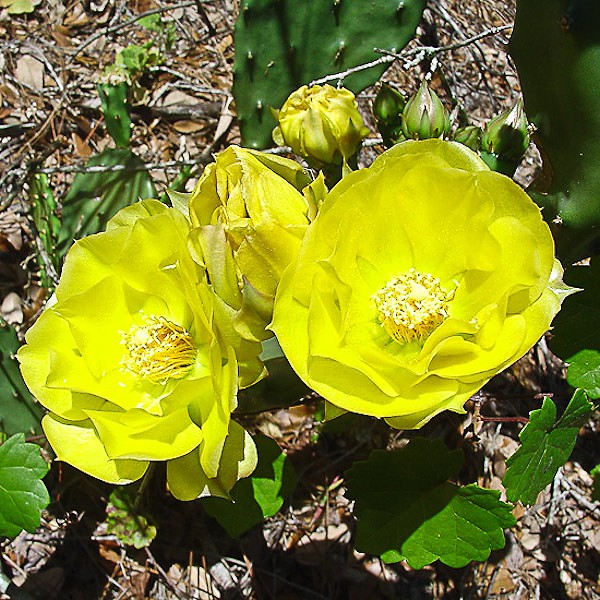
Photo by JB

Prickly Pears

Opuntia species

Cactaceae

Florida is home to several species of Prickly Pear Cacti of the genus Opuntia, some native, others cultivated.   In the area of “Treasure Coast Natives” we have Opuntia humifusa and Opuntia stricta.  The former differs from O. stricta by having glossy (vs. flat-tone) stems, on average smaller pads (but they overlap in size), and spine clusters with usually just 1-3 major spines (as opposed to usually more, up to around 10).

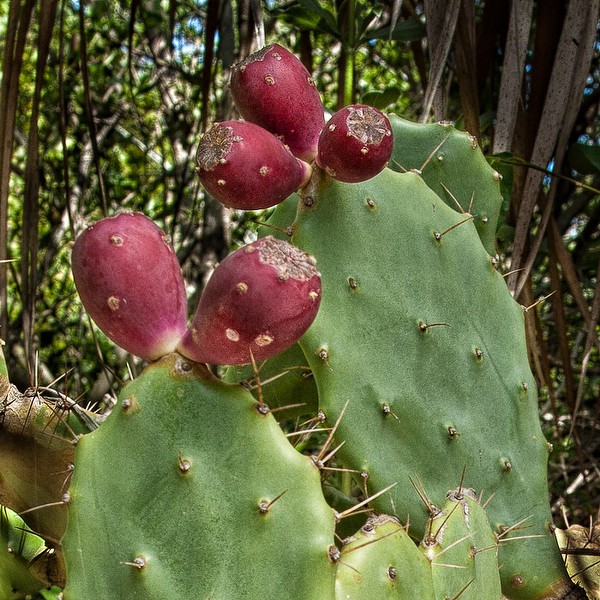
A third species a person might see hereabouts, and not native, is the red (vs. yellow) -flowered Opuntia cochenillifera.  This cultivated species has spineless pads, which are eaten as “nopales,” as are other Opuntia species which usually have to be peeled to get past the spines.  Opuntia fruits, tunas, are red and tasty, but handle them gingerly, because the nearly-microscopic hairs called glochids burrow in your skin and keep you awake later.  More interestingly, the name cochenillifera means cochineal-bearing, which brings us to an important point.

Cochineal Bugs resemble scale insects in their ability to make a waxy “nest” for the females to colonize and suck out the plant juice.  The bugs squish bright red-purple and were the basis for the historical international carmine dye industry originally based in Mexico and spread eventually to other regions.  Carmine dye is a bright red fabric colorant, “the roadcoats are coming,” serving also in foods and cosmetics, sometimes as “dye E120.”   Use in edibles and cosmetics has fallen off, in part due to concerns with toxicity.  There are cochineal farms in South America and Mexico.  Ounce per ounce cochineal extract is  worth more than gold (at least at outdated gold prices).  (Investment advice: if you are worried about hyper-inflation don’t bury gold under the doghouse; instead, move to the dunes and plant prickly pears.)

Tunas by JB

An effort to start a carmine dye industry in Australia failed but resulted in American Opuntia stricta becoming our revenge for their Melaleuca.

This is all leading up to the fact that Cochineal Bugs have variably spread to and been imported to Prickly Pear populations far and wide, including here in Florida.  Walking in the scrub it is a frequent experience to see unhealthy looking Opuntias with the tell-tale cochineal wax.   Embedded in the wax are the bugs.  If you can get one out, perhaps on a knife tip, without pricking your finger and mash it, you’ll have a purple-red fingertip tattoo thanks to natural dye E120.

 
2 Comments

Posted by on August 1, 2012 in Prickly Pear


Tags: , ,

Scarlet Sage is No Money Tree, But It Does Have Leverage

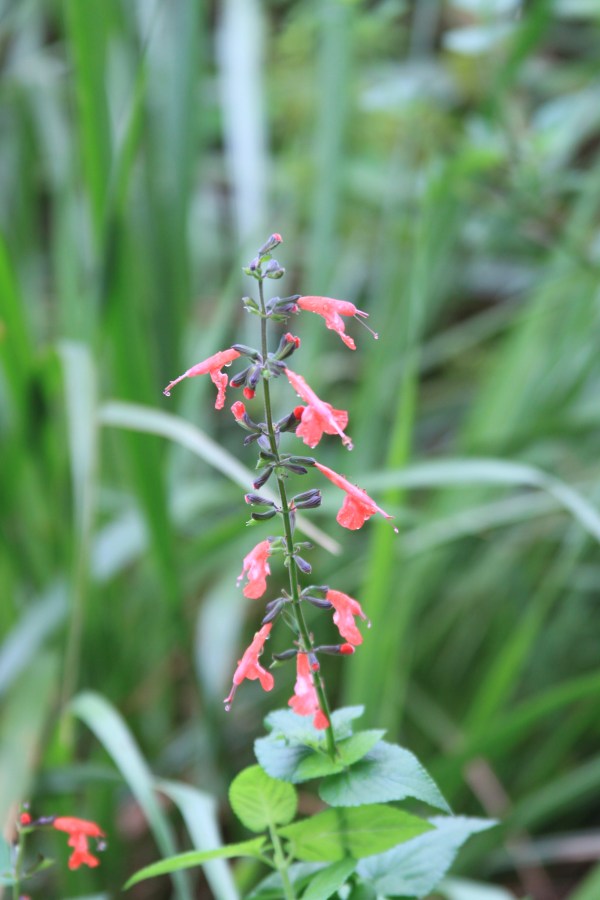
Scarlet Sage
Salvia coccinea
Lamiaceae

Billy is in North Carolina. John is vacationing in Maryland, thus the momentary dip in photo quality. That left me all lonesome to go visit Green Cay Wetlands CLICK in Delray Beach, home of the friendliest water birds in town and huge native aquatic plants on steroids, well actually on reclaimed sewer water. (Come to think of it, sewer water does contain steroids, but this is a nice blog so we’ll just forget about that.)


Very few plants at Green Cay are wild, but it is a terrific venue to see swampy-marshy natives from the comfort of an elevated boardwalk. Alligator Flag, Pickerel Weed, Arrow Arum, Water Lilies, and Sagittaria galore. Sedges in sedge heaven. A special treat yesterday was Scarlet Hibiscus puttin’ on the ritz, and frankly Scarlet, there’salso  a pretty planting of Scarlet Sage, today’s highlight.

There’s something special about the Mint Family, the Lamiaceae (aka Labiatae). Maybe it’s the square stems, or the minty essences, or the culinary herbs, or those two-lipped flowers. That’s all obvious. Something else about the Mint Family you seldom see are the weird little ovaries which become the fruits. Each flower produces four “nutlets” surrounding what’s called a gynobasic style—the style extends to the floor of the flower between the nutlets. The style and four-nutlet ovary look like a four eggs on a saucer with a straw pushed down between them to the saucer. (You can see this in the diagram below with two of the four nutlets visible.) Spot that and you will end all argument as to whether a plant belongs to the Mint Family, at least in a traditional sense.

Salvis coccinea, unfortunately not by JB

Salvia is a jumbo genus of maybe 800 species, give or take, with some Salvia familiar to almost everybody as culinary sage, or as garden flowers, or as wildflowers, or as something to smoke. The Mexican hallucinogenic Salvia divinorum has been sending people on trips for a long time; it may be a human-influenced hybrid or cultigen. But back to Florida!

Salvia coccinea is a lovely wildflower popular in wild places, restored places, and in cultivation. The flowers are mostly scarlet, although cultivars exist with pink blossoms and white ones. We think of it as a native annual or perennial wildflower that pleases gardeners by attracting hummingbirds, tolerating shade, and by self-seeding, but it is an invasive exotic elsewhere, such as Madagascar.

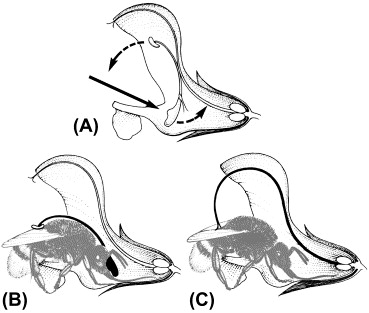
The Salvia lever system at work. This diagram is not Salvia coccinea, although the system in S. coccinea is the same (but not worked by bees). Credit for diagram is given at end of post.

The fun thing to know about Salvias is their tippy pollination mechanism, which no doubt has something to do with their diversification into so many species, with the system “adjusted” for different pollinators in different species. The floral lever system looks like an upside-down teeter-totter with the fulcrum attached to the roof of the flower tube. The lever is a stamen. The anther is at one end of the lever, held above the floral entrance vestibule. The other end of the lever is deep within the flower blocking access to the nectar. When the correct pollinator enters or pushes its beak inward, the inner end of the lever is shoved upward, bringing the outer anther-end downward into contact with the visitor, patting it with pollen.

Next time you get around a Salvia, and you will, open the flower and find the lever.

Credit for the diagram: The staminal lever mechanism in Salvia L. (Lamiaceae): a key innovation for adaptive radiation? Regine Classen-Bockhoff et al. Organisms, Diversity & Evolution 4(3): 189. 2004.

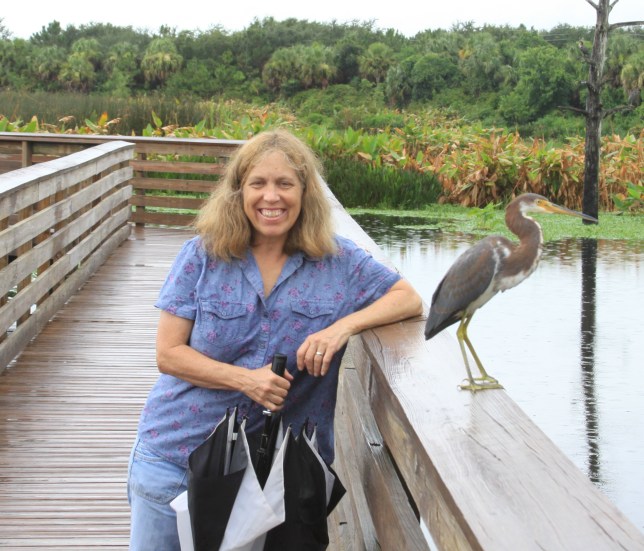
George’s wife-on-steroids Donna and friend

 
4 Comments

Posted by on July 23, 2012 in Scarlet Sage


Tags: , ,

Rubbervine Among the Mangroves

Rubbervine

Rhabdadenia biflora

Apocynaceae

Peck’s Lake, which is a part of the Intracoastal between Hobe Sound and Stuart is a popular fishing hole, and on the shore is a boardwalk providing comfy passage through swamp then mangrove jungle, past a shell midden, and onward to the salty shore with an observation dek to watch the boats go by. The species along that transect are plentiful, including magnolias, mangroves, and mastics. And porpoises, said hello as we stood on shore. All three mangrove species along with their friend Buttonwood were in flower.

Rubbervine at Peck’s Lake, Florida. (This and all photos today by John Bradford.)

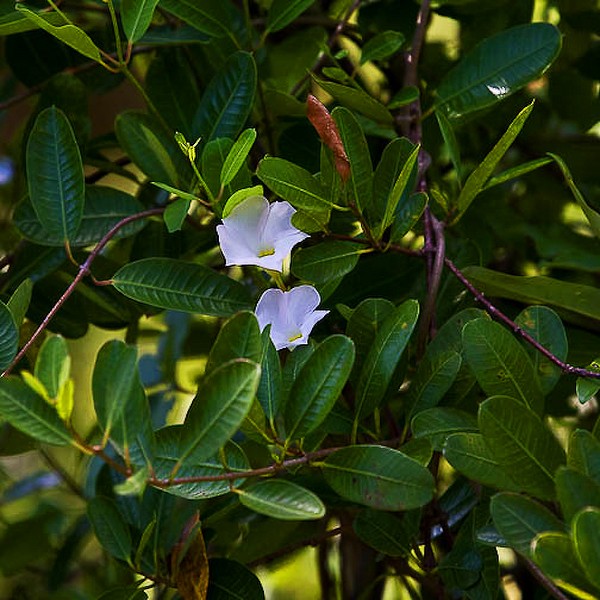
The showpiece was the pretty Rubbervine, or Mangrove Vine, with its large white blossoms scattered all through the White Mangrove zone and spilling over onto the boardwalk.

Why a vine would select mangrove stands as its main domicile is a question to ponder. Perhaps that’s a select opportunity for the “right” vine where the brackish conditions suppress competing twiners and climbers.
OKAY then, why can this particular species thrive there in the brineland? As a broad speculative possibility, it is a member of the tough Dogbane Family, the Apocynaceae, which tend often to tolerate harsh living, thin nasty soils, blazing sun, and, probably most importantly, dryness. But a mangrove stand isn’t dry, is it? Well, yea, physiologically dry, with a saline soil. Osmosis you know. So maybe standing up to that sun and salt is in the vine’s family tree. The flesh drips white milk when broken. The toxic latex is generally regarded as a feeding deterrent, but I’ve always wondered if the latex, found commonly in Apocynaceae, also helps with all that dryness we’ve been fretting.

Rubbervine and other Apocynaceae are larval host to various sphinx (hawk) moths, who drink themselves nasty on the poisonous plant sap. They proclaim their toxicity with bright warning coloration.

The blossoms are showy, the fruits are mildly weird, and the seeds are even weirder. Starting with the flowers, they are presumably pollinated by sphinx moths, given that they are standard “moth” flowers, white with a long narrow tube penetrable by little other than the long mothy proboscis.

The gate at the flower throat.

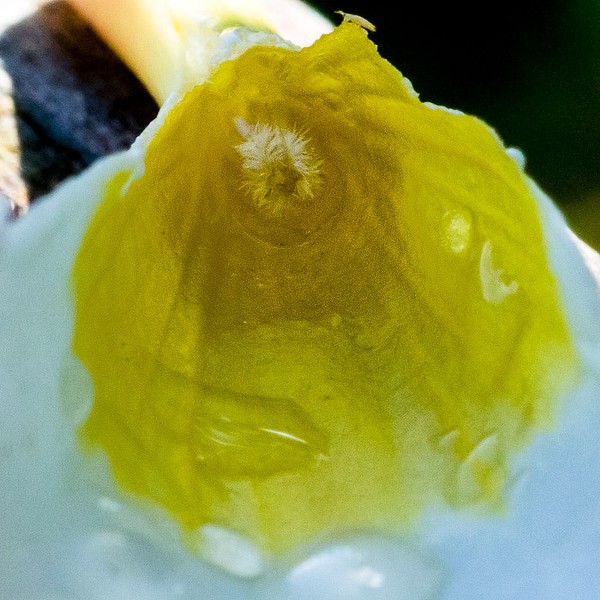
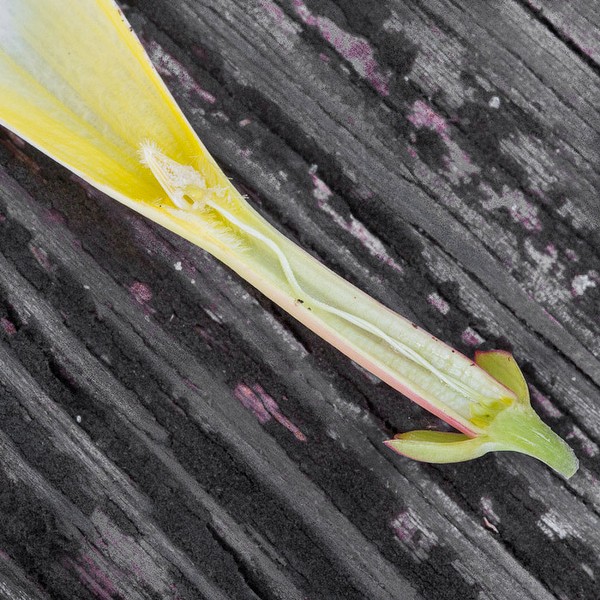
Being members of the Apocynaceae, the flowers have a particularly noteworthy family characteristic. They are more or less funnel-shaped, and just at the point where the funnel narrows a “cap” made of five anthers pressed together edge-to-edge blocks the way. (A little reminiscent of a folded paper cootie-catcher if you are old enough to know what the heck I’m talking about.) You need a long fine needle to get between those anthers and poke deeper into the flower, a great gatekeeper for allowing a proboscis probe while thwarting “nectar thieves.”

It gets weirder. The stigma (pollen receptive surface) sits immediately under the anther- cap. The stigma is in the shape of a can on a stick (the stick is the style, a narrow stalk). The business part of the can-shaped stigma is the underside of the can, the bottom end. When a proboscis probes the flower, pollen is scraped off during proboscis removal, as it slides out. The Apocynaceae are the only plants I know with scrape-pollination on the bottom of the stigma.

Flower slit open to show the anther cap (the cone) at the throat. The stigma hides under the cap. The long thread is the style.

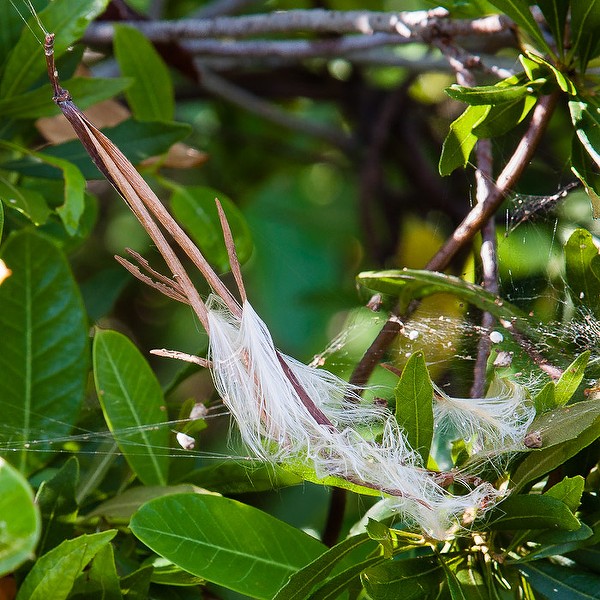
Then come the fruits resembling perky paired beans. Apocynaceae fruits generally come as twins, like bunny ears. Some readers may have observed this in Frangipani or Madagascar Periwinkle. The pods open to release seeds that look like quill pens. Each seed is two inches long counting the poofy quill. The body of the seed is a long (maybe an inch) heavy torpedo, which open landing penetrates the thick mangrove stand vegetation all the way down to the mud. How many wind-dispersed species do you find in mangrove stands? It’s a pretty good system, allowing the vine to spread through any given stand and to hop to another. It would not be hard to imagine the silky parachute clinging to the landing gear of a bird for those long hops.

Pod releasing seeds

 
1 Comment

Posted by on July 17, 2012 in Rubbervine


Tags: , , , ,