RSS

Tag Archives: Savannas Preserve State Park

Dwarf Huckleberry

Gaylussacia dumosa

Ericaceae

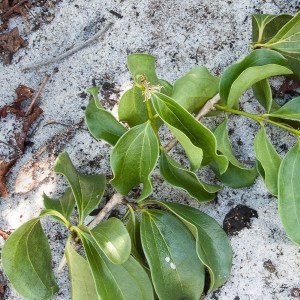
Yesterday John and George experienced Savannas Preserve State Park near Port St. Lucie and featuring marshes, wet prairies, scrub, low pinewoods, and all the associated biodiversity. CLICK to visit.  The area is rich in members of the Azalea Family, the Ericacaceae, including today’s little oddity, Dwarf Huckleberry.     The Dwarf Huckleberry was the show-plant of the day, in full bloom on high dry sandy spots hanging out with its relatives tarflowers and blueberries.
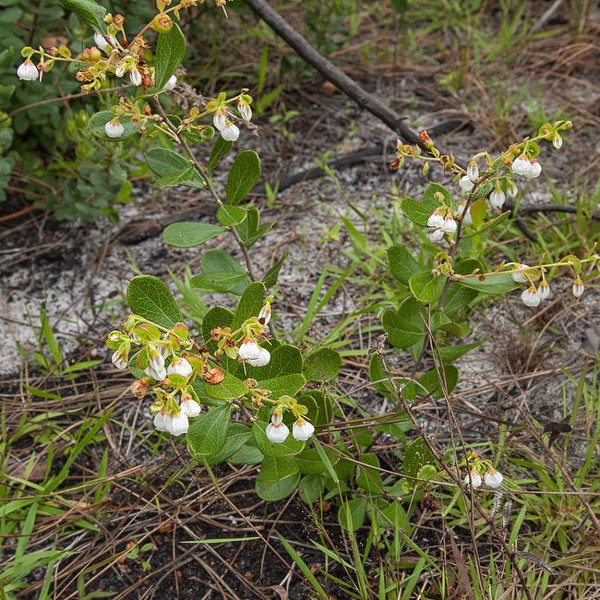
Dwarf Huckleberry.  All photos today, except the damaged blueberry flowers,  by John Bradford.

Dwarf Huckleberry. All photos today, except the damaged blueberry flowers, by John Bradford.

Two things about Dwarf Huckleberry deserve attention in Treasure Coast Natives.   Each has an historical component.

Historical Thing 1.  Odd distribution.  If you’d like an example of a case proving species are tough to define, here it is.  Harvard Professor Merritt Lyndon Fernald who reigned as King of northeastern U.S. botany for the first half of the 20th Century, studied our huckleberry and perceived one species with two varieties distributed eye-poppingly from Newfoundland to very nearly where John and I saw it yesterday.  Fernald dubbed the northern populations Gaylusaccia dumas variety bigeloviana, noting only minor differences between these and the southern variety (var. dumosa).   The truly interesting part was an ecological component, with the populations at the northern end of the distribution mostly in bogs, and those to the south more prone to dry sandy habitats. (It might be worth mentioning that bogs, with extreme acidity, can be “physiologically dry.”   There are other cases of split bog-upland distributions.)
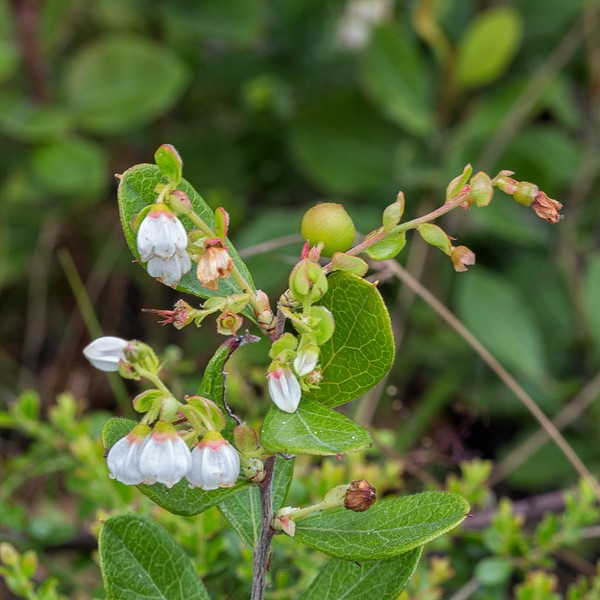
Yesterday at Savannas.

Yesterday at Savannas.

This single-species view prevailed for almost 100 years until a new interpretation popped up in 2007, granting the northern end of the bipolar complex to secede as Gaylusaccia bigeloviana.  The fuzzy geographic border between G. bigeloviana and the remaining G. dumosa runs across the Carolinas.   So in short, a classic botanical situation: a plant group stretched out over a long distribution, with some differences pole-to-pole.   One widespread species with two varieties?  Two species?  Something else?  You decide.  Want to argue? No thanks—pretty much a fool’s argument really.  No matter how you slice and dice it, dwarf huckleberries from bogs in Newfoundland look like plants John and I saw in Savannas Preserve State Park.  (For northward peek,  see p. 5  CLICK)

Historical Thing 2.  Crimes against nature.  Back in 1888 botanist L.H. Pammel—noteworthy as an advising professor to George Washington Carver—published a long treatise on the “perforation of flowers,”  that is, on holes drilled into blossoms by insects to rob nectar, as opposed to entering properly.  Nectar thieves!  One of his examples was, yep, Gaylusaccia dumosa burgled by five species of wasps, as
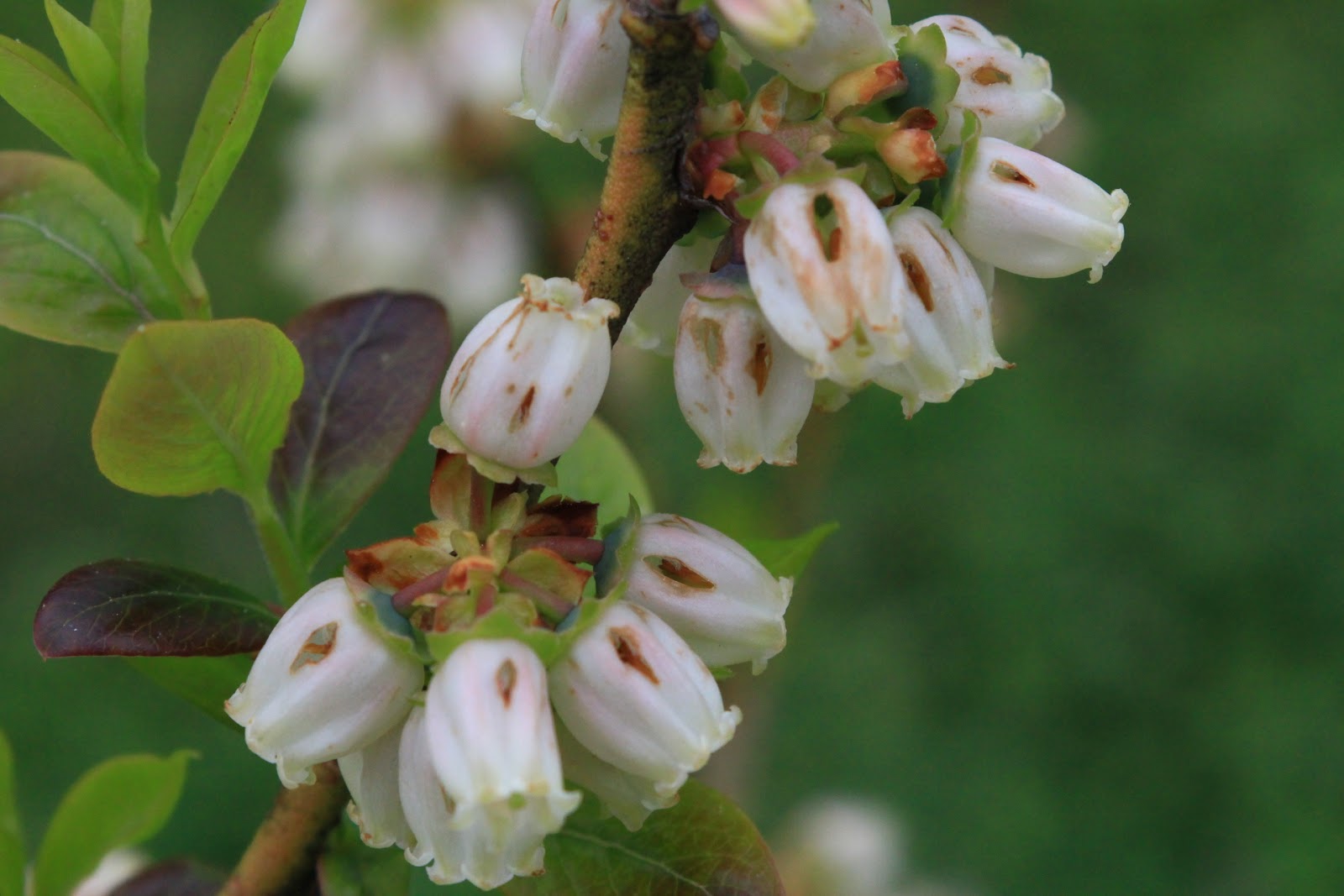
Related to Huckleberry, these Blueberry flowers have been perforated and robbed.    Prof. Pammel would like this photo, which I've borrowed from Google Images.

Related to Huckleberry, these Blueberry flowers have been perforated and robbed. Prof. Pammel would like this photo, which I’ve borrowed from Google Images.

observed at Orlando, Florida, nipping holes in the side of the bell-shaped petal tube.  The circumstances of that observation in Orlando ca. 1888 must have been interesting!  Do wasps consume nectar?  Yes, some do,  including sting-less males of certain species.

 —————————————————————————————————————————————————————–

Huckleberry FAQ’s

1. What does Gaylussacia mean?  Joseph Gay-Lussac (1778-1850) was a prominent French chemist.  Dumosa is a specific epithet applied to plant in thickets.

2. How do Huckleberries differ from their cousins, the Blueberries?  Blueberries have a variable number of seeds loose in the berry.  Huckleberries have 10 seeds in the fruit, each seed in a little hard case.

3. Where can I see a modern classification of huckleberries?  http://www.efloras.org/florataxon.aspx?flora_id=1&taxon_id=113345
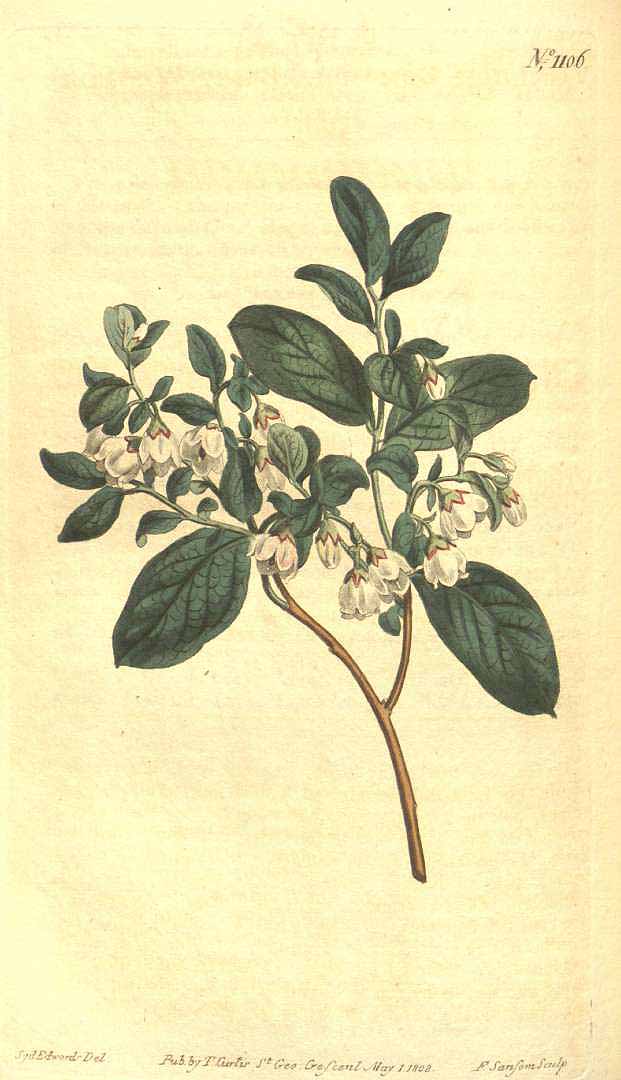
Our species, color plate from Curtis Botanical Magazine
Our species, color plate from Curtis Botanical Magazine
 
10 Comments

Posted by on March 23, 2014 in Dwarf Huckleberry, Huckleberry


Tags: , ,

DYCs are the Bees Knees

Narrowleaf Sunflower

Helianthus angustifolia

Asteraceae

Last Friday John and George trekked the Trail to the River (CLICK), also known as the Halpatioke Nature Trail,  a biodiverse satellite of Savannas State Park, in Port St. Lucie.

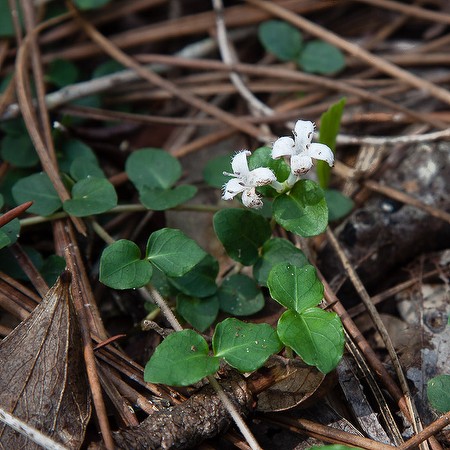
One of the many handsome marvels on the way to the river is Partridgeberry (Mitchella  repens), which I’m sorry, I can only regard as a wildflower from childhood Canadian canoe trips, not a South Florida trail flower.   It just doesn’t fit my world view here!

Partridgeberry (Twinflower, by JB)

Partridgeberry (Twinflower, by JB)

Also along the path are several members of a plant clique referred to by botanists as “DYCs.”  DYC stands for, “darned yellow Composites,” and apt term for anyone who has tried to sort out yellow-flowered members of the Aster Family.  Now please remember the “flowers” in the Aster Family are not real flowers, but rather are clusters of hundreds of tiny flowers all massed into one big false blossom.  A Sunflower is a whole lot of flowers.  (Details on this are in our archives CLICK)

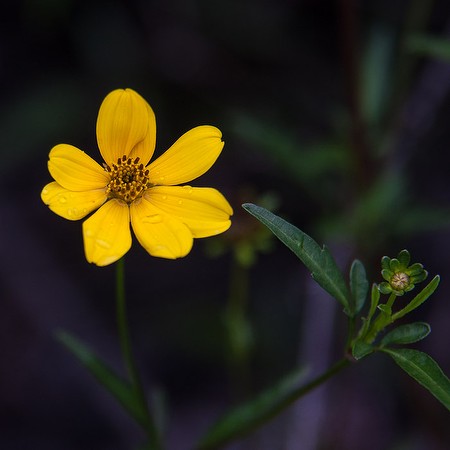
Bidens mitis a DYC (JB)

Bidens mitis a DYC (JB)


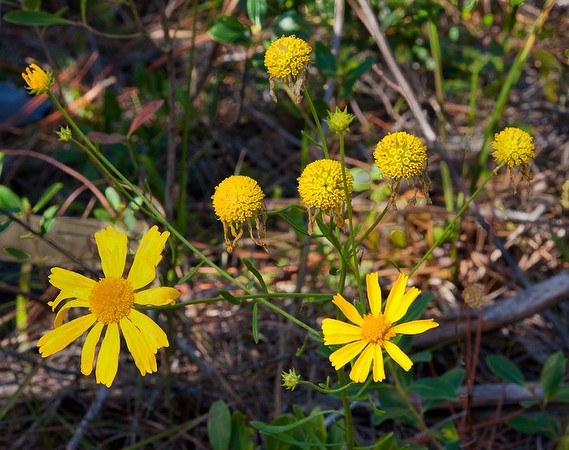
Balduina angustifolia, another one (JB)

Balduina angustifolia, another one (JB)

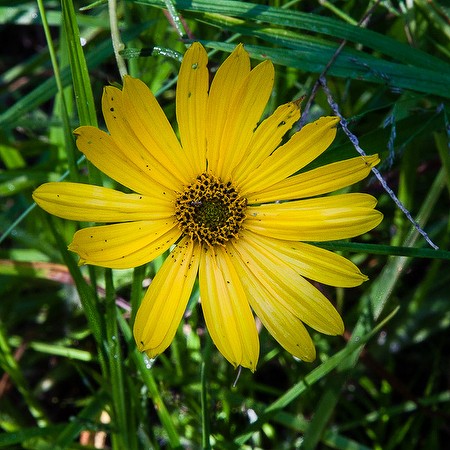
The King of the DYCs Friday was Narrow-Leaf Sunflower (Helianthus angustifolius),  with the lesser Smallfruit Beggarticks (Bidens mitis) as its loyal vassal.

If everything that could be known about Sunflowers were suddenly revealed it might boggle our brains.  They are a group with a lot goin’ on.  Technically, Sunflowers are the genus Helianthus, of which there exist roughly 50 species, all native to North America including Mexico.  About 18 species grow “wild” in Florida, natively or escaped.  From a taxonomic standpoint, they are messy messy messy, with hybrids, ancient and new cultivars, chromosomal variants,  intermediates,  unclear species borders, and divergent classification interpretations.

Narrowleaf SF (the King of the DYCs, by JB)

Narrowleaf SF (the King of the DYCs, by JB)

The big familiar common sunflower is Helianthus annuus, distributed “naturally” from Mexico to Nunavut.   Ancient peoples no doubt helped its transcontinental spread and diversification.  How many native American plant species have achieved agricultural prominence?  Native American humans used it for almost every use conceivable.  Arguably the most interesting ancient uses were culinary, for “seeds,” ground flour, and oil.   There were probably large-seeded (achenes)  cultivars in pre-settlement “horticulture.”

We like sunflower oil today, but a funny thing happened along the way.  After an early history of cultivation in North America partly for livestock forage and chickenfeed, Sunflowers fell of out of agricultural favor but caught on in Russia as an oil crop.  Oil-bearing strains returned to the U.S. from Russia with love in the 70s, and may help our grandchildren’s energy deficit someday.

Another sunflower with ancient “roots” is the so-called Jerusalem Artichoke (Helianthus tuberosus) distributed across much of North  America, including some of Florida.  What does it have to do with Jerusalem or artichokes? Its tuber is a food source and a source of combustible alcohols.

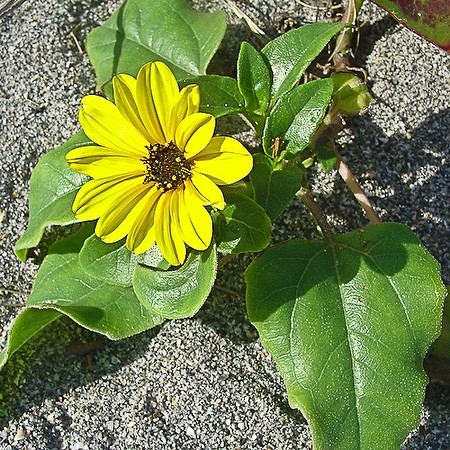
Little Beach Sunflower (by JB)

Beach Sunflower (by JB)

A garden favorite in Florida and far beyond is the Beach Sunflower, Helianthus debilis,  easy to grow and as pretty as a day at the beach.   Amazingly, this highly diverse foot-tall species can hybridize with the big common sunflower.  (See what I mean about messy species boundaries?)

But what about our Sunflower along the trail to the river?  Narrowleaf Sunflower (Swamp Sunflower, H. angustifolius) is a wildflower and a garden selection CLICK.   The flower extends northward and westward from Texas to New York from a southeastern limit probably near the trail to the river.

Narrowleaf SF is a chemical factory.  Aster Family members in general produce an array of smelly and bioactive compounds, so any given species can be a chemist’s goldmine.  Narrowleaf Sunflower has attracted recent attention most importantly for cytotoxic (cell-killing) agents with lethal effect against cultured human cancer cells.  CLICK   This general sort of screening and discovery is not rare, but in an already much-cultivated prolific plant it’s even better.  That would be a parallel history to the life-saving Oncovin chemotherapy from the Madagascar Periwinkle.

Even if Narrowleaf Sunflower turns out not to counter cancer, or even if it does, it feeds bees in spades.  UF Entomology Professor Jaret Daniels describes native bees filling the pollination gaps left by non-native honeybees diminishing from Colony Collapse Disorder, and he points out native wildflowers drawing on average 19 times as many bees as non-native blossoms.  Even better, he lists nine super-charged bee-feeding wildflowers.  Five of the nine are DYC’s, including Narrowleaf Sunflower.

 
2 Comments

Posted by on November 5, 2013 in Sunflower


Tags: , , ,

Native Agave Species, Probably Not Native and Perhaps Not Even Species

Agave sisalana

Agave decipiens

Agave neglecta

John and George this week indulged their multi-week fixation on the Savannas Preserve State Park and neighboring scrublands.  Yesterday we were working on the railroad all the live-long day.  Railroad tracks are interesting botanically, because the rights-of-way have been there a long time as unintended plant refuges, and because choo-choos spread species.   The floral beauty this week is stunning with yellows coming from Goldenrods, Crotalarias (not necessarily native), and weird little Neptunia.  Butterfly Pea (Centrosema virginiana) was so abundant and so gorgeously blue-violet to surpass the average flower garden.  Giant Foxtail Grass (Setaria magna) was swaying in the breeze with the bristly inflorescence actually the size of a fox’s tail.

But the great encounters were all three “important” Agave species growing untended in Florida.  Agaves are about as fascinating as they are beautiful, with a complex history in human affairs.

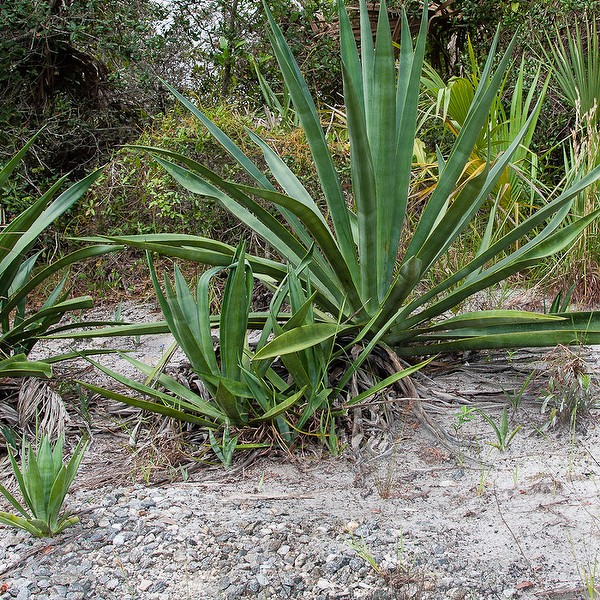
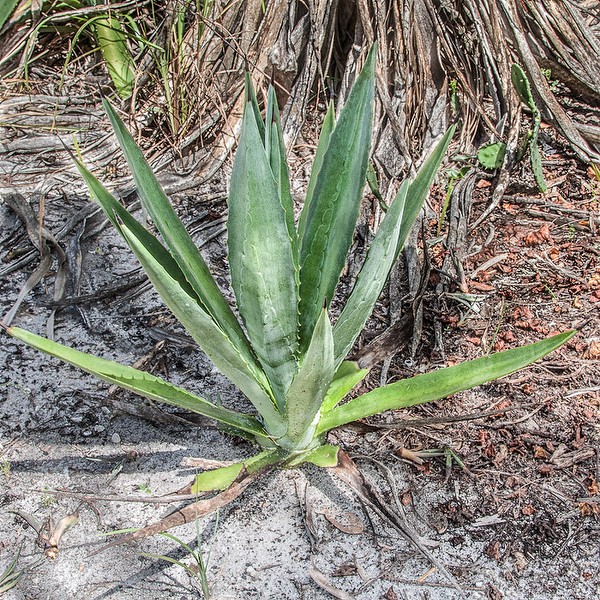
Agave sisalana (by JB)

First on the list is an abundant but definitely non-native Agave.  Florida once was a hotbed of research on fiber plants, one of them being Agave sisalana, the source of commercial sisal fibers, as in ropes, doormats, and similar rough-scratchy commodities.  Agave sisalana is still with us in scrubby places.  It is the only common Agave in natural areas having no (or few, small, and irregular) prickles along the margins of mature leaves. Recognize this species from the distance by its straight narrow leaves with comparatively parallel margins.  Agave sisalana is a Florida Exotic Pest Plant Council Category II invasive exotic, which raises a question, how can a seedless species invade?

That’s easy:  Agave sisalana, like most agaves, forms “bulbils” in its maturing inflorescence. Bulbils are baby clones of the parent plant; they represent vegetative reproduction and do not grow from sprouting seeds. Neither fruits nor seeds are known in A. sisalana.  The bulbils are tougher than nails, and can float and can last forever unrooted; they are the “perfect” propagules.  Bulbils are useful for humans wanting to cultivate agaves, which has been goin’ on a long time.

Agave remains decorate human excrement on the order of 6000 years old in caves.    CLICK and

CLICK AGAIN 

(Do you think somebody will be examining our leavings 6000 years from now?)

Agave sap burns human flesh (believe me!) to the point of being dangerous to the eyes, yet pre-Europeans served agaves in the kitchen, wrapping food in the waxy cuticle, chewing quids made of the leaves, eating the plant flesh, and sipping the sap in beverages.  The last-mentioned practice grew into a Mexican industry.  Just ask Jose Cuervo.

Agave fibers are beautiful strong, easily extracted by rotting the flesh off of the leaf, and just plain nice.   We’re talking about ancient cordage, hammocks, and fishing gear.

Prehistoric sandals probably made at least in part of Agave fibers (from the second link provided above)

So now a few strands of our story come together.   Agaves originated almost certainly in or near Mexico and Texas where human civilization is ancient.  The plants were valuable for foods, drinks, and fibers.   They are easy to store, move, and plant.  This all ties into a big Agave fact.  This is important, so listen carefully:  multiple named “species” of Agaves are in fact ancient cultivars and hybrids, created and moved around by the hand of people and their canoes.  This helps explain the sterility, wacky variation patterns, mixed chromosome numbers, and distributions of some “species,” including the Florida “natives.”

Not proven, but personally I am convinced that that’s the story behind the Agaves distributed among the Caribbean Islands.   Ancient Caribbean-dwellers were expert mariners and fisher-persons.

And all this begs a huge inadequately investigated question—a question hobbled by a reluctance among traditional taxonomic botanists to take pre-Columbian civilization into account in assessing modern plant distributions.  The question is: how did agaves come to Florida?  Possibility 1:  The Tex-Mex scrub flora around the Gulf was more or less contiguous with present-day Florida scrub.  There are western carry-overs from those times still with us in Florida.  Possibility 2:  Maybe the indestructible bulbils floated across the Gulf or Caribbean Sea, or maybe seeds fluttered here on the salty breezes.  Possibility 3:  If humans were growing agaves on Caribbean Islands, couldn’t the canoes have stopped by for a Florida vacation?   Or could humans have carried bulbils around the Gulf from Mexico?

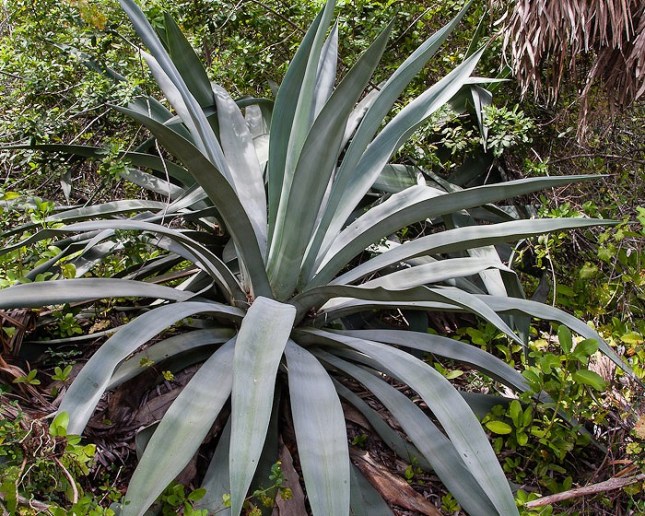
Agave decipiens (by JB)

The level of involvement of Florida in pre-Columbian Caribbean commerce is not known.  Those who wonder how Papayas got here ponder this.  Here is an unstudied silly notion:  our Florida Agave decipiens resembles the Caribbean Agave karatto.  In Flora of North America, botanists James L. Reveal and Wendy Hodgson suspected the history of Agave decipiens to be rooted in human activity:  “Agave decipiens might have been introduced from Latin America by Native Americans; it is not otherwise known from the wild. The proliferation of chromosome numbers suggests prolonged human propagation and a probable hybrid origin.”

Agave decipiens is a large Florida endemic recognized by the even and well-developed (although of variable length) bristles fully along the leaf margins.  The leaves are almost-straight, with little twists and shape irregularities; the margins not as parallel as in Agave sisalana, which differs further by having no or very few marginal prickles.  There can sometimes be a short “trunk” at the base.  The species is beautiful and in cultivation, although a glance at Google Images reveals material cultivated under this name to be a little “dubiously identified” at times.

Even prettier is our likewise endemic Agave neglecta.   The leaves are broader (> 15 cm) than those of A. decipiens and of A. sisalana, and far more curved.   The fine mini-prickles are restricted to the lower half of the leaf margin,  As with Agave sisalana, fruits are reportedly not produced.   (However, there are specimens with fruits bearing this ID in Florida herbaria—see discussion below.  Sterile and fertile plants are possible—this occurs in the similar A. karatto, and could be either most likely cytological variation, or sometimes merely a question of pollination.)  The taxonomic King of Agaves, Howard Scott Gentry, as reported in Flora of North America, felt that Agave neglecta resembles Agave weberi cultivated for its fibers.  Reveal and Hodgson in FNA suggested, “The plant [A. neglecta] may well be a cultivar of A. sisalana or A. kewensis and represent an ancient introduction from Mexico.”  (We do not see the Agave sisalana similarity except for the missing fruits.)  Most agaves are pollinated by bats, which begs another question.  Do Florida agaves achieve pollination?  If pollinated, would the fruitless Agaves make fruits and seeds?  I don’t know, probably not, but worth a try with a step-ladder, paint-brush, and a few baggies.

Agave neglecta (by JB)

 
19 Comments

Posted by on September 23, 2012 in Agave


Tags: , , ,

Monkey-Oranges, Snakebites, Rat Poison, and Memories of the 60’s

Monkey-Orange

Strychnos spinosa

Loganiaceae

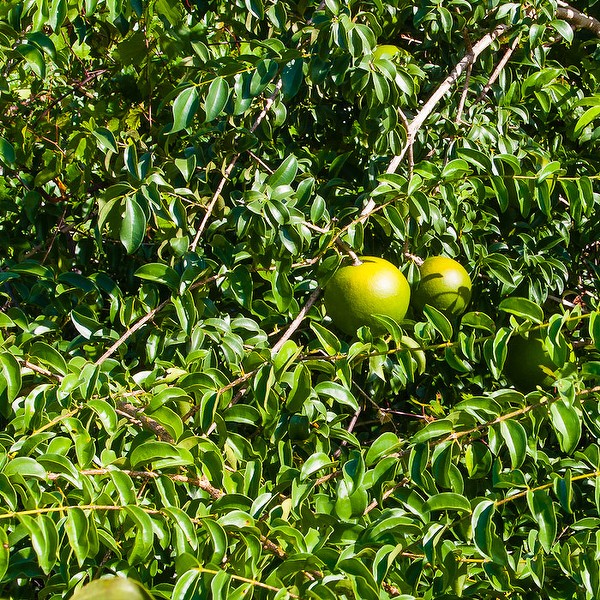
In recent weeks John and George have focused on the beautiful Savannas Preserve State Park and its neighborhood around Jensen Beach, partly in preparation for an upcoming workshop there, partly because  it  beats working.   During all those doings, John, Park Biologist Christopher Vandello, and George teamed up to identify an invasive exotic shrub with croquet-ball fruits.  Christopher has been restoring a lovely sugar sand scrub ridge crossed by an ancient paved road with a simultaneous view of the Intracoastal and the inland “savannas” marsh.   Unfortunately this primo piece of creation is exotically invaded with  the spawn of garden waste dumped long ago:  Sansevieria, feral ornamental bromeliads, Suriname-Cherry,  Callisia, Kalanchoe, and more.  The most striking and spreading unwelcome guest  is a thorny sprawling shrub resembling at first glance Snowberry (Chiococca) but with cannonball fruits the size and shape of grapefruits and rock hard.

Strychnos spinosa (by JB)

Many species in the world have fruits of that general sort, perfect for throwing, and they’d be fun to step back 50 feet and shoot with a .22.    They look just like the citrus Bael Fruit (Aegle), but the foliage is wrong.   They look like some lemonish citrus, but the foliage is all wrong.  They look like Calabash, but the foliage is all wrong.  We took some prickly branches and vegetable bocce balls back to park headquarters, went to work on the computer,  and they turned out to be “Monkey-Oranges”  (Strychnos spinosa).  Another name is Natal-Oranges, fitting as the site has a meadow of Natal Grass (Melinis).

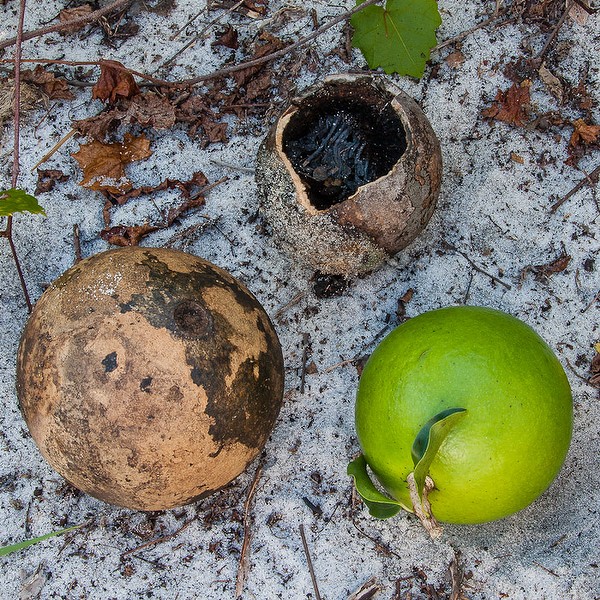
If we were in Africa these would be elephant snacks. People make things out of those hard “gourd” shells. (By JB)

The foliage is distinctive with opposite leaves having long smoothly upcurved veins.  Monkey-Oranges are not even related to Sunkist, but rather are (debatably) in the Loganiaceae, more familiar to Florida native plant enthusiasts  for Spigelia and Mitreola, and (debatably) Polypremum.   This is the family of the super-uber-lethal Carolina-Jessamine (Gelsemium).

That “lethal” part fits Strychnos spinosa.  The genus Strychnos is the source of the alkaloid drug strychnine, mostly (but not entirely) from the species Strychnos nux-vomica.  How does strychnine crop up in everyday life?  Rat poison.  Or if you are roughly of my “Woodstock” age you may recall exhortations from some authorities in the 1960s, “shun the LSD!, it is laced with strychnine.”   Whether or not that was ever true, strychnine is a powerful drug in the alkaloid group along with its friends likewise ending in –ine, such as morphine, codeine, nicotine, atropine, and an alkaloid I’m enjoying now as I type (you guess).   Strychnine inhibits the shut-off mechanism for nerve-muscle signals.  A high dose is a path to boot hill.  Lower controlled doses can be therapeutic, which brings us back to Strychnos spinosa.

Aging flowers (by JB)

In its native Africa the tree serves as a traditional neurological drug, applied, among other things for snakebites.  Could this be a manifestation of the genuine beneficial potential of strychnine?

The fruits also serve as food, with the extra benefit of coming in a natural “can” (that steel shell) thwarting competing critters (although big animals munch freely), bugs, and decay.   They hold up in storage for months.  I’m not hankering to savor the flavor of strychnine-laced fruits, but cultures who have been doing it for a few millennia have the hang of it.   A little superficial Google research seems to indicate that strychnine is in the seeds and in the green fruits but that ripe ones are probably more or less okay. (Forget it!)

The natural habitats— just like the Savannas State Park scrubby dunes—are desert-ish, although proximity to water seems favorable.  The tolerance for aridity, the indestructible fruits, and easy wood production make Strychnos spinosa a candidate for cultivation in dry lands, such as Israel where the tree is in cultivation.  In this interesting link, see Figures 7 and 8 taken in Israel yet also illustrating the scene in Savannas State Park yesterday.  CLICK

 
Leave a comment

Posted by on September 15, 2012 in Monkey-Oranges


Tags: , ,