Manyspike Flatsedge
Cyperus polystachyos
Cyperaceae
This summer John loaned me a book about brouhaha over a fancy species of Orchid from South America. Entertaining reading about obsession, rivalry, and general silliness…and food for thought. In a world of a quarter million flowering plants, that much attention to a single species (if you can’t eat it, medicate, or turn it into fuel) is wasted opportunity. I’m more fascinated with the crummy weeds in my back yard than with one showy big-flowered Orchid. (But then again I dig mutts from the pound.)
Today’s spotlight is on the so-called Manyspike Flatsedge, Cyperus polystachyos, which perhaps you never heard of — because there is not much to hear. But you have seen it, and next time you see it you’ll know it. This species is nondescript, unpretentious, and you step on it, but it’ll have the last laugh.
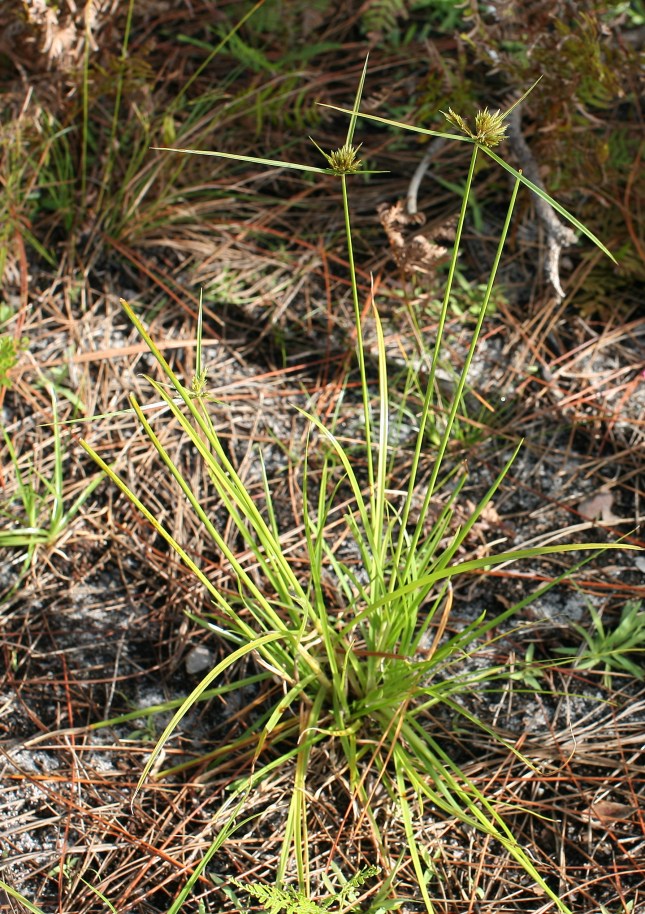
Everyone has seen this! (Photo by JB.)
The weird thing is this species grows everywhere. Why some species are rare, endangered, and confined to two counties in Florida, while others are taking over the world? Manyspike Flatsedge covers Florida and ranges southward to South America. Is it then tropical? Well, yes, and looking northward it goes all the way to Maine. The plant is also in Hawaii, Africa, Asia, and Australia. Where did it originate? Where was it distributed before ships circled the Globe? Who knows?
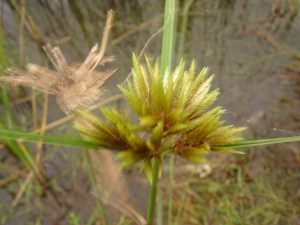
Look how flat the spikes are. (By JB)
When I say grows everywhere, I don’t merely mean on a global scale. To narrow the focus locally, there is probably one within 200 yards of where you are sitting. The habitats are just about any: lake shores, depression ponds, roadside ditches, hammocks, pine woods, weedy roadsides, saltmarsh, shell mounds, burned forest, prairie, sand hills, and scrub. The sites are often moist, but not necessarily, and the soil is often organically enriched but then again can be acid, alkaline, clay, lava, or sand.
The species is as varied as it is widespread, a challenge to taxonomists who disagree on its definition. Manyspike Flatsedge can inhabit your mowed lawn, or left alone may be two feet tall. The inflorescence may be compact or spread out, branched or not, and yellowish or red.
How does a species get around like that? The fruits are tiny (1 mm long) achenes (fruits that resemble seeds), as is true of the other 599 species of Cyperus. The achenes clearly float and blow around, and more importantly probably ride in or on birds. Oh, by the way, several other species of Cyperus are global super-weeds too. If you are not familiar with Cyperus, think of Papyrus, which is weedy itself.
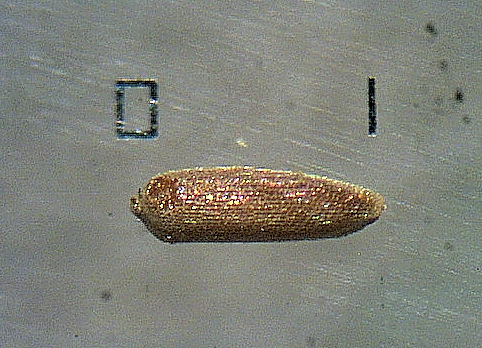
Intercontinental ballistic achene (by JB)
The surface of the achene is sculptured with bumps and depressions. And this is common on small seeds and achenes, especially perhaps those in wet habitats. Why the patterned surface? The leading thought in my experience is to cling to mud on birds’ feet, like mud sticks to the sculpted pattern of your waffle-stomper hiking boots. Another thought you encounter is that a rough irregular surface may catch the wind. Additional notions are possible and 100% speculation: maybe passing through a bird’s intestine a little bit of the bird’s intestinal content, natural compost, clings and helps the achene initiate intimacy with soil mycorrhizae or other microbes, or remain moist, or experience a tiny boost of nutrition. Or, much more boringly, maybe the external bumps and valleys are just natural “bubble wrap.”
That this sedge grows on salty places adjacent to the sea probably helps it roam the Seven Seas. Maybe Isaac moved it around even more.
But how will I know it when I see it? First off, it looks like a standard “Cyperus” Flatsedge, with leaves clustered at the base and another tuft clustered at the top of a triangular stem. The flowering spikes are utterly flat, and numerous. Now here is the easy part: there are just 2 styles, as opposed to the three in most of our other locally common Cyperus species. If the styles are two and the spikes are flat, you probably found it. (And to make certain, the spikelet is under 2 mm wide and there is no elongate pointed tip on the spikelet scales.)
What do Florida, New England, Brazil, Morocco, Israel, Thailand, Polynesia, and Australia have in common? Cyperus polystachyos. How did that come about? If by the hand of humans, that is quite a bioinvasion. If by the hand of Mother Nature, and I hope so, that’s quite a helping hand.
 John Bradford
 George Rogers
 George Rogers
 Dee Staley
 Treasure Coast Natives