RSS

Climbing Aster builds its own retirement plan

Climbing Aster

Ampelaster carolinianus (Symphyotrichum carolinianum, Aster carolinianus)

Asteraceae

Everyone who savors the native outdoors treasures personal fond experiences, often rooted in earlier memories.  Something I’ve always loved in varied northern locales is wild Asters as the days grow cold and as the tree become stark branch silhouettes against the gray sky.  Asters take me back to hikes on November days in Michigan where the Asters as the last wildflowers standing, say “hey, it’s not all that bleak.”  A parallel experience applies more subtly on refreshingly cool November days around here.  That took place last week on a class outing to the Grassy Waters Preserve with one of my all-time favorite species, Climbing Aster.  Today, November 26, it is blooming with gusto in the Palm Beach State College Medicinal Plant Garden.
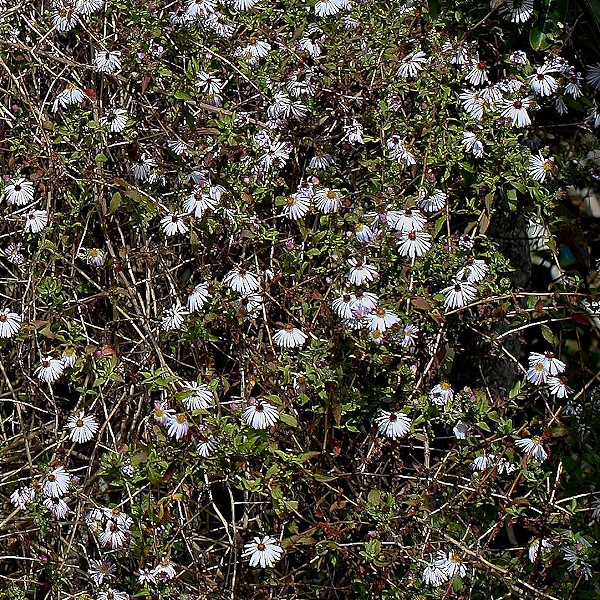
Climbing Aster (by JB)

[Now a disclaimer, the name “Aster” used informally here embraces multiple genera in the Aster Family.  Asters, including today’s species, tend to have complex nomenclatural histories.]

Capable of blooming some all year, in late autumn this species self-asserts with hundreds of fragrant flower heads near-white to pale violet, the younger heads with a yellow eye, and the older one dark-purple at the center.   (The topic of changing eye color came up about a year ago in our article on Allapattah Flats and White Pine Barren Aster.)
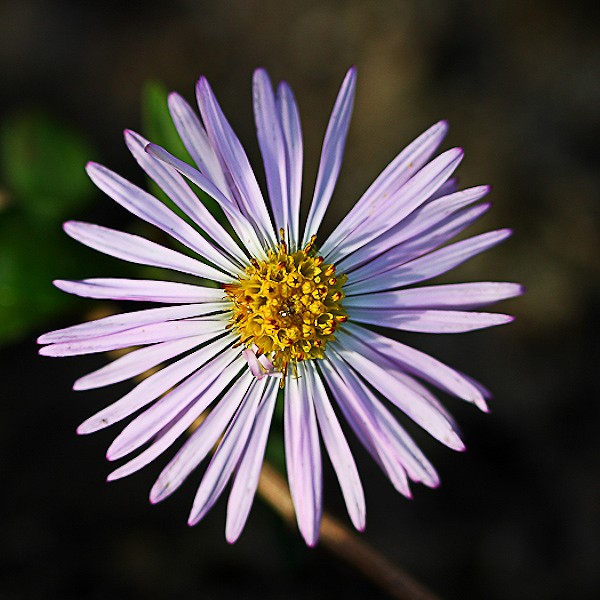
200 little flowers (by JB). Ray flowers lilac. Disc flowers yellow.

Botany 101:  what a flowering head in the Aster Family is all about.  What looks like a single flower at first glance is a “composite” of many tiny flowers collectively disguised as a single bloom.  But why?  Here is one answer:  A single pollinator visiting a “blossom” actually pollinates a hundred little flowers all at once.  The tiny flowers come in two basic types:  those “petals” around the periphery of the head are ray flowers.  The eye is made up of numerous itsy bitsy “disc” (or disk) flowers.  If you bust apart a flower head, and if your eyes are sharp, you can discern those individual flowers, complete with petals making a tube, stamens joined edge-to-edge into a tube, two stigmas, and an (inferior) ovary.  The sepals are modified as the “pappus,” usually bristles or scales.  The bristles become the parachutes familiar on the dispersing “seeds’ of many members of this family, such as Dandelions and Thistles.
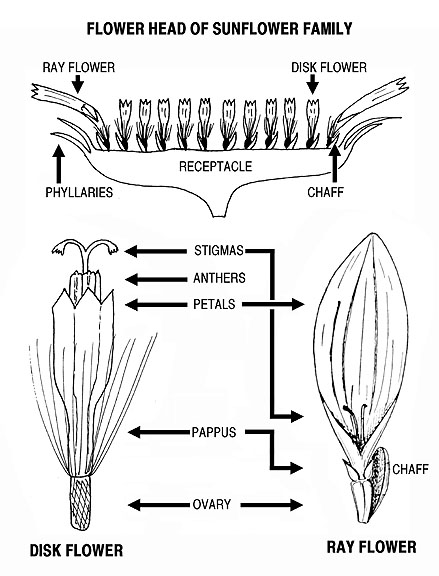
This will help. (By Illinois Natural History Survey).

The heads generally start out functionally male (pollen producing) before entering their female (pollen-receptive) phase.  Glance at the diagram.  The anthers form a tube, and they release pollen to the inside of the tube.  The stigmas rise through the anther tube, plunging the pollen upward until it spills forth.  Thus the pollen emerges from the tube before the stigmas pop out; they spread apart after emergence to begin the female phase.

To return to the species of the day, Climbing Aster is limited to the Southeastern U.S. in moist habitats from Florida to South Carolina and sort of North Carolina, where it may now be extirpated.  (And yet is available commercially, so it may be secondarily un-extirpated as a domesticated native species yielding to the call of the wild.)

Climbing Aster is the only species of the genus Ampelaster, the genus name  coming from Greek for vine-Aster.  And this brings us to perhaps the most remarkable aspect of this species.  Early in life it scrambles over other vegetation, making a mound of Climbing Aster on top of host plant(s).   The Aster is not twining, and it has no tendrils.  Instead, it rambles and sprawls.  Aiding the climb, the vine makes lateral branches that tie the vine to the host and weave the mound together.

Oh yes, I promised something remarkable.  Once the mound is formed, the Aster becomes woody.  The wood and the intertwined branches become a self-supporting  scaffolding, making the underlying host no longer necessary.  We could re-name it “Strangler Aster.”  To be redundant, this Aster makes its own trellis, hard, woody, reinforced by interlacing branches, and indestructible, perfect for its flood-prone riparian natural habitat.
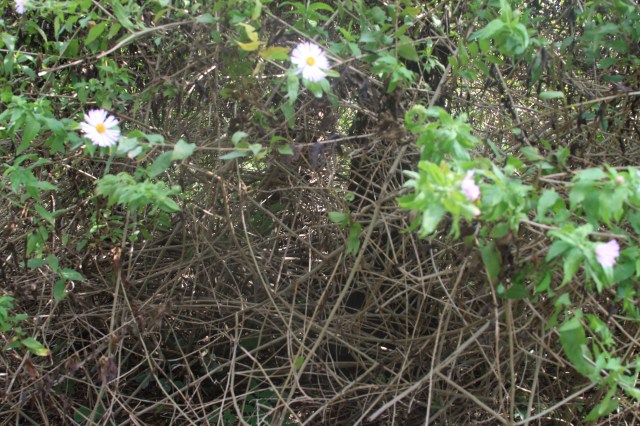
Unter der Aster, with woody self-built living trellis (by GR)
 
3 Comments

Posted by on November 26, 2012 in Climbing Aster


Tags: , ,

Roquette Science

Cakile lanceolata

Brassicaceae (Cruciferae)

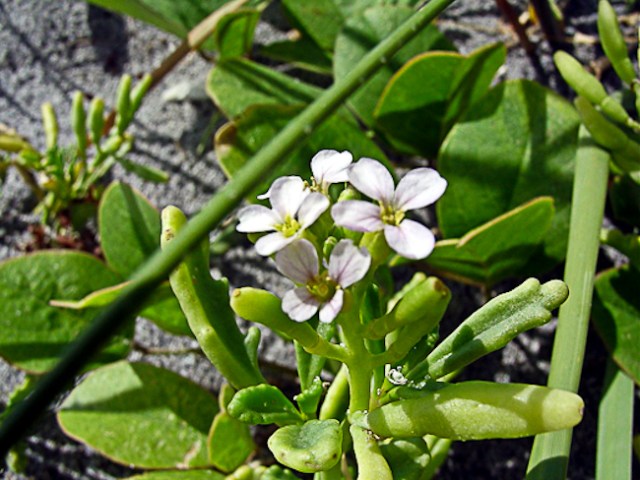
Today the lively Lakelas Mint Chapter of the Native Plant Society, John, and I walked the narrow dune-hammock between the sea and the highway on Hutchinson Island.  Such botanical bounty!:  Baybeans and Railroad Vines in blossom, Christmas Berry in berry and bloom,  Stoppers, Blolly, and by golly plenty more.  An odd little standout is Sea Rocket…and of course question number 1 is why “Rocket”?

On this Merriam-Webster’s Collegiate Dictionary sez: From Middle French, “Roquette,”  for arugula  or “any of several plants of the Mustard family.”

Another name for the Mustard Family is the Cruciferae (crew-SIF-eh-ree),  as in “eat your cruciferous vegetables,” the crux of the matter being the four petals forming a cross (crucifix).   There are, incidentally, 6 stamens—four long and two short.  So you can always tell any old Crucifer, from Cabbage to a Wallflower by the same basic flower construction.  They all look alike.

(Or at least they all used to.  DNA study is gerrymandering the family boundaries.)

Sea Rocket (by JB)

The Mustard Family is a pungent bunch.  You may notice there’s low P.U. until you mash the leaf.  Then “mustard gas” rises assertively.  They work like one of those light sticks for rock concerts and flat tires, with two key components stored separately and no reaction until smashing the inner glass  capsule mixes the stuff and lets there be light, or in our case lets there be wassabe.

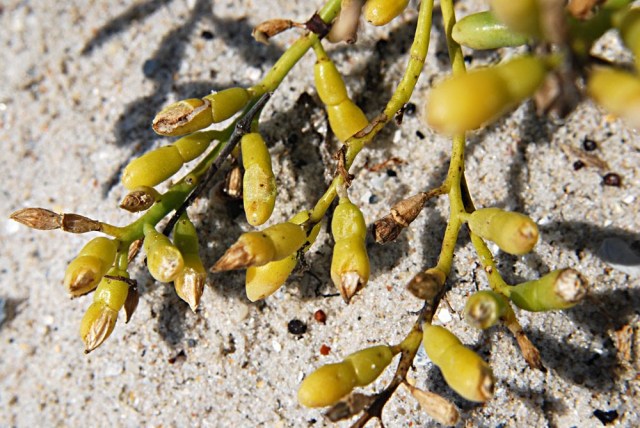
The succulent beanlike fruits separate into two segments, one segment remaining anchored on the mother plant, the other segment breaking free carrying one or few seed(s) in a protective corky padded space-capsule to blow and drift in wind, sand, and waves to a new start.  Thus they get around, and Cakile species extend up and down seashore and freshwater-inland coasts from Santa to St. Tropez.

Sea Rocket fruits. Look closely and note that these rockets have two stages. (Photo by Wayne Matchett)

What’s more subtle and mysterious is the short-distance migratory cycle.  Now please be patient with redundancy for emphasis:  the fruit breaks into two segments: one goes and sows wild oats, and the other stays home.  Sound like the beginning of a parable.  Maybe the parable helps answer the question of how this delicate-looking wildflower occupies stormy, salty, eroding, windswept beaches where so little grows.  We better take a closer look at their habitats. There are actually two habitats, generally speaking:  the actual beach and the beachside dunes.

Remarkably the beach individuals reportedly grow more rapidly and make more seeds than their dune neighbors, and this matches my limited observations.  Reasons to prefer beachfront property seem likely to include natural fertilization by decaying seaweed on the beach, and more competition up on the dune.

Now let’s work in a fact of life well known to any coastal dweller or CNN viewer attuned to the ravages of the aptly named Sandy.  At stormy times the natural action of wind and waves is to relocate things that begin on the beach onto the dunes.  So how do Sea Rockets manage to hang on and repopulate the beach?  Here are three scenarios to keep Cakile on the beach:

1.  The Apron Strings Scenario.  Recall the fruit segment attached to Mama Rocket.  Most Cakile repopulation is within spitting distance of the mother plant.  Cling, be fruitful and multiply, building up a self-replenishing clump, until a hurricane rearranges the sand (and even then the rearranged sand will likely have Cakile segments in it).

2.  The YoYo Scenario.  An uphill-downhill cycle from harsh but fertile beach up to a safe but crowded dune,  and then back to the beach is nice to imagine. What goes up must come down.  Fruit segments and entire uprooted tumble-weeds with the clingers could erode back down to the beach cyclically.

3.  The Gilligan’s Island Scenario.  That upper fruit segment breaks free to roam.  They drift  ashore and establish new clumps.  By the way, who pollinates a lone castaway?  At least some Cakiles can self-pollinate.

To sum it all up, part of what makes Sea Rocket so extra-pretty is its indomitable will to look like a delicate wildflower in the face of sand-blasting and cyclones.

Better a rockette than a wallflower.

 
2 Comments

Posted by on November 18, 2012 in Sea Rocket


Tags: , , ,

Blazing Stars (and blazing buccal lining)

Liatris species

Asteraceae

Today John and George became so perplexed identifying sedges time flew in sunny Jonathan Dickinson State Park (CLICK), where we encountered Mudfish alive and in person, familiar to some readers from blog commentary and fishing fame.

White Prairie Clover (Summer Farewell, Dalea pinnata) filled a distant meadow with a white we did not recognize from afar.   Below the snowy heads on the stem are glistening blister glands reminiscent of poison ivy on your ankle.  After scratching and sniffing the glands, the odor perfumed my hand for an hour.   Not nose- nasty really, sort of like the essential oils of mints, pines, or eucalypts.

Summer Farewell. See the blister glands? (By JB)

Then came the part I regret to confess.  The dumb move went down thusly:  “Those glands must be loaded with a feeding deterrent; might be interesting to see how it tastes.”    Nibble nibble.    Okay, this was on a maturity level with a four-year-old poking a coathanger in a wall socket.  You can’t describe the blister gland taste, because taste is not the primary sensation.  Rather, the entire lining of my mouth experienced oral shock and awe in one nanosecond.  The oral mucosa turned to superglue.  It wasn’t merely unpleasant—panic is a better word.   John asked demurely if I was experience poisoning.  (And please, it might be best not to mention this incident to my mother.)

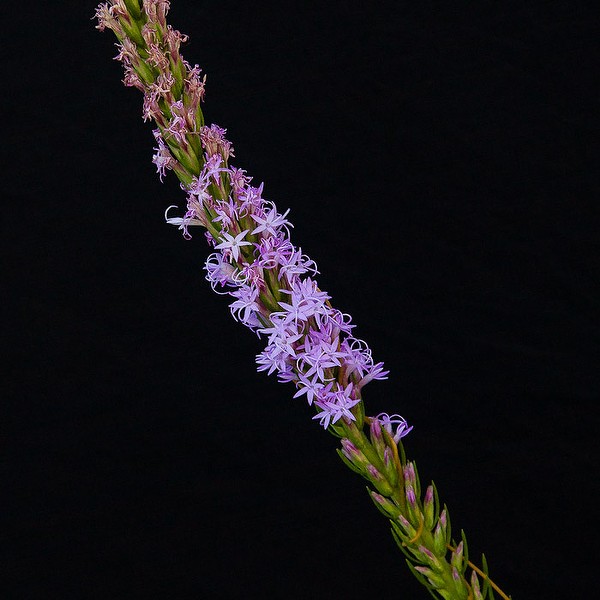
Liatris sports jaunty upright magic wands of (usually) purple flower heads sufficiently spectacular and durable to  sell as cut flowers and garden plants.  Blazing Stars! Gayfeathers!  We don’t need to buy any around here though, because we are naturally endowed.   About five species beautify our usual flower-peeping radius.   Florida claims about 14 species, three limited to our state, most in dry habitats including scrub.  Altogether there exist almost 40 species.

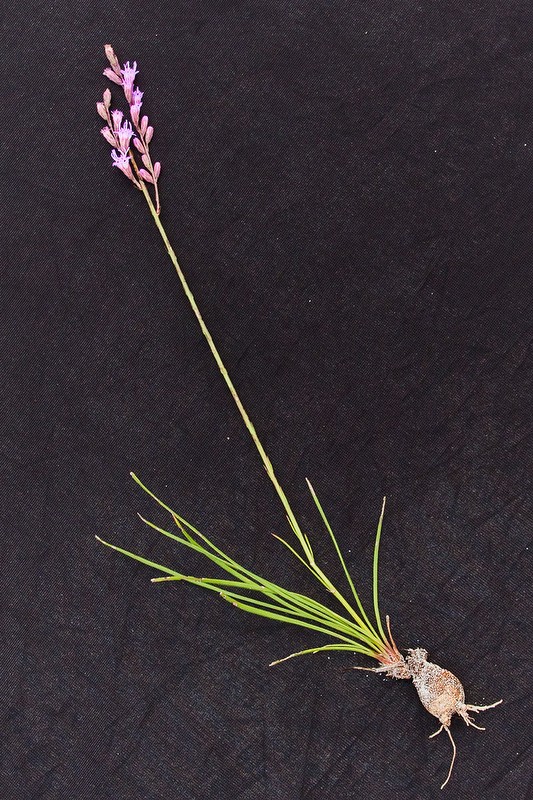
The Liatris adaptations to harsh above-ground hazards are noteworthy.  They are Armageddon-proof with safe underground structures called corms.  Corms are short, broad, vertical subterranean stems (not roots) shaped like a child’s top or a beet.  Not that many everyday garden plants have corms:  think gladiolus, cyclamen, crocus, and edible Aroids.

Liatris corm (by JB)

Another adaptation is more subtle.  As background, Florida Rosemary (Ceratiola ericoides) is allelopathic, that is, it spews natural herbicides to suppress vegetative competition or neighbors that might invite fire.  Guess what’s resistant to that allelopathic attack?  Among others, a species of Liatris in Florida scrub has rosemary-proof seeds according to ecologists Molly Hunter and Eric Menges.

Conspicuous in the Park was a dichotomy in the dominant flower displays.  One party had broad flat-topped  horizontal clusters in white, yellow, or purple.  The other party, by contrast, elevated their white, yellow,  or purple flowers on narrow vertical spikes.   Liatris is in the latter staunch spike group.

Granting flat-topped clusters their own virtues, today it is all about Liatris, so what are the pros to posies on a pole?  And now we speculate.  Disclaimer: The following may be BS, but big boo hoo.  First of all, I haven’t done the engineering math, but a tall wand seems to allow for extra-many flowers in a growing season, and some spikes have leaves among the flowers and thus flower and photosynthesize at the same time.   A broad flat inflorescence offers a “big bang” of flower power, a show with a big peak moment.  But a vertical spike can “burn like a 4th of July sparkler,” spacing out flowers over time, catering to “trap-lining” (repeat-visitor) pollinators.  Ditto for “seed” dispersal, parsing the seeds (achenes) out, not just in space but also in time.

And, to end on silly notions run wild, if there’s physical damage to a spike, such as being eaten by a deer, the lower levels may live on in.  And as one final plus of the skyscraper approach, enjoy this YouTube (CLICK) showing how a high-rise condo accommodates a lot of residents at once.

A vertical spike spacing flowers out in time (stolen from Google Images)

 
6 Comments

Posted by on November 13, 2012 in Blazing Star


Tags: , , , ,

Cryptic Invaders, Elephant Salad, and the Africanization of American Grasses

Pennisetum purpureum (Elephant Grass, Napier Grass)

Phragmites australis (Phragmites, Reedgrass)

Saccharum giganteum (Plume Grass)

Tall and showy in the breezy autumn sun are those super-sized grasses rising from the marshes, shores and roadside ditches.  Three striking grasses of local wet habitats may rise together in the hot Florida weather, but they don’t have much else in common.  Time for a nod to Elephant Grass, Phragmites, and Plume Grass.

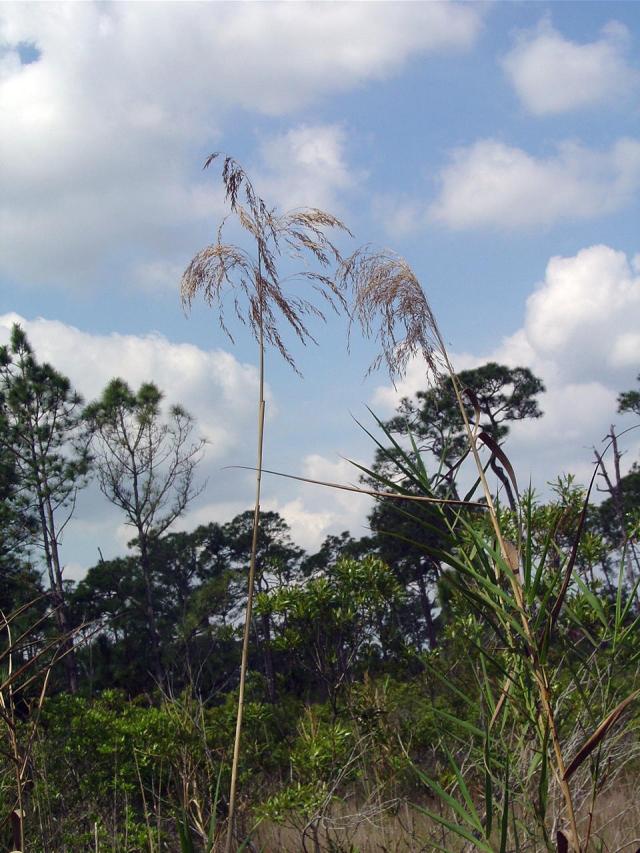
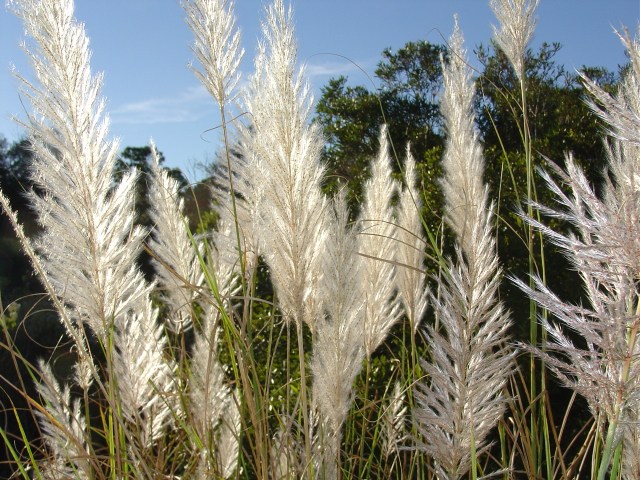
This trio is easy to sort out visually (and see notes at end of article for more details).   The flower clusters of Elephant Grass look like bristly tan hotdogs.  That’s a gimme.  The Phragmites inflorescence in Florida is a bushy panicle with droopy feathery side-branches.  The Plume Grass inflorescence resembles that of Phragmites but is nearly leafless below the inflorescence; the inflorescence branches are stiffer; and the spikelets have awns (needlelike wires at the tips), which are missing in Phragmites.

Each of the three has its own peculiarities:

1. Phragmites is a scary example of subversive bioinvasion.

2. Plume Grass has a double-habitat secret identity.

3. Napier Grass may propel your great-grandchildren’s monorail.

Phragmites. (I have forgotten who took today’s grass photos.)

Is Phragmites native?  Now that’s a loaded question…with no simple answer.  Contrary to some assertions, some Phragmites is native to North America.  Preserved U.S. remains are thousands of years old.  Looking more broadly, Phragmites occurs around much of the world as a mind-boggling species complex revealed in its intricacy by DNA studies.  Botanist Kristin Saltonstall has documented what’s going on here.  (CLICK for details)  There are 27 genetically distinct Phragmites strains, 11 of them endemic to North America.  The most common U.S. strain, known as “M,” probably invaded the U.S. from Europe via southeastern seaports after around 1910, and has snuck quietly but aggressively throughout much of the original North American Phragmites range and beyond.  This is the main invasive strain pestering Europe.  Another strain, the one in Florida, is known as “I” and occurs additionally in South America and in Asia/Australia.  Its original nativity and ultimate classification are not clear, although Saltonstall clearly suspects it to be an old non-native introduction in the U.S.  So, to draw upon some elegant DNA work, is the Florida Phragmites native?   Probably not.  (There are additional taxonomic notes at the end of the article.)

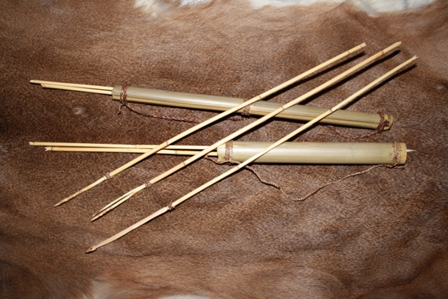
Phragmites stems are straight and strong, giving them ancient and modern uses, with applications as diverse as hut construction, mats, reed boats,  flutes, bagpipe components, “cigarettes,” and arrows.   I make primitive bows and arrows, and have tried Phragmites shafts, which are lightweight and fragile.  Although I have not looked into the matter seriously, I think pre-European Phragmites arrows were generally fitted with reinforcing wooden tips, as shown in Primitive Archer Magazine, from which this photo came:

Ranging from Long Island to Texas and Central America, Plume Grass is elegant in the autumn, looking like a garden species.  Well it actually DOES look like a garden species, especially the related Eurasian horticultural selection Ravenna Grass.  It is likewise related to and similar to Miscanthus known to some as pretty garden grasses and to others as loathsome bioinvaders.  Miscanthus sinensis has shorter flower stalks and longer leaves (the leaf tops reaching the bases of the flower clusters.)

Plume Grass pluming

Where does Plume Grass grow?  To a Floridian, the answer is it swims with the gators. (CLICK for a dandy Gigapan by John.  Find the Plume Grass.)  But what about to a hillbilly like me?  There’s Saccharum giganteum near my parents’ old home in the foothills of the Smoky Mountains, in Smoky Mountain National Park, and down the other side into Tennessee. (To be honest though, it is not fond of high elevations.)

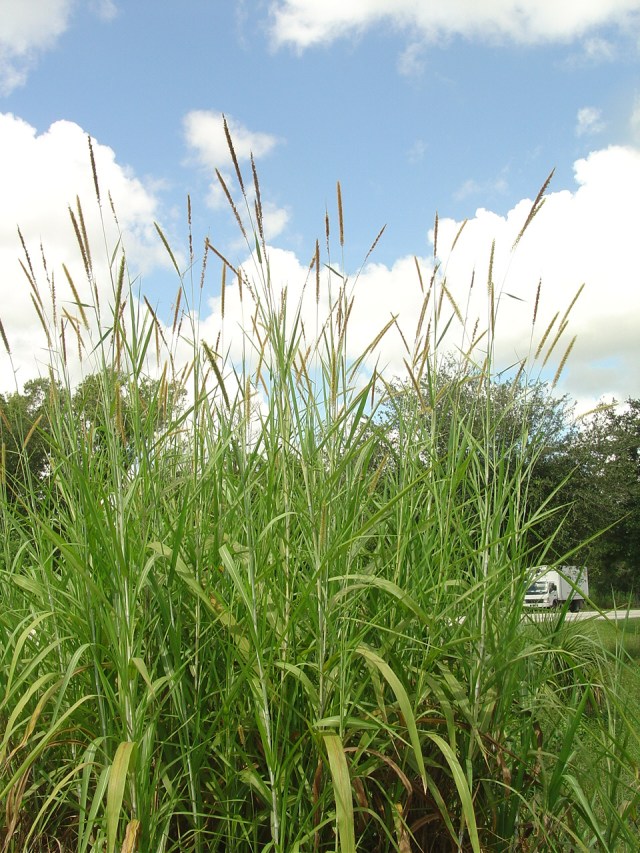
This is getting long so we better hurry along to our third super-sized grass, Napier Grass or Elephant Grass.  This African species, reportedly munched by elephants, likes South Florida.  Driving from Jupiter to Stuart along I-95 yesterday I lost count of the clumps.  Any Floridian who drives a car has seen this jungle-maker.  You could hide an elephant in it.  Brought here as a fodder, Napier Grass threatens to take over the state as one gigantic rhizomatous lawn 15 feet tall.   And what a complex relationship with humans:  if you think it may help feed the world you might be interested in the named and improved pasture selections.  If you think it may take over the world you might like to burn it.  Good idea!  As biofuel of course.  This stuff makes Switch Grass look wimpy.

Napier

Setting aside arguments having to do with ethanol per se, why not put all that green to good use before it smother us?  Then use the corn to make corn flakes.  Even better,  Napier Grass takes up nutrients, including notably phosphorus, from eutrophic waters and from contaminated soils.  One objection to this approach is that, hey, don’t plant an evil invasive weed, but isn’t it too late to worry about that?  We can harvest all the Napier Grass we want from what’s already with us.

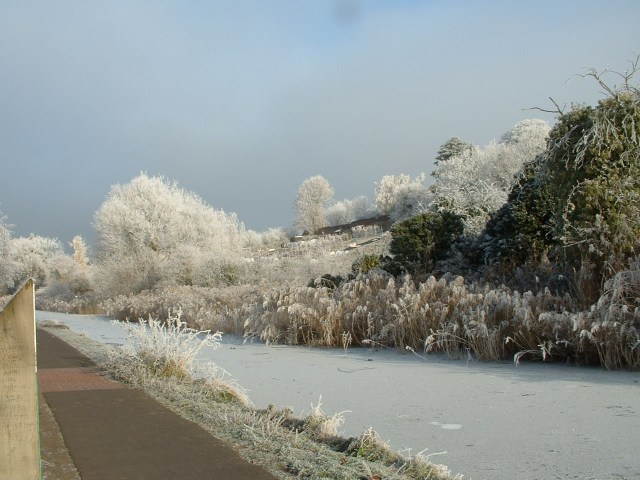
After the article was posted, my friend Mary Hart sent this winter wonderland photo of Phragmites near her home in Worcester, U.K.,taken in 28 degrees in January 2012, reminding us that the species has become in places a critical nesting site and food source for water birds.

Phragmites across the Pond (and across the canal), in Worcester, U.K., January 2012, sent by Mary Hart.

———————————————————-

Notes:  Phragmites has the ligule small (1 mm vs. > 2 mm in Saccharum), leaf blades not auriculate (as opposed to Arundo and Hymenachne) and without the light basal coloration characteristic of Arundo. The internodes are pubescent (vs. glabrous in Neyraudia) and the lemmas are glabrous (vs. pubescent in Neyraudia).

This is no place for a pseudo-taxonomic revision.  But for a thumbnail:  According to Bernd Blossi at Cornell, several characteristics distinguish the several endemically native Phragmites strains (collectively subsp. americanus) from the introduced “M” (subsp. australis).  Subspecies americanus has deciduous (vs. persistent) leaf sheaths, ligules > 1mm long (vs. shorter), smooth shiny stems (vs. dull and rough),  reddish or other-colored  (vs. tan) stem bases, low rhizome density,  slow colony expansion (vs. rapid), and round rhizomes < 15 mm in diameter (vs. thicker and flattened).  Type I (subsp. berlandieri) of uncertain nativity and unsettled taxonomy shares shiny stems with subsp. americanus, but has the persistent leaf sheaths and short ligules (< 1 mm) associated with subsp. australis.  Subspecies berlandieri has been lumped into a broader segregate species  P.  karka in some interpretations.

 
3 Comments

Posted by on November 5, 2012 in Elephant Grass, Phragmites, Plume Grass


Tags: , , , , ,

Bluestem Grasses – Andropogons

Bluestem Grass

Andropogon, several species

Poaceae

Hurricane Sandy and Hurricane Work Obligations thwarted the usual Friday trip this week.  A little alter in time, this morning dawned cold and brightly sunny, and I visited the Sweetbay Natural Area near the Palm Beach North County Airport.  One of John’s and my favorite wet sites with a civilized paved sidewalk.  The cold was compensated by the striking beauty of the horizontal sunbeams lighting up the silvery beards on the various Bluestem (Andropogon and Schizachyrium) grasses.  Those fireworks alone justify an early start.

Splitbeard Bluestem with its split beard (don’t recall who took the pic)

It is not my purpose now to be schoolin’ ya about how to distinguish the Andropogon species.  John and I tried that, and the results are a click away at  floridagrasses.org.

Some readers might agree that locally the Bluestem Grasses can be tough to differentiate.  Whenever you see reference to a “species complex,” watch out for a puzzling network of funny business.   Most of our nearby species belong to the “Andropogon virginicus complex,”  which seems to be diploid, comparatively free of apparent hybridization, and yet often with subtle visible differences between species.

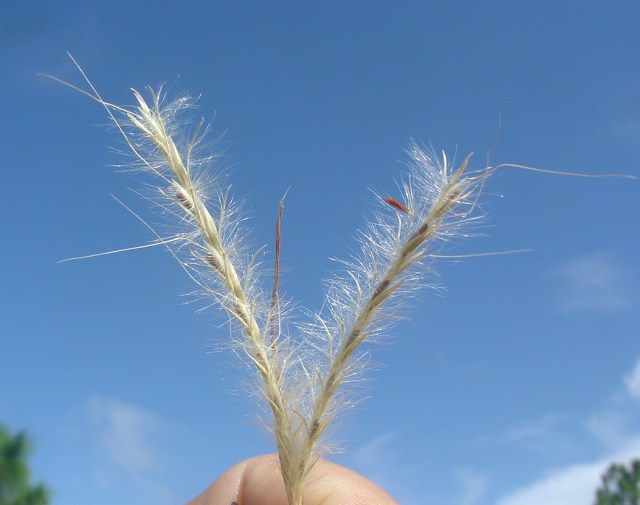
One of the prettiest and most distinctive species is the Splitbeard Bluestem, Andropogon ternarius, which is a tetraploid (has 4 sets of chromosomes) and has a particularly delicate appearance:  tall and slender with big long silvery-white bunny ears (spikelet clusters) displayed on wirelike wands.  It looks like a work of art, and  I always enjoy encountering this exquisite bit of creation.  Gardeners agree.  I recently saw this species for sale at approximately $40 per cell tray.  A seedy variant developed in Florida chiefly for habitat restoration is called “Ft. Cooper.”

The plant world is full of fluffy-puffy feathery wind-dispersal units, but Andropogons are  the ZZTops of the flora.  In fact the name Andropogon means dude with a beard.

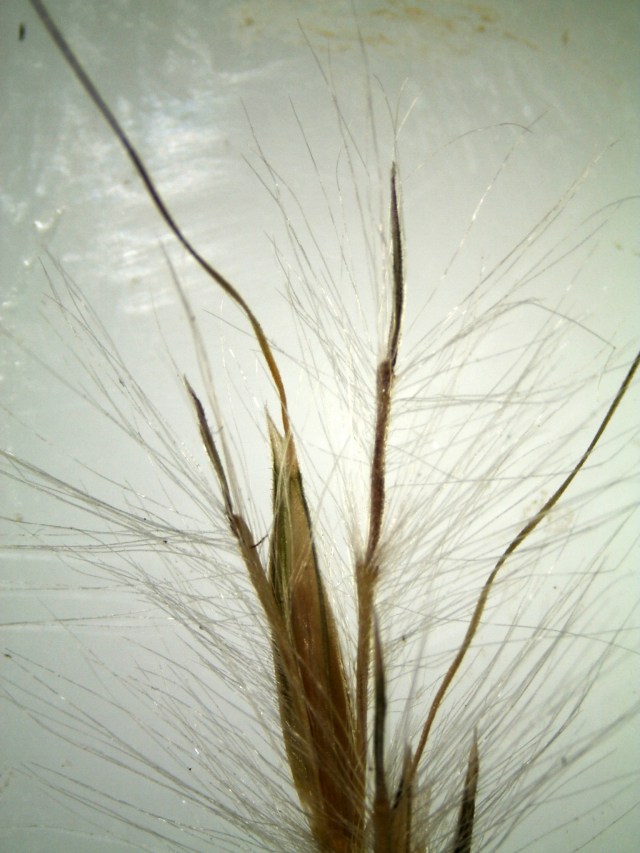
You could scarcely design a species more appropriate to wind-dispersal.  The bunny ears bust apart at the slightest whisper, separating into parachute-bearing “seeds” (spikelet clusters) to blow hither and thither.  The microscope view shows what they bust apart into.   The feathery parachute hairs in the photo are of obvious function.  The two long threads (awns) visible in the picture are less obviously useful.  The awns probably catch the wind or bump against adjacent plants and help the bunny ears bust apart.   Also interesting are the two small vertical “daggers” you see flanking the main spikelet.  Those are sterile (seedless) spikelets.    Who knows—maybe they’ve lost their function but the genes that make them have not quit altogether, sort of like the human canine teeth.

Andropogon ternarius spikelet cluster. Center-left is large fertilie spikelet with long awn. Smaller sterile spikelet “dagger” is vertical just center-right. Another awn is visible tilted to the right.

The natural distribution of Andropogon ternarius is roughly the southeastern 1/3 of the US from Florida to New Jersey, Indiana, and Texas.   At least that was where it was is was yesterday.   Sandy may redistribute some bunny ears today.

Split-bearded dudes

 
6 Comments

Posted by on October 29, 2012 in Bluestem Grass


Tags: , ,

Bay Bean

Baybean

Canavalia rosea

Fabaceae

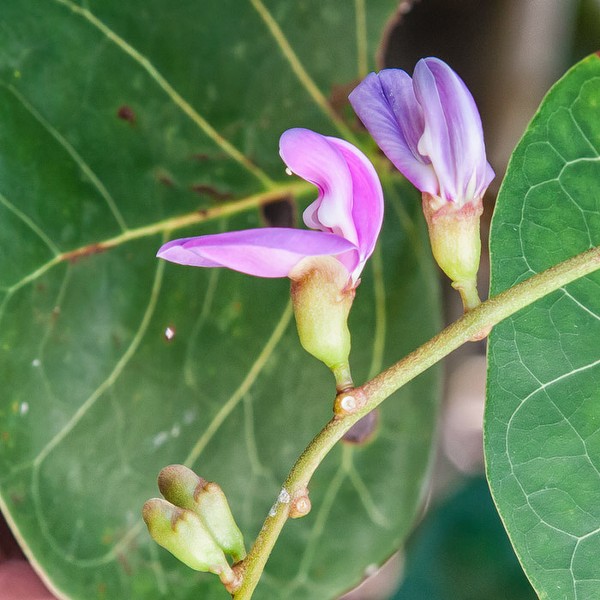
Bay bean flowers in front of sea grape leaves (by JB)

Today John and George played hooky in the coastal dune-hammock strand on Hutchinson Island at Beachwalk-Pasley.   This restored strip is a living museum of maritime species.  The treat is seeing all together in glorious flower at once:  Bay-Cedar, Bloodberry, Buttonwood, Corky Stem Passion Vine, Cowpea, Crownbeard, Fiddlewood, Native Lantana, Marlberry, Nickerbean, Purple Morning Glory, Railroad Vine, Sea-Rocket, and more.  The star fruit-laden species were Sea-Grapes and Fiddlewoods.  The most magnificent display was the Baybean, trailing on the ground, festooned over upright plants, and dangling from overhead limbs like a party decoration.  Flowers, fruits, seeds—the whole works.

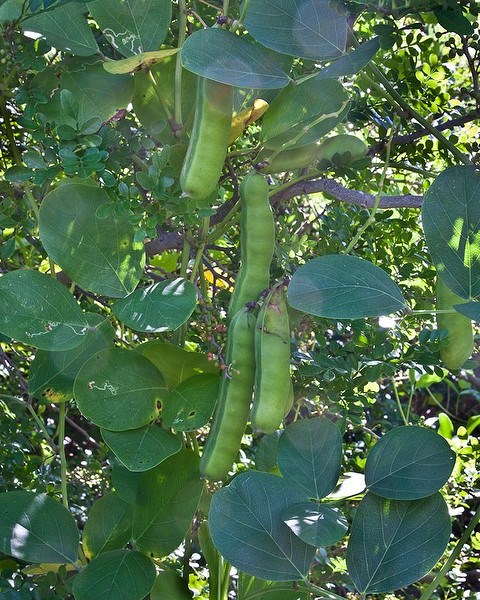
Dangling Canavalia pods (by JB)

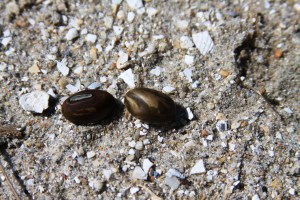
Baybean beans are easy to spot with their blotchy surface pattern.  To me they look like engorged ticks on a dog’s neck.

The dangling pods are the size of a flattened sausage, and made of tough stuff. The big pea-type flowers are a rich rose color.   You can find on-line reports of the blossoms drugging their pollinators, but I’m skeptical of that.  (Would be fun to investigate though.) Something bay-beany with a bigger blog presence is smoking the big tough fibrous  Canavalia pods or leaves for a “Woodstock” experience.  Sometimes they are in the false marijuama sold as “bath salts.” The blog world has lots of of chatter on this topic, yet they all seem to miss one minor point: YOU’D HAVE TO BE CRAZY!?!

Here is why I would never ever ingest Canavalia in any format: I enjoy life.   Canavalia is the namesake of one of the world’s most fascinating poisons, canavanine.  Canavanine occurs in Canavalia, although I do not know about C. rosea specifically.  It is present in other pants too, such as alfalfa.

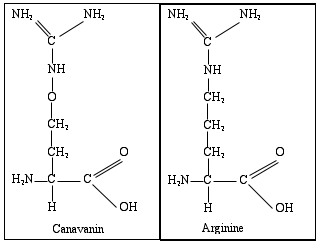
Here is how canavanine works.  It is wickedly insidious, and pardon the Biochemistry 101. Living things are all about proteins.   Proteins have precise structures and precise functions.  Proteins are chains of amino acids, just like sentences are chains of words.  Alter an amino acid, and you have the effects of a mutation, not good.   An amino acid impotant in protein building is arginine.  You can buy it in the health food store.  Now here is the important point—Canavanine resembles arginine.  Canavanine sabotages proteins by becoming built into them disguised as arginine.  This is the equivalent of saboteurs secretly replacing ball bearings with rubber balls in the airplane factory.  Kaboom!  Put THAT in your pipe and smoke it.

[Note: The chemical structures come from the Universite Pierre & Marie Curie, Paris]

 
2 Comments

Posted by on October 20, 2012 in Baybean


Tags: , ,

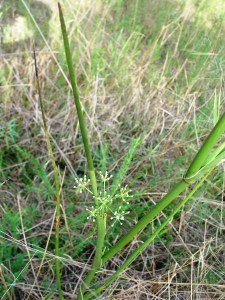
Cowbane, drying out in the marsh

Cowbane

Tiedemannia filiformis (Oxypolis filiformis)

Apiaceae (Umbelliferae)

Northern transplants like myself recall Queen Anne’s Lace (Daucus carota)—actually an Old World weed and the ancestral species of the modern carrot—in childhood meadow memories involving bug nets.  Every time I see Water Cowbane my brain sees Queen Anne’s Lace.  They are related in the Carrot Family.  Water Cowbane lives in marshes and along wet shores throughout Florida and beyond.  John and George enjoyed it in its full flowering glory Friday along the marshy nature trails in the PB County Solid Waste Authority “wilderness.”

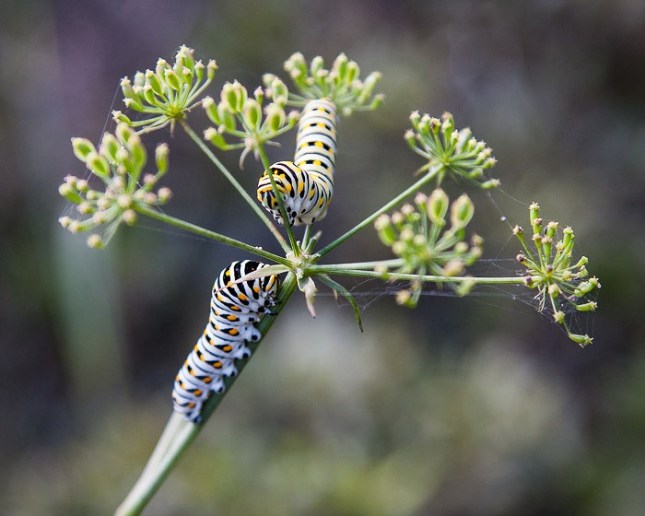
Cowbane with Black Swallowtail caterpillars (JB)

Beware “bane” in a plant name (Henbane, Dogbane, Horsebane, Bugbane, Fleabane); it is a sign of poison, and Cowbanes have in fact poisoned cattle.  Despite grocery store members, such as celery, and several spices and herbs, the Carrot Family often tends to be dangerously toxic, including Water Hemlock (Cicuta), Poison-Hemlock (Conium), and additional nasties.

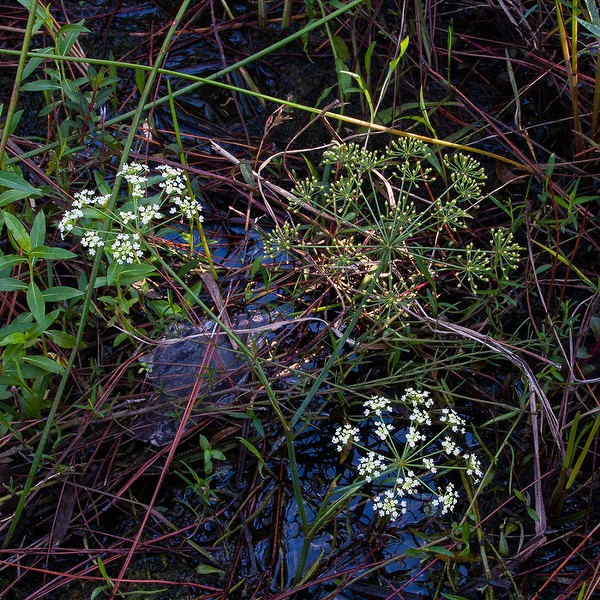
Cowbane (JB)

It is unclear to what extent the toxins enter and protect the Black Swallowtail Butterfly caterpillar, which favors the Carrot Family in general, and locally this species as host plants.  The caterpillar, which can disable the toxins, develops a false “snakes tongue” as its personal scarecrow.  You might say it is a bird-bane.

Water Cowbane has abnormal  leaves shaped like thick knitting needles.  The proper term for organs with this shape is “terete.”

Knitting needle leaves

Now  here is the punchline, so listen up:  terete leaves (or similar photosynthetic terete stems) occur in many unrelated plants in marshy or boggy habitats.  In other words, among plants of open sunny marshes there is convergent evolution leading to narrow cylindric leaves.  I won’t bore you with a list of examples here, but some are in the notes below.

Looking beyond wetland plants, where else do you encounter terete leaves or round photosynthetic stems?  In deserts,  such as the African Spear Sansevieria familiar to gardeners.  This makes sense, since a terete leaf (or a round photosynthetic stem) has a comparatively low surface area relative to internal tissues, thus reducing water loss and sun exposure.  Another dry place is perched up epiphytically where water isperiodically hard to come by.  Here too we see terete leaves, such as those on some Vanda Orchids.  Salty habitats are “dry,” and  our local Sea-Puslane has more or less terete leaves.  Right—that all makes sense, but . . .

How could it be that plants sitting directly in water have “desert” –style terete  leaves or similar stems?  Back in the year the Wright Brothers flew (1903) botanist Rosina Rennert wrote a detailed monograph on precisely this topic featuring the Water Cowbanes as a “Swamp Xerophyte.”  She is not by any means the only biologist to develop the idea of aquatic habitats being “dry” to plants; she just focused the spotlight brightly on today’s species.

At Jonathan Dickinson State Park, 11/13/15 by John Bradford

At Jonathan Dickinson State Park, 11/13/15 by John Bradford

I am not up on the relevant contemporary plant physiology, but going about my routine botanical business from time to time I run across repeated reasons explaining how marsh life can be “dry” to a plant.  Most obviously a marsh can be relentlessly sunny, and it can dry out periodically, toggling from a wetland to a “desert.”  Additionally, roots need oxygen to function properly,  and a plant rooted in stinking no-oxygen mud may have trouble with root functions. And third, the water chemistry of some wetland settings impedes water uptake.     Some wetland species vary the form of their leaves dramatically in response to different water and soil conditions.  It would be interesting 109 years later to resume Rosina Rennert’s experiments doing that.  I wonder what Rosina thought of Wilbur and Orville’s flying machine.

————————————————————

Notes: Unrelated plants with knitting needle leaves:  Some Rushes (such as Juncus scirpoides), some Grasses (such as Panicum tenerum, Paspalum monostachyum), and some Sedges (Eleocharis interstincta,  Cyperus articulatus, in both species the photosynthetic stem is the terete organ), some Arrowheads (Sagittaria teres), and Quillworts (Isoetes flaccida).

 
2 Comments

Posted by on October 14, 2012 in Cowbane


Tags: , , ,

Floating Ferns, Ammunition, Fertilizer, Cow Dung Slurry, and Eggbeaters

Azolla filiculoides and additional species

Salvinia minima and more

This week’s Friday trip was displaced by a scintillating department chair meeting, two life-wasting hours dedicated to e-mailable calendar events, futile parking space rants, program enrollment statistics, personal horn-tooting, and oh-so-witty repartee.  My seat-neighbors survived with sneaky smart phone activity.  My phone is dumb, so I just stared out the window sullenly, dreaming of native plants and chicken marsala, and wondering what was floating on the polluted drainage ditch across the parking lot.

Upon adjournment, I checked out the ditch and found the pond scum to be largely fertilizer-fed Blue-Green Bacteria (Blue-Green “Algae”), and, better, there were little floating ferns, always fun to see. (They have their own Cyanobacteria, so stay tuned.)

In Florida we have two genera of small floating ferns:  Azolla and Salvinia.  Each has two Florida species, more or less, with room for debate on exactly which species are present, how they are defined, and exactly where they are native.  Let’s not get into all that in our fun little blog, except to mention that the ancient Old World rice paddy species Azolla pinnata seems to have made its Florida debut right here in Palm Beach County.

Both Salvinia and Azolla float with an option of settling onto wet mud when waters recede.  Both are abundant in local waters.  Both come and go, almost magically, and have the capacity to go forth and multiply—to the extent of utterly covering the water surface, or clogging irrigation pumps.

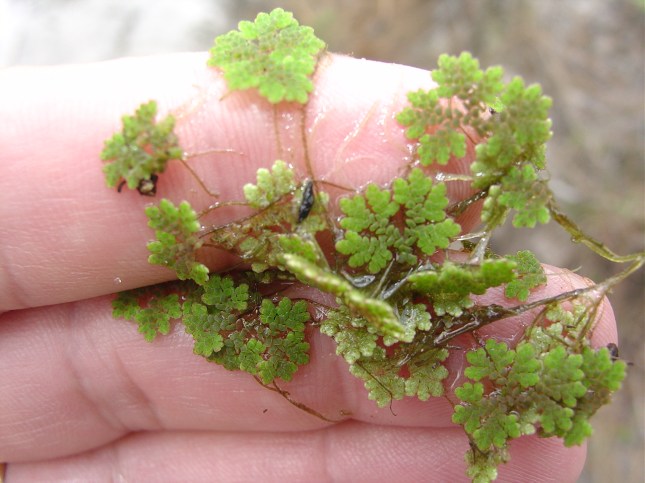
Sometimes called “Waterferns” or “Mosquito Ferns,” Azollas are the smaller-statured  of the two.  You could mistake them at first glance for Duckweeds (that’s a different blog).  A single Azolla plant can be the size of a coin, floating on the water surface with tiny branches bearing tinier leaves overlapping like shingles.  Each plant has a roughly circular irregular and lumpy outline.  (Azolla pinnata has an outline like a squashed conifer tree.)   They can form small roots, with the absorptive root function supplemented by thin-walled hairs on the leaf surfaces.

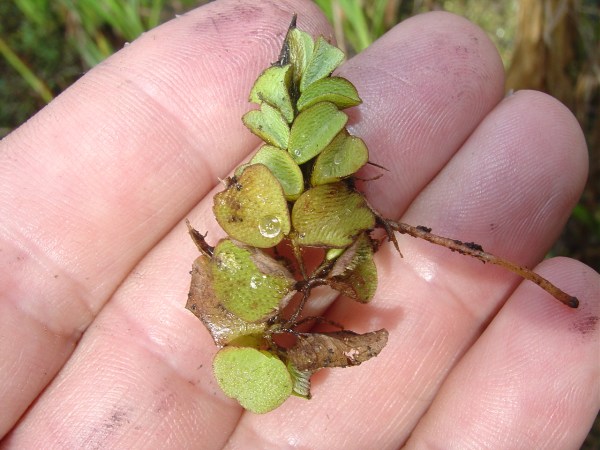
Azolla filiculoides (by JB?)

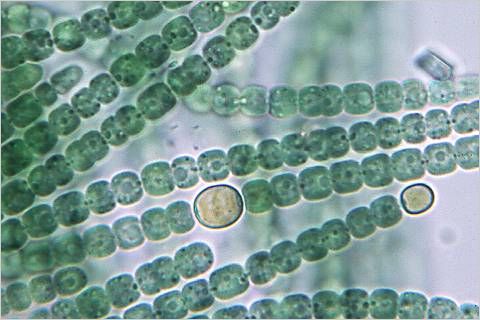
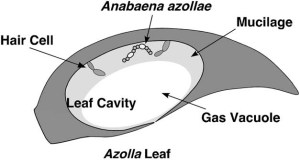
Azolla consorts in a symbiotic relationship with Cyanobacteria (often misnomered “Blue-Green Algae”) able to fix nitrogen, that is, transform atmospheric nitrogen into fertilizer.  (The German chemist Fritz Haber won a Nobel Prize in 1918 for figuring out how to do this industrially to make fertilizer and to make  ammunition.)  The symbiotic Cyanobacterium, Anabaena azollae, is impotent in the presence of oxygen, so the fern gives its little friends climate-controlled mucilage-lined gas chambers in hollow cavities in the leaves.  Anyone with a microscope can break the fern apart with a needle in a drop of water and see the Anabaena dramatically.

Anabaena liberated from Azolla (by Grupo Biologia Alicantina)

Lots of plant, fungus, and animal species have one-on-one symbiotic relationships with microbes.  Inquiring minds might wonder  what happens to the intimate relationship when the host undergoes its sexual cycle.  How do the host babies wind up with their own microbe?  Different  strokes for different folks, in Azolla the bacterium rides through the fern’s entire reproductive cycle.  Ain’t that somethin’!  Each baby Azolla has Anabaena as its birthright, sort of a trust fund baby.

Azolla leaf with Anabaena in gas chamber (from J. Plant Physiology 166. 2009)

A floating fern that can make fertilizer is a handy asset in a rice paddy, and Azolla has been boosting since ancient times.  That’s why Azolla pinnata is sort of interesting here, even if invasive.  Did it follow rice cultivation to the Agricultural Area, or just show up on its own accord? (You can imagine 100 ways for it to arrive.)

Salvinias are sometimes called Water Spangles.  Our widespread Water Spangle is the Invasive Exotic Salvinia minima, perhaps enjoying a little Global Warming and inching northward.  This Tropical American native has spawned reports across the southern U.S. with cameo appearances in northern states.  (Taxonomic-nomenclatural confusion and easy mobility complicate assessment of the exact distribution.)  It can turn a canal into a green lawn, as I saw recently in Riverbend Park in Jupiter.

Salvinia minima (by JB?)

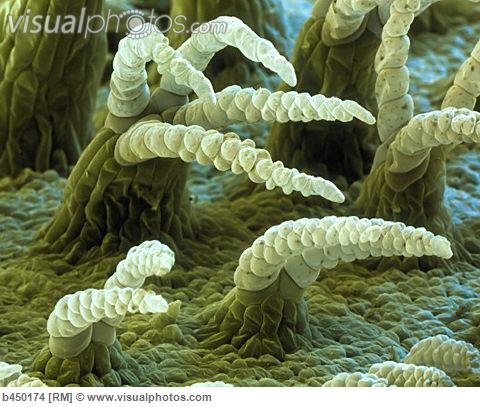
Salvinia is easy to recognize.  The leaves are in whorls of three.  Two leaves are identical, nearly circular in outline, about a centimeter in diameter. (The leaves are larger in S. molesta , which has a couple reports in Florida, but not in our haunts so far.)  The third leaf in the whorl looks like a brushy branchy root dangling in the water.  The two round green leaves have unwettable surfaces with extreme hairs.  In S. minima the hairs look like a scary Halloween tree; in S. molesta the hairs look like an eggbeater.

Scary Salvinia minima hairs (by Visual Photos.com)

Don’t look for spores as encountered under the fronds in most ferns.  Both Azolla and Salvinia have a special adaptation to the boating life— spores in little hard cases called “sporocarps.”

I have a personal theory that pond scum is going to save the world.  What grows faster?  Scarfs up pollutants in the process?  And utilizes bad carbon dioxide?  We’re talking biofuels, and even food.  This video will give an idea how fast Azolla can grow —just toss in a little cow dung slurry—and feed the world! (Or at least feed the livestock.)  CLICK

 
20 Comments

Posted by on October 7, 2012 in Floating Ferns


Tags: ,

Sonicatin’ in the Meadow

Meadowbeauty

Rhexia cubensis (and additional species)

Melastomataceae

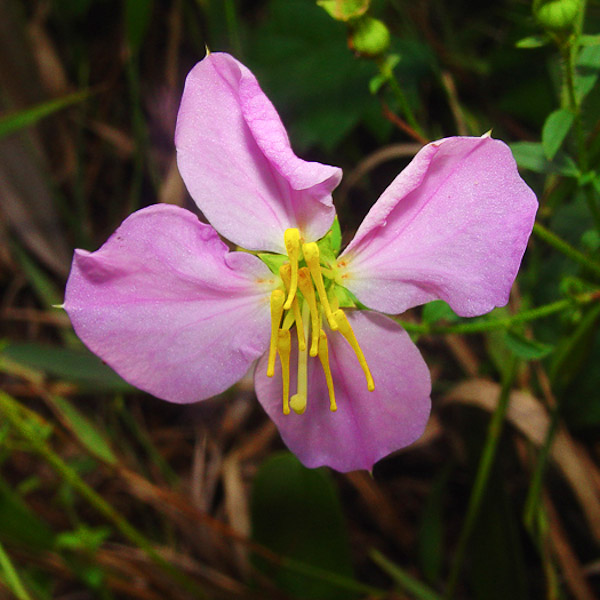
When it comes to meadow flowers, the fairest of them all are Meadow Beauties (species of Rhexia), with their delicate pinky-lavender, or less often white or yellow flowers.  Do beauties in the meadow resemble the big Tibouchinas in the garden?  Yes, they’re all family, the Melastomataceae, along with Tetrazygia bicolor (misnomered West Indian “Lilac”) a popular shrub in native plant gardens.  Melastomataceae have elegantly curved leaf veins, and have unique oversized yellow curved anthers. (Anthers are the pollen-producing flower organs.)

Image

About 10 species of Rhexia reside in Florida, representing the lion’s share of this 13-species genus mostly confined to the U.S. with minor extensions into Canada and the West Indies.  Rhexias rise up after disturbance and can spread vegetatively.  Some have tubers and/or creeping horizontal roots pretending to be rhizomes.

In our immediate zone of exploration, Rhexia nuttallii is the only species that has its anthers in a radially symmetrical arrangement at the flower center.  In the other species the anthers are longer and in a lopsided bilaterally symmetrical arrangement.  Rhexia cubensis has glands on the stem hair tips and particularly bristly fruits in contrast with glandless hairs in R. mariana and less-bristly fruits.  Rhexia nashii too has the stem hairs glandless, and differs from R. mariana by having non-bristly (or nearly so) fruits.

Do you find these beauties to be sometimes hard to identify? They vary; for instance, Rhexia cubensis has diploid, tetraploid, and hexaploid strains.  (This refers to chromosomes in pairs, or sets of four, or sets of six.) Some species hybridize.  Rhexia mariana is especially known for mixing it up with its kin.

The anthers are bright yellow, presumably as snazzy come-ons for bees, yellow suggesting yummy pollen.  There is a little controversy around that topic.  Yet yellow decoration of bee flowers is widespread, and the bee-draw of yellow on flowers is generally accepted.  (And suggests some fun experiments.)  Certain Melastomataceae have two types of anthers:  big yellow advertising anthers along with smaller, drab-colored “business” anthers to dust the bee visitors with pollen.  If dual-anther types exist in Rhexia I’m not aware of it.  How they do function in Rhexia is fascinating, however.  So read on:

They employ “buzz pollination,”  a phenomenon found in about 8% of flowering plants dispersed among unrelated families—thus a great example of convergent evolution.  Many members of the Potato Family, Solanaceae, feature buzz pollination, and now back to Rhexia.  Most pollination research has involved Rhexia virginiana, which is absent around here, so we’re extrapolating recklessly to our local species.

Those big, elongate, curved anthers draw bees seeking pollen as an important baby-bee protein source.   In most non-buzz flowers the anthers open, wads of pollen spill forth, bees get dusted, and off they go.  But that is a crude approach vulnerable to bee greed, wrong pollinators,  bad timing, and weather.  In Rhexia and other buzz flowers the anther has a single pore at the tip.  The pollen remains safely inside the anther until good vibrations puff some pollen out pore.  Not just any bee can get a buzz on.  Forget honeybees.  Bumblebees do the job, and so do multiple additional types of native bees.  A fancy term for buzz action is sonicating.

Enjoy  simulated sonication here: BUZZ

Now this is just pure speculation, but don’t those anthers shaped like a bent bottle with an expanded chamber at the base and a narrow neck look like guitars where the music box “amplifies” the buzz?  In some Rhexias the anthers change color on their second day.  Interestingly, the vase shape of the anthers repeats in the fruit, which likewise has a swollen base and narrow neck, dispersing the tiny “cochleate” (snail-curled) seeds.  As in so many other wetland plants, the tiny seeds have sculptured surfaces.

The buzz system rations pollen.  In Rhexia (virginica) only 10.2 % shakes forth per visit. Thus to complete its load a buzzy-bee is compelled to move along, and plenty of pollen remains behind for other bees on other days, extending the effective life of the flower.

[The photo is R. cubensis, by John Bradford.]

 
2 Comments

Posted by on September 30, 2012 in Meadowbeauty


Tags: , , ,

Native Agave Species, Probably Not Native and Perhaps Not Even Species

Agave sisalana

Agave decipiens

Agave neglecta

John and George this week indulged their multi-week fixation on the Savannas Preserve State Park and neighboring scrublands.  Yesterday we were working on the railroad all the live-long day.  Railroad tracks are interesting botanically, because the rights-of-way have been there a long time as unintended plant refuges, and because choo-choos spread species.   The floral beauty this week is stunning with yellows coming from Goldenrods, Crotalarias (not necessarily native), and weird little Neptunia.  Butterfly Pea (Centrosema virginiana) was so abundant and so gorgeously blue-violet to surpass the average flower garden.  Giant Foxtail Grass (Setaria magna) was swaying in the breeze with the bristly inflorescence actually the size of a fox’s tail.

But the great encounters were all three “important” Agave species growing untended in Florida.  Agaves are about as fascinating as they are beautiful, with a complex history in human affairs.

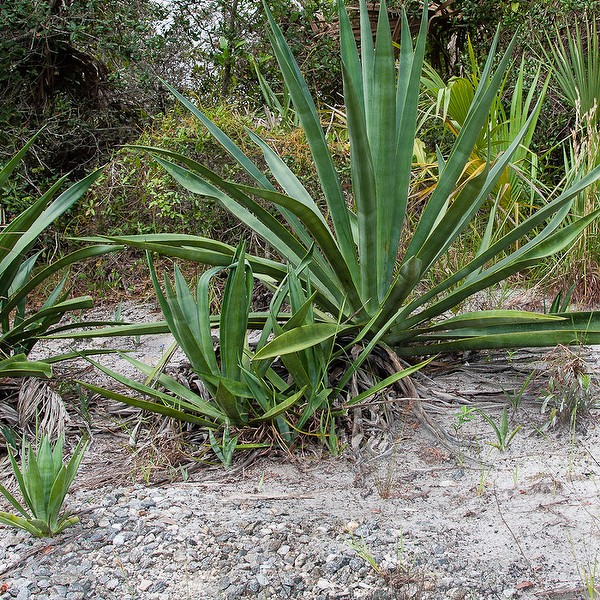
Agave sisalana (by JB)

First on the list is an abundant but definitely non-native Agave.  Florida once was a hotbed of research on fiber plants, one of them being Agave sisalana, the source of commercial sisal fibers, as in ropes, doormats, and similar rough-scratchy commodities.  Agave sisalana is still with us in scrubby places.  It is the only common Agave in natural areas having no (or few, small, and irregular) prickles along the margins of mature leaves. Recognize this species from the distance by its straight narrow leaves with comparatively parallel margins.  Agave sisalana is a Florida Exotic Pest Plant Council Category II invasive exotic, which raises a question, how can a seedless species invade?

That’s easy:  Agave sisalana, like most agaves, forms “bulbils” in its maturing inflorescence. Bulbils are baby clones of the parent plant; they represent vegetative reproduction and do not grow from sprouting seeds. Neither fruits nor seeds are known in A. sisalana.  The bulbils are tougher than nails, and can float and can last forever unrooted; they are the “perfect” propagules.  Bulbils are useful for humans wanting to cultivate agaves, which has been goin’ on a long time.

Agave remains decorate human excrement on the order of 6000 years old in caves.    CLICK and

CLICK AGAIN 

(Do you think somebody will be examining our leavings 6000 years from now?)

Agave sap burns human flesh (believe me!) to the point of being dangerous to the eyes, yet pre-Europeans served agaves in the kitchen, wrapping food in the waxy cuticle, chewing quids made of the leaves, eating the plant flesh, and sipping the sap in beverages.  The last-mentioned practice grew into a Mexican industry.  Just ask Jose Cuervo.

Agave fibers are beautiful strong, easily extracted by rotting the flesh off of the leaf, and just plain nice.   We’re talking about ancient cordage, hammocks, and fishing gear.

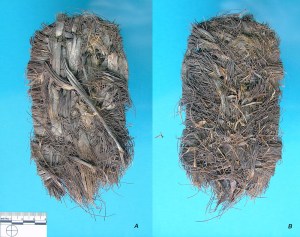
Prehistoric sandals probably made at least in part of Agave fibers (from the second link provided above)

So now a few strands of our story come together.   Agaves originated almost certainly in or near Mexico and Texas where human civilization is ancient.  The plants were valuable for foods, drinks, and fibers.   They are easy to store, move, and plant.  This all ties into a big Agave fact.  This is important, so listen carefully:  multiple named “species” of Agaves are in fact ancient cultivars and hybrids, created and moved around by the hand of people and their canoes.  This helps explain the sterility, wacky variation patterns, mixed chromosome numbers, and distributions of some “species,” including the Florida “natives.”

Not proven, but personally I am convinced that that’s the story behind the Agaves distributed among the Caribbean Islands.   Ancient Caribbean-dwellers were expert mariners and fisher-persons.

And all this begs a huge inadequately investigated question—a question hobbled by a reluctance among traditional taxonomic botanists to take pre-Columbian civilization into account in assessing modern plant distributions.  The question is: how did agaves come to Florida?  Possibility 1:  The Tex-Mex scrub flora around the Gulf was more or less contiguous with present-day Florida scrub.  There are western carry-overs from those times still with us in Florida.  Possibility 2:  Maybe the indestructible bulbils floated across the Gulf or Caribbean Sea, or maybe seeds fluttered here on the salty breezes.  Possibility 3:  If humans were growing agaves on Caribbean Islands, couldn’t the canoes have stopped by for a Florida vacation?   Or could humans have carried bulbils around the Gulf from Mexico?

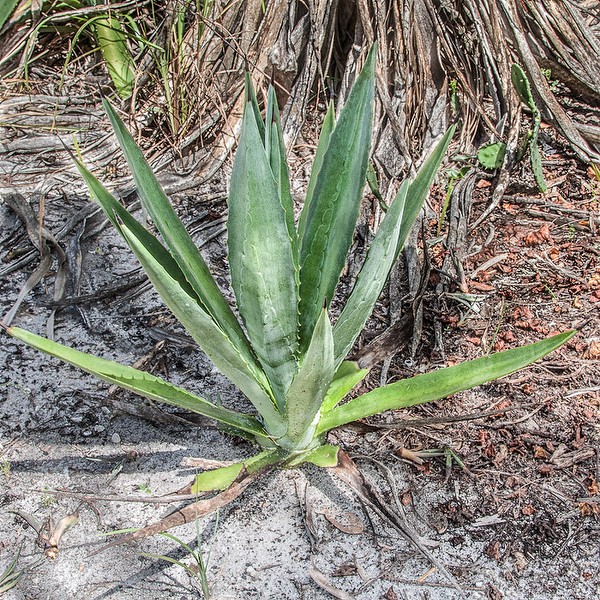
Agave decipiens (by JB)

The level of involvement of Florida in pre-Columbian Caribbean commerce is not known.  Those who wonder how Papayas got here ponder this.  Here is an unstudied silly notion:  our Florida Agave decipiens resembles the Caribbean Agave karatto.  In Flora of North America, botanists James L. Reveal and Wendy Hodgson suspected the history of Agave decipiens to be rooted in human activity:  “Agave decipiens might have been introduced from Latin America by Native Americans; it is not otherwise known from the wild. The proliferation of chromosome numbers suggests prolonged human propagation and a probable hybrid origin.”

Agave decipiens is a large Florida endemic recognized by the even and well-developed (although of variable length) bristles fully along the leaf margins.  The leaves are almost-straight, with little twists and shape irregularities; the margins not as parallel as in Agave sisalana, which differs further by having no or very few marginal prickles.  There can sometimes be a short “trunk” at the base.  The species is beautiful and in cultivation, although a glance at Google Images reveals material cultivated under this name to be a little “dubiously identified” at times.

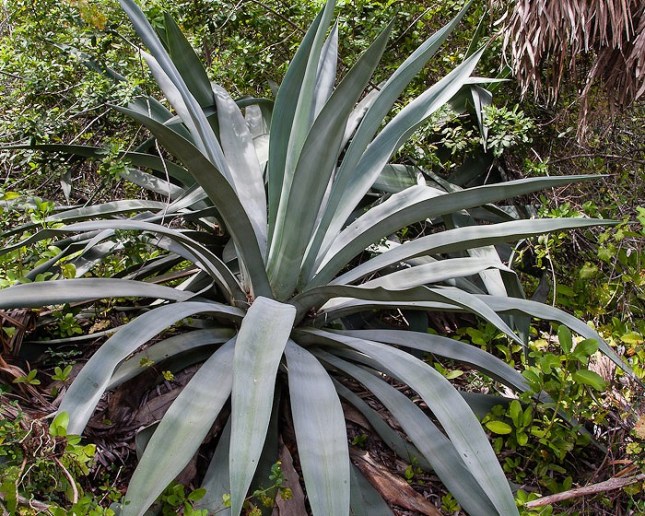
Even prettier is our likewise endemic Agave neglecta.   The leaves are broader (> 15 cm) than those of A. decipiens and of A. sisalana, and far more curved.   The fine mini-prickles are restricted to the lower half of the leaf margin,  As with Agave sisalana, fruits are reportedly not produced.   (However, there are specimens with fruits bearing this ID in Florida herbaria—see discussion below.  Sterile and fertile plants are possible—this occurs in the similar A. karatto, and could be either most likely cytological variation, or sometimes merely a question of pollination.)  The taxonomic King of Agaves, Howard Scott Gentry, as reported in Flora of North America, felt that Agave neglecta resembles Agave weberi cultivated for its fibers.  Reveal and Hodgson in FNA suggested, “The plant [A. neglecta] may well be a cultivar of A. sisalana or A. kewensis and represent an ancient introduction from Mexico.”  (We do not see the Agave sisalana similarity except for the missing fruits.)  Most agaves are pollinated by bats, which begs another question.  Do Florida agaves achieve pollination?  If pollinated, would the fruitless Agaves make fruits and seeds?  I don’t know, probably not, but worth a try with a step-ladder, paint-brush, and a few baggies.

Agave neglecta (by JB)

 
19 Comments

Posted by on September 23, 2012 in Agave


Tags: , , ,