Meadowbeauty
Rhexia cubensis (and additional species)
Melastomataceae
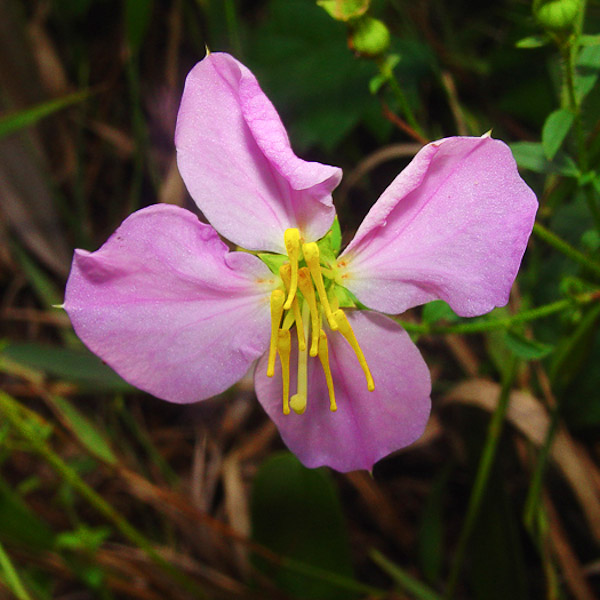
When it comes to meadow flowers, the fairest of them all are Meadow Beauties (species of Rhexia), with their delicate pinky-lavender, or less often white or yellow flowers. Do beauties in the meadow resemble the big Tibouchinas in the garden? Yes, they’re all family, the Melastomataceae, along with Tetrazygia bicolor (misnomered West Indian “Lilac”) a popular shrub in native plant gardens. Melastomataceae have elegantly curved leaf veins, and have unique oversized yellow curved anthers. (Anthers are the pollen-producing flower organs.)
About 10 species of Rhexia reside in Florida, representing the lion’s share of this 13-species genus mostly confined to the U.S. with minor extensions into Canada and the West Indies. Rhexias rise up after disturbance and can spread vegetatively. Some have tubers and/or creeping horizontal roots pretending to be rhizomes.
In our immediate zone of exploration, Rhexia nuttallii is the only species that has its anthers in a radially symmetrical arrangement at the flower center. In the other species the anthers are longer and in a lopsided bilaterally symmetrical arrangement. Rhexia cubensis has glands on the stem hair tips and particularly bristly fruits in contrast with glandless hairs in R. mariana and less-bristly fruits. Rhexia nashii too has the stem hairs glandless, and differs from R. mariana by having non-bristly (or nearly so) fruits.
Do you find these beauties to be sometimes hard to identify? They vary; for instance, Rhexia cubensis has diploid, tetraploid, and hexaploid strains. (This refers to chromosomes in pairs, or sets of four, or sets of six.) Some species hybridize. Rhexia mariana is especially known for mixing it up with its kin.
The anthers are bright yellow, presumably as snazzy come-ons for bees, yellow suggesting yummy pollen. There is a little controversy around that topic. Yet yellow decoration of bee flowers is widespread, and the bee-draw of yellow on flowers is generally accepted. (And suggests some fun experiments.) Certain Melastomataceae have two types of anthers: big yellow advertising anthers along with smaller, drab-colored “business” anthers to dust the bee visitors with pollen. If dual-anther types exist in Rhexia I’m not aware of it. How they do function in Rhexia is fascinating, however. So read on:
They employ “buzz pollination,” a phenomenon found in about 8% of flowering plants dispersed among unrelated families—thus a great example of convergent evolution. Many members of the Potato Family, Solanaceae, feature buzz pollination, and now back to Rhexia. Most pollination research has involved Rhexia virginiana, which is absent around here, so we’re extrapolating recklessly to our local species.
Those big, elongate, curved anthers draw bees seeking pollen as an important baby-bee protein source. In most non-buzz flowers the anthers open, wads of pollen spill forth, bees get dusted, and off they go. But that is a crude approach vulnerable to bee greed, wrong pollinators, bad timing, and weather. In Rhexia and other buzz flowers the anther has a single pore at the tip. The pollen remains safely inside the anther until good vibrations puff some pollen out pore. Not just any bee can get a buzz on. Forget honeybees. Bumblebees do the job, and so do multiple additional types of native bees. A fancy term for buzz action is sonicating.
Enjoy simulated sonication here: BUZZ
Now this is just pure speculation, but don’t those anthers shaped like a bent bottle with an expanded chamber at the base and a narrow neck look like guitars where the music box “amplifies” the buzz? In some Rhexias the anthers change color on their second day. Interestingly, the vase shape of the anthers repeats in the fruit, which likewise has a swollen base and narrow neck, dispersing the tiny “cochleate” (snail-curled) seeds. As in so many other wetland plants, the tiny seeds have sculptured surfaces.
The buzz system rations pollen. In Rhexia (virginica) only 10.2 % shakes forth per visit. Thus to complete its load a buzzy-bee is compelled to move along, and plenty of pollen remains behind for other bees on other days, extending the effective life of the flower.
[The photo is R. cubensis, by John Bradford.]
 John Bradford
 George Rogers
 George Rogers
 Dee Staley
 Treasure Coast Natives