(The pod sticks like a tick. Trefoil refers to the trifoliate leaves)
Desmodium tortuosum and so many more species
Fabaceae
This weekend’s botanical joy has been a study for plant physiology class of the leaf movements by Desmodium leaves to light changes and biological rhythms. Boring to most folks no doubt, but one of the tricky treats we all can see in this back yard marvel. The leaf bases have muscle power, true of most legumes and big-time in Desmodium. The leaf-muscles are called pulvini (pull-VINE-ee), and wiggle-waggle the leaf blades up and down in response to the plant’s wants and needs.
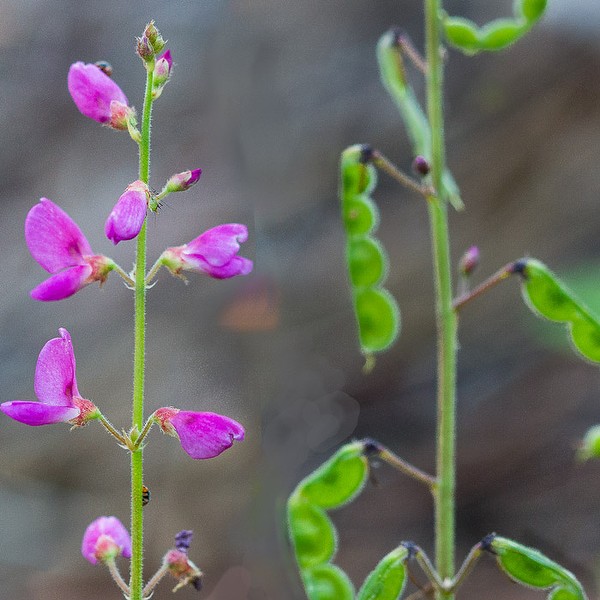
Flowers and segmented pods (John Bradford)
Anybody with socks or pant cuffs knows Desmodium for its laundry fun. The segmented flat pods cling to fur and fabric with hooked hairs like Velcro. Although a hiker’s nuisance, it’s quite an evolutionary trick to take a flat “peapod,” segment it into break-apart pieces like a Kit-Kat bar, and give them stick-o-rific hairs. I find that as amazing and awesome and phenomenal as any ol’ orchid flower, but sadly there are no Desmodium Societies to join.
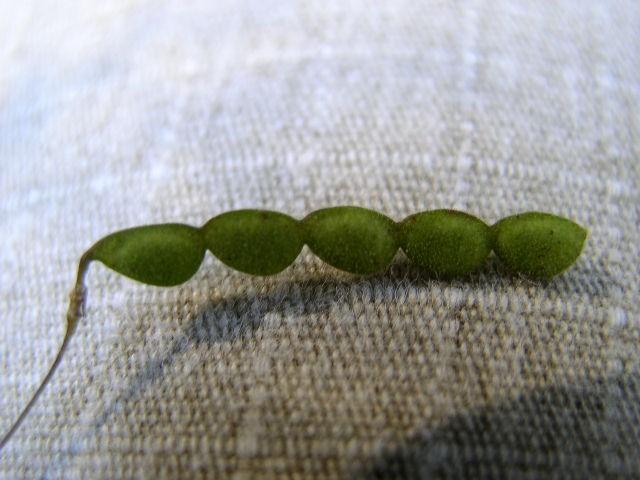
Possibly the beggar-lice helped make Desmodium such a successful genus, with some 300 species around the world, with two dozen in Florida a mix of native, introduced, and of ambiguous nativity. Anything that clingy gets around, and how much of that travel over thousands of years is “natural” is impossible to say. Weeds is weeds.
Just to narrow the field, let’s zoom in on a big one, “Florida” Tick Trefoil, Desmodium tortuosum. The book in front of me deems it not native, but other authorities place its “natural” origins as close as Cuba, and who’s to say those pods don’t sometimes cover the 90 miles without human help! So let’s not be overly dogmatic. In any case, humans sure have moved it around the southern U.S. quite a bit on purpose.
Here’s a case of why flip-flopping with Mother Nature is not always wise. A couple generations ago the species was “good”—even planted. It smothered weeds. It fixed nitrogen. It was a green manure, a cover crop, living mulch. It succeeded…opps, a little too well.
Modern Dixiemodium tortuosum tortures agriculture. (The “tortuosum” refers to the twisted pods.) It is arguably the #1 peanut weed in Georgia, prompting lots of herbicide spraying. I wonder if any gets into the Skippy. Desmo-tort pesters peanuts something awful. I just read that a single specimen about 2 feet from a peanut plant can diminish the yield by almost 20%, and just 8 desmodiums per approx. sq. yard can cut peanut production by over a third. That’s a serious weed, and it gets in the way of adding fungicides. Farmers are lucky that Dixie Tick Trefoil is one of the few annual Desmodiums, rising up during late season growth. Certain herbicides can be timed to pass over the early-growing peanuts and to suppress the later-maturing Desmodium.
Let’s end on a more colorful note. A curious aspect about Desmodiums is mixed flower color, even on single individuals, the combo usually being lilac flowers mixed with blue-ish blossoms (as well sometimes as white). This link shows a mix on the same inflorescence TRIP HERE and look closely.
Mixed colors are not rare in plant species, and are generally interpreted as a signal to pollinators conveying the reproductive status of the flower, let’s say nectar availability. It would be reasonable to regard the changes as mere floral age, but some Desmodium species take it a step further. The flowers have a tippy landing platform with the anthers and stigmas concealed until a bee lands, fairly standard for many legumes. In Desmodiums, the penetrating bee “trips” the flower on a one-time basis like a rat trap. The tripped flower pulls the trigger on the color change: “attention pollinators: this flower is taken care of, so go find another.”

 John Bradford
 George Rogers
 George Rogers
 Dee Staley
 Treasure Coast Natives
