RSS

Category Archives: Bluestem Grass

Bluestem Grasses

Andropogon (and Schizachyrium)

Poaceae

Today’s sunny fieldtrip took John and George through the north end of Seabranch State Park near Hobe Sound, Florida, the present epicenter of our green interests.  Today’s word to describe the glory of nature: Bluestem Grasses!
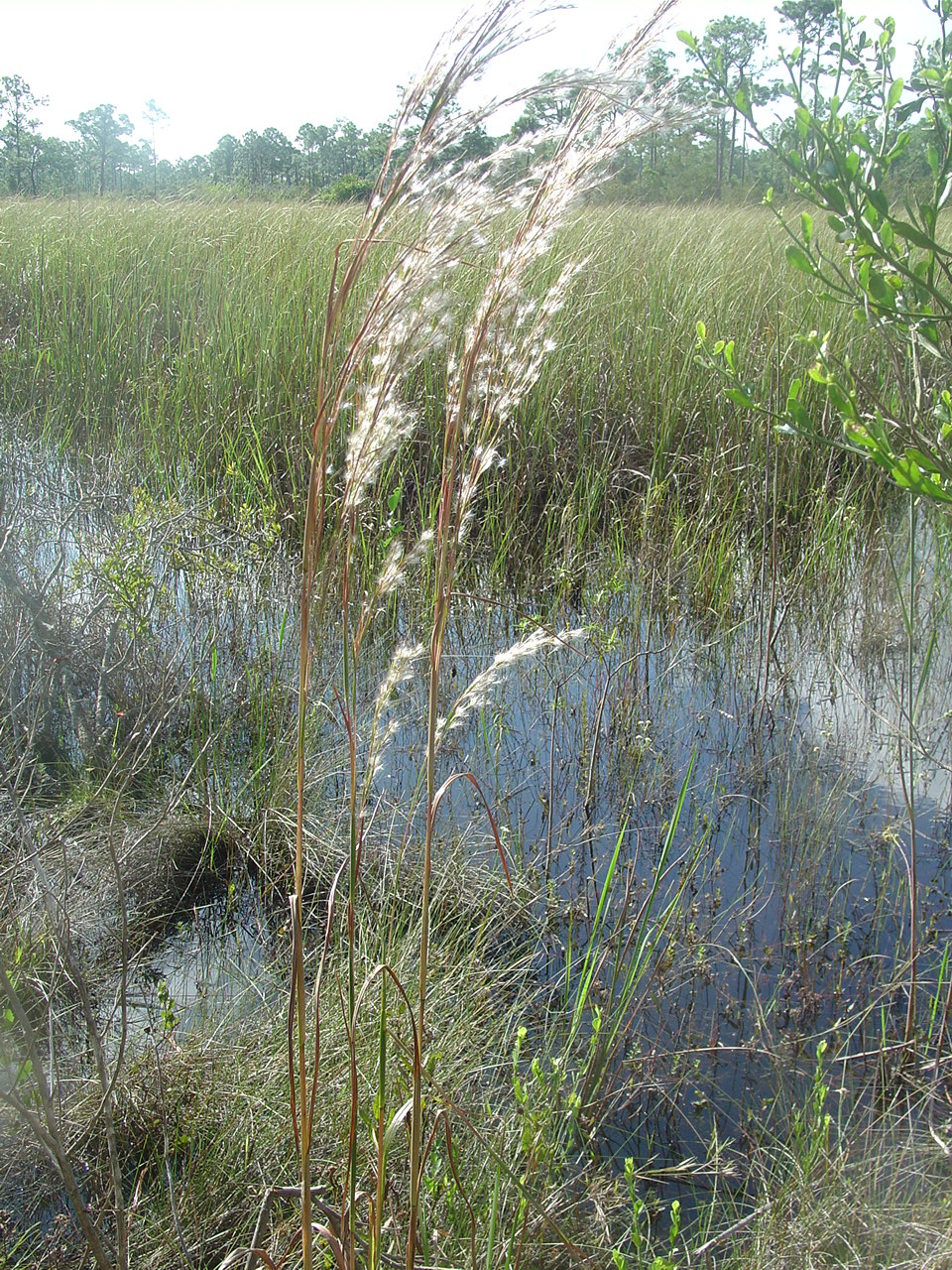
All Bluestem Grass photos today by John Bradford.

All Bluestem Grass photos today by John Bradford.

These are those large puffy-topped grasses, sometimes over 6 feet tall so pretty in October.  Always reluctant to pick favorites, apply tickle-torture and I may confess preference for those gorgeous wands of puff.  It isn’t just the silvery tops dancing in the breeze, but also the array of foliar colors.  So autumnal, a celebration of sunbeams and flickering memories, such as fond recollections of childhood strip mines.

I grew up in West Virginia immediately across the Ohio River from bigtime earth-rape.  Bluestems restore a tentative wisp of beauty to the toxic post-mining landscape.  (“Restoration,” yea sure.  Let’s go see the phosphate mines here in Florida.)  CLICK to see a Bluestem (“Broomsedge”) consoling an old mine crater in Illinois.

Bluestems make all the difference along roadsides, in old abandoned farm fields, along railroad tracks, and on rocky hilltops across much of North America and worldwide.  By the way, grouse like them.  Here is a Bluestem enhancing John’s path of life.

Several species coexist locally.  If you are nutty enough to try to sort them out, try our grassy web site.   Distinguishing these species can be extra-exasperating because:  1. The common species can be bewilderingly variable.  2. Different nearby regions house different species assortments.  3. Some hybridize.  4. They do not stick to their textbook habitats or to field-guide dimensions.  So for today, they’re just all “Bluestems.”
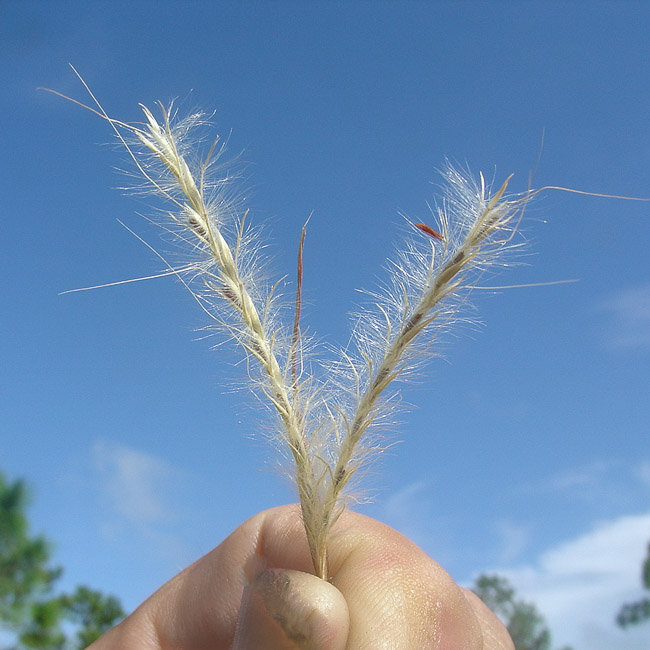
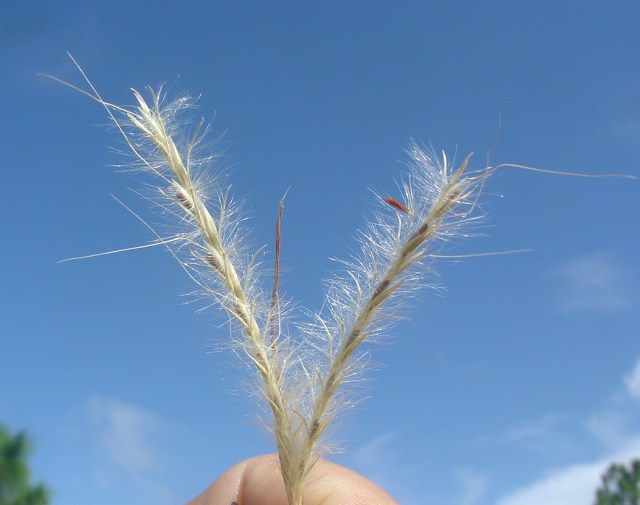
Andropogons usually have two bunny-ears.

Andropogons usually have two bunny-ears.

As hinted a moment ago, they tolerate the world’s worst soils:  graded roadsides, rocky hilltops, hellish railroad tracks, and scrub.  These rugged grasses have a few tricks, some of them studied in only one or few species.

Trick #1.  Some Bluestems have symbiotic root fungi (mycorrhizae) procuring phosphorus from shamefully nutrient-poor soils.

Trick #2.  Bluestems suppress potentially competing vegetation.  It is not mere competition.  Recent research shows some to diminish the “normal” nitrogen-fixing (fertilizer-providing) bacterial associates of non-grass species.

Grasses are turning out increasingly to have their own symbiotic arrangements with unconventional nitrogen-fixing bacteria.  Although data are sparse and preliminary, Bluestems sometimes have such unconventional nitrogen-fixers.  So could they sabotage the other guy’s nitrogen relations while enhancing their own, making the Bluestems kings of the starved soils?  Can they form a nitrogen monopoly?

Even weirder, one species preferentially takes up its soil nitrogen as ammonia, as opposed to slurping in nitrate, the other form in which plants take up nitrogen.  The selfish Bluestem is able to diminish soil nitrate to the detriment of potential competitors, while it somehow enhances soil ammonia for its personal private consumption.
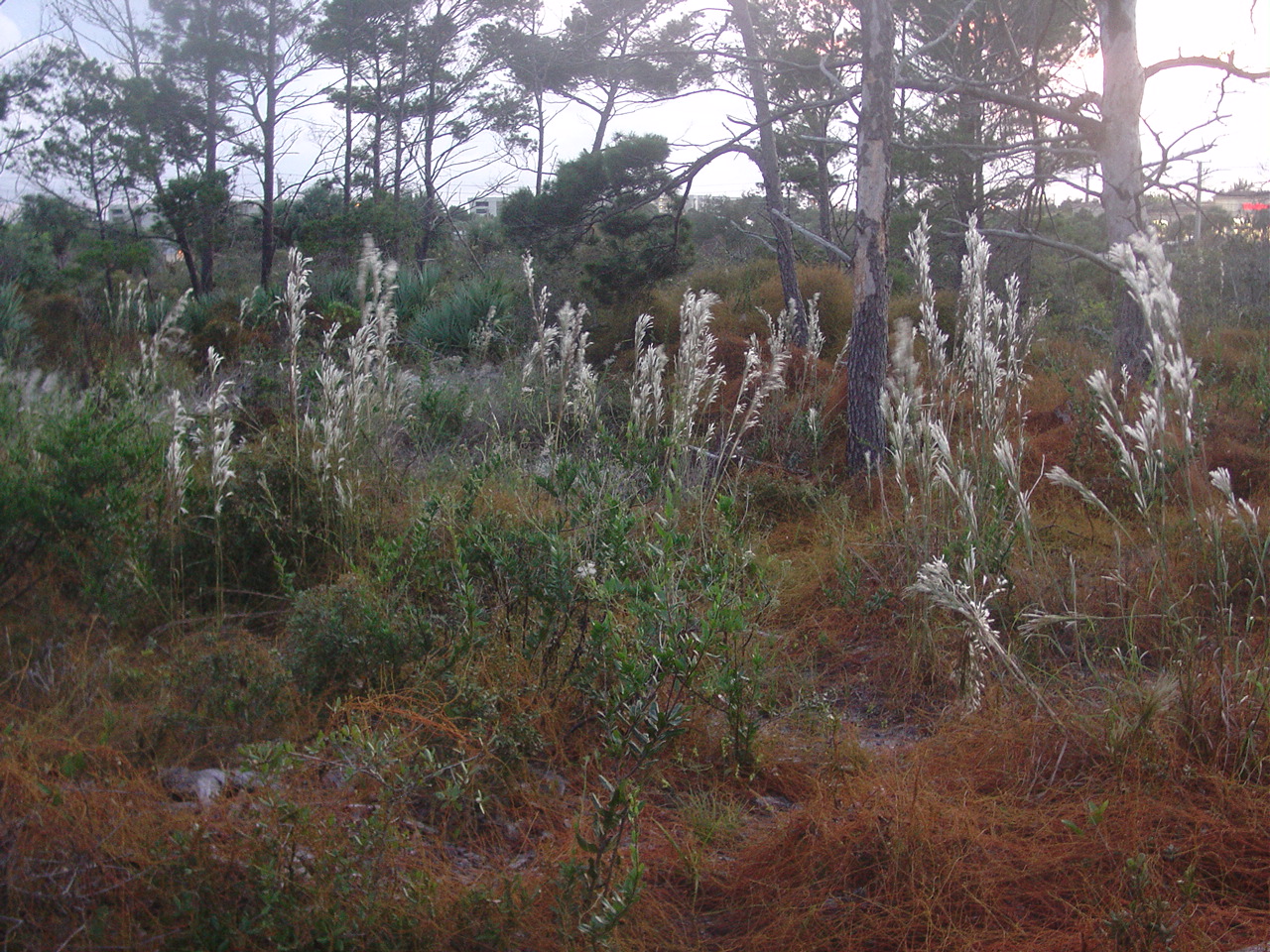
Andropogon floridanus Jupiter Inlet Oct.

 
2 Comments

Posted by on October 11, 2014 in Bluestem Grass


Tags: ,

Bluestem Grasses – Andropogons

Bluestem Grass

Andropogon, several species

Poaceae

Hurricane Sandy and Hurricane Work Obligations thwarted the usual Friday trip this week.  A little alter in time, this morning dawned cold and brightly sunny, and I visited the Sweetbay Natural Area near the Palm Beach North County Airport.  One of John’s and my favorite wet sites with a civilized paved sidewalk.  The cold was compensated by the striking beauty of the horizontal sunbeams lighting up the silvery beards on the various Bluestem (Andropogon and Schizachyrium) grasses.  Those fireworks alone justify an early start.

Splitbeard Bluestem with its split beard (don’t recall who took the pic)

It is not my purpose now to be schoolin’ ya about how to distinguish the Andropogon species.  John and I tried that, and the results are a click away at  floridagrasses.org.

Some readers might agree that locally the Bluestem Grasses can be tough to differentiate.  Whenever you see reference to a “species complex,” watch out for a puzzling network of funny business.   Most of our nearby species belong to the “Andropogon virginicus complex,”  which seems to be diploid, comparatively free of apparent hybridization, and yet often with subtle visible differences between species.

One of the prettiest and most distinctive species is the Splitbeard Bluestem, Andropogon ternarius, which is a tetraploid (has 4 sets of chromosomes) and has a particularly delicate appearance:  tall and slender with big long silvery-white bunny ears (spikelet clusters) displayed on wirelike wands.  It looks like a work of art, and  I always enjoy encountering this exquisite bit of creation.  Gardeners agree.  I recently saw this species for sale at approximately $40 per cell tray.  A seedy variant developed in Florida chiefly for habitat restoration is called “Ft. Cooper.”

The plant world is full of fluffy-puffy feathery wind-dispersal units, but Andropogons are  the ZZTops of the flora.  In fact the name Andropogon means dude with a beard.

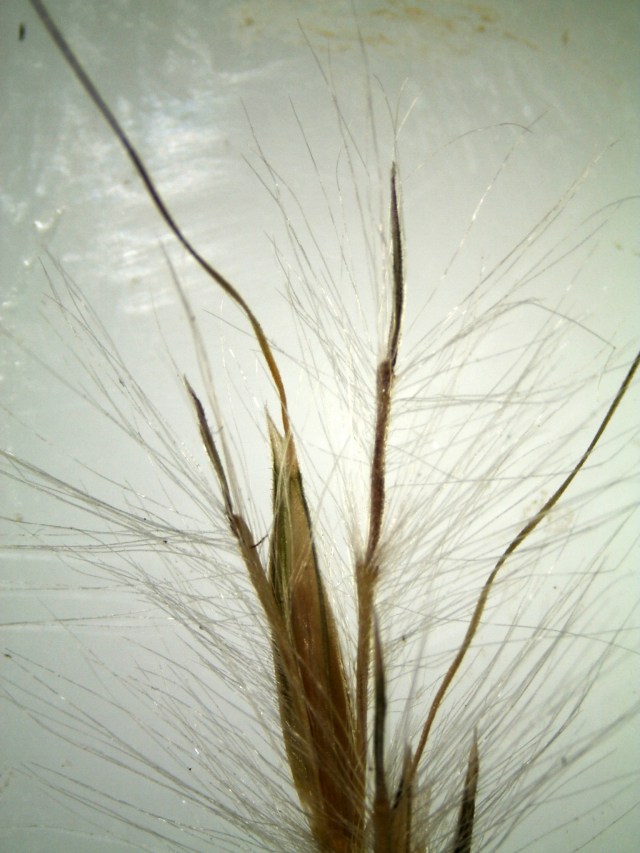
You could scarcely design a species more appropriate to wind-dispersal.  The bunny ears bust apart at the slightest whisper, separating into parachute-bearing “seeds” (spikelet clusters) to blow hither and thither.  The microscope view shows what they bust apart into.   The feathery parachute hairs in the photo are of obvious function.  The two long threads (awns) visible in the picture are less obviously useful.  The awns probably catch the wind or bump against adjacent plants and help the bunny ears bust apart.   Also interesting are the two small vertical “daggers” you see flanking the main spikelet.  Those are sterile (seedless) spikelets.    Who knows—maybe they’ve lost their function but the genes that make them have not quit altogether, sort of like the human canine teeth.

Andropogon ternarius spikelet cluster. Center-left is large fertilie spikelet with long awn. Smaller sterile spikelet “dagger” is vertical just center-right. Another awn is visible tilted to the right.

The natural distribution of Andropogon ternarius is roughly the southeastern 1/3 of the US from Florida to New Jersey, Indiana, and Texas.   At least that was where it was is was yesterday.   Sandy may redistribute some bunny ears today.

Split-bearded dudes

 
6 Comments

Posted by on October 29, 2012 in Bluestem Grass


Tags: , ,