RSS

Hooked on Cheesytoes

Stylosanthes hamata and additional species
Fabaceae

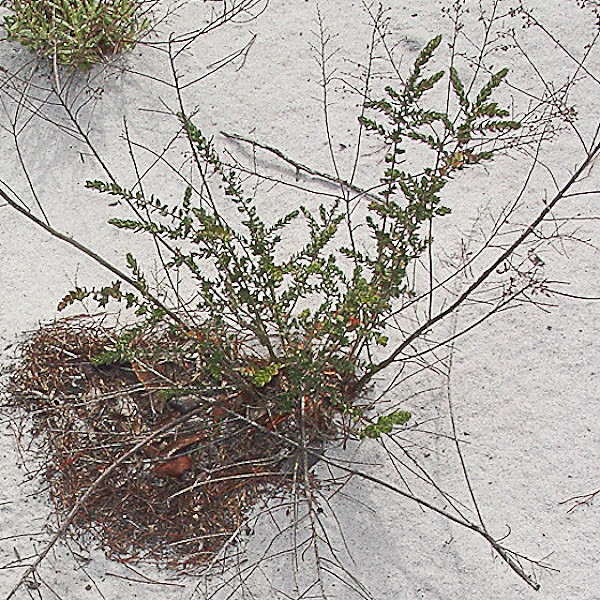
The first time I saw Cheesytoes (what a name!) was on a rough roadside a few years ago—the kind of scratchy place you change a flat tire. The Cheesytoes seemed to fit in among the coarse exotic weeds there. Not recognizing the posie, I keyed it out and was pleased to greet a native species. Who knows, maybe it was rising defiantly from the original scrubby soil seedbank underlying the thoroughfare. At least cultivar ‘Verano’ (see below) withstands herbicide attack, which may help explain the roadside living of today’s plants.
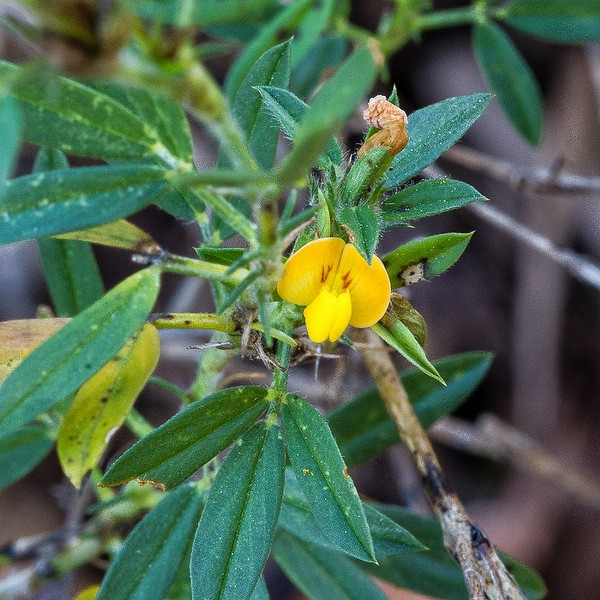
Photo by John Bradford.

Photo by John Bradford.

Rising from an old seedbank is plausible, because species of Stylosanthes have particularly hard durable seeds. This matters in a crop plant when you wish to reap and sow, and a recent (2011) study in Grass and Forage Science suggests microwaves to get the party started with one Stylosanthes species.
Styloanthes is an odd little genus. There are more or less 25 species, 23 of them in warm America and two in the tropical Old World. Florida has three species, more or less: Stylosanthes biflora is widespread rom Central to North Florida. Some native plant nurseries sell it. Why not? Tough, undemanding, and attractive in a rascally way. Stylosanthes calcicola occupies the very southern tip of Florida and is state-listed as endangered. Native to our botanical home range is S. hamata.

Species of Stylosanthes interface with human activity mainly in the pasture. They are legumes for varied and trying circumstances. They fix nitrogen and have an unusual ability to extract phosphorus from the substrate. Not bad, let’s see, fix nitrogen, extract phosphorus, and oh yes, as an added rancher bonus the plants repel ticks. All of these things have prompted fodder plantings from China and Australia to Brazil.

Our own Stylosanthes hamata is historically a broadly defined species, or “species plus some.” Taxonomic studies, chromosomal observations, biochemical data, and  DNA work have combined over the years to show the “species” to be a mix of diploid plants (having one set of chromosomes) and hybrid strains with extra chromosome sets derived from other species, in other words a genetic hodgepodge. TheStylosanthes hamata” cultivar ‘Verano’ is a combination of two species. So then, cryptic genetic pollution of a native population by alien cultivated material is possible, similar to the situation in Phragmites reeds.

In Florida both diploid (two chromosome sets) and tetraploid (four chromosome sets, probable hybrids) occur. Wouldn’t it be fun to look into that in detail? Diploid and tetraploid “S. hamata” strains behave differently: the diploids require alkaline soil but the tetraploids do not; the diploids seem to be less drought tolerant; the diploids seem to require long days for flowering; and at least some tetraploids seem to be herbicide-resistant. This, however, is all based on narrow data with the knowledge that there are multiple tetraploid strains. So overgeneralization is very possible, but maybe those extra chromosomes confer added protections against adversities. 

Not long ago in this blog we looked at fruits on Sea Rocket, finding that they snap into two segments, one remaining on the parent plant on a proven favorable habitat, and the other hitting the road dispersal-wise.  Here it is again. In Sea Rocket the wandering brother floats away. In Cheesytoes, the wanderer has a hook to snag a passerby and saying farewell to the homebound segment. Oh, btw, “hamata” means hooked.
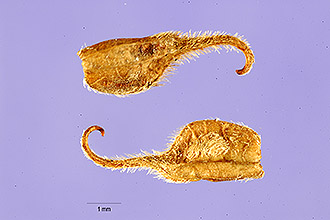
Hooked Stylosanthes segments, by Tracey Slotta, USDA (permitted use).
Hooked Stylosanthes segments, by Tracey Slotta, USDA (permitted use).
 
3 Comments

Posted by on February 7, 2013 in Cheesytoes


Tags: , ,

Pinweeds, Frostweeds, and the Family Fungus

Frostweeds (Helianthemum species)

Pinweeds (Lechea species)

Cistaceae

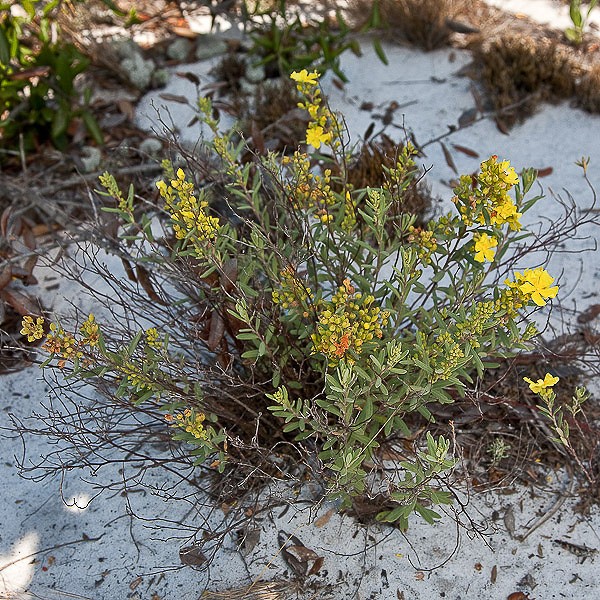
Helianthemum nashii on the sugar sand (by JB)

Helianthemum nashii on the sugar sand (by JB)

Scrub is arguably (but let’s be agreeable) the most botanico-rific Florida habitat. Here is the oddest, oldest, and most diverse ecosystem in town. No space here to wax lengthy on scrub, so let’s knuckle down and concentrate on four interrelated mysteries of the sugary sands:
1. How can clumps of Frostweeds (Helianthemum species) abide in in the middle of parched, sun-baked, nutrient-poor, almost-lifeless white sand patches?
2. How can Pinweeds (Lechea species) do the same thing?
3. Why do the two do it together?
4. Why is there always broken glass in those habitats?

All scrub plants tolerate an extreme habitat, but helianthemums and lecheas occupy the extreme of the extreme where cacti might seem comfortable and to some extent are, yet these brave little plants don’t look like tough cacti at all. Lechea is extreme-looking in a different way, but helianthemums look like pretty garden flowers with yellow blossoms above silvery-tinted foliage. Some Helianthemum species are commercial garden flowers.

I can’t speak about broader geography, but in my favorite scrub sites, Helianthemum and Lechea hang out together like Fred and Barney. Remember that—it’s important.

Frostweed flowers (by JB)

Frostweed flowers (by JB)

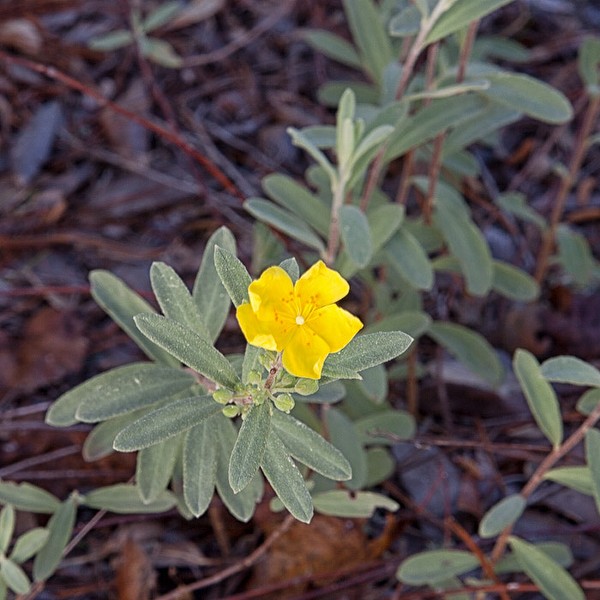
The togetherness becoems more interesting with the knowledge that the two are related, both belonging to the Rockrose Family.  : The kinship helps explain their mutual affinity for Sahara conditions. It’s a family trait. In fact, species of Helianthemum are native to the Sahara itself.

Lechea flowers, sort-of---as big as pinheads

Lechea flowers, sort-of—as big as pinheads

Sometimes, as I hammer to students, when a single species puzzles you, look to its relatives for insights. You can’t generalize 100%, but you can make great educated guesses. If I know a child is a Rockefellar, there’s probably a trust fund. If a critter belongs to the Canine Family it is not likely vegan. If a plant belongs to the Cistaceae, seek it on sunny sand and stones. A center of diversity for Cistaceae is the dryish, sandish, rockish, sunnyish Mediterranean Region, and wherever else you find them from the Yukon to Chile, they are probably in the local “desert.” Even in the garden world, Cistaceae are known as rock garden dwellers. This is the Rockrose Family after al.  Want to learn a new vocabulary word? Chamaephytes (KAM-eh-fights) are plants that hide buds safely underground, and many Cistaceae are chamaephytic. Many grow in clumps that catch debris in the wind to become self-mulching, as in the photo below.

Pinweed (by JB)

Pinweed (by JB)

A particularly noteworthy adaptation to harsh living prominent among Cistaceae are mycorrhizal fungal helpers. Mycorrhizae (my-coe-RIZE-ee) are fungi sharing symbiotic relationships with plant roots, helping the roots snag nutrients and even water. Ever wonder why so few scrub plants succeed in gardens? I don’t really know but suspect most require a soil-mycorrhizae context difficult to simulate in the back yard. In Cistaceae some of the mycorrhizal fungi are truffles. Not the chocolate candies, but the fungal tubers so beloved by hogs and gourmets. Now truffles are costly, so there’s always been interest in truffle farms. Cistaceae, including Helianthemum, have received serious research as possible host plants for the tasty tubers. Hey there’s an idea, Florida is open for business!  Boot out the scrub jay deadbeats and convert all that useless scrub to tax-paying truffle farms.

No e-mails please (pro or con)—-Just kidding you know.

All this said, a question emerges. If Cistaceae depend on mycorrhizae to live where nobody else will, and if two of our most extreme open-sand scrub dwellers both belong to Cistaceae, is their togetherness rooted in mutual mycorrhizae? Does Helianthemum arrive with mycorrhizae in its seeds (yes—stay tuned), and thus set the stage for its cousin Lechea to tag along? Do the two share a single mycorrhizal network?

In species of Helianthemum the seed coat has a gummy outer layer inhabited by the friendly fungus which rides along with the seed. The relationship is so intimate and necessary that seedlings of Helianthemum do not even form root hairs, as the fungus apparently assumes their function.

By the way, Helianthemum is othewise adapted to extremes; it has silvery reflective foliage bearing star-shaped hairs, thus the “frost” in the name. It looks a little hoary. Some self-propagate from subterranean rhizome fragments. Species of Helianthemum make “cleistogamous” (kleist-OG-ah-mus) flowers in addition to their conventional yellow blossoms.  Cleistogamous flowers are tiny and non-showy, and self-pollinate without opening.

Lechea is just odd. The small variably fuzzy leaves appear fairly drought-proof. The flowers are tiny pinheads. I never see them open. Maybe they do not have to open much, as Lechea has a reputation for self-pollination.  My personal point of origin, the University of Michigan Herbarium, has an interesting Lechea comment on their web site: “The flowers rarely open, but are reported to do so in early morning on bright days.” I just don’t get up early enough.

 
6 Comments

Posted by on January 30, 2013 in Frostweed


Tags: , , , , ,

Mighty Oaks and Tiny Tyloses

Mighty Oaks and Tiny Tyloses

Live Oak

Quercus virginiana

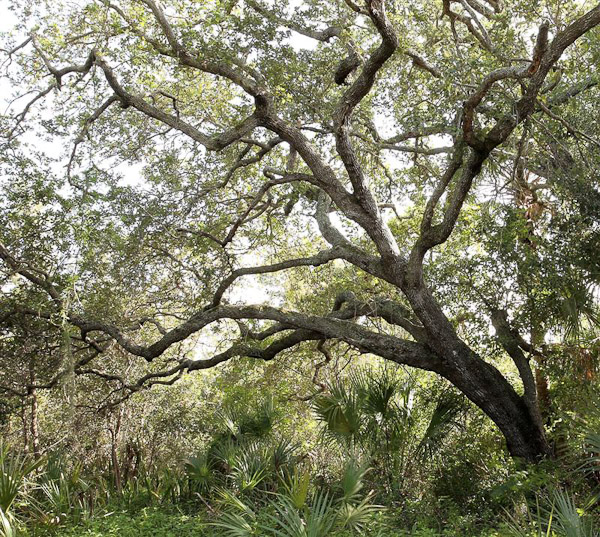
Live Oak by John Bradford

Live Oak by John Bradford

Over the weekend I sat in bittersweet contemplation outside my mother’s nursing home during a golden twilight waiting for nurses to complete their dinnertime tasks and permit a visit. My company during that quiet wait was a massive old Live Oak guarding with solemn dignity its human contemporaries likewise confined to the premises.

On a subsequent visit I brought a measuring tape. The trunk swells at about four feet above the ground as the branches begin to diverge. Beneath the swelling the diameter is about 28 inches. To estimate the corresponding age I’ll borrow data from another Live Oak, one felled in a hurricane with 196 annual rings and 50 inches of diameter, giving its growth rate from acorn to chipper as about 3.92 years per inch. If that can be generalized, then the nursing home oak dates back to the year the Wright Brothers flew at Kitty Hawk, conceivably roughly the same age as the oldest resident in the nursing home.

The tree is thus an apt living memorial to the representatives of the Great Generation facing the end of life in its shadows—dating from their first days and witnessing with them the Depression, WWII, Elvis, Viet Nam, and their Baby Boomer children, and weathering the storms with scars as did they. This memorial knows what it is commemorating.Why do a tiny minority of plant species become the aged giants? Why do Oaks become mighty? And to underscore mighty: According to “Big Trees, The Florida Register,” The state champion Live Oak, of unknown age  is the Cellon Oak in Alachua County with a trunk diameter of almost 10 feet.

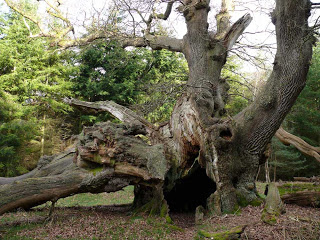
[After the blog was posted, our blog-friend Mary Hart in worcester UK added a comment—see below—on a truly ancient Oak: The King of Limbs i nthe UK.  I’ve inserted the photo below.]

The King of limbs.  See comment below by Mary Hart.

The King of Limbs. See comment below by Mary Hart.

So to repeat the question, why can Oaks live for centuries? I do not know, but it is time to speculate. And one way to attack the question is to ask, the converse bassackwards: what kills other woody species in a shorter timeframe? Well, yea, sure, storms, insects, chainsaws, and competitors, but those are not interesting answers. How about wood decay, becoming hollow and rotting? Do Oaks have an advantage there? Yes.

Be patient. This photo will become relevant to that advantage.

Be patient. This photo will become relevant to that advantage.

To dig in on this and explain the bubblegum, we need to talk a moment about wood structure. Water passes upward in trees through tiny tubes called tracheids and vessels. Tracheids are small in diameter and we’ll ignore them (some trees, such as pines have tracheids only and no vessels). Most trees have larger-diameter pipes known as vessels. As a tree grows in diameter often the only vessels actively involved in carrying water are the younger ones in the outer part of the wood, the sapwood.

The older vessels deeper in the trunk lose their water transport function and can become passageways and breeding cavities for decay. It pays to plug these older vessels to strengthen the heartwood and to block decay, just as communities block old mineshafts. The blockages look like balloons inflated inside the vessels and are called tyloses (tie-LOW-seas). Oaks are not the only trees that have them; in fact, tyloses are likewise common in other long-lived alpha trees. But Oaks are particularly good at it, which is why Oak wood is waterproof and strong for wooden ships and barrels. CLICK

barrel-of-monkeys-721072
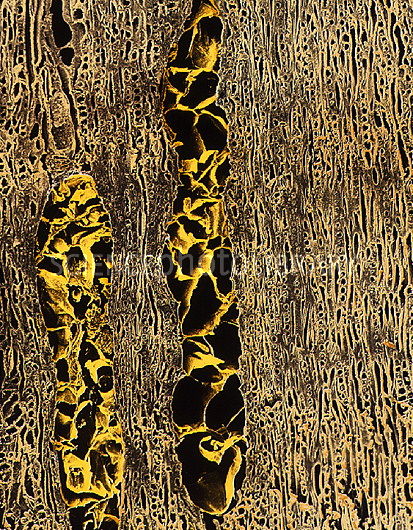
The picture below, taken by Dr. Jeremy Burgess and Science Photo Library, shows a vessel in Oak wood plugged with tyloses. How tyloses grow is fascinating. Vessels are made of dead cells unable to grow, so they cannot make their own tyloses. To grow tyloses, nearby living cells have to push little bubbles of cytoplasm into the dead vessels through tiny keyholes called pits, and then the tyloses expand within the vessel. That is, the tyloses in a vessel are not part of it, but rather are balloons extended from adjacent cells. That’s pretty fancy for a dumb hammer handle. If I wanted to block a PVC pipe with bubblegum, I’d drill a hole into the pipe then blow a bubble to the inside of the pipe.

Vessel in Oak wood filled wiht balloonlike tyloses.  (By Dr. Jeremy Burgess, Science Photo Library)

Vessel in Oak wood filled with balloonlike tyloses. (By Dr. Jeremy Burgess, Science Photo Library)

 
5 Comments

Posted by on January 21, 2013 in Live Oak


Tags: , ,

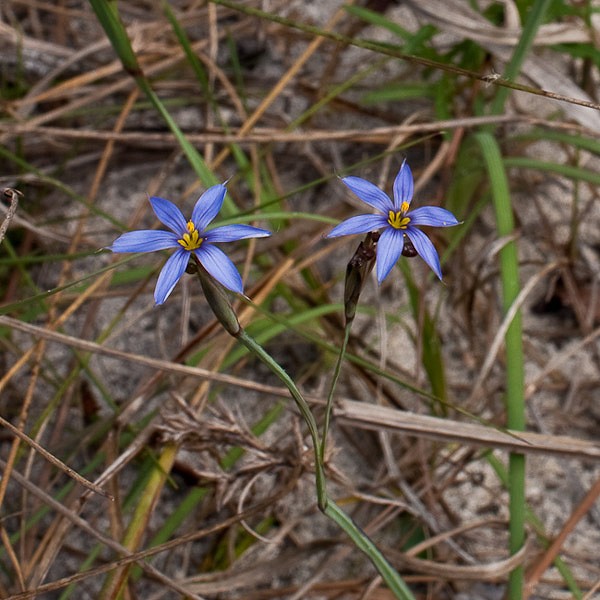
What Does Florida Have in Common with Ireland? Blue-Eyed Grass and Palms

Blue-Eyed Grass
Sisyrinchium species
Iridaceae

Last Friday John and George visited the Kiplinger Natural Area in Stuart.  (See John’s latest Halpatioke Trail photos: CLICK)  There’s always something botanical to enjoy at Kiplinger, and a treat this week was Blue-Eyed Grass, Sisyrinchium angustifolium (base not fibrous, moist habitats).  Also locally we have Sisyrinchium nashii (base fibrous, leaf blade < 4 mm wide, capsule < 5 mm long), and in scrubby dry sites Sisyrinchium xerophyllum (base fibrous, leaf blade usually > 4 mm wide, capsule to 8 mm long).

Well, maybe.  Sisyrinchium species are in the eye of the beholder, controversial and weakly defined in many cases.  If you don’t believe that, select a geographic area and compare the Sisyrinchium species definitions and nomenclature in a couple of botanical references, but I don’t really want to go there.

Taken by John Bradford.  In Bermuda? In Ireland? In Kiplinger?  You decide.

Taken by John Bradford. In Bermuda? In Ireland? In Kiplinger? You decide.

Where I do want to go is Ireland, Bermuda, and Greenland.  The natural distribution of Sisyrinchium, with about 80 species, is almost entirely in the Americas, but go off-shore and it gets interesting, and go all the way to Ireland and it gets weird.  When I first learned of allegedly natural Sisyrinchium occurring in northern North America, and Greenland, and Ireland I imagined Vikings relocating pretty Blue-Eyed Grasses between pillages and plunders.  No dice.  More credibly, botanists have implicated migrating geese as the perps, but the honkers went down in the botanical literature.

And that brings us to today’s mystery.  And here it is: Sisyrinchium bermudiana is the (unofficial) National Flower of Bermuda.  But hold the phone:  The Irish species is Sisyrinchium bermudiana. [ A two-island natural distribution Bermuda and Ireland?  Geese and Vikings didn’t do that!  BTW, it’s been documented in both places since the 19th Century.

Before we go on, may it please the court stipulate a few facts:  First of all, remember what I said about the wobbly status of Sisyrinchium species.  Second, we in this blog are not the first people to notice this odd pattern, and others have “resolved” it by decree and edict.  You can find various statements “settling” the case…but the verdicts disagree.  A crime has occurred but the jury is hung.  Figuring out the irrefutable relationships of those dual island populations is a problem for DNA analysis, and if that’s been done I’m not aware of it.  [Plausible scenario: a doctoral student doing this somewhere now has the computer set to snag all on-line mention of Sisyrinchium.  This blog pops up much to their disgust and annoyance.  If that is you, hi there, send me an e-mail.]  There’s ever-so-much I’m not aware of, and our purpose here is not to resolve the mystery but merely to savor it.  Just like OJ, who really wants to know?  We’ll leave resolution to smart people in hi-tech labs.

Let’s visit Bermuda first.  With dissidents, there’s a sense among even contemporary authorities that the (unofficial) national flower of Bermuda is Sisyrinchium bermudiana.  Who could be more authoritative on this than the Bermuda Botanical Society?  As recently as their most recent (Fall 2012) Newsletter they have a manifesto asserting the validity of Sisyrinchium bermudiana.  For your enjoyment that article is plagiarized in its entirety below.  Take that, Ireland.

Just like CNN, fair and balanced reporting now requires input from the Emerald Isle:

Can Sisyrinchium bermudiana actually occur in Ireland, and natively?  Leprechauns as well as stodgy botanical references think it’s not malarkey.  The venerable Flora Europaea is thumbs up.  Ditto (as”probably native”) for the Ecological Flora of the British Isles.  Even better, CLICK HERE  to see Irish endorsement with details. The plant is an official Priority Threatened Species listed with the no-nonsense International Union for the Conservation of Nature.  The habitats are shores, wet spots, and moist grasslands.

So here we have either the world’s wackiest plant distribution, or serial errors by serious authorities.  Who cares?  As Kahlil Gibran spake with profundity, “Say not I have discovered the truth, but rather I have discovered a truth.”

——————————————————————————-

From the Fall 2012 Newsletter of the Bermuda Botanical Society:
ENDEMIC PERENNIAL – BERMUDIANA
(Sisyrinchium bermudiana)

The Bermudiana is one of the few endemic
species left in Bermuda and is part of the
Iridaceae family.  It is a small herbaceous
perennial and is the unofficial national
flower of Bermuda.  The leaves grow from
six to nine inches long and its flowers have
six purple petals and are yellow at the base,
which gives the plant a beautiful yellow
glow.  (Flora, 2005; Forbes 2005).

Also known as Bermuda iris (or blue-eyed
grass), for many years before botanists knew
of more continental species of Sisyrinchium,
the Bermuda variety was considered as a
North American type.  It was thought that
our Bermudian species does not grow in the
wild anywhere else in the world, as pointed
out by Hemsley in 1884 (Journ. Bot. 22:
108-110).  It is interesting to note that plants
which were taken to the New York
Botanical Gardens grew easily and flowered
well when grown under glass. (Flora of
Bermuda, 1865).

Although this pretty little blue Iris is found
growing in the wild in dry sunny places all
over Bermuda, there is also a place for it in a
cultivated home garden.  It has typical Iris
shaped leaves, and flowers throughout the
month of April and sometimes even longer.

Sisyrinchium bermudiana will flourish in
any open, sunny position and is propagated
by seed. The seed is produced in the pods
on top of the plant after the end of its
flowering period. (Whitney, 1955).  The
seeds can be sown directly in the ground in
early spring.

 
8 Comments

Posted by on January 15, 2013 in Blue-Eyed Grass


Tags: , ,

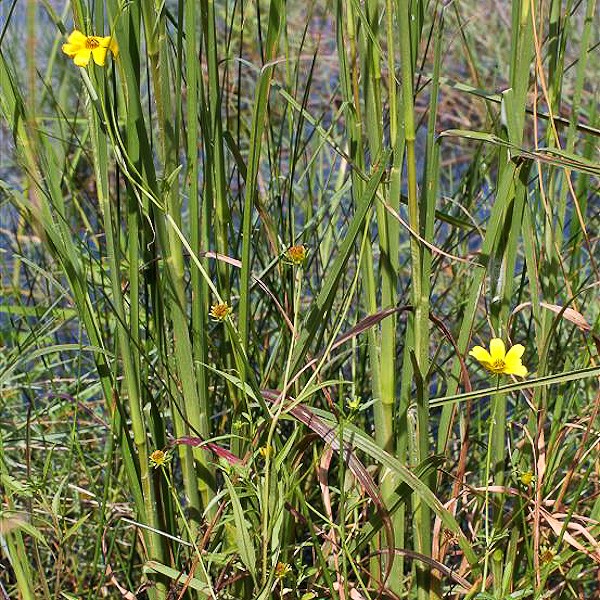
Bur-Marigold

Bur Marigold
Bidens mitis (and B. laevis)
Asteraceae

Yesterday John and George checked out the plant life along the Halpatioke Trail in a Port. St. Lucie outparcel from Savannas Preserve State Park. The trail touches several habitats from scrub to brook, to brackish shore, and is home to such pleasing species as Partridgeberry (Mitchella repens), Innocence (Houstonia procumbens), and Florida Butterfly Orchid (Encyclia tampensis). John has launched a e-journal of the flora and fauna along that trail. CLICK

Bidens mitis by JB

Bidens mitis by JB

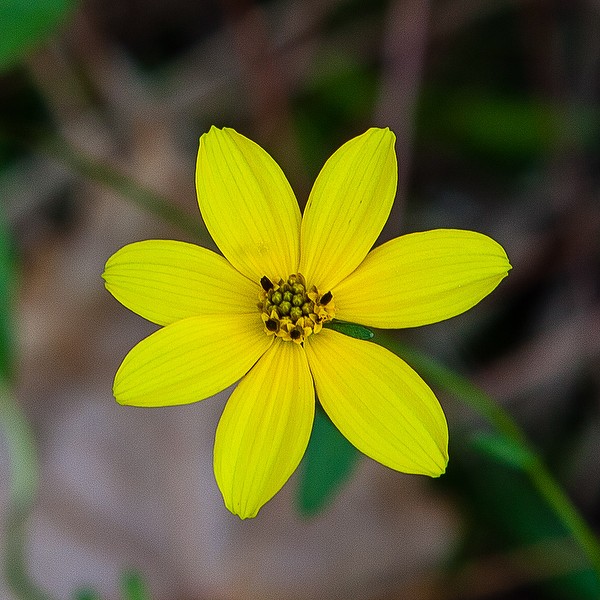
What’s particularly pretty there in early January? A lot, and we had déjà vu all over again with, “what’s that sunny clump of yellow flowers over there by the stream?” Oh yea, of course, Bidens mitis. These are some showy wetland wildflowers.

Up close by JB

Up close by JB

Bidens mitis is similar to another species found locally, Bidens laevis (see below for distinctions) as well as to a species probably in all 48 contiguous states and every Canadian province, but not Florida: Bidens cernua. Yellow-flowered Asteraceae have a way of confounding identification, and all belong to the technical category known in the field as DYCs (danged yellow composites).

Bidens is a large genus, with over 200 species, about nine in Florida. One of the most common weeds is Beggarticks, Bidens alba, identified by its ability to spear its two-pronged seedlike fruits into your pants cuffs. In additional to weediness, Bidens species are known for diverse roles in traditional medicine, and potential involvement in modern pharmacology. Too boring to list here all the ailments countered with Bidens; however, a particularly prominent use is against urinary tract infections. So if you get lost in the woods and suffer a UTI…

These wetland annuals beg a question: In an environment of rising and falling water levels, how do the “seeds” (achenes) know when to sprout and when to sit tight? Mary Leck and colleagues have investigated this in the similar B. laevis. After basic chilling requirements are met (farther north), germination follows light and oxygen levels. Germination is deferred in the dark, in extreme dryness, and under anoxic conditions. Achenes buried and then unearthed enjoy a 19-month window of germination capability. That the window exceeds a year allows for repopulation from the seed bank even after a “bad” year.
—————————–
Notes:
Key to similar Bidens species

1. Native to Scranton PA area, invasive intermittently in Florida…Bidens washingtoniensis
1. Native to Florida or adjacent states…2
2. Leaves usually pinnately lobed or compound; teeth on achenes absent or under 1 mm long…Bidens mitis
2. Leaves usually not pinnate, sessile; achene teeth 2-5 mm long…3
3. Ray flower petals > 15 mm long; chaff with orange tips…B. laevis
3. Ray flower petals < 15 mm long; chaff scales with pale yellowish tips…B. cernua (not in FL)

Bidens washingtoniensis

Bidens washingtoniensis

Data source for B. laevis germination: Leck et al., Bull. Torrey Bot. Club 121: 230-239. 1994.

 
7 Comments

Posted by on January 5, 2013 in Bur Marigold


Tags: ,

Don’t Nap on the Carnivorous Grass

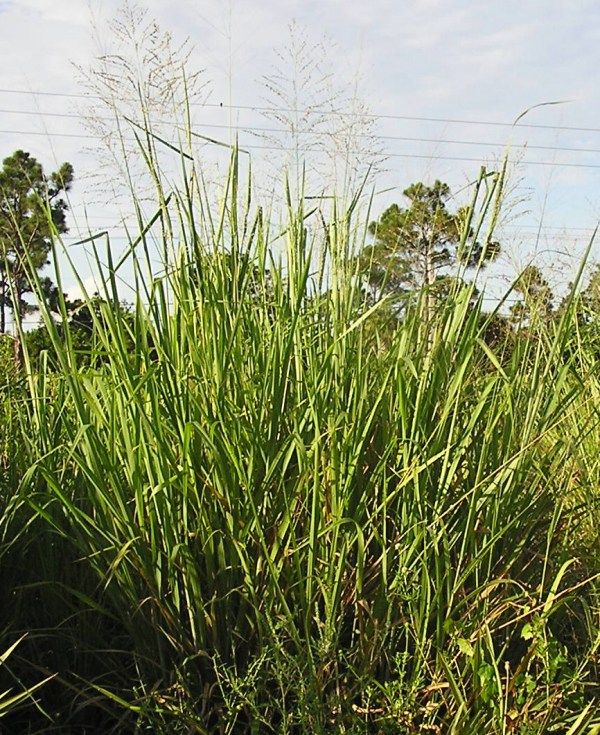
Switch Grass
Panicum virgatum
Poaceae

What could be more boring than an article on grass?  Well, hey now, as a grass lover, I take offense at that narrow attitude!  Switch Grass is in fact an interesting grass.  Gardeners think so, with their fancy colorful cultivars, such as ‘Prairie Fire’ and ‘Ruby Ribbons’.  A more pragmatic energy-hungry world likes Switch Grass too: as a potential cellulosic biofuel, if anyone manages to start turning cellulose commercially into ethanol. According to Scientific American the yield from Switch Grass is over five times the energy used to produce it, compared with a wimpy 1:1 with corn.

Switch Grass (by JB)

Switch Grass (by JB)

Cellulosic ethanol may power the Ta-Ta in your future, but even more amazing, who ever heard of flesh-eating grass?  In a world of some 12,000 grass species, a local native may be the first documented mowable carnivore.  No, I have not effectively checked for other meat-eating grasses, but in any case, it turns out yet again that underground Florida is a strange social network.

Switch Grass inflorescence (by JB)

Switch Grass inflorescence (by JB)

That plant roots form symbiotic (mycorrhizal) contracts with fungi has long been known.  Mycorrhizal fungi help decay soil organic matter and shunt the results directly into the host plant.  Mycorrhizae are deemed especially important for phosphorus acquisition, as this nutrient does not “flow” into the roots in water as readily as nitrogen does.

To continue with the already-known, that fungi can attack, kill, and digest soil insects won’t stop the presses either, although commercial insecticidal applications sure are something.

But now dare to dream, and put those two hackneyed fungal phenomena together into a new innovation: insectivorous mycorrhizal fungi.  Switch Grass has em’.  The fungus Metarhizium robertsii has been shown to infect and murder soil insects, and to transfer the bug nitrogen to Switch Grass (and to beans).

The species is perhaps at heart a tallgrass prairie grass, with an enormous range sprawling from Canada to Costa Rica (and probably by introduction, to Argentina).  Here is our area, it is not rare, but not dominant, a visual treat mixed in with other grasses and sedges.

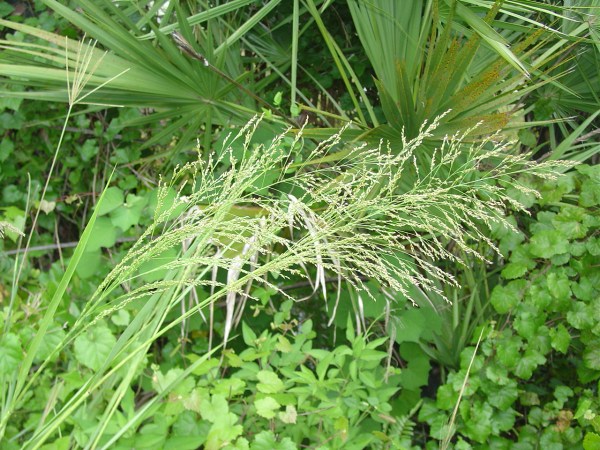
Out botanizing, it is easy to recognize Switch Grass.  The plants are often large and attractive, let’s say 3′-5′ tall with an open, airy, vaguely pyramidal inflorescence.  It looks somewhat like the non-native Guinea Grass (Panicum maximum), but differs in a way that is easy to see:  rub the spikelets briskly between your corn husker hands.  In Guinea Grass there is an inner white nugget (technically a hard lemma) white, bony, and wrinkled. Nothing like that in Switch Grass.

Getting back to biofuel, that might be more valuable.  But then again, maybe biotechnology can find a way to transfer bug-eatin’ ability to St. Augustine Grass so a few million acres of lawn in Florida can feed on its own grubs instead of megatons of lake-choking fertilizers.

Dog captured by carnivorous grass.

Dog eats grass is not news.   Grass eats dog, now that’s news.

Note: For readers interested in deeper reading:
http://211.144.68.84:9998/91keshi/Public/File/41/336-6088/pdf/1576.full.pdf

 
1 Comment

Posted by on December 30, 2012 in Switch Grass


Tags: ,

Broken Families, Underground Parasites, and Fruit-Stealin’ Stinkbugs

Graytwig

Schoepfia chrysophylloides (S. schreberi)

Schopfiaceae (Traditionally placed in Olacaceae, a DNA-splintered family)

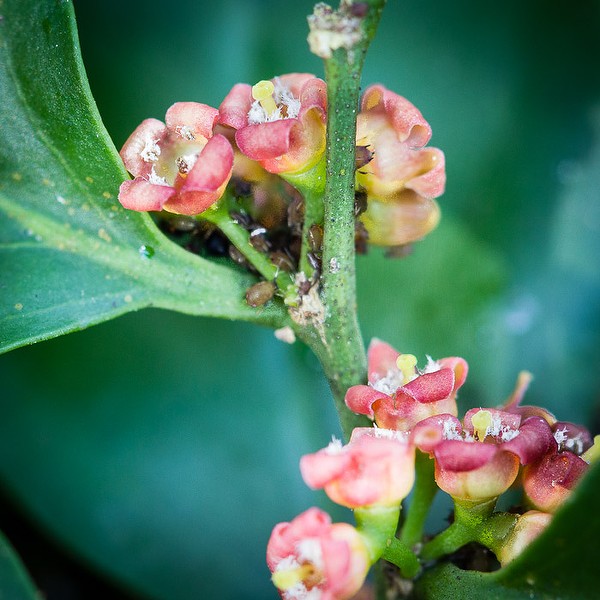
Today as temperature plummeted, John and George strolled the Rocky Point Hammock near Port Salerno, Florida. Rocky Point is a small remnant of scrubby Coastal Hammock, fun to visit due to the ancient oaks and the diverse vegetation, including species we do not often encounter, such as the big beautiful sedge Cyperus tetragonus. The alpha species today was Graytwig in full bloom with jillions of tiny fragrant maroon-red flowers along the stems like holiday twinkle lights.

Schoepfia chry flowers jb

Except when in flower, Graytwig is a shy small tree or shrub recognized most readily by its namesake kinky gray twigs peeking out from under alternate, often-folded leaves with wavy margins.  The crushed leaves have a distinctive smell.  The pea-sized drupes go through a red phase before blackening.  Graytwig grows mostly along the southeast and central Florida coast, extending to the west side of the state to the south and into the West Indies and to South America.  There are 23 species of Schoepfia altogether around the world.

The flowers are tiny (1/8″ tall), fragrant, reddish-maroon cups clustered irregularly along the stems.  They are heterostylous.  That is, one strain has short styles and slightly elevated anthers, and the other strain has long styles and anthers positioned lower in the floral tube.  Readers interested in learning more about heterostyly as an adaptation to promote expanded genetic exchange are invited to an earlier Treasure Coast Natives article where we explored heterostyly in more detail in connection with Wild Coffee, another species abundant at Rocky Point. CLICK

So let’s jump ahead to another Graytwig oddity — it is a root parasite.  The roots make cone-shaped “suckers” (haustoria) able to penetrate and rob the roots of surrounding hosts of diverse species.  This is not rare in scrubby plants.  Other scrubish parasites include Love Vine, Black-Senna (Seymeria), Hog Plum (Ximenia), and Indian Pipes (Monotropa).  The parasitism in Monotropa is possibly significantly via mycorrhizal fungi,  and would be fascinating to know which additional plants swipe nutrients from each other via mycorrhizal (fungal) root connections.

In South Florida we see two extreme means of acquiring plant-life’s needs on our challenging soils:  parasitism and carnivory. Our parasitic plants tilt toward dry sandy habitats, and our parasites tilt toward wet marshy homes.  I guess the main problem in anoxic wet marshy mud is nitrogen, acquired by green carnivores ingesting bug-type victims.  The various gizmos and physiology flesh-eaters need to catch and digest wiggly prey may require ample water.  With dry-habitat plants (just speculating here) the main challenges can reasonably be assumed to be obtaining water and the benefits dissolved in it.   Wouldn’t it be interesting to know the details?  In any case, in dry places look for root parasites, and some above-ground ones too CLICK

Now here is something even weirder and more puzzling.  There seems to be a special relationship between stinkbugs and Schoepfia.  The Asian stinkbug Parastrachia japonensis is tied to Schoepfia jasminodora. Amazingly, the adult bugs lug the Schoepfia fruits back to their stinky nests. CLICK

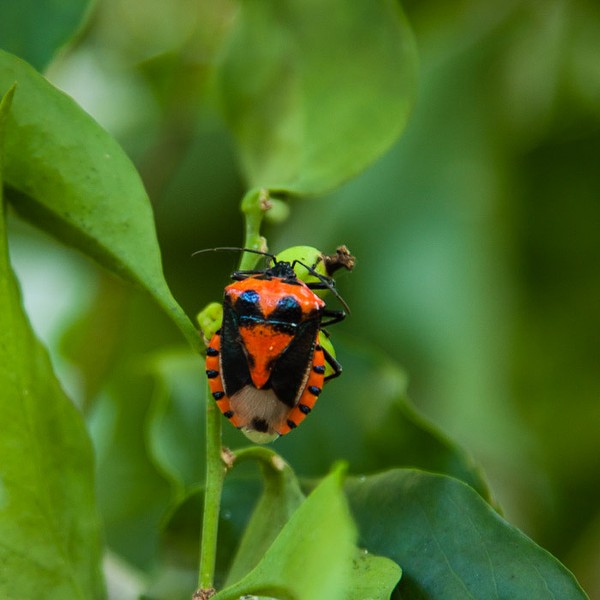
Our own Schoepfia chrysollphylloides (as S. schreberi) is reported to be the host for stinkbug  Ramosiana insignis which consumes multiple organs, and for Vulsirea violacea, which specializes on the fruits.  We caught the stinkbug below in the act of messing with the Schoepfia fruits. (Note: According to Bugguide.net,  V. nigrorubra and V. violacea were interpreted as the same species until recently.  Our photo matches the photos of V. nigrorubra on that site.  It would be interesting for someone with time on their hands to explore fully the relationship between the bug and the bush.)

Graytwig can be cultivated, although the Institute for Regional Conservation website Natives for Your Neighborhood  lists it as” extremely difficult to grow,” which might explain why this eye-pleaser is so infrequently encountered in native plant gardens.

Schoepfia with Sinkbug Vulsirea nigrorubra jb

                                                        Stinkbug on Schoepfia (by JB)

 
2 Comments

Posted by on December 22, 2012 in Graytwig


Tags: , , ,

Passion on the Bluff

Passiflora edulis, P. incarnata, P. foetida, P. suberosa

Passifloraceae

Yesterday John and George walked the Hawk’s Bluff Trail near Jensen Beach, Florida.  The Bluff is a coastal dune of white sugar sand overlooking a vast and lovely marshy area, essentially Savannas Preserve State Park.

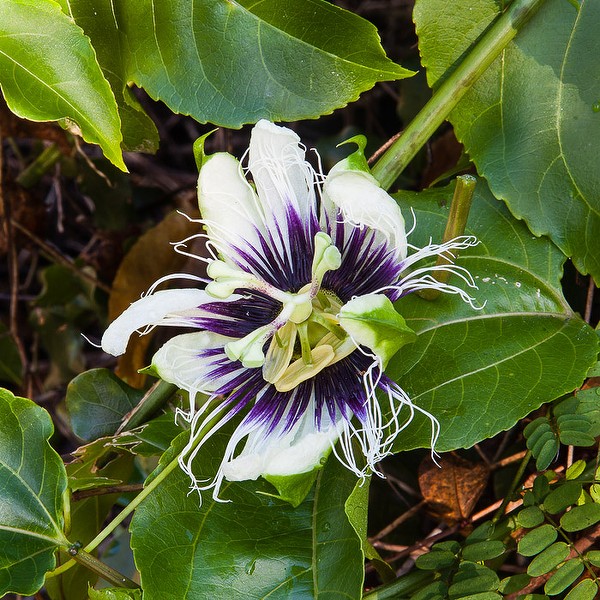
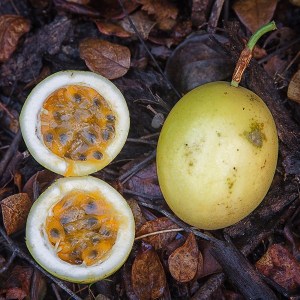
As we set off downslope we noticed a fruit resembling a giant yellowish egg dangling from a distant tree. As we approached we found the hillside to be smothered Kudzu-style with a massive non-native edible passionfruit vine (Passiflora edulis) smothering all in its path.   So we took some photos of this overbearing plant and feasted on passionfruit like a couple castaways.

Passiflora edulis (by JB)

Passiflora edulis (by JB)

We all love passionfruits, but did you know some species have poisonous contents, even cyanide?  Bioactivity might explain the prevalence of passionfruit extracts in traditional medicines in various cultures.

Yellow Passionfruit (by JB)

Yellow Passionfruit (by JB)

There are about 11 species growing outside of cultivation in Florida, some native, some not.

Now let’s get one thing straight, the passion in passionflower has nothing to do with lust.  We’re talking about the Passion of Christ.  According to legend, the Conquistadors interpreted the flower somewhat self-servingly as divine sanction of their conquest.  I’m not going to repeat the interpretation of the blossom with respect to the Crucifixion here, as that account is all over the Internet.

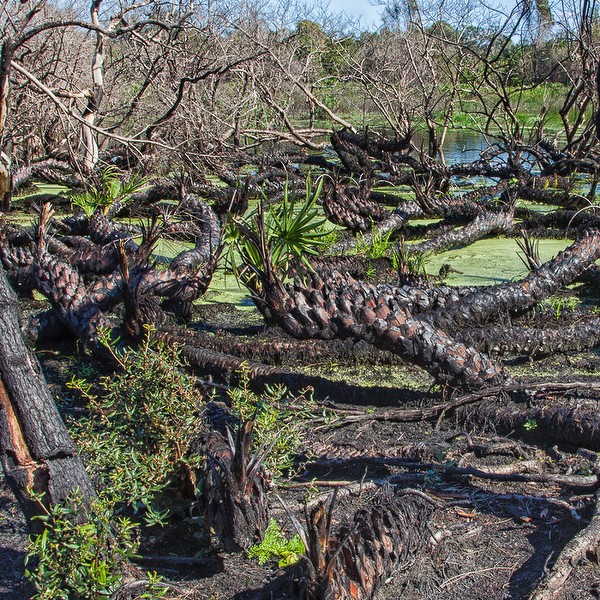
But John and I didn’t contemplate religion or cyanide—we just enjoyed a little passionfruit and mosied along the trail.  We did, in fact, discuss religion very soon thereafter,  however, when we came upon this preview of Hell at the bottom of the hill. (For a more graphic preview you might enjoy Scaremare at Liberty University in Lynchburg, Virginia.  CLICK LIKE HELL)

Twisted souls in Hades.  (Well, okay, really Saw Palmetto stems after a ightning fire at Hawk's Bluff.)

Twisted souls in Hades. (Well, okay, really Saw Palmetto stems after a fire at Hawk’s Bluff.)

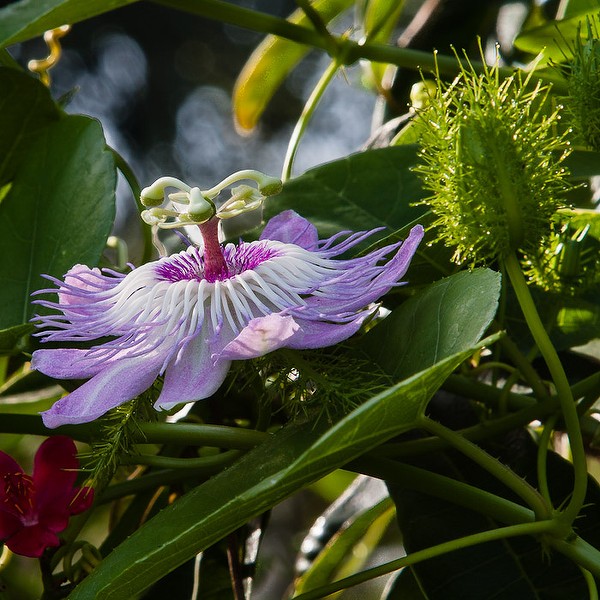
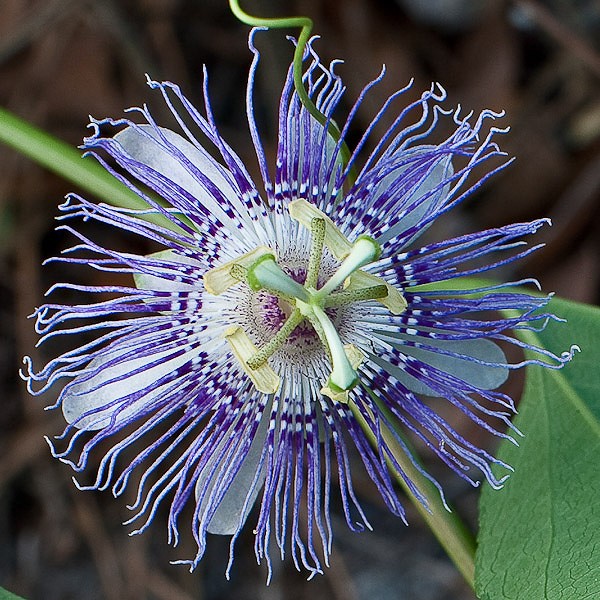
Now before we go any further, let’s lighten up and get friendly with the basic construction of a passionflower.   They are unique, they are complex, and they are diverse.  We’ll use John’s side view of the non-native Passiflora foetida to explore the structure.  The white (purple-tipped) fingers above the sepals and petals are called the corona (crown); these are appendages on the petals and sepals apparently responsible for advertising,  and may help control access to the flower.  The pedestal in the floral center is called the androgynophore;  it  elevates the stamens and stigmas.  Look closely:  the five stamens in this species spread from the top of the pedestal, and the three stigmas are just above the stamens.

Passiflora foetida (by JB).  Note the androgynophore, wiht 5 stamens near the top and three stigmas.

Passiflora foetida (by JB). Note the pedestal, with 5 stamens near the top and three stigmas.

To make it all more interesting, the parts move (not necessarily the same ways in every species).  The best-known movement is that the stigmas start out well above the anthers, so that the visiting insect pushing under the anthers is merely dusted with pollen.  Later, the stigmas descend to the level of the anthers or below and brush pollen off the visiting insect.  In John’s photo above, the stigmas have dropped to nearly the anther level.      More intriguingly, there are reports—in just one species known to me—of the entire pedestal tipping toward a visiting bird.

And who does visit?  The diversity of pollinators matching the diversity of Passionflowers is dizzying:  bees (mostly), wasps, hummingbirds, moths and butterflies, bats, and probably more.

Corky Stem PV (by JB)

Corky Stem PV (by JB)

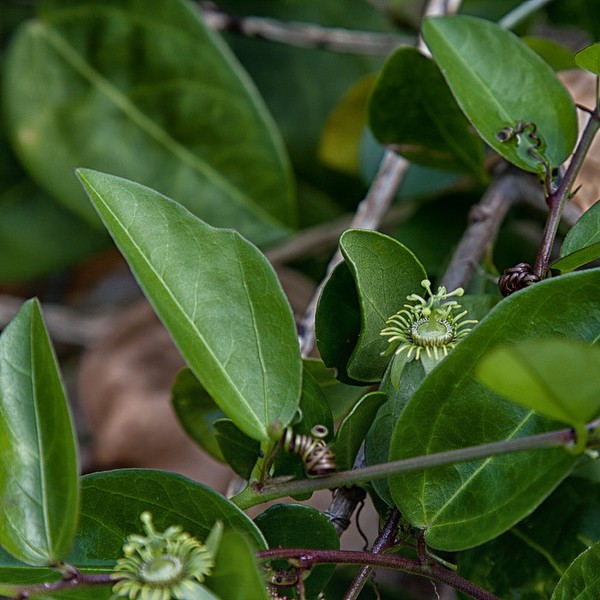
We started our hike with the big imposing Edible Passionfruit, and ended it with the  modest native Corkystem Passionflower, favored among native plant gardeners as larval host for Zebra Heliconian, Gulf Fritillary, and Julia butterflies.  Maybe that tough corky stem limits the larval devastation, which can be considerable.   But what pollinates Corkystem Passionflower?  This is one of the few species known to be compatible with its own pollen, which may help explain how it became an invasive exotic pest on the other side of the world.   At least in some places wasps are the reported main pollinators.  Butterflies visit the flowers too, and bees no doubt  buzz in, although I can’t claim to have witnessed it.

Native Passiflora incarnata (by JB)

Native Passiflora incarnata (by JB)

 
8 Comments

Posted by on December 17, 2012 in Passion Flower


Tags: , , ,

Dreamy Drifts of Pink

Mexican-Clover

Richardia grandiflora

Rubiaceae (Coffee Family)

Returning reluctantly to my office just now from Tropical Smoothie with my Limey Blimey smoothie,  heavenly meadows of pink in the athletic field soothed my troubling mind, thanks to a member of my favorite Dicot family, the Coffee Klatsch (aka the Rubiaceae).   Typical of life here in Misnomer Meadows, “Mexican-Clover”  is no Clover and it is not natively Mexican.  Thus for the sake of accuracy some call it Fairy Cups.  If you live in South Florida you have seen the pink cloud in the median strip.  Some observers say it looks like snow, but those must be Floridians who have never actually seen snow.  And just like snow, this weed’s not native to South Florida.  South America is home.

Richardia grandiflora Fairy Cups by John Bradford

Richardia grandiflora Fairy Cups by John Bradford

The genus Richardia consists of about 15 species ranging naturally from the Southeastern U.S. to Argentina, with some escaped in the Old World.  The original native U.S. representation is a messy question beyond the scope today.  Some of the species can be tough to distinguish, even in our normal “Treasure Coast-ish” botanical radius.  (Handy notes below.)

Any fool can distinguish Richardia grandiflora at 70 mph in the highway median.  Seems like cars, lawn mowers, and Global Warming might be expanding its range northward, at least as far as arctic Gainesville, and motivated searchers could probably pinpoint more-northerly patches.

How does one pretty weed take over vast areas of lightly maintained turf as a monoculture?  I have no single answer, but here is a bundle of silly notions:  1. The Coffee Family is a talented weed family.   2. The mat sprawls low.  I dug one up this morning.   The underground rhizome bears roots all over itself, and it sprouts, sprouts, and sprouts near or even below  the ground surface.   Mowing clearly prompts branching from way down low,  allowing this Dicot to pose as a Grass.   3. The weed is mighty drought-tolerant,   happy on sterile soils, and probably nematode-proof (just guessing based on a related species).   4. Each fruit splits into a variable number of bumpy little “seeds.”  The “seed” production of a single patch is infinite, and all those little crumbs build up a seedbank.  5. And the big question, are Richardias alleleopathic?  That is, do they make natural herbicides to suppress competition?    I do not know.  They look like it, and seem like a study waiting to happen, along with the dormancy characteristics of the fruit segments.

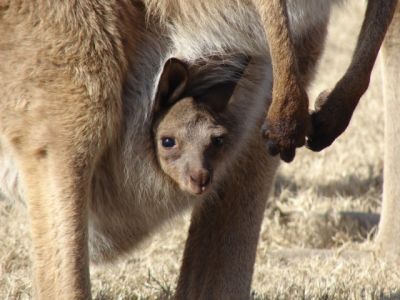
Mexican-Clover has opposite leaves, and between their bases is the hallmark of the Coffee Family, an “interpetiolar” (between the petioles) stipule.  The stipule is fringed on top, and basally forms a cup around the node where new buds form.  Although often in the Coffee Family the stipule functions to draw symbiotic ants, or to protect the terminal bud, my guess is that in Mexican-Clover the stipule catches water and coddles the sprouting buds nestled like baby kangaroos in the stipular pouch.   The stipule is so fancy, I took a picture of one today for reader stipular titillation.

The stipule is fringed on top, and encases the lateral buds (future branches).  Rising at 45 degrees on each side are the petioles (leaf stalks).

The stipule is fringed on top, and encases the lateral buds (future branches). Rising at 45 degrees on each side are the petioles (leaf stalks).

The fairy cup flowers look like classic butterfly-pollinated blossoms, and butterflies visit, along with bees and other insects. A big patch of MC can be bug-lively.  Each flower head is a sponge in a cup, with the maturing fruitlets embedded deep in the moisture.  The flowers are packed together tightly with their sepals rising vertically as a collective water trap in the center, reminiscent of some Bromeliad tanks.  Bringing a specimen in this morning after a wet night, the flower heads left puddles of water on the microscope stage.

Being a lawn weed, Mexican-Clover raises the boring question, over and over, about  “what do you spray on it?”  Now please understand, as a pesticideophobic, lunatic fringe nature-nut, this question is not my cup of tea.  TC Natives is not for squirt-gun how-to-garden advice.  Yet turf herbicides interest me from the dark side.  Noodling around Google reveals many recommendations to use Atrazine to get those ugly Fairy Cups out of your lovely yard.

Two bumpy fruit segments. The structure below the twin segments is the semi-persistent calyx (set of sepals).

Two bumpy fruit segments. The structure below the twin segments is the semi-persistent calyx (set of sepals).

So now a moment on the Atrazine soapbox.  That is bad stuff unless you like deformed amphibians.  Atrazine is one of the most-used turf herbicides in the U.S., although alternatives might replace it.  Perhaps you thought the U.S. had already pretty much eliminated chlorinated pesticides, such as DDT, Chlordane, and Lindane.   Well, is an herbicide a pesticide?  I’d like to know, because we still have plenty of chlorinated herbicides, the two main examples being lawn poisons we pay technicians to infuse into our personal environments, 2-4-D, and Atrazine.  2,4-D is a chlorinated (auxin) hormone mimic.  And Atrazine has a slight molecular similarity to the fertilizer material urea.  Plants take up Atrazine from the soil as they might take up urea.  (Where does the rest of the Atrazine go?)  Atrazine is so water-soluble it contaminates waters worldwide.  And it is implicated ominously in environmental-health issues.  Rather than rant, I’ll pass the buck:  see what (the controversial) Professor Tyrone Hayes at the University of California has to say on this topic.    CLICK

Call me Bud.

Call me Bud.

—————————–

Notes:

Distinguishing the species of Richardia in our normal activity radius, especially R. scabra and R. brasiliensis, can be a pain in the grass.  By the way, the “handbook” features don’t hold much water.  Professor Alexander Krings in North Carolina had the same pain, and did something about it, compiling a guide to this problem.  Paraphrasing his work, try this:

Richardia grandiflora is easy: It is the only one with the (usually pink) flowers over 12 mm long.

Richardia brasiliensis:  Stems bristly evenly from tip to base, top of leaf evenly hairy,  and the inner face (narrowest face) of the fruit segment is broadened (Brazil is a broad country).

Richardia scabra:  Stem becoming more or less bare toward base.  Top of leaf hairy primarily near the edges.  The smallest face of the fruit segment  narrowed to a narrow groove.

(The kangaroo pic was stolen from Down Under.)

 
9 Comments

Posted by on December 11, 2012 in Mexican-Clover


Tags: , ,

Toothpetal False Rein Orchid

Habenaria floribunda

(aka H. odontopetala in some interpretations, not a question to explore here)

Orchidaceae

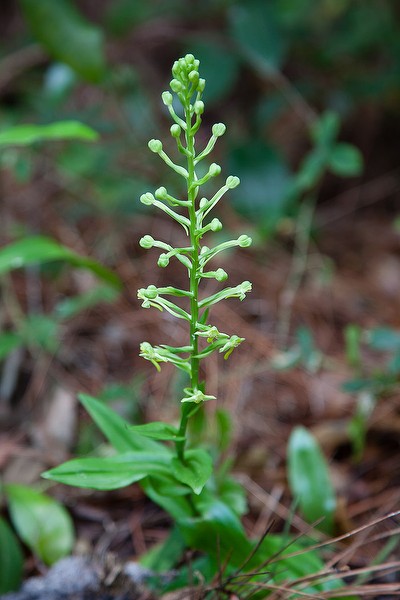
Habenaria floribunda.  All Habenaria photos today by JB.

Habenaria floribunda. All Habenaria photos today by JB.

Habenaria is massive genus of some 600 species, with about three or four in our usual radius of bioactivity.  One locally occurring species, Habenaria repens (Waterspider False Rein Orchid), can exist oddly as a floating mat.  But we’re here to talk about one to enjoy with dry feet, Habenaria floribunda, blooming abundantly in a pine woods near you.  We went to Halpatioke Park in Stuart yesterday.

I’m reluctant to rattle on about the intricate pollination mechanisms of orchids, for a couple reasons, one is that that topic is documented to a farethewell  elsewhere, so why bother here in our little “take a stroll and know the flowers you see”  series?  Thing is, this is one you DO see, so it is one to stop and contemplate and sniff, if you have good eyes and a good nose.

A wee bit of Orchid background.  Orchid flowers deviate from “normal” flowers in certain specializations.  Most Orchids have their pollen grains packed into masses called pollinia, so that pollination is not by single grains as in most flowers, but rather by Fed-Ex delivery of up to millions of grains all clumped together.   These pollinia are variably “glued” onto the pollinating insects as they visit to probe for nectar.  Although research is sparse, it is a good bet that most (but not all) Florida Habenaria pollination is the work of moths.

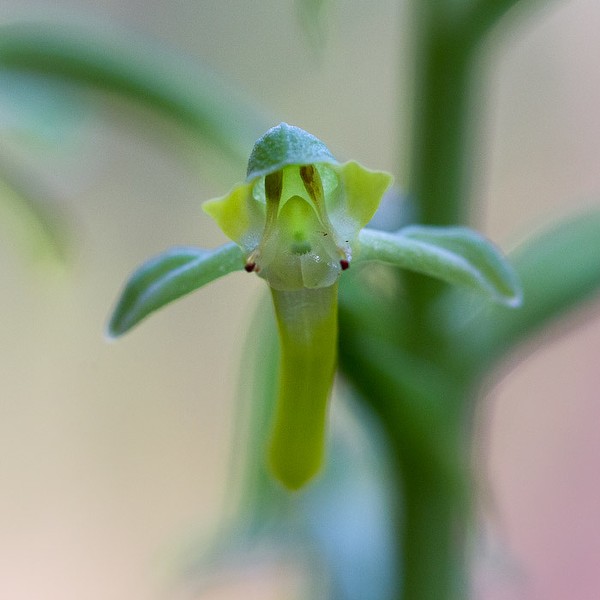
Habenaria floribunda, looking into the alien's face.

Habenaria floribunda, looking into the alien’s face.

Let’s now use John’s beautiful close-up photos.  Look first at the view straight into the blossom.  And now we must resort to highly technical jargon:  The blossom looks like an alien wearing a hood.  The alien’s eyes are the pockets where the pollinia (pollen packets) lie in temporary storage.  On either side of the alien’s white two-lobed lower lip are two small dark spots.   Those two dark spots are sticky tabs that attach to the insect visitor.  As the visitor probes for nectar those two sticky dots take hold on the bug’s face.

The nectar probing takes the form of the moth inserting its long needle-like proboscis into the alien’s mouth and downward into the alien’s long narrow chin where the nectar hides.  As the moth pushes in, its face kisses the Orchid flower, coming into contact with those sticky pads.

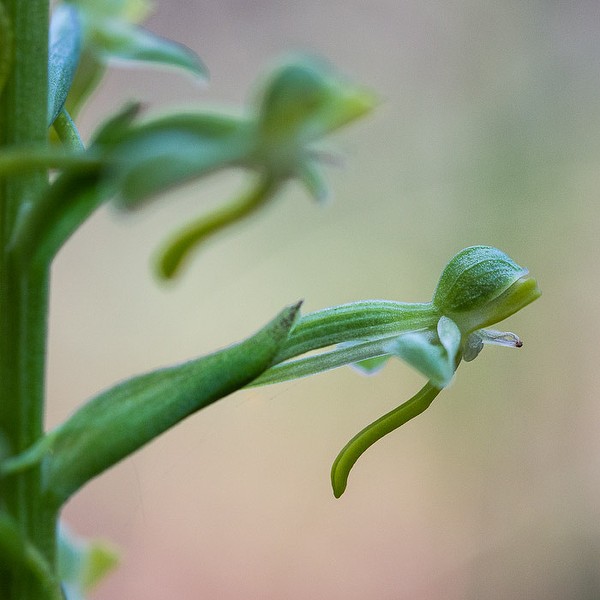
Side view, with projection, thread, and sticky pad.

Side view, with projection, thread, and sticky pad.

The sticky pad now super- glued to the moth-face links to the polonium by a thread, so as the insect’s departure yanks the polonium free.  Look closely at John’s side view photo.  The thread connecting the pollinium with the sticky pad extends along a projection jutting out on either side of the alien’s two-lobed lower lip.  The projection holds that sticky pad out there to punch the moth in the face.  In the side view photo you can see the projection, the thread, and the sticky pad.  (The polonium is up inside the hood not visible from the side.)

A pollinator-visitor arriving with pollinia glued to its face deposits the pollinia on the stigmatic surface (pollen-receiving surface).  That surface has already been described as the alien’s two-lobed white lower lip just below the open mouth between the two sticky pads.

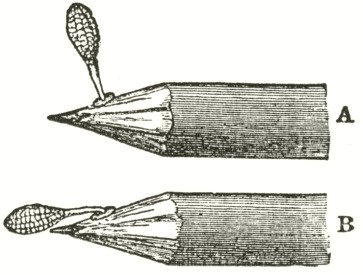
Pollinia on pencils (see below for credit).

Pollinia on pencils (see below for credit).

—————————————–

Vocabulary notes.

For readers preferring a more technical approach than made-up aliens, here is a photo of an actual Martian taken this week by the Curiosity.  To repeat, the eye contains the pollinium.   The orange sticky pad is called the viscidium, and the gray thread is called the caudicle.   The open mouth leads to the nectar in the alien’s chin, also called the spur.  The organ in Orchid flowers where the stamens, stigma, and style are fused into one is called the column.

Actual Martian, with pollinia, threads, sticky pads, and mouth opening into spur. (See below for credit.)

Actual Martian, with pollinia, threads, sticky pads, and mouth opening into spur. (See below for credit.)

(Martian photo source: http://droidloot.spreadshirt.com/yip-yip-alien-hoodie-chest-burster-A8895804.  Pollinium on a pencil from http://darwin-online.org.uk/content/frameset?pageseq=1&itemID=F800&viewtype=text)

 
5 Comments

Posted by on December 2, 2012 in Toothpetal False Rein Orchid


Tags: , ,