Mighty Oaks and Tiny Tyloses
Live Oak
Quercus virginiana
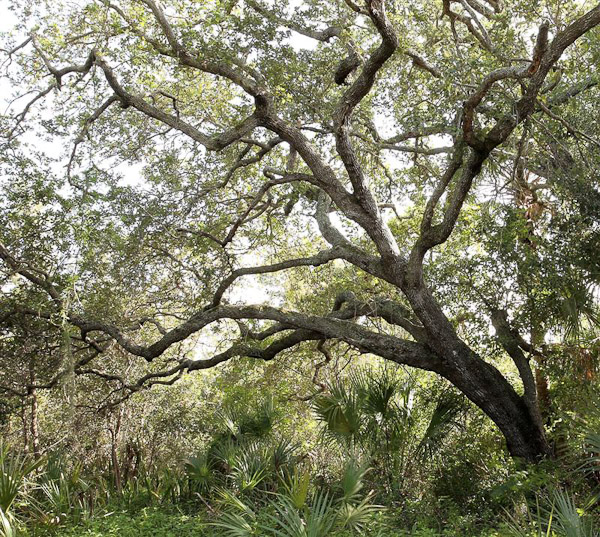
Live Oak by John Bradford
Over the weekend I sat in bittersweet contemplation outside my mother’s nursing home during a golden twilight waiting for nurses to complete their dinnertime tasks and permit a visit. My company during that quiet wait was a massive old Live Oak guarding with solemn dignity its human contemporaries likewise confined to the premises.
On a subsequent visit I brought a measuring tape. The trunk swells at about four feet above the ground as the branches begin to diverge. Beneath the swelling the diameter is about 28 inches. To estimate the corresponding age I’ll borrow data from another Live Oak, one felled in a hurricane with 196 annual rings and 50 inches of diameter, giving its growth rate from acorn to chipper as about 3.92 years per inch. If that can be generalized, then the nursing home oak dates back to the year the Wright Brothers flew at Kitty Hawk, conceivably roughly the same age as the oldest resident in the nursing home.
The tree is thus an apt living memorial to the representatives of the Great Generation facing the end of life in its shadows—dating from their first days and witnessing with them the Depression, WWII, Elvis, Viet Nam, and their Baby Boomer children, and weathering the storms with scars as did they. This memorial knows what it is commemorating.Why do a tiny minority of plant species become the aged giants? Why do Oaks become mighty? And to underscore mighty: According to “Big Trees, The Florida Register,” The state champion Live Oak, of unknown age is the Cellon Oak in Alachua County with a trunk diameter of almost 10 feet.
[After the blog was posted, our blog-friend Mary Hart in worcester UK added a comment—see below—on a truly ancient Oak: The King of Limbs i nthe UK. I’ve inserted the photo below.]
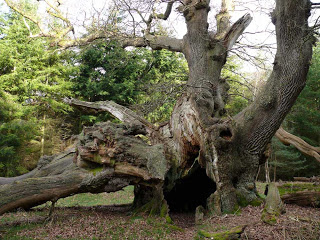
The King of Limbs. See comment below by Mary Hart.
So to repeat the question, why can Oaks live for centuries? I do not know, but it is time to speculate. And one way to attack the question is to ask, the converse bassackwards: what kills other woody species in a shorter timeframe? Well, yea, sure, storms, insects, chainsaws, and competitors, but those are not interesting answers. How about wood decay, becoming hollow and rotting? Do Oaks have an advantage there? Yes.

Be patient. This photo will become relevant to that advantage.
To dig in on this and explain the bubblegum, we need to talk a moment about wood structure. Water passes upward in trees through tiny tubes called tracheids and vessels. Tracheids are small in diameter and we’ll ignore them (some trees, such as pines have tracheids only and no vessels). Most trees have larger-diameter pipes known as vessels. As a tree grows in diameter often the only vessels actively involved in carrying water are the younger ones in the outer part of the wood, the sapwood.
The older vessels deeper in the trunk lose their water transport function and can become passageways and breeding cavities for decay. It pays to plug these older vessels to strengthen the heartwood and to block decay, just as communities block old mineshafts. The blockages look like balloons inflated inside the vessels and are called tyloses (tie-LOW-seas). Oaks are not the only trees that have them; in fact, tyloses are likewise common in other long-lived alpha trees. But Oaks are particularly good at it, which is why Oak wood is waterproof and strong for wooden ships and barrels. CLICK

The picture below, taken by Dr. Jeremy Burgess and Science Photo Library, shows a vessel in Oak wood plugged with tyloses. How tyloses grow is fascinating. Vessels are made of dead cells unable to grow, so they cannot make their own tyloses. To grow tyloses, nearby living cells have to push little bubbles of cytoplasm into the dead vessels through tiny keyholes called pits, and then the tyloses expand within the vessel. That is, the tyloses in a vessel are not part of it, but rather are balloons extended from adjacent cells. That’s pretty fancy for a dumb hammer handle. If I wanted to block a PVC pipe with bubblegum, I’d drill a hole into the pipe then blow a bubble to the inside of the pipe.
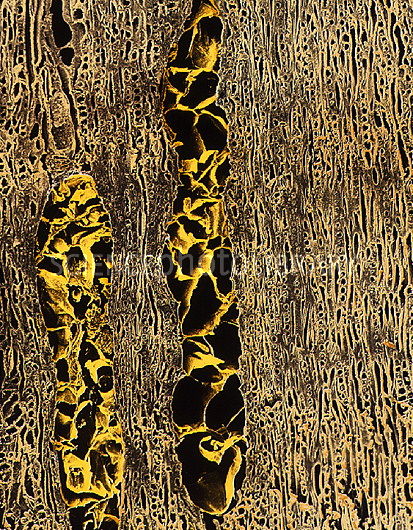
Vessel in Oak wood filled with balloonlike tyloses. (By Dr. Jeremy Burgess, Science Photo Library)
 John Bradford
 George Rogers
 George Rogers
 Dee Staley
 Treasure Coast Natives
Mary Hart
January 22, 2013 at 3:50 am
The UK has a great number of ancient oaks, the largest would take 9 adults joining hands to encircle it! The King of Limbs, a mighty oak in Savernake Forest is believed to be older than England – which became a state in AD 927. The source of this information was the Woodland Trust www woodlandtrust.org.uk The oak referred to is, I’m fairly sure Quercus petraea.
Date: Tue, 22 Jan 2013 04:21:43 +0000 To: maryhart29@hotmail.co.uk
George Rogers
January 22, 2013 at 2:05 pm
Found a picture and put it in. Thank you Mary!
George Rogers
January 22, 2013 at 6:36 am
And the tyloses illustrated are in an English Oak. I’m going to try to find an image of the King of Limbs later today and put in in if possible. Thank you Mary.
FeyGirl
January 23, 2013 at 10:39 am
Wonderful trees…. Great post! Do you mind if I re-blog, on the heels of my Oaks of the Hammock post?
George Rogers
January 23, 2013 at 11:13 am
Sure—that would be great.