Bur Marigold
Bidens mitis (and B. laevis)
Asteraceae
Yesterday John and George checked out the plant life along the Halpatioke Trail in a Port. St. Lucie outparcel from Savannas Preserve State Park. The trail touches several habitats from scrub to brook, to brackish shore, and is home to such pleasing species as Partridgeberry (Mitchella repens), Innocence (Houstonia procumbens), and Florida Butterfly Orchid (Encyclia tampensis). John has launched a e-journal of the flora and fauna along that trail. CLICK
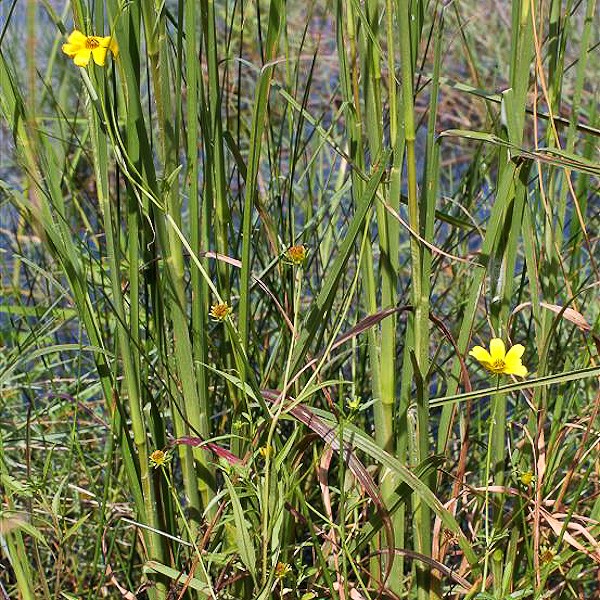
Bidens mitis by JB
What’s particularly pretty there in early January? A lot, and we had déjà vu all over again with, “what’s that sunny clump of yellow flowers over there by the stream?” Oh yea, of course, Bidens mitis. These are some showy wetland wildflowers.
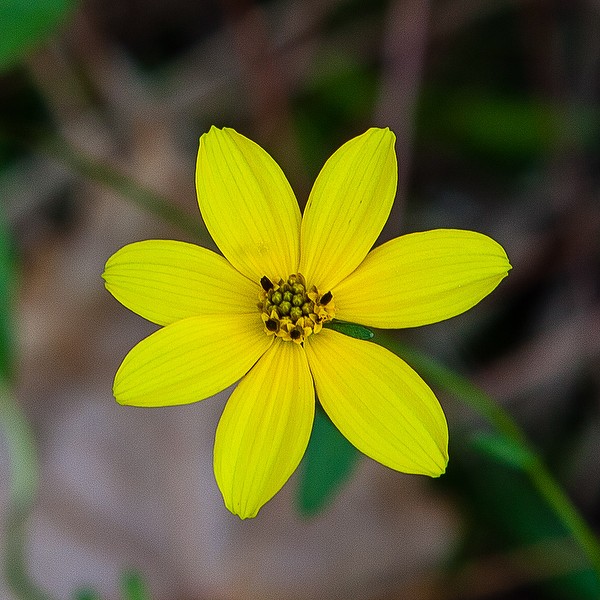
Up close by JB
Bidens mitis is similar to another species found locally, Bidens laevis (see below for distinctions) as well as to a species probably in all 48 contiguous states and every Canadian province, but not Florida: Bidens cernua. Yellow-flowered Asteraceae have a way of confounding identification, and all belong to the technical category known in the field as DYCs (danged yellow composites).
Bidens is a large genus, with over 200 species, about nine in Florida. One of the most common weeds is Beggarticks, Bidens alba, identified by its ability to spear its two-pronged seedlike fruits into your pants cuffs. In additional to weediness, Bidens species are known for diverse roles in traditional medicine, and potential involvement in modern pharmacology. Too boring to list here all the ailments countered with Bidens; however, a particularly prominent use is against urinary tract infections. So if you get lost in the woods and suffer a UTI…
These wetland annuals beg a question: In an environment of rising and falling water levels, how do the “seeds” (achenes) know when to sprout and when to sit tight? Mary Leck and colleagues have investigated this in the similar B. laevis. After basic chilling requirements are met (farther north), germination follows light and oxygen levels. Germination is deferred in the dark, in extreme dryness, and under anoxic conditions. Achenes buried and then unearthed enjoy a 19-month window of germination capability. That the window exceeds a year allows for repopulation from the seed bank even after a “bad” year.
—————————–
Notes:
Key to similar Bidens species
1. Native to Scranton PA area, invasive intermittently in Florida…Bidens washingtoniensis
1. Native to Florida or adjacent states…2
2. Leaves usually pinnately lobed or compound; teeth on achenes absent or under 1 mm long…Bidens mitis
2. Leaves usually not pinnate, sessile; achene teeth 2-5 mm long…3
3. Ray flower petals > 15 mm long; chaff with orange tips…B. laevis
3. Ray flower petals < 15 mm long; chaff scales with pale yellowish tips…B. cernua (not in FL)

Bidens washingtoniensis
Data source for B. laevis germination: Leck et al., Bull. Torrey Bot. Club 121: 230-239. 1994.
 John Bradford
 George Rogers
 George Rogers
 Dee Staley
 Treasure Coast Natives