Urtica, Laportea, and Boehmeria in the Urticaceae
Cnidoscolus and Tragia in the Euphorbiaceae
A prominent memory from fooling around the hills of West Virginia as a kid was, “be careful about jumping down into muddy ravines.” I can still see in my mind’s eye the standard summertime ravine bottom biological community: Jewelweed (Impatiens capensis), nettles (species of Urtica and/or Laportea), and yellowjackets (or some sort of hornet with that general appearance). The yellowjackets were benign, but the nettles would sting the living beejeebers out of exposed epidermis….then you rubbed jewelweed juice on the welts in some vain hope of relief. We called it “the 15-minute itch.”
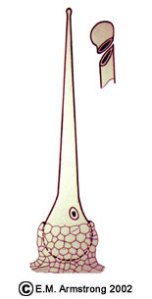
Turkey baster hair of pain. (From Wayne’s World waynesword.palomar.edu)
Throughout most of the eastern U.S. the stingers are Laportea canadensis and Urtica dioica (and other Urtica species). Laportea has alternate leaves, Urtica sports opposite leaves.
Around Palm Beach and Martin counties, Urtica and Laportea are not common, but they are a little here to punish the unwary. Laportea aestuans (leaves alternate) is probably native to more tropical places, maybe making its way northward aided by Global Warming. Urtica chamaedroides (leaves opposite) is scattered around Florida. I have showed students an Urtica, probably this species, in the PBSC plant nursery in Palm Beach Gardens, apparently having hitchhiked on nursery plants. Given the weediness of Urtica, there would be no earth-shaking amazement in coming across additional species locally.
What is astounding about Urtica and Laportea is their vengeful hairs. Plants with toxins are a dime a dozen. Plants with thorns, spines, and prickles are too. But these little nettle stinkers smite their foes with an injection of toxin. The tip of the hair snaps off in your flesh, and movement of the hair squeezes a bulb at the base, sending a little squirt of irritant into the wound. The whole thing looks and works like a turkey baster. The irritating “venom” seems to contain formic acid, as in ant bites.
The plants are not all bad though. Urtica is grown as a green fertilizer.
The small wind-pollinated flowers have a spring-loaded mechanism to toss their pollen onto the breeze. The stamen filaments are bent inward as the flower develops, and when the moment of truth arrives, they pop forth explosively flinging the pollen. How the anthers open coordinated with the springing filaments is a mystery of nature.
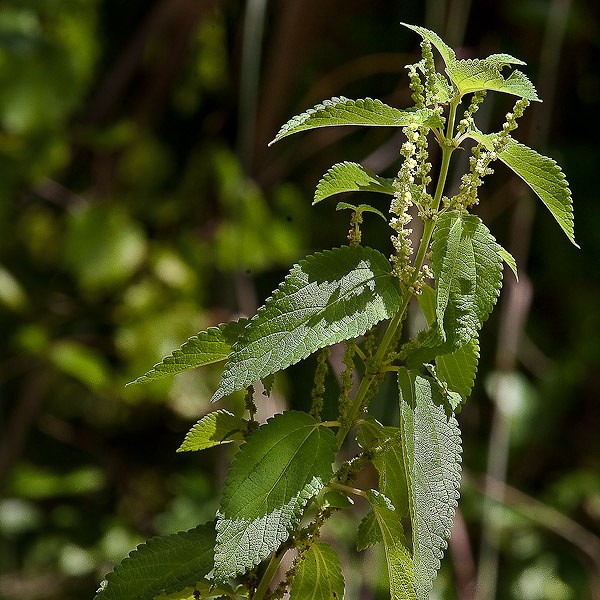
Does it bite? Nasty Urtica, or nice Boehmeria? You decide. (By JB)
False-Nettle, Boehmeria cylindrica is abundant around our haunts. It looks like Urtica but has no stinging hairs. False-Nettle brings us now to a little ethnobotany. Members of the Nettle Family have long strong fibers. Examples include Hemp (Cannabis), Urtica dioica (which has served as a fiber source), and Ramie, which is Boehmeria nivea, an Asian species. Cannabis persists to this day as a weed in U.S. areas where it was grown historically for hemp. My Michigan-dwelling brother just told me of encountering Cannabis growing spontaneously near his rural home. I’m pretty sure that’s no smokin’ weed, but rather left over from Hemp farms once active in the area. Florida was once a major fiber-growing and fiber-research state, and one fiber plant still with us escaped is Ramie. It differs from False Nettle by having the leaf blades white-hairy beneath and branchy (vs. spike like) flower clusters.
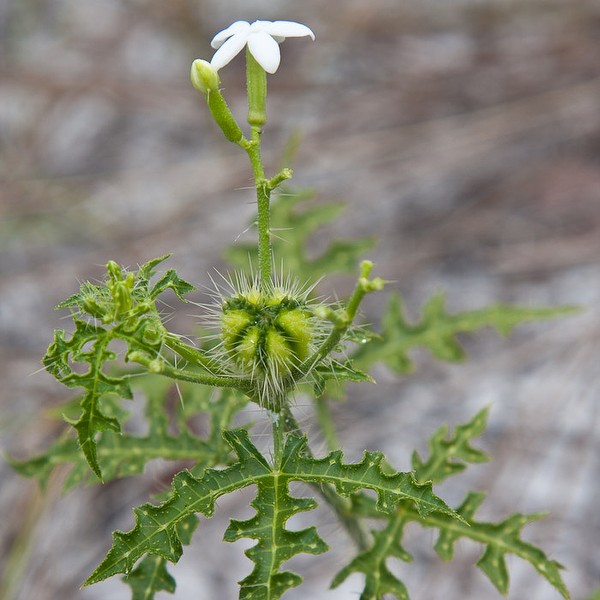
Oh $#%^&!! something just stung my ankle!! (Tread Softly by JB)
Although not related to Urtica and Laportea, another locally prominent nettle, Cnidoscolus stimulosus, is sometimes called Tread Softly, Bull Nettle, or Spurge Nettle. Usually in dry sunny sandy habitats, Tread Softly is in the Spurge Family and is related to “Cuban-Spinach” (Cnidoscolus chayamansa). I can attest from recent experience ankle contact with its stinging hairs is an epiphany. Also related to Tread Softly, likewise in the Spurge Family, and scattered in Florida—even if our own immediate counties have few or none—are the Noseburns, species of Tragia. They too inject a sting, and the mechanism is extra-special. Contact with their hairs stabs a dagger of calcium oxalate into your soft skin. This is the same stuff that puts the dumb in Dumbcanes, but that’s not for today.
To sum it up, just watch your step.
 Treasure Coast Natives