What’s going on back there under the passionvine foliage? Look closely…there are two Zebra Longwing Butterflies all a flutter, and a chrysalis. We’ll come back to that after some fun context.
Florida may claim it as our state butterfly, but so could Caribbean Islands and nations all the way into South America. The Zebras need passionvines for their hungry caterpillars, so I’ll guess without data that the butterfly’s range is related to that of the genus Passiflora. My wife Donna and I have several species of passionvines in our butterfly garden where experience shows the Longwings have their preferred species, such as Corkystem. When the caterpillars get on a bender along with Gulf Fritillaries, they can make short work of passion-foliage. I’ve never seen this written anywhere, but to my eye, these colorful butterflies darken into shadows in the shade, which they like to haunt. Butterflies come to flowers for nectar, right? Yes, but how many eat pollen? Today’s friend does.
Now for the main points.
1. The chrysalis is camouflaged like a dead leaf. Cool.
Boo!
2. For the most part, an inverted male fertilizes the female while she is still inside the chrysalis, as in the photo below.
photo by Donna Rogers
3. Sometimes two males hop on the same female chrysalis. A female can be inseminated by more than one male, yet the two males jostle and flutter for “dibs.”
The approximately 30 species of primrosewillows (Ludwigia) in Florida could keep you busy awhile. Most but not all have bright yellow flowers, but some have no petals at all. They range from the large invasive exotic Peruvian primrosewillow rising way taller than a human from roadside ditches to itsy bitsy mud creepers.
Ludwigia octovalvis by John Bradford.
Today’s species is large and showy, sunny yellow and often in large “decorative” stands in wet habitats. Bees love it.
Bees love it.
Mexican primrosewillow differs most conspicuously from the Peruvian PRW by having a long narrow nearly round fruit as opposed to a stubby four-sided fruit. Mexican PRW is hardly “Mexican,” as it ranges seemingly natively across most of the Southeastern United States, and has become one of the tropical world’s most widespread weeds, most odiously in rice fields.
The fruit.
It and other ludwigias have traditional uses in medicine, not worth listing here. The interesting thing is that this species and its kin produce linoleic acid, a fatty acid essential in human nutrition and the subject of a considerable literature in that connection. Who knows what potential lies there.
Ludwigias are preferred, if not exclusive, host plants for the caterpillars of the banded sphinx (hawk) moth, a pollinator of the crinum lilies (and probably also similar Hymenocallis spider lilies) with which the primrosewillow shares marshy habitats. The caterpillars are astounding in at least two ways, their enormous size (about like your index finger) and their mixed coloration scheme. Even nibbling together on a single plant there can be camouflage green ones, showy yellow ones, and eye-catching psychedelic siblings. Wow! How? and Why? This is a situation where research and speculation swirl into one.
Banded sphinx camouflage caterpillar. Birds won’t eat me because I hide so well.Yelow variant on the same plant at the same time as the one above. Birds don’t dare eat me because I advertise my poison.Psychedelic variant. Same plant. Same time. Birds won’t eat me because I’m so fancy.
Just this summer biologists CL Francois and G Davidowitz studied a related sphinx caterpillar color mix and found the differences to be controlled by a very simple genetic system, perhaps (mainly) just one gene. This sort of suggests that the colors of the caterpillars more or less to depend on a genetic roll of the dice…sort of like, “will my next grandchild be a boy or a girl?” (It is a girl.) Just like a family can have boys and girls in one house, a caterpillar family can have all those different color types on one plant (as well as boys and girls). The researchers suspect that the built-in automatic color mixes give the diverse caterpillars an advantage in a diverse world. Don’t put all your eggs in one color basket. In any place and time some may become bird food but others may be better hidden, or more conspicuously toxic. Interesting in this connection that some are showy and others are camouflaged.
That all is no doubt true, but it gets more complicated. Ecologist Linda Fink, formerly of UF, has looked into the banded sphinx moth in addition to related species and found that all the color variants appear mixed on any given host plant species, and (here is the surprise), the ratios of the different colors in the mix depend on the plant species.
Paper wasps (Polistes) are beautiful pieces of creation: intelligent, complex, good-looking, and docile if you don’t ask for it. I’ve spent hours around them in two contexts botanizing and engaged in home maintenance, including on a ladder painting and repairing under the eaves and stuff like that. Ever stung? About once a decade or less, from the same cause: grabbing a branch to show flowers to students on a fieldtrip, only to find the branch pre-occupied. With a whole class watching, no profanity! If somebody grabs me I’ll sting too, and the sting isn’t ferocious, unless maybe the recipient has an allergy.
Polistes on Polygonella by John Bradford
Some folks may dislike paper wasps as predators. As the sweating co-digger in a home butterfly garden, I do wish paper wasps did not consume nice caterpillars, but then again, wolves consume nice deer, and we consume nice cows. By the way, the green lynx spider turns the tables, lurking on flowers and catching pollinators, having a special fondness for a tasty Polistes treat.
You’d be surprised how poorly studied paper wasps are, due largely no doubt to the inconvenience of their lifestyles, nesting naturally in hard-to-visit habitats, roaming long distances, and not universally regarded as charismatic. Most research centers on their nesting on residential structures…they need wood to chew and form into the papery umbrella-shaped nest.
Digger wasp. Irrelevant to today’s topic but cool to see. By JB.
The nutritional habits of paper wasps are complex and odd. They haul caterpillars and other victims back to the nest to feed larvae. The foraging wasp to some extent consumes, softens, and partially pre-digests the prey, regurgitating the glop as baby formula. Roaming wasps additionally visit flowers to collect nectar for their personal energy needs, and sometimes to contribute honey to the nest.
On Stillingia
The birds, bees, and butterflies think they own pollination, but respect also the paper wasps. They too pollinate. Some orchids and all figs have wasps as pollinators, but those are different sorts of wasps. Paper wasps visit a lot of flowers, although they have an exclusive relationship with few. The only local totally waspy case I can bring to mind is the shrub Corkwood, Stillingia aquatica, where pollination in the wet season is soley by wasps, or essentially so. Bees and wasps visit in the dry season, but when the marsh is under 2 feet of summer rain the bees bug out and the wasps have a monopoly. Big marshy habitats can be miles across, requiring athletic pollinators.
Polistes with facial pollen. On Stillingia.
Stillingia inflorescences and the surrounding leaves are yellowish. Wasps love yellowish, although they visit flowers of other hues too. Some Polistes favorites are Goldenrods, additional members of the Aster Family having yellow centers, members of the Carrot Family, Milkweeds, and Sweetscents (Pluchea).
Polistes wasps are super-powered. One big brazen Brazilian species, Polistes lanio, has returned to its nest like a homing pigeon after being released 2 km away, flying at 8.7 meters/second, potentially covering those 2 km in under 4 minutes, almost 20 miles per hour. How does it finds its way? Quite a feat for a microscopic brain, and I can’t find my glasses.
Those out foraging and pollinating are mostly females, as the males—which grow from unfertilized eggs—live comparatively briefly, although there is variation, and in some species males participate in feeding larvae.
What we need around here is a study on the relationships between paper wasps and plants in South Florida: where they nest, their daily habits and home ranges, flower preferences, interactions with other flower-visiting insects and spiders, and contributions to pollination. Wow that would be great if you think about it, so easy to say, but if you think about it more, you’d have to have the power of Polistes to take it on. No wonder we’re still in the dark.
(Agalinis translates roughly as “much flax” because the foliage resembles flax, having linear (linifolia) leaves.)
Orobanchaceae, a family of parasitic plants
In the places where the mud is ankle deep lives a pretty wildflower, or should I say a few, as there are about 17 lookalike Agalinis species in Florida, perhaps three in our immediate area. They are tall, thin, delicate and attractive, not to mention partly parasitic, swiping nutrients from neighbor’s roots.
Agalinis by John Bradford
The flowers have a weird life history, possibly not 100% true, yet documented for Agalanis species in other regions and seemingly applicable locally. Each flower lasts only a day or less, so hurry…get pollinated!
by JB
The blossoms open early in the morning, releasing pollen before the pollen-receiving stigma is ready to go. Any bee who happens along picks up that fresh pollen and takes it to a different flower ready to receive. This delay holds the door open to cross-pollination as opposed to self-pollination, the ultimate form of inbreeding. Spoiler: Selfing may follow.
The long light violet dohicky is the style, the stigma at its tip. The pollen-filled anthers are horizontal at the top of the entrance.
As the day progresses the originally short style grows and grows while its stigma tip becomes pollen-receptive. The style attains a ridiculous length, bending down across the entrance to the flower so that an incoming bee must push under its stigma-tip and dust it with pollen to access the interior.
No bees today? No problem…then comes backup: The style ultimately grows into the shape of a J curling up under the pollen-releasing anther. With luck gravity may drop pollen from the anther onto stigma tip curled under it.
Corolla dragging pollination.Last chance to pollinate.
But a pollen sprinkle is iffy, and the flower has an even better finale. Late in the day the petal tube and attached pollen-shedding anthers begin to drop free. The hooked style is attached to the plant, not to the tube. As the funnel-shaped tubes begins to fall, its inner anthers slide past the hook, maybe even snag on it. The passing stigma scrapes pollen from the anthers and/or mops pollen out of the narrow end of the funnel. Wind motion may help the scouring process. Another name for the petal tube is the corolla, and this type of last-ditch self-pollination is called “corolla dragging.” On other species of Agalinis dangling in the wind can last an hour.
Stillingia aquatica is an amphibious shrub prominent in the depression ponds near my home. One of multiple light-wooded species called “corkwoods” in the U.S., this little shrub and I are the best of friends. Its flower spikes are a world of entertainment. You’d think, well, yea, flowers, some bees or something come and go, and you get fruits.
Well yes, true, but if you keep your eye on the spikes, there’s more going on.
The main pollinators are wasps, wasps and more wasps….
Polistes dorsalis
Polistes major
That much is not unexpected, but that’s also where I met what I learned to be this rakish katydid nymph.
Even more fun…the lifeform below is not a fancy ant…it is an ant mimic however, the nymph of a broadheaded bug. I guess nobody messes with a big badass ant. It is actually a vegetarian.
This Ebony Bug on corkwood chooses armor over intimidation.
But not the next creature. This green lynx spider looks so nice and photosynthetic, but it hides among the flowers to ambush a pollinator.
By John BradfordHiding on the corkwood
Caught dinner! Is the prey bigger than the predator?
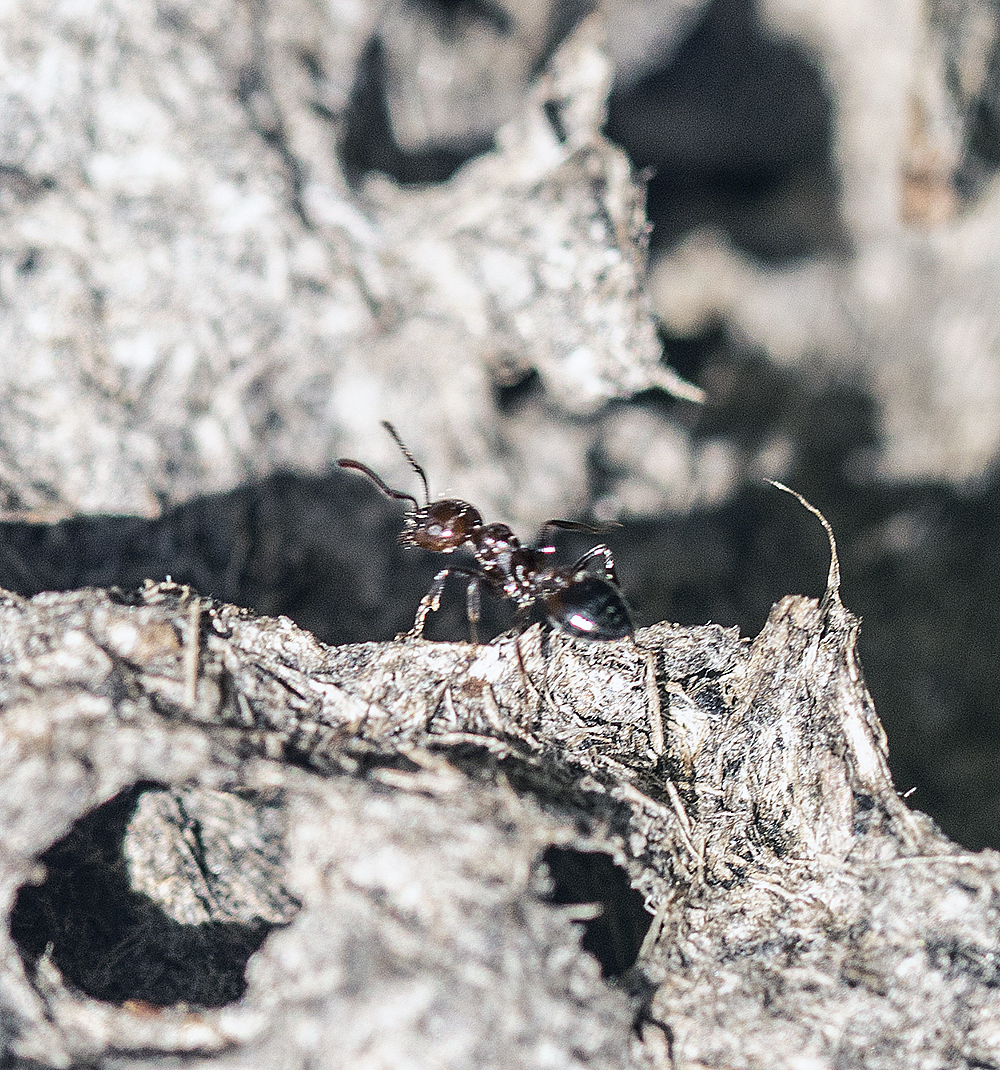
Crematogaster is a name of controversial origin. As spelled, it means burning stomach. But they don’t need Nexium… the name probably originated from cremasto-. Cremasto– means “suspended,” as in “cremaster,” the stalk suspending a butterfly chrysalis. The ant in its defensive mood arches its “stomach” (abdomen) suspended up over its head with its stinger facing forward, thus the name Acrobat Ants. The stinger does not sting, but instead is a spatula for dabbing toxins onto foe. They can bite too. Professor George Atkinson (1854-1918) was a prominent U.S. entomologist.
Carton nest in Hypericum
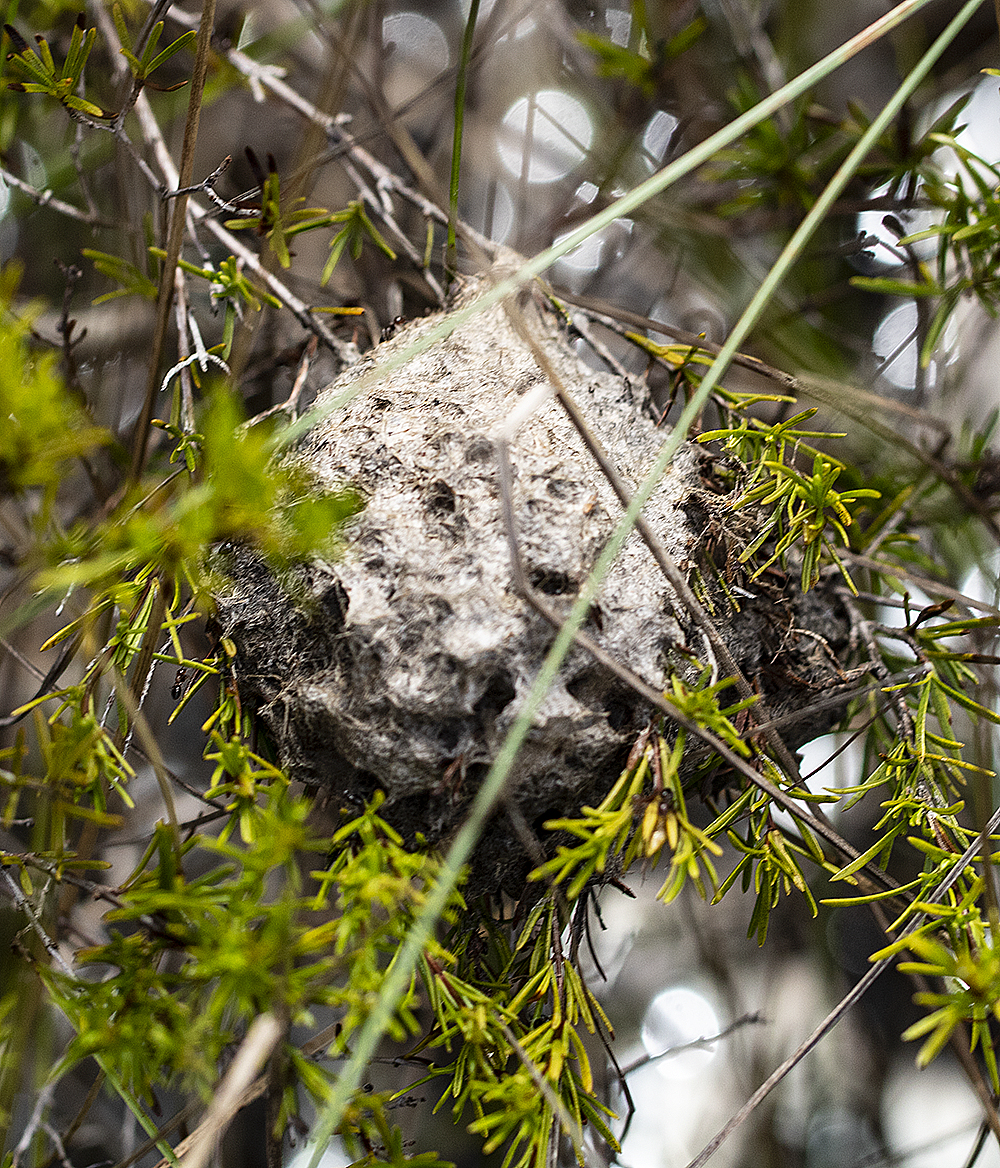
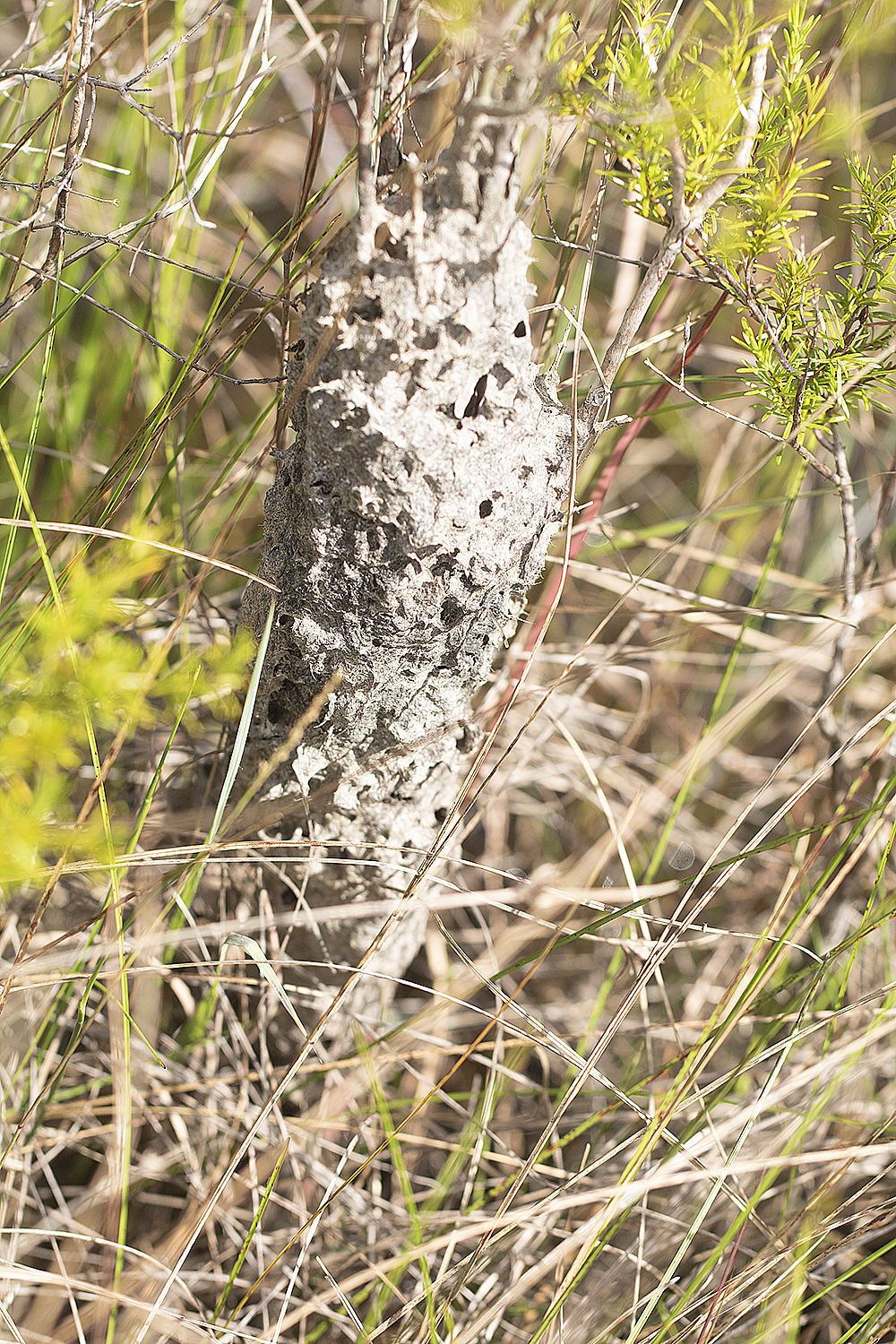
Around South Florida and beyond, a curious sort of ant nest decorates marshes, in John’s and my experience mostly the depression ponds dominated by Peelbark St. Johnswort (Hypericum fasciculatum) and Corkwood (Stillingia aquatica). These “carton” nests are gray and papery resembling hornet nests in color and texture. The cartons range in size from a tennis ball to a cucumber, up on a host plant, usually Hypericum around here, safe and dry above the high-water level.
Don’t touch, we are nice but will bite if abused..
It was Professor George Atkinson who first described the nests in 1887, attributing them incorrectly to ant species not otherwise known to such constructive feats. Something wrong there!
Ant nests don’t get much attention, and the next leap forward waited until 1919 when Harvard Professor William Morton Wheeler discovered the nest dwellers to be a previously undescribed species he named C. atkinsoni. The species is especially fond of periodically inundated open marshy habitats usually near the sea. Recently some entomologists reclassified C. atkinsoni as a variant of another species, C. laeviuscula, although an objection to the demeaning merger is the unique nest-building by C. atkinsoni. Around the world, varied ants, including other species of Crematogaster, make carton nests broadly defined, but in the Southeastern U.S., C. atkinsoni has a monopoly.
I live here.
To this day, the ant and its nests seems under-studied, at least as far as I can tell on Google. What does an ant colony in a paper box perched isolated above the flooded marsh eat? What are its seasonal cycles? Given the abilities of tropical carton-nest ants, there are multiple possible answers on how to “get provisions” during high-water lockdown. Your guess is as good as mine, although look twice at numbers 4 and 5:
Capture food before the flooded season and store it in the nest?
Capture insects or seeds visiting the host plant, or visiting neighbor plants accessible by leaf and stem bridges? (Even in high water the crowded plants touch each other so it is possible to get around a good bit. C. atkinsoni has been reported to eat other insects.)
Cultivate seeds in the nest? (Ants are known to nibble growing roots from seedlings in their nests. Some epiphytes establish in tropical “ant gardens.”)
Cultivate fungi? (This is likely the (or a partial) answer…some non-U.S. species of Crematogaster cultivate fungi, including yeasts, on the carton material itself. Looking into this would be an interesting research project, by taking “biopsies” from the nest for laboratory culturing without destroying the colonies.)
Farm sucking insects for their honeydew? (Other species of Crematogaster in other tropical habitats farm scale insects in their nests, and UF entomologist W. Whitcomb reported varied Florida crematogasters associating with aphids.)
Wait it out, perhaps with some adult die-off?
Might be possible to find this out, and to a point is a tempting research project, but not if you’d have to poison the ants and destroy the nests. The nests are rare, complex, and beautiful, not to mention in protected natural areas. Better to leave something to the imagination.
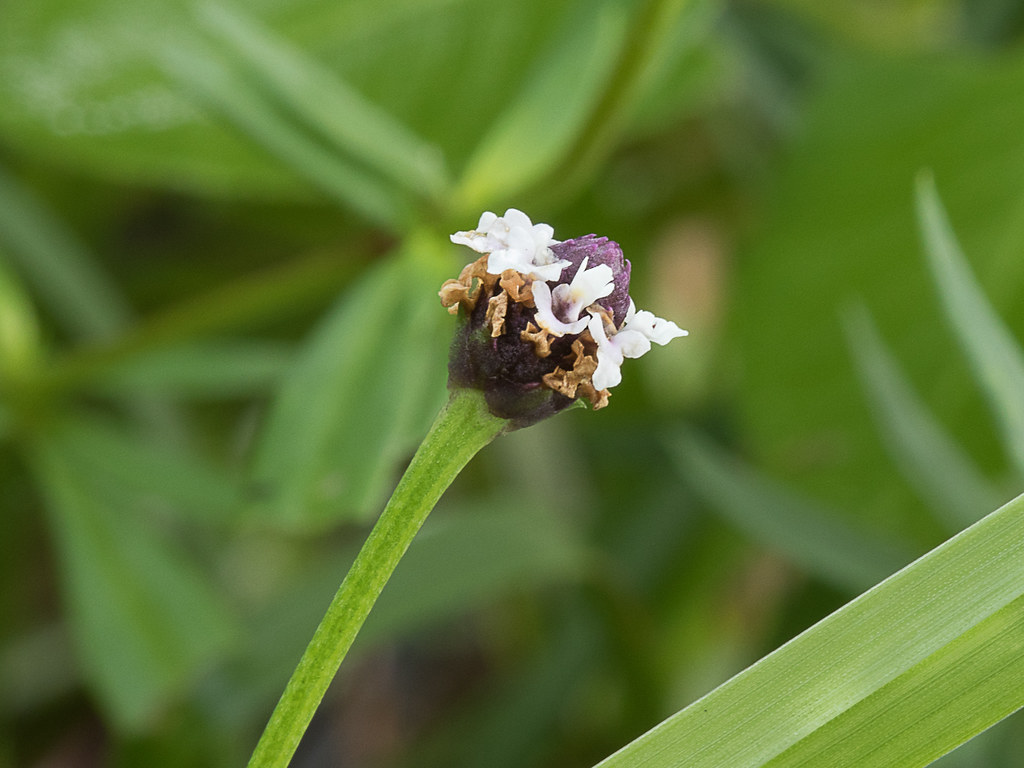
(Phyla comes from Greek phylon for a swarm, referring to the sprawling growth pattern. Nodiflora means the flower clusters are borne at the nodes.)
Verbenaceae
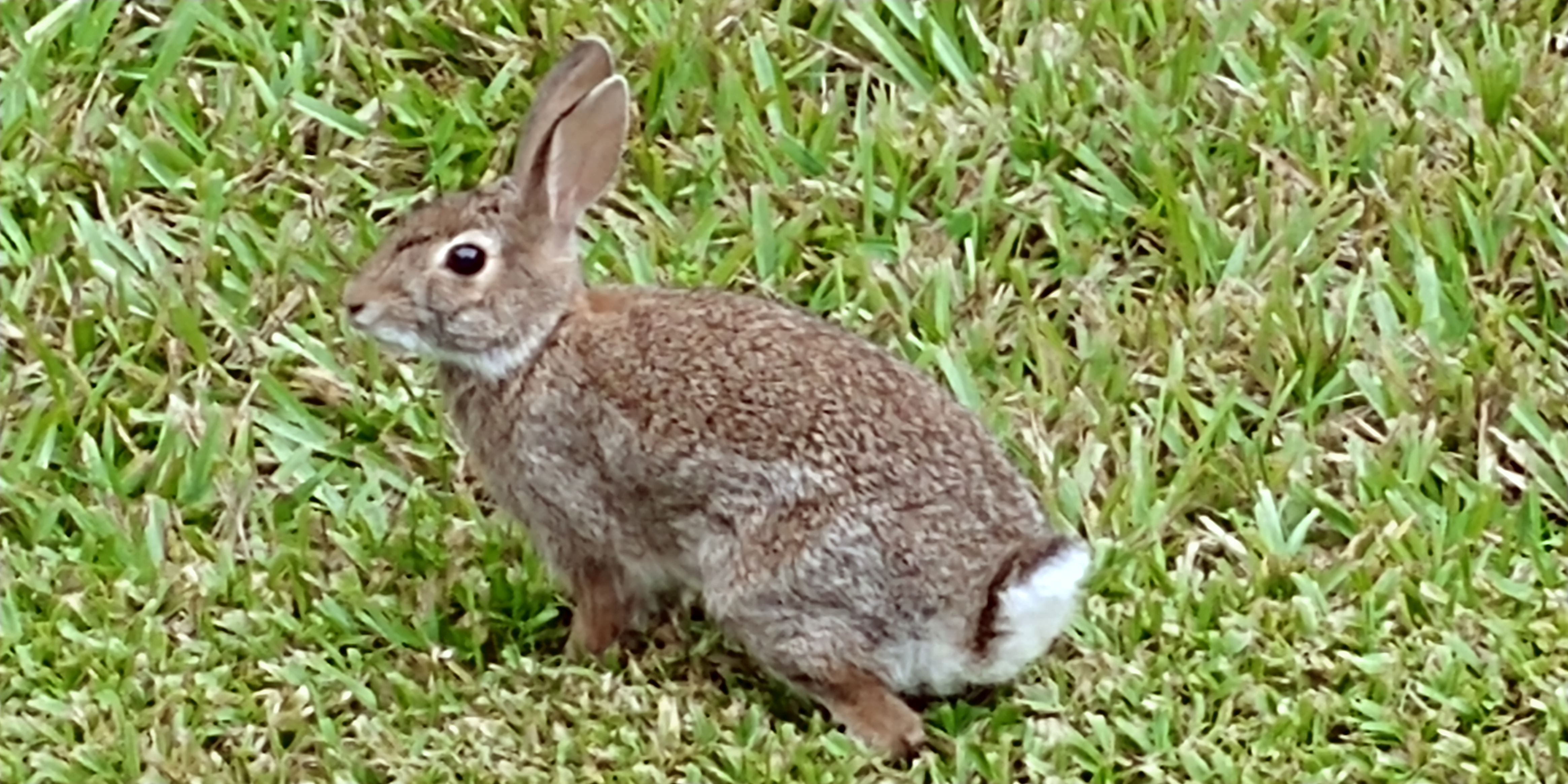
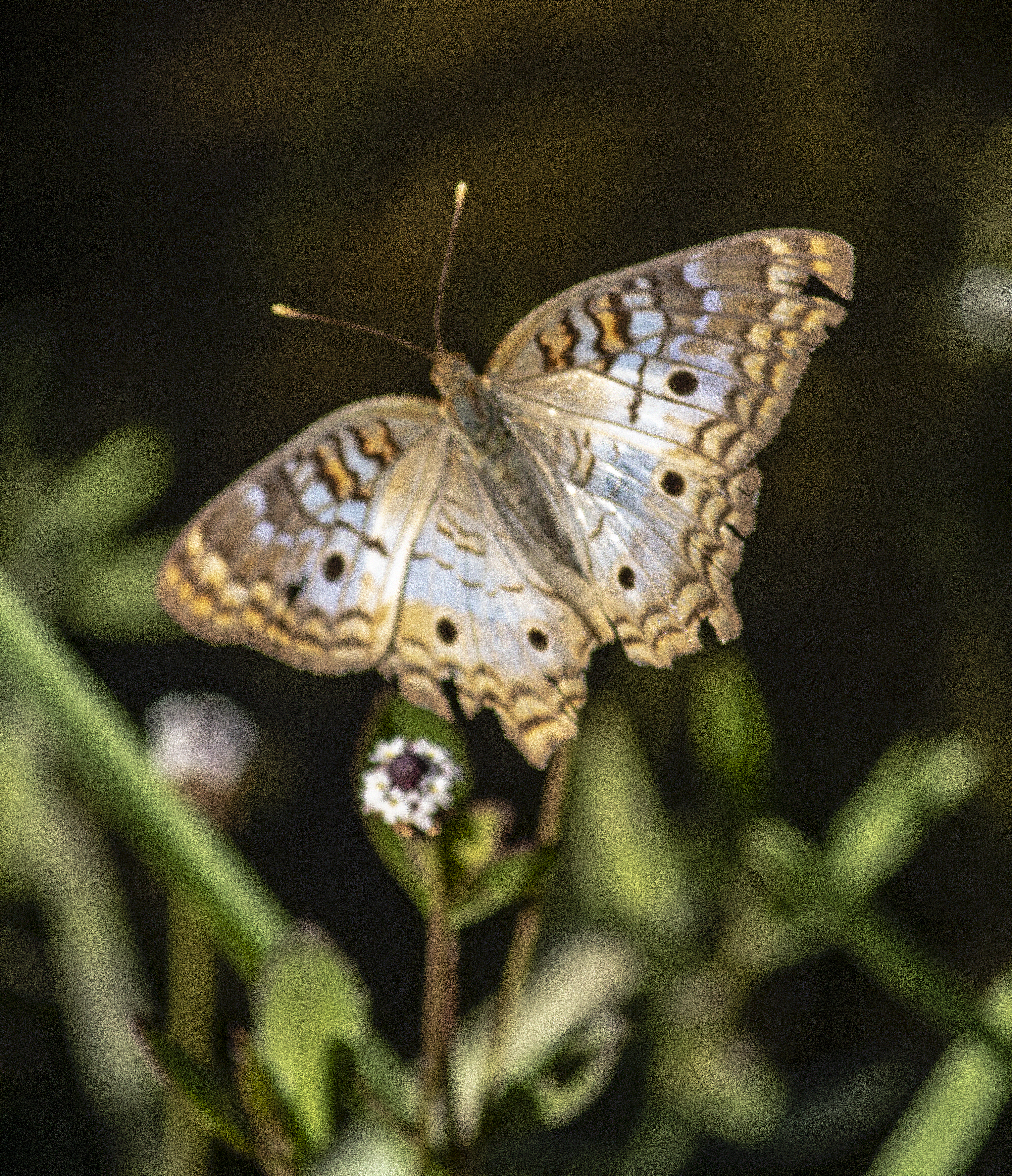
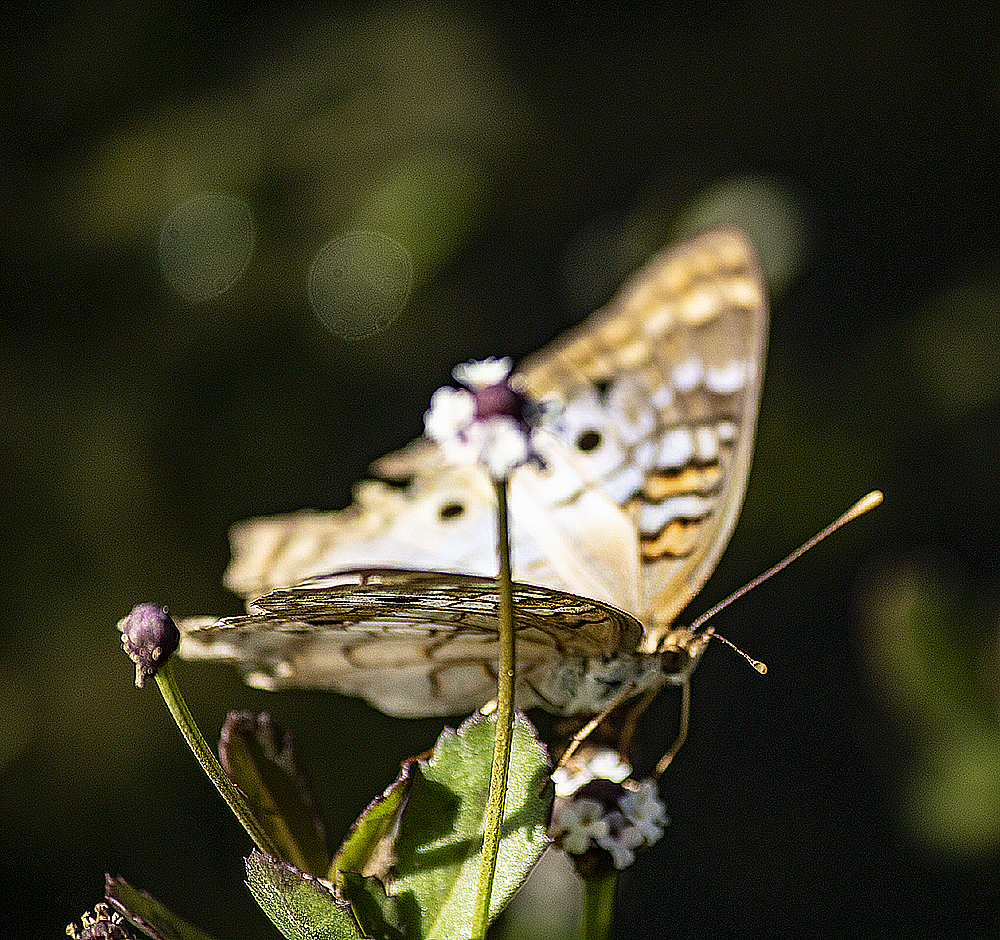
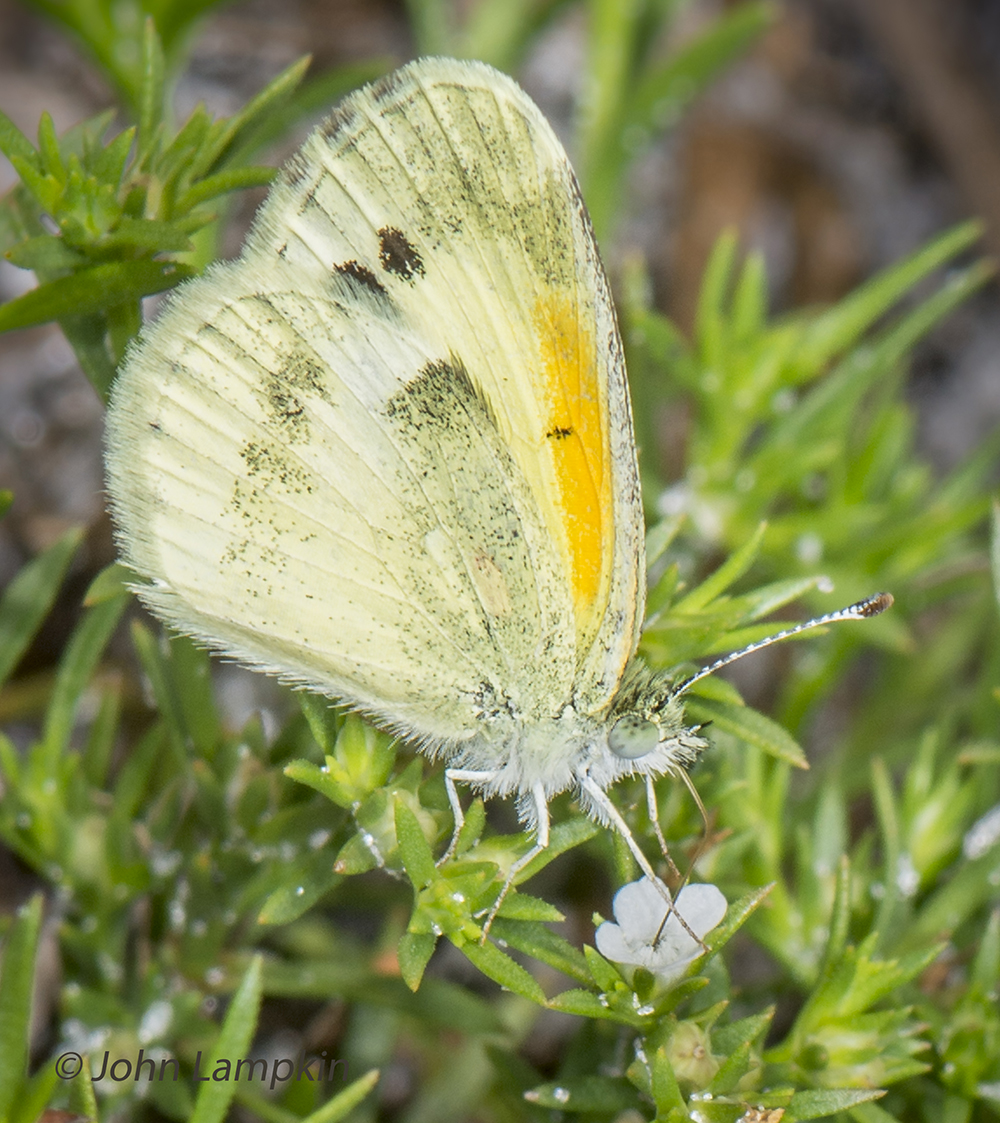
I did not really intend to watch butterflies today, but White Peacocks active all around forced the issue. They love Fogfruit which has appeared in this blog a few years ago, but what the heck, the bunny says do it again.
Why am I out just before a hurricane?
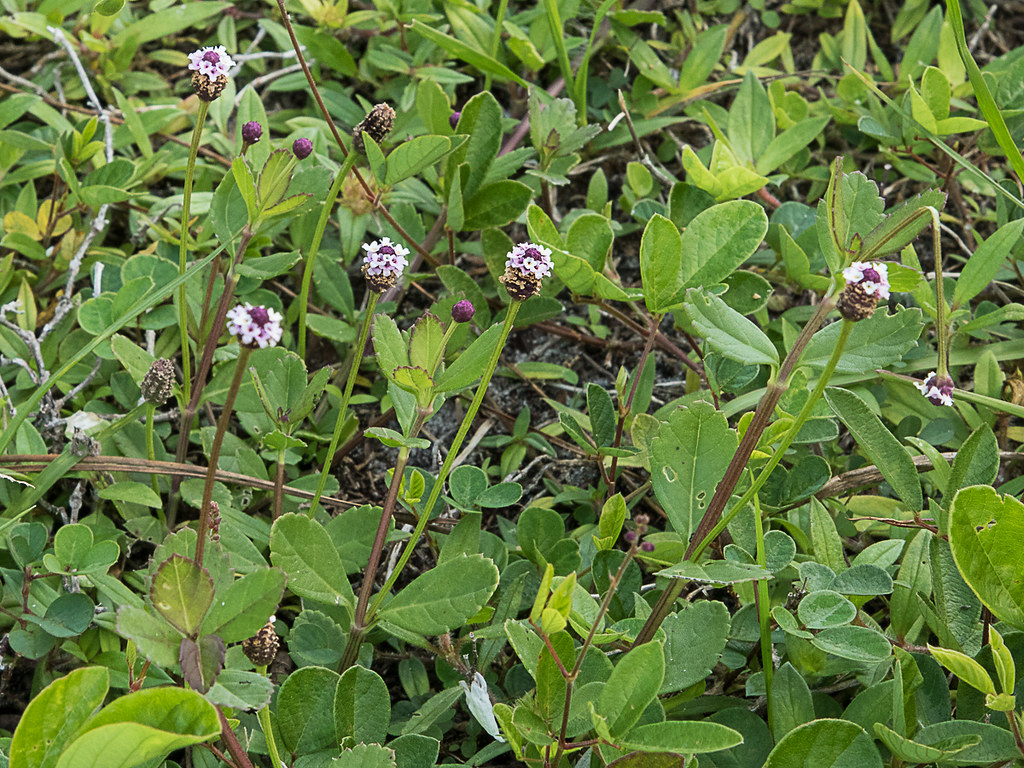
This plant is worldwide in warm climates. How it managed world domination is anybody’s guess. The fruit segments resemble small seeds, so it might move via wind, birds internally or externally, furry bunnies, and human activity. Floating stem fragments root along shores. In any event, it is everywhere warm and beyond, in the eastern U.S. as far north as Pennsylvania. Botanist Caroline Gross and collaborators recently studied its DNA to find the species originated in the Americas and spread naturally to Africa, to Asia, and amazingly to Australia. I mean almost certainly before seafarers could have brought it. There are not many plant species native to Florida and to Australia. Yea, right, just try to name one. This modest mat-former is a globe trotter.
By John Bradford.
It loves moisture…so much that when a patch abuts open water, the watery side of the patch can be conspicuously more robust than individuals just a few feet away. The species is not restricted to wet places, occurring also in varied challenging situations, including dry sandy sites, dunes, and roadsides. Fogfruit can withstand flooding, drought, salt, and limited frost. Deep roots allow competition with grasses. When crowded by competitors, Phyla rises to the occasion, growing oddly tall, and when there’s no need to rise it sprawls into a mat. Some motivated folks use it as a turfgrass alternative.
By JB
Other folks, lots and lots of them use it medicinally. Phyla is a little green chemical factory, is clearly bioactive, and is “all over” traditional medicinal uses. You could fill a boring page with 100 examples, such as dandruff.
What I really really like about the Phyla is its support for White Peacock butterflies. CLICK Along a canal near my home are scattered patches of today’s little weed, and every patch had a resident White Peacock. The master of each patch perches on the tallest stem motionless sometimes for several minutes and at other moments wanders around the area of a ping pong table enjoying the sweet Phyla nectar. A little internet research shows the patch-masters as males, each claiming a territory which they guard from interlopers, and invite female guests for nectar and companionship.
Having not much to do, trapped home by retirement, Covid, and approaching Isiasis, I sat by the canal with binoculars and fire ants, and trolled White Peacock sociology. I’m assuming with little basis every interaction I witnessed was male-to-male territoriality, except maybe for one long complex dance that seemed different, perhaps a dance of love. But setting tawdry sex aside, the males mostly stayed within their territories. It is possible to identify them individually by damaged spots and clefts in the wings, showing that after each encounter they returned to their proper corners.
I watched two presumed males in particular in adjacent territories, Fred on the left and Joe on the right. They mostly minded their own business perching and grazing, but every now and then one would encroach a bit on the other, Fred mostly trespassing on Joe. Joe would signal Fred to bug off by means of a split-second chase. You can see it here CLICK slowed to 25% time. A third Peacock came along and set foot in Joe’s kingdom and got chased off with much more bluster than the routine Joe-Fred border incidents. The third party then went and tried Fred’s patch with the same determined result. Hope he found a patch of his own. Wow they are complex and beautiful. I don’t think I’ll ever spray another insecticide.
(Juncus is an ancient name for rushes. Megacephalus means big head.)
Juncaceae, the Rush Family
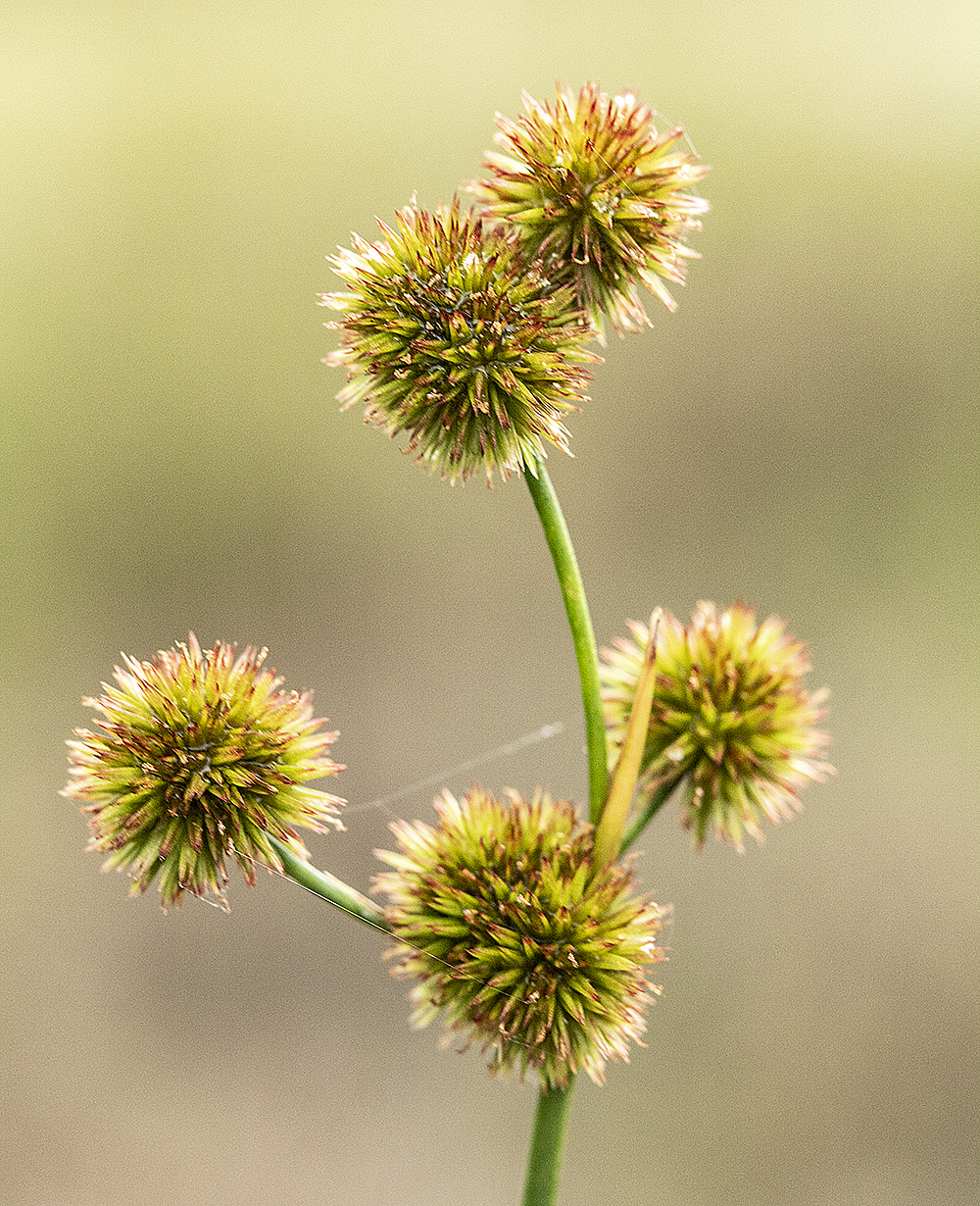
Sometimes a plant deserves attention for merely being a curiosity. Somewhat mysteriously, a number of marshy wetland species pack their flowers and fruits into spherical heads on wands that bend and blow in the wind, conking the ball-shaped heads into each other. Examples include Tracy’s Beaksedge, Sparganium, and today’s Bighead Rush. There must be something good in the marshy environment about globes. Gets the imagination going, although the benefit might be mutual protection of the flowers and fruits, circling the wagons, blocking pests, maybe holding water, or buffering temperature extremes. Does knocking together as the wind blows help with cross-pollination? Later, do the impacts help knock the balls apart and disperse the seeds?
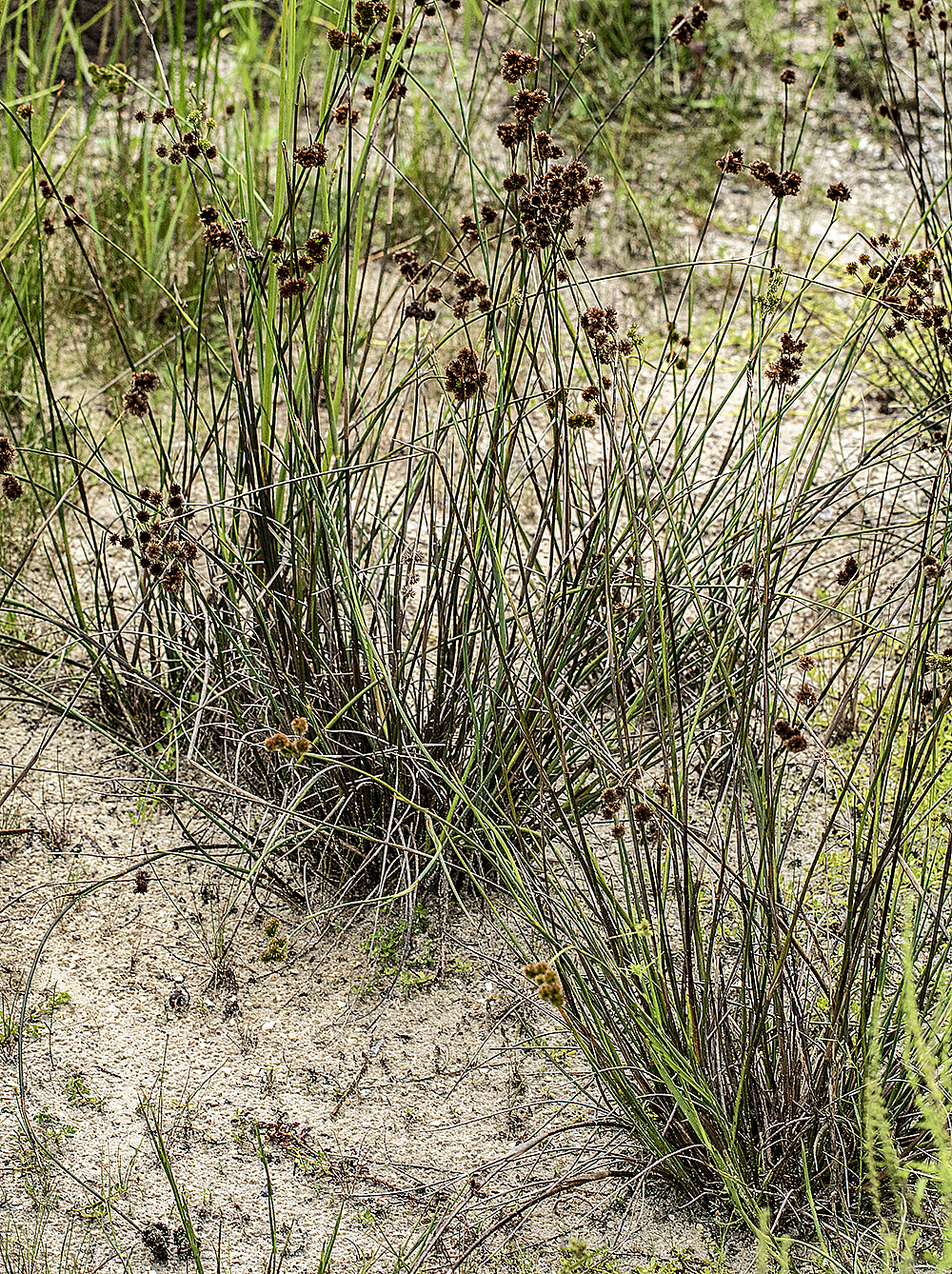
In any case, the well-named Big Head Rush is a prime example. The rushes dominate sandy/muddy shores inundated part of the year and exposed the rest of the year. In short, sometimes very very wet and other times in the miniature desert of a dried sandy shore.
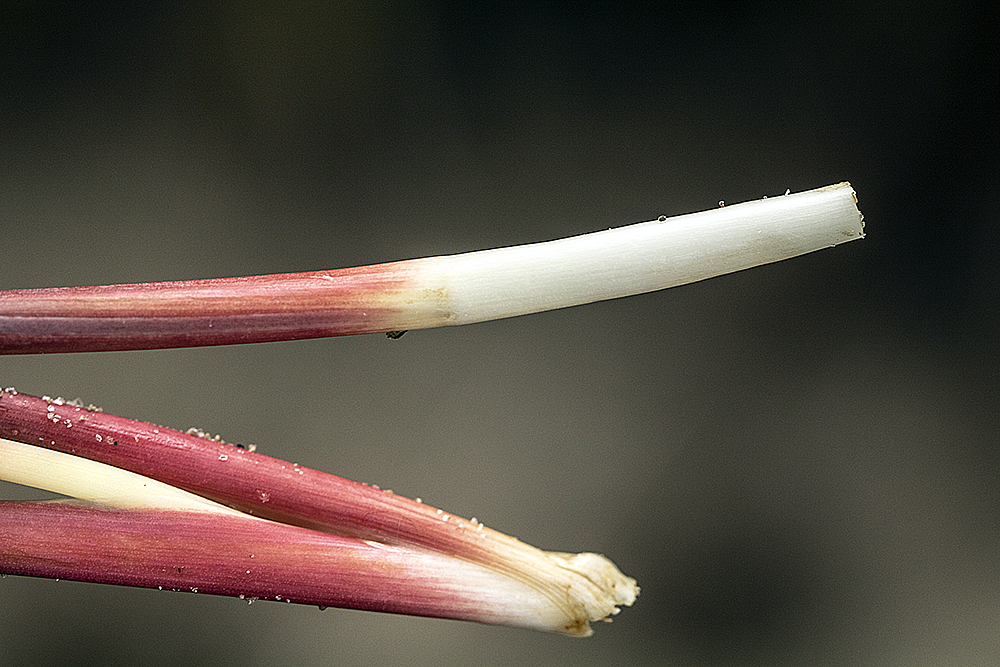
The heads are not the only curiosity. Like many aquatic (and additional) plants, the base where the plant meets the earth is bright red. This phenomenon is better-known in more- prominent plants, for example, sugar canes, dyes coming from the leaf sheaths in some sorghums CLICK, , or red leaf bases helping to distinguish cultivars of rice. The red comes from pigments known as anthocyanins, familiar in red petals or in red fruits as attractants to pollinators and to seed-dispersers. Familiar also as “sunscreen” in young or stressed foliage. Recent research has shown anthocyanins to be also anti-fungal, so maybe reddish, or purplish, or blackish fruits are fighting fungi instead of just attracting birds..
Bright red at the base.
Fungal protection makes sense where the plant meets the ground, perhaps especially so in species with wet bases for long spells. It isn’t just Bighead Rush. Similar red bases appear in the marsh in Xyris, Sagittaria, Alligator-Flags, and varied grasses and sedges.
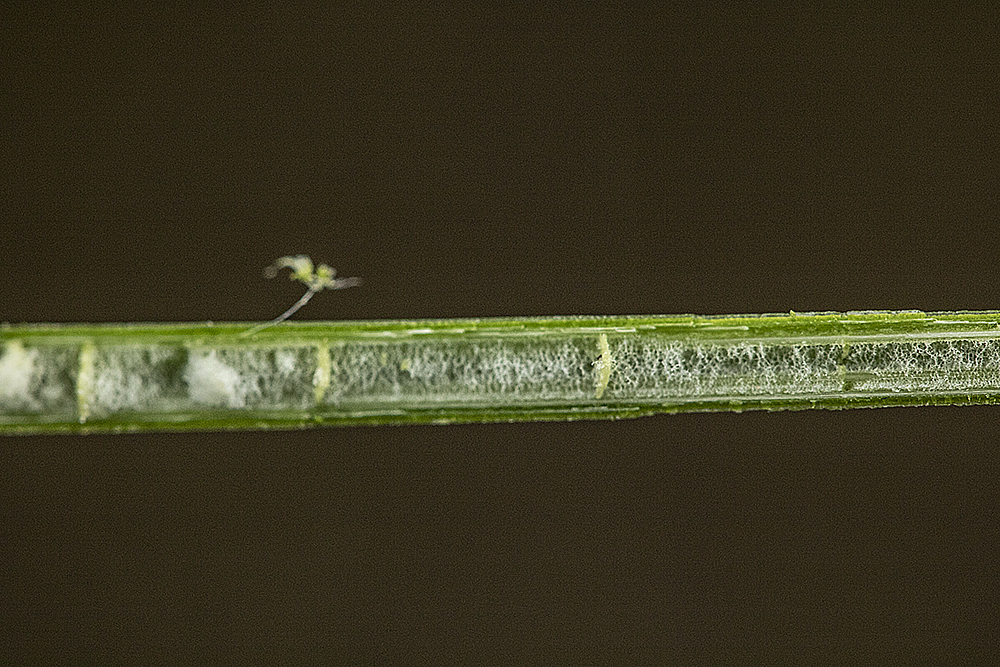
Bighead Rush leaves look like knitting needles, technically called terete (teh-REET) leaves. That shape is often associated with hot, sunny, dry habitats where a normal leaf blade is vulnerable to drying and exposure. Actually it serves a purpose at both extremes…standing up to hot and dry when necessary, and during the wet season acting like an air-pipe being filled with soft porous material between reinforcing dividers, as in bamboo.
On the inside the knitting needle leaf is a reinforced air pipe.
(Hyper-means above, and -icum comes from the same root as icon, above the icon, referring to the historical use of some species to adorn religious icons. A fascicle is a bunch, such as a cluster of leaves.)
Clusiaceae
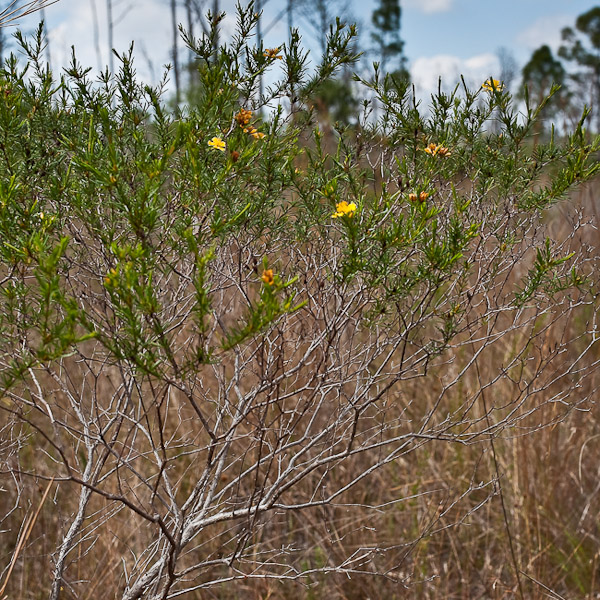
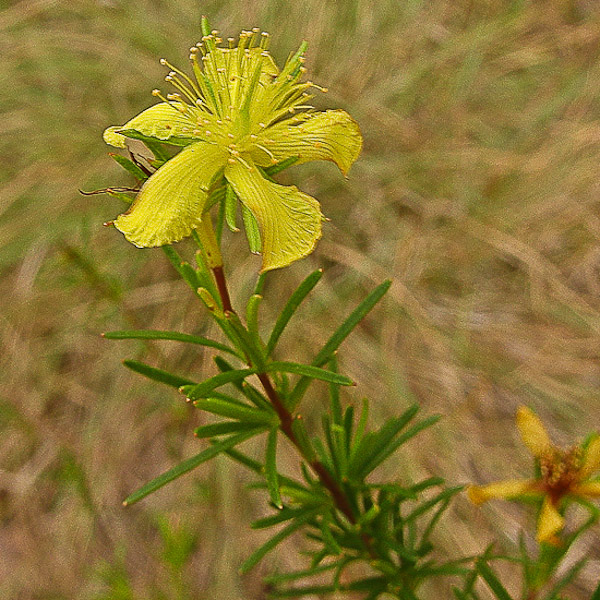
St. Johnsworts are many…around 500 species, 50-ish in the U.S., around 30 in Florida. They are well known for bioactive contents, photosensitizing the skin of human and beast after consumption, locoweeds, and medicinal uses, especially to fight depression. These things are all over the internet, and therefore of no new interest here. More fun to go into less-documented aspects of Peelbark St. Johsnwort, Hypericum fasciculatum.
PBSJW. Today’s pictures all by John Bradford.
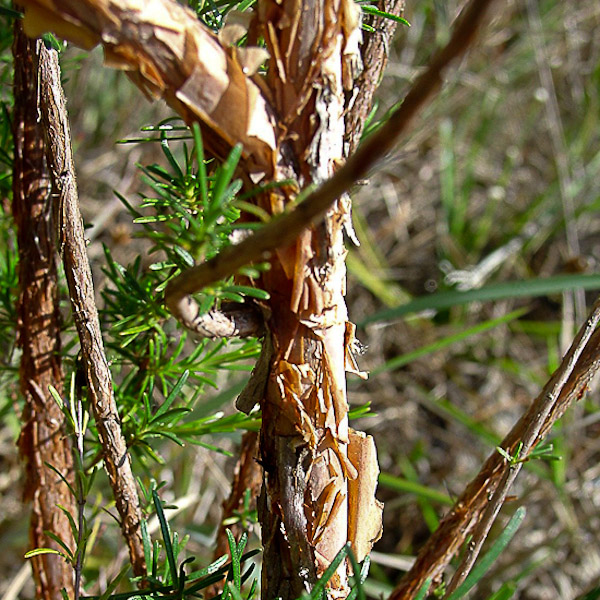
So then, first, why “peelbark”? Hypericum fasciculatum is mostly a species of seasonally inundated marshes…you might say “Hypericum marshes”…and of wet shores. It spends much of its time up to its knees in water. Seasonally flooded plants have a problem: ventilating their roots during highwater times. Want another seasonally inundated plant with similar peeling spongy bark? Bald Cypress knee bark resembles Peelbark St. Johnswort. Those porous barks no doubt aerate the above-water regions. in my opinion the exposure in Bald Cypress sustains the living phloem just under (actually part of) the bark. In the St. Johnswort the peeling bark perhaps likewise feeds the phloem, and possibly ventilates the roots which have two special adaptations of their own.
The first special adaptation is the formation of “adventitious” (on the stem) roots near the high water level. This tendency has served during the dry months as a marker of erstwhile high water limits.
The second special root adaptation is a series of air channels (aerenchyma). Botanists who have studied similar roots in similar species have found the channels to help maintain optimal levels of the airborne hormone ethylene.
Why would an aquatic plant with unlimited water have narrow needlelike leaves resembling a dryland conifer? It looks like a desert plant. So does its marshland neighbor corkwood, Stillingia aquatica. One answer is probably that semi-impaired suffocating roots are unable to service large broad leaves well, and a second reason for skinny “desert” leaves seems to be those challenging months when the shrub is high and dry.
Here is a fishy mystery to ponder. Why do Hypericum fasciculatum plants in bodies of water having fish manage a stronger seedset than those in fish-free habitats? No. the answer is not “fish manure fertilizer.” Sometimes ecological relationships are fun to unravel, as UF ecologist T.M. Knight and collaborators did in 2005. Fish eat dragonfly larvae. Dragonflies eat bees and things. Bees and things pollinate PBSJW. So no fish = many dragonflies = scarce pollinators. If fish abound, however, so do the pollinators and the seeds.
(Polypremum loosely translates as many-branched, and procumbens means “lies down” without rooting from the stems)
Tetrachondraceae
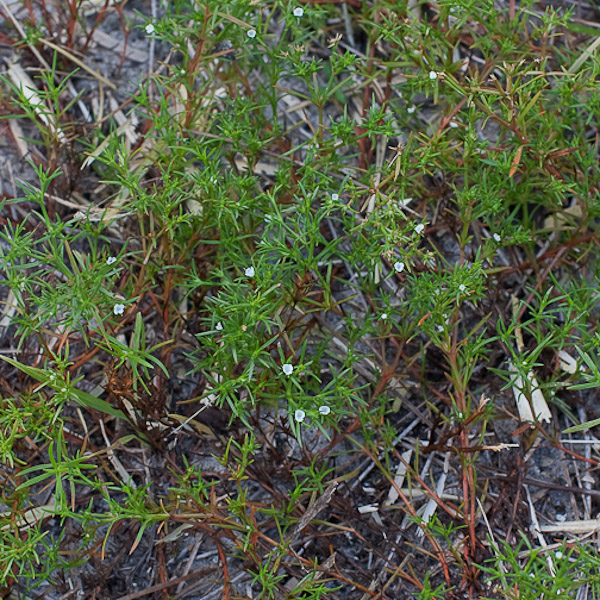
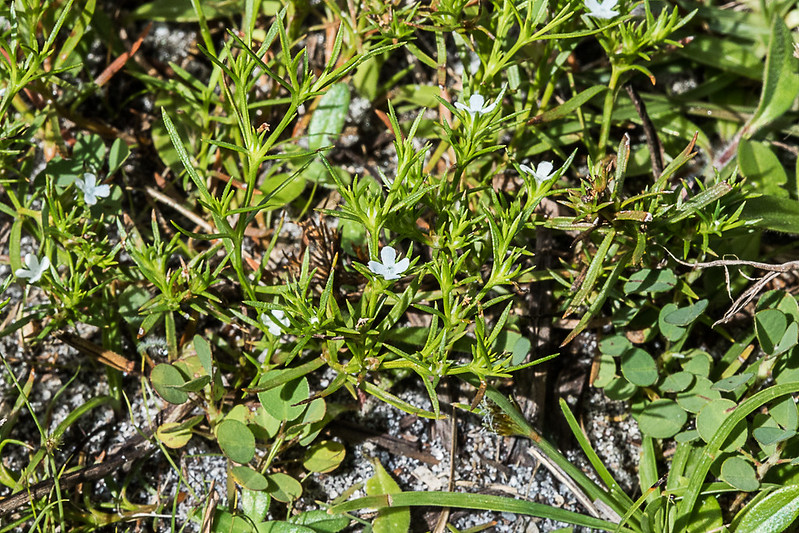
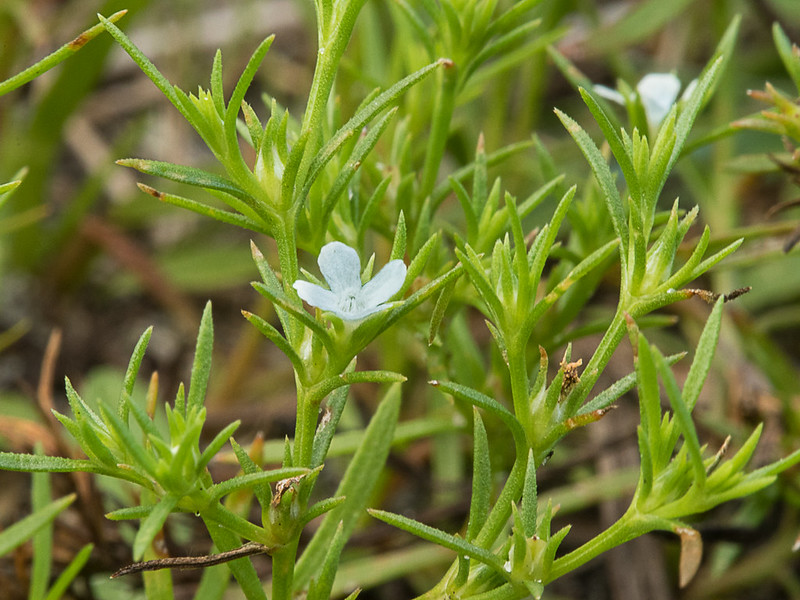
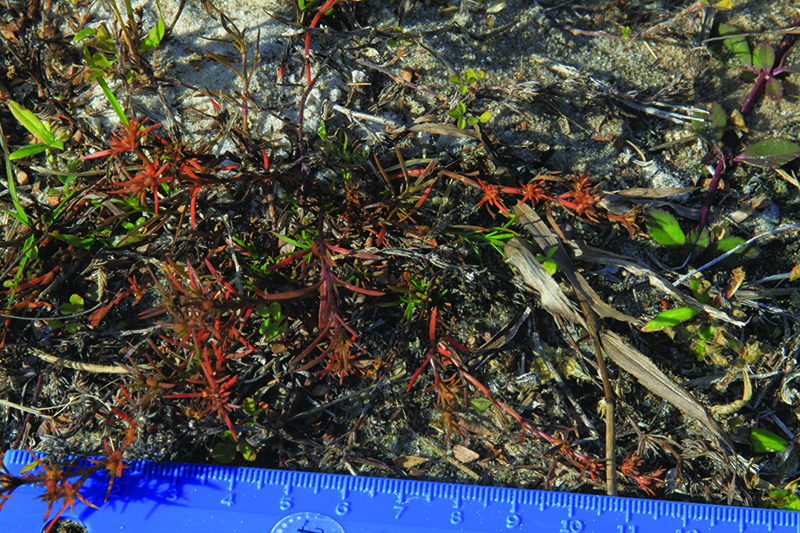
Rustweed is a curious little thing. Merely figuring out its relationships was a botanical head-scratcher for a couple centuries until DNA came along to solve all mysteries. It lives on sun-baked sandy surfaces from Florida to Mexico and to the northeastern U.S., very abundant around Palm Beach County. Branching is Y-shaped, and the paired leaves look like little sawtooth daggers.
Today’s non-microscope and non-butterfly pictures by John Bradford.
The first of three Polypremum oddities is that the plants transform from leafy green to rusty orange-brown at times of extreme sun exposure or drought. They are not dying…merely getting a tan. Do they go back from rusty to light green? I don’t think so. Somebody ought to conduct a comparative study on their performances and tolerances in the two phases. Do the rusty plants thrive under stresses green ones can’t handle? Do the green ones grow faster under favorable conditions?
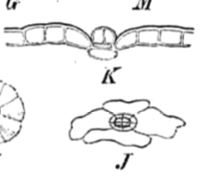
A second oddity is microscopic and beyond my photographic ability, so below is a drawing from a 19th Century German treatise on plant hairs.
The leaves have on their undersides microscopic “glands” with a beautiful structure and recessed into the leaf surface. What do they do? I’ve been wondering that since the 80s. We often think of glands on leaves as producing nectar to favor defensive ants. Not in this case. To make a varnish to protect the leaf? Naw, wrong placement. To excrete excess salt? I doubt it, wrong habitat. Drain excess water? Water-secreting structures are common, but these have the wrong structure and placement, rejected. You know what they look like to me? The complex structures on Tillandsia leaves that function in part to take in water in a stressfully dry habitat.
Did somebody say stressfully dry habitat? You know, like Rustweed-inhabited sand in a Florida scrub. Speaking speculatively, I’m guessing those little “glands” help take in precious water from rain, mist, and dew out on those parched sands. Might be tough to test and prove without sophisticated gear, although weed scientists have shown plant hairs on other species to take up herbicides in water. Things that matter get studied. One quick test that might suggest or nix water intake would be to see if the leaves gain weight upon foliar water exposure, with no water applied to the root.
With a tan
Oddity number 3 requires a speedy pre-lesson. In a flowering plant’s sexual cycle, to make a long story short, the pollen grain sprouts a tube called the pollen tube, and the pollen tube delivers the sperm to the egg inside the future seed. The textbooks tell us the pollen grain with its seminal cargo arrives from another plant thanks to the birds and bees. Textbooks lie.
Dainty Sulfur meets Rustweed, contributed by John Lampkin
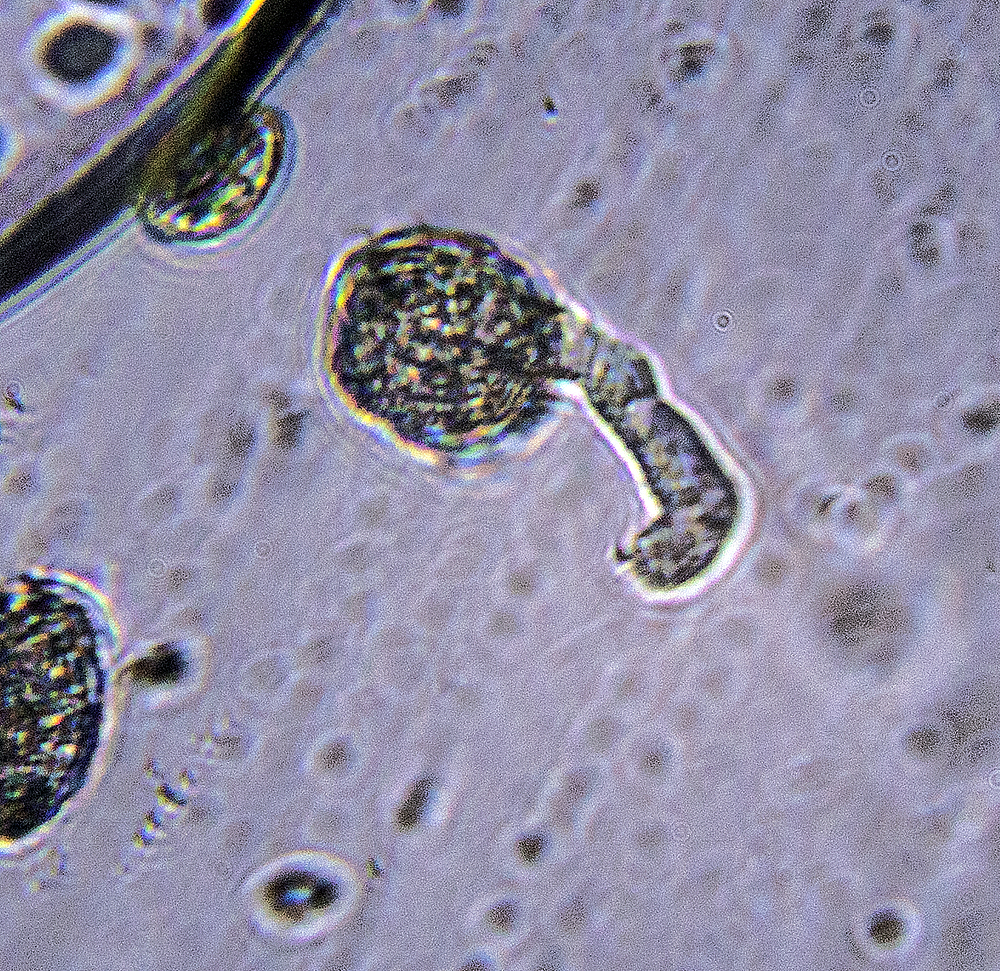
Suppose you are a lone Rustweed, bereft of that “another plant,” established by a wind-blown seed on some remote sandy patch to colonize. Rustweed has colonized Hawaii, Guam, and Palau. How can it reproduce all alone and isolated? Not a problem, as iconic botanists Asa Grapy and John Torrey noted back in 1841. They found Polypremum to germinate its pollen tubes within the flower that made them, no need for pesky birds and bees. That germinated pollen (i.e. with pollen tube) takes care of fertilization without ever leaving its home flower. As far as I can tell, nobody has re-noticed or mentioned it since, although various forms of self-pollination are not rare. That 179-year assertion by Torrey and Gray had to be checked, what if they were wrong OMG!!!, so I brought some Polypremum home today for a look. They were correct, the pollen trapped inside the flowers is still sporting pollen tubes rarin’ to go.
Pollen with its pollen tube hanging around today inside the flower that made it.


 John Bradford
 George Rogers
 George Rogers
 Dee Staley
 Treasure Coast Natives
#/media/File:Sorghum_bicolor_14_DSCN0382.jpg)