Passiflora foetida (Love in a Mist)
(Foetida means smelly.)
Passifloraceae, the Passionflower Family
Want to try a creepy adventure? This morning I got up at dawn to beat the thunderstorms, which have not come. Plunged into the murky mists in an inundated Hypericum marsh to tend to a little botanical business. In over your knees in the morning twilight among reeds, tussocks, fallen logs, bird groans, croaking frogs, and wil-o-the-wisps, it is eerie to hear “things” swimming. I mean what swamp dwellers splash when they swim!? The imagination runs wild. Critters splash into the black water as you approach. To the neurotic, a frog plop sounds like a hippo. Any pythons in PB County? Do Cottonmouths splash when they flop in from a low branch? Not so spooky are the Zebra Longwing Butterflies out in force today, interestingly going about their flutter duties low in the foliage. Zebra Longwings bring to mind Passionvines, the topic with such a long lead-in.
By John Bradford
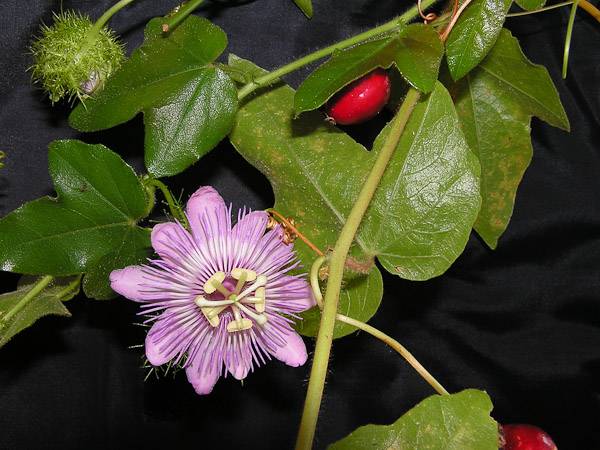
Today’s blog rests on the shoulders of titans. Biologist Dr. Walter Bien suggested the topic and sent info. He and John Bradford took the photos. Passiflora foetida, native to South America, is introduced and weedy all around the hot-climate world, including here. If we must be invaded the intruder might as well be beautiful, and curious.
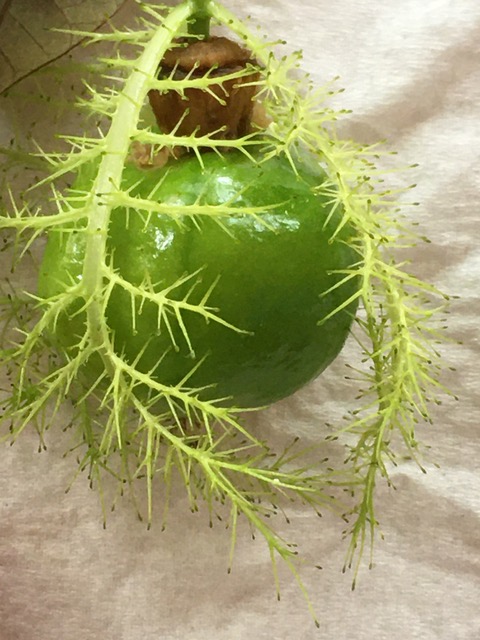
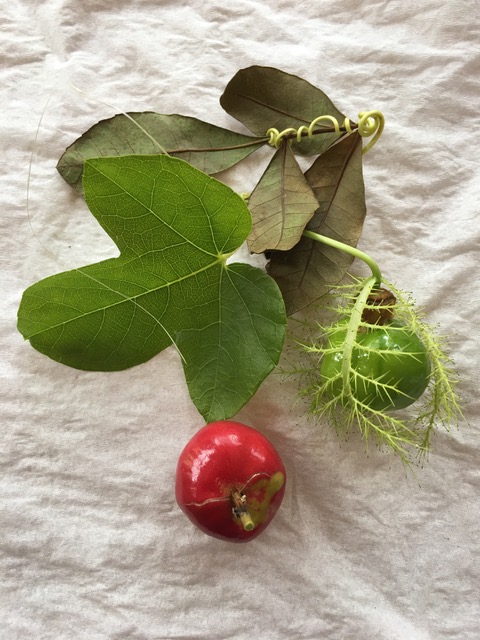
The pretty flower looks like many other passionflowers. The fruit suggests a red cherry, helping to explain its global conquest with the help of birds. Today’s focus is on the net wrapped around the fruit, inspiring the name “Love-in-a-Mist.” The mist is made of bracts wrapping round from beneath the flower.
Now any fool can guess the net protects delicacies within. Demonstrably so. If you want to keep the bad guys out, a little toxin can be useful. Could offing pests be a first step toward carnivory? If you’re going to kill’em you might as well eat’em. Granny salvaged roadkill after all.
By Walter Bien
As Dr. Bien related, the net is protocarnivorous. Glands on it secrete a compound called passifloricin and sticky mucilage to trap insects. Passifloricin is a lactone a broad family of cyclic molecules often bioactive and in many fragrant essential oils. Passifloricin kills microscopic protists and undoubtedly also small insects. Going beyond mere defense, the secretions have protein-digesting enzymes. Drumroll please! That ability is characteristic of carnivorous plants.
Walter Bien
Please don’t go push poor little buggies into the web of death, but it might be interesting to peek in with a magnifying class.


Linda Grashoff
June 6, 2020 at 3:54 pm
You didn’t mention splashing alligators. That would have been my fear. . . . Uh, why do Zebra Longwings bring to mind Passionvines?
George Rogers
June 6, 2020 at 5:00 pm
Hi Linda. Just thought of you because there was a nice “oil slick” on the canal behind my home. It fragmented like broken glass with the toss of a dirt clod. Yea…gators too, although where I was today the jungle probably too dense for big ones to traverse. On the long wing butterflies. my wife and I have a bunch of passionvines in our yard. The lognwings come and lay hundreds of yellow eggs all over the passionvines. When the first caterpillars hatch it seems (seems) they eat the unhatched eggs along with the PV foliage! Could it be? Serious sibling rivalry. Then they make the weirdest bilobed lumpy gray chrysalis resembling a decayed leaf…and finallycomes the good part in somewhat over a week. We saw one hatch out this afternoon. The entire longwing thing really was just an excuse to unwind from my swamp terrors. Hope you are doing great.
Suellen Granberry-Hager
June 6, 2020 at 9:49 pm
Very interesting post. There is always something new to learn about plants.
George Rogers
June 7, 2020 at 7:58 am
Hi Suellen…has Covid cramped your wide-ranging ramblings?
Annie Hite
June 6, 2020 at 11:01 pm
Fascinating about the protocarnivorous net and an excellent reminder to wear my hand lens around my neck when I walk around our natural areas. As you often point out, there is more than meets the naked eye out there.
George Rogers
June 7, 2020 at 8:00 am
I know what you mean…from hand lenses to binocs to camera….I need a big dog with a saddlebag
Pat Bowman
June 7, 2020 at 6:19 pm
Want to know something odd! We were out that getting asafoetida from the Indian Grocery.l.. Thought of your post! How odd,
Sent from my iPad
>
Maria Perez
June 7, 2020 at 10:37 pm
I am glad you suggested your website for an interesting post about moss. Finding this, i am in awe! My mother and I encourage the growth of this exact passionflower vine. We have no idea where or when it first appeared. One day, there were just vines with purple flowers climbing all around our screened porch. Since then, it has made its way across the garage, to the palm trees growing by the mailbox, and to the Ylang-Ylang trees growing near the back gate. We have a handful of Zebra Longwings year round it seems. I knew that the passionflower vine was a favorite of it but I had no idea that it was protocarnivorous. I wonder if that happens to be a trait that makes it a favorable host plant of the butterfly.
George Rogers
June 8, 2020 at 5:27 pm
That particular species can grow like a beast. I guess the birds gift the seeds to us thanks to those bright red fruits. Now that you mention it, I wonder what the relationship is between the proto-c and zebra longwing and fritillary caterpilars