RSS

Tag Archives: Crematogaster atkinsoni

Acrobat Ants:  High, Dry, and a Little Mysterious

Crematogaster atkinsoni

Crematogaster is a name of controversial origin.  As spelled, it means burning stomach.   But they don’t need Nexium… the name probably originated from cremasto-.  Cremasto– means “suspended,” as in “cremaster,” the stalk suspending a butterfly chrysalis. The ant in its defensive mood arches its “stomach” (abdomen) suspended up over its head with its stinger facing forward, thus the name Acrobat Ants.  The stinger does not sting, but instead is a spatula for dabbing toxins onto foe.   They can bite too.   Professor George Atkinson (1854-1918) was a prominent U.S. entomologist.
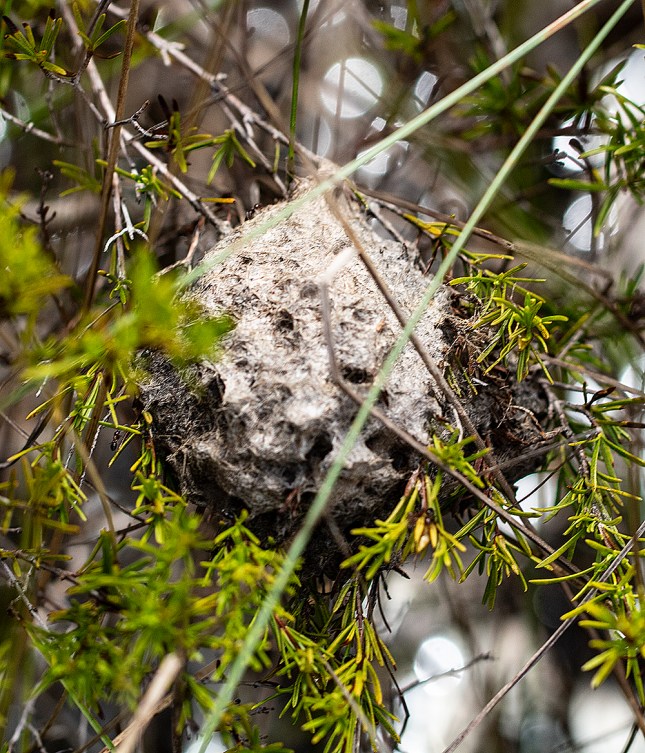
ant nest 2

Carton nest in Hypericum

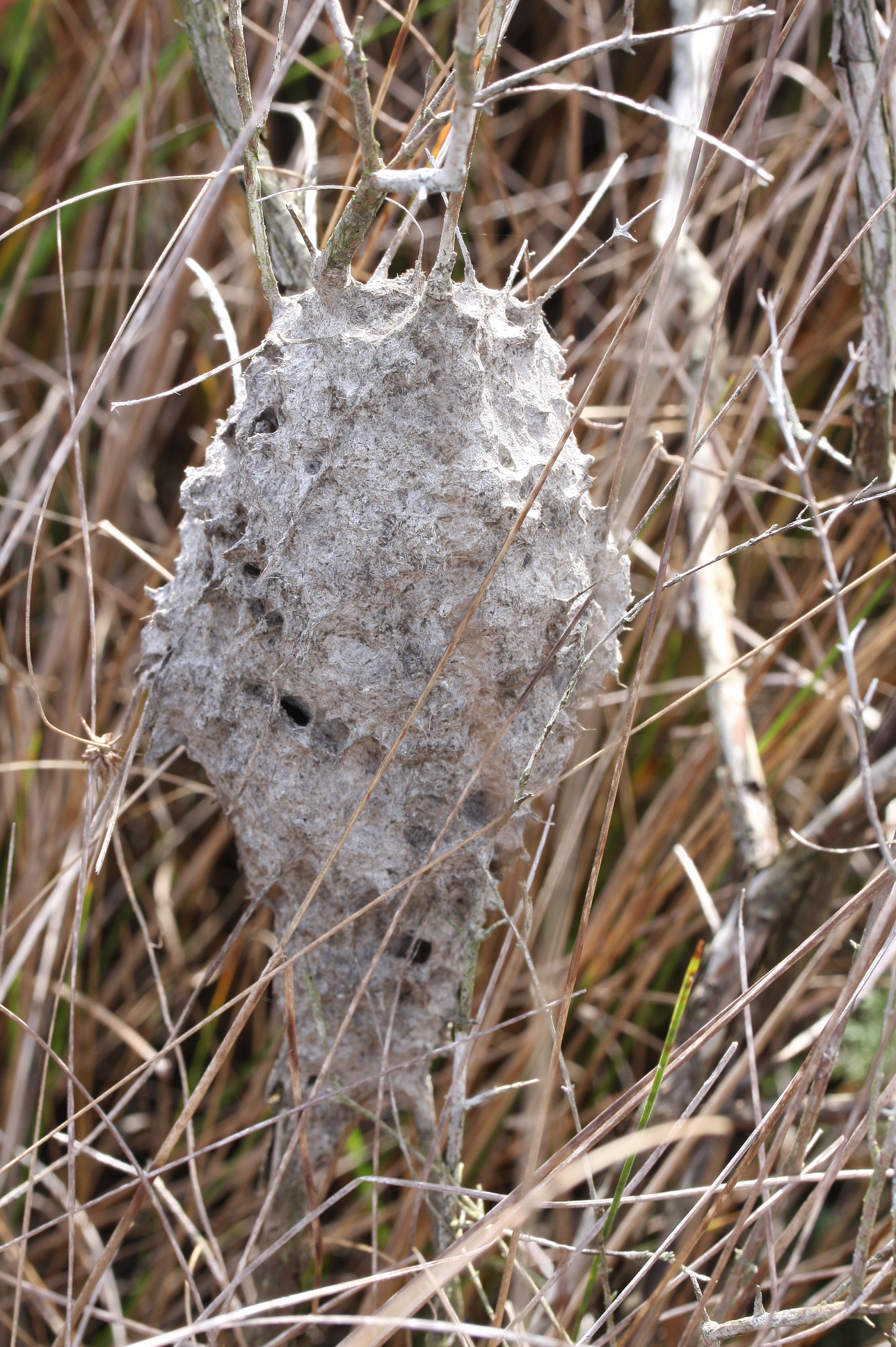
Around South Florida and beyond, a curious sort of ant nest decorates marshes, in John’s and my experience mostly the depression ponds dominated by Peelbark St. Johnswort (Hypericum fasciculatum) and Corkwood (Stillingia aquatica).  These “carton” nests are gray and papery resembling hornet nests in color and texture. The cartons range in size from a tennis ball to a cucumber, up on a host plant, usually Hypericum around here, safe and dry above the high-water level.
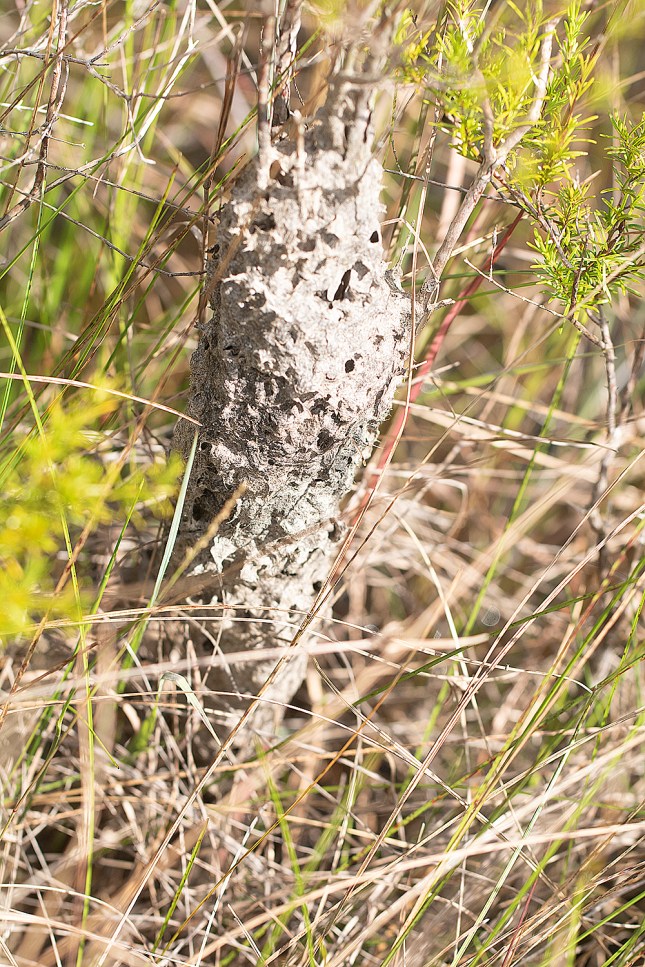
ant nest far

Don’t touch, we are nice but will bite if abused..

It was Professor George Atkinson who first described the nests in 1887, attributing them incorrectly to ant species not otherwise known to such constructive feats.  Something wrong there!

Ant nests don’t get much attention, and the next leap forward waited until 1919 when Harvard Professor William Morton Wheeler discovered the nest dwellers to be a previously undescribed species he named C. atkinsoni.  The species is especially fond of periodically inundated open marshy habitats usually near the sea.   Recently some entomologists reclassified C. atkinsoni as a variant of another species, C. laeviuscula, although an objection to the demeaning merger is the unique nest-building by C. atkinsoni.   Around the world, varied ants, including other species of Crematogaster, make carton nests broadly defined, but in the Southeastern U.S.,   C. atkinsoni has a monopoly.
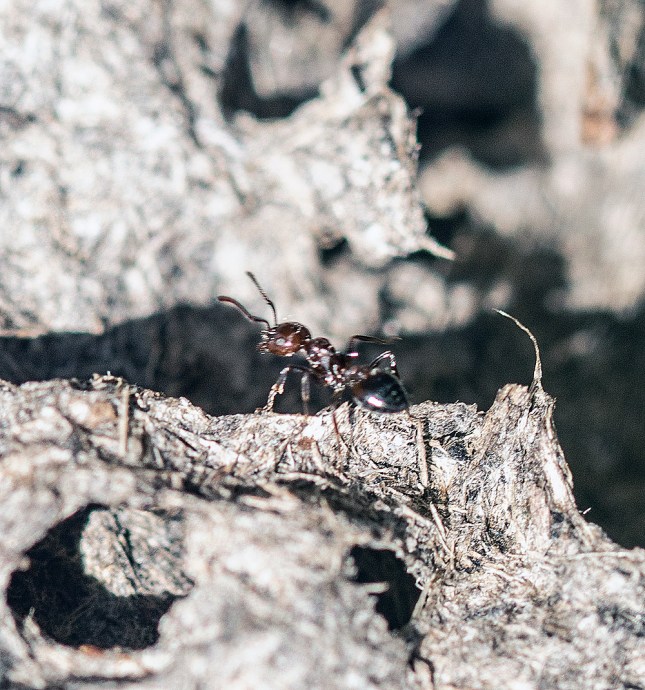
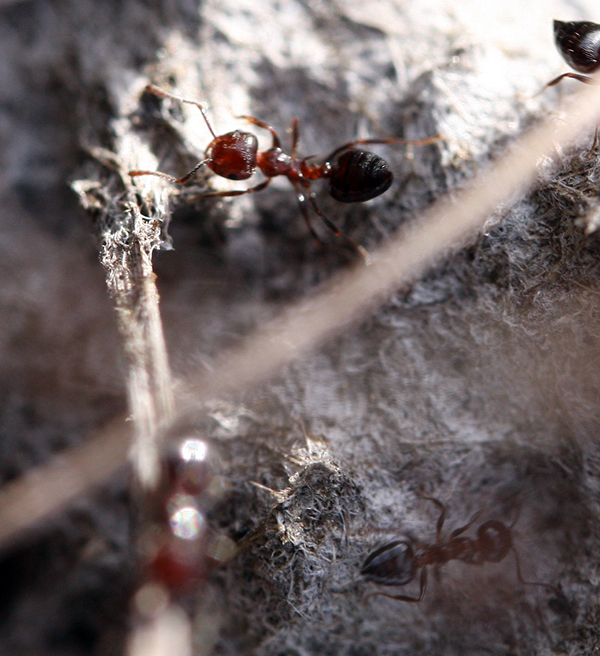
ant

I live here.

To this day, the ant and its nests seems under-studied, at least as far as I can tell on Google. What does an ant colony in a paper box perched isolated above the flooded marsh eat?   What are its seasonal cycles? Given the abilities of tropical carton-nest ants, there are multiple possible answers on how to “get provisions” during high-water lockdown.  Your guess is as good as mine, although look twice at numbers 4 and 5:

  1. Capture food before the flooded season and store it in the nest?
  2. Capture insects or seeds visiting the host plant, or visiting neighbor plants accessible by leaf and stem bridges? (Even in high water the crowded plants touch each other so it is possible to get around a good bit.  C. atkinsoni has been reported to eat other insects.)
  3. Cultivate seeds in the nest? (Ants are known to nibble growing roots from seedlings in their nests. Some epiphytes establish in tropical “ant gardens.”)
  4. Cultivate fungi? (This is likely the (or a partial) answer…some non-U.S. species of Crematogaster cultivate fungi, including yeasts, on the carton material itself. Looking into this would be an interesting research project, by taking “biopsies” from the nest for laboratory culturing without destroying the colonies.)
  5. Farm sucking insects for their honeydew? (Other species of Crematogaster in other tropical habitats farm scale insects in their nests, and UF entomologist W. Whitcomb reported varied Florida crematogasters associating with aphids.)
  6. Wait it out, perhaps with some adult die-off?

Might be possible to find this out, and to a point is a tempting research project, but not if you’d have to poison the ants and destroy the nests. The nests are rare, complex, and beautiful, not to mention in protected natural areas.   Better to leave something to the imagination.
 
4 Comments

Posted by on August 8, 2020 in Crematogaster, Uncategorized


Tags: , , ,

Hat Pins, Isoetids … and bassackwards gases

Eriocaulon decangulare, E. compressum

Eriocaulaceae

John and George enjoyed getting out into the piney forest today; after a chilly dawn the day turned spectacular.  We planned a group walk through a scrubby pinewoods zone in Seabranch State Park. Most of today’s sightings have already entered this blog, so we’ll drift to the marshy area near the swamp where we’ve spent much time lately. (OK, we got lost there.) (Really)

Ant nest in marsh.  Crematogaster atkinsoni?

Ant nest in marsh. Crematogaster atkinsoni?

Hello there

Hello there … who bumped our nest?

As an aside due to John getting us into ants, in every sense, here is some ant biz.   In marshy places (this photo from the Cypress Creek Natural Area) are ants in big papery nests resembling hornet nests, and presumably safe above the high water line.   They seem to be Crematogaster atkinsoni, known to behave this way in Florida.  But don’t bet the (ant) farm!  This is a plants blog.

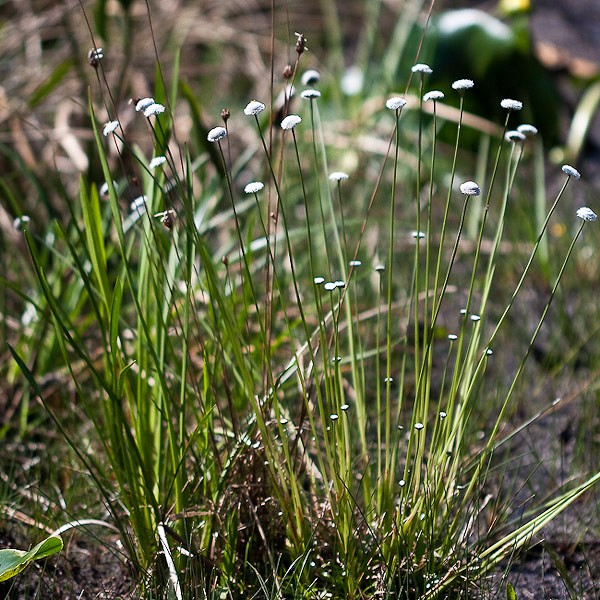
Attractive in the midwinter sunshine are species of Eriocaulon and similar genera in the Pipewort Family. They go by several English names: Hat Pins, Pipeworts, Bog Buttons.  Some folks hitch the different English names to individual genera, but the species all look too much alike for single handles to stick to single species.  The flower stalks truly do look like hat pins, the plants standing from a few inches tall to knee-high depending on the age, habitat, and species.

Eriocaulon compressum (by John Bradford)

Eriocaulon compressum (by John Bradford)

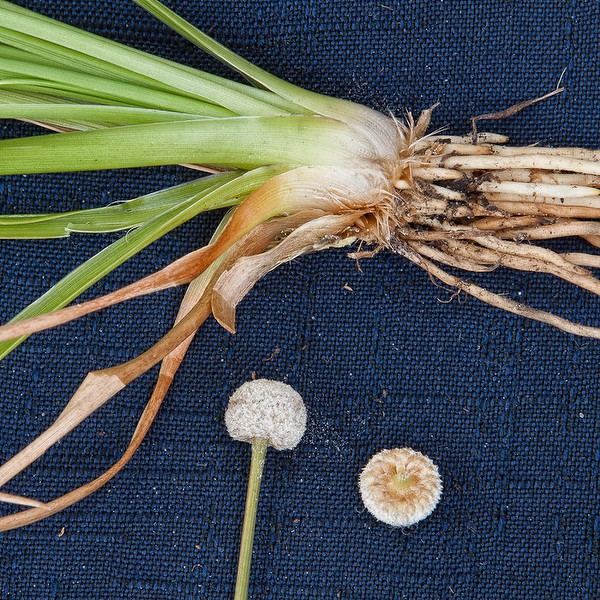
Now consider briefly a separate group of aquatic plants, the genus Isoetes, also known as quillworts.  There are plenty in Florida but not in our immediate haunts. The reason for an intrusive Isoetes non sequitur is to explain the name “isoetids,”   defined as plants resembling Isoetes not as genetic relatives, but as unrelated species sharing a peculiar aquatic growth form.  They look like slightly succulent grasses.  The plants have air channels in their leaves and roots, and have roots clustered intimately with the leaf bases. The root mass is disproportionately large relative to the foliage.

Ten-angle Pipestem, the root mass is intimate with the leaf bases, and there's a lot of root. (By John Bradford)

Ten-Angle Pipewort, the root mass is intimate with the leaf bases, and there’s a lot of root. (By John Bradford)

The isoetids have a unique life style to go with their characteristic life form.  The most abundant and thoroughly studied example  in our area is the so-called Ten-Angled Pipewort,  Eriocaulon decangulare. The similar Eriocaulon compressum has the same structure.

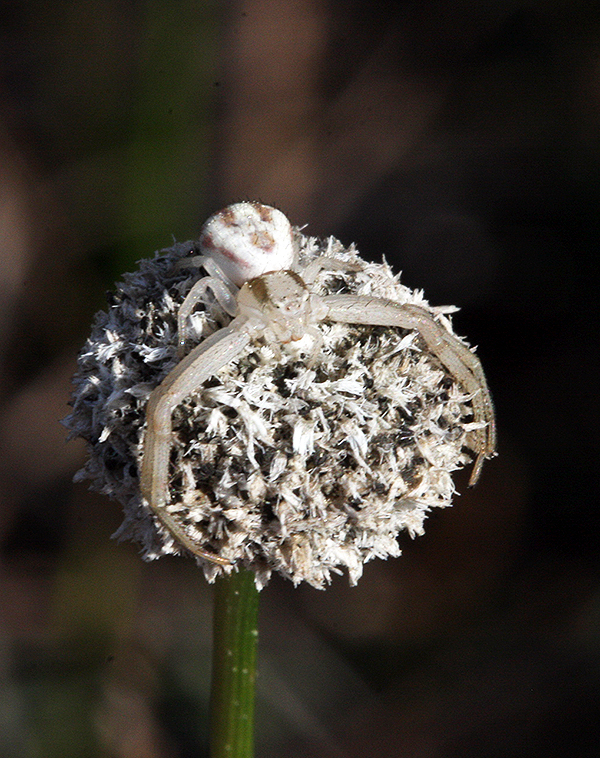
Eriocaulon compressum with hanger-on

Is this a tuffet?  Eriocaulon compressum with comfy guest

If you’ve read through the boring blah blah blah this far perhaps you’re waiting to see the shockingly unique life style unveiled. Here we go:  In second grade we all learned that plants absorb carbon dioxide through their foliage to let photosynthesis manufacture sugars. But today we learn that is not the whole truth and nothing but the truth.

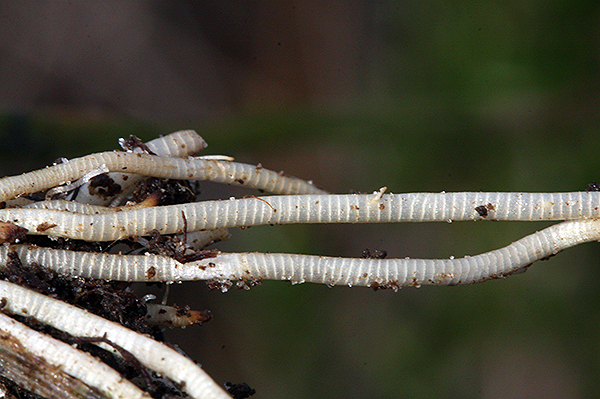
Ten-Angle Pipestem roots, showing air channels.  The following photo shows the same root cut open.    Gasses pass through the reinforcing cross-supports.

Space worms?  No,  Ten-Angle Pipewort roots, showing air spaces. The following photo shows the same root cut open. Gases pass through the porous reinforcing cross-supports.

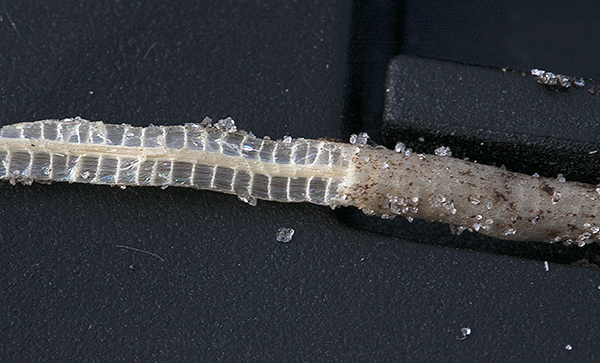
Eriocaulon decangulare root cut open

Eriocaulon decangulare root cut open to show the air channels

When you spy a plant with big puffy air channels in its leaves and roots, it is natural to assume a ductwork system open to the clear blue sky.  Those roots need help down in the mud!  But no—wrong, or partly wrong.   Here’s the problem. Many isoetids live completely submerged with no opening to the air.   Ooops, we have the airshaft upside down—-they are exchanging gases through the roots.

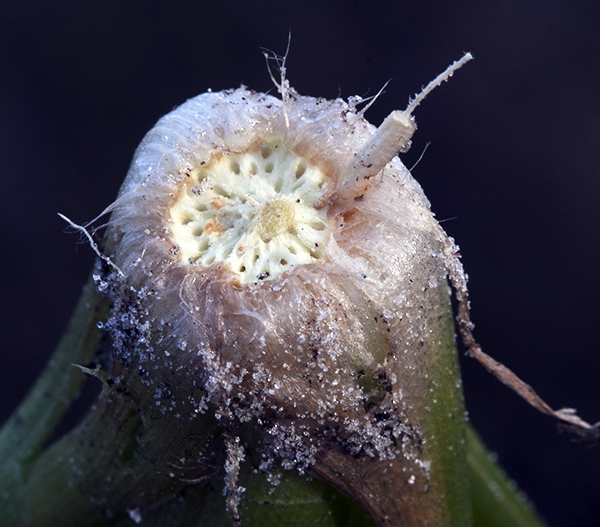
Ten-Angle Pipewort root-stem-leaf junction upside-down.  The fluffy material around the margin are inverted leaf bases.  The porous white center is the inverted stem base with its air channels.  At 2 o'clock a single inverted  root enters the system delivering CO2 immediately at the leaf bases and the stem air-channels.  (The thin thread at the tip of the root is a vein left behind when the spongy exterior was stripped off.)

Ten-Angle Pipewort root-stem-leaf junction root end-up. The fluffy material around the margin are leaf bases. The porous white center is the inverted stem base with its air channels. At 2 o’clock a single upside-down root delivers CO2 immediately at the leaf bases and at the stem air-channels. (The thin thread at the tip of the root is a vein left behind when the spongy exterior was stripped off.)

A completely or partially submerged plant lives in stinky goo with plenty of decay going on down there. The roots absorb carbon dioxide from soil microbial activity, bacterial waste gas,  sending the CO2 upward to the leaves for photosynthesis. And waste oxygen escapes down and out through the roots.

This creates the possibility of symbiotic relationships with soil bacteria happy to “breathe” that waste oxygen exiting the roots, and eager to make carbon dioxide to enter the roots.  Maybe those bacteria are even decaying material the plant produces.  I’ll bet that’s happening with Eriocaulon, but am not aware of research showing it in that genus.  Gas-exchange symbiosis with root bacteria is, however, documented in Isoetes itself.  Just think, the entire cycle of life, a mini ecosystem, all in one cubic foot of soil. Maybe.

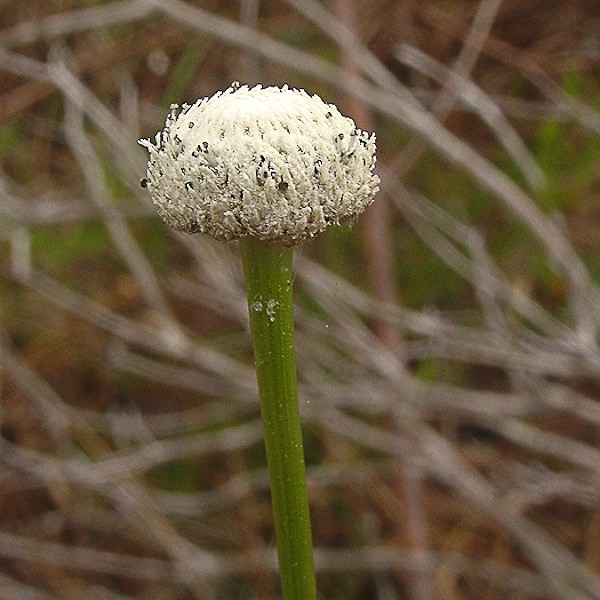
Ten-angle pipestem flower head (by John Bradford)

Ten-Angle Pipewort flower head (by John Bradford)

———————————————-

Note.  For a deeper look: Raven, J. A. et al.  The role of CO2 uptake and CAM in acquisition of inorganic C by plants of the isoetid life-form: a review, with new data on Eriocaulon decangulare L.  New Phytologist 108: 125-148. 1988.

 
1 Comment

Posted by on January 29, 2015 in Eriocaulon


Tags: ,