Hypericum fasciculatum
(Hyper-means above, and -icum comes from the same root as icon, above the icon, referring to the historical use of some species to adorn religious icons. A fascicle is a bunch, such as a cluster of leaves.)
Clusiaceae
St. Johnsworts are many…around 500 species, 50-ish in the U.S., around 30 in Florida. They are well known for bioactive contents, photosensitizing the skin of human and beast after consumption, locoweeds, and medicinal uses, especially to fight depression. These things are all over the internet, and therefore of no new interest here. More fun to go into less-documented aspects of Peelbark St. Johsnwort, Hypericum fasciculatum.
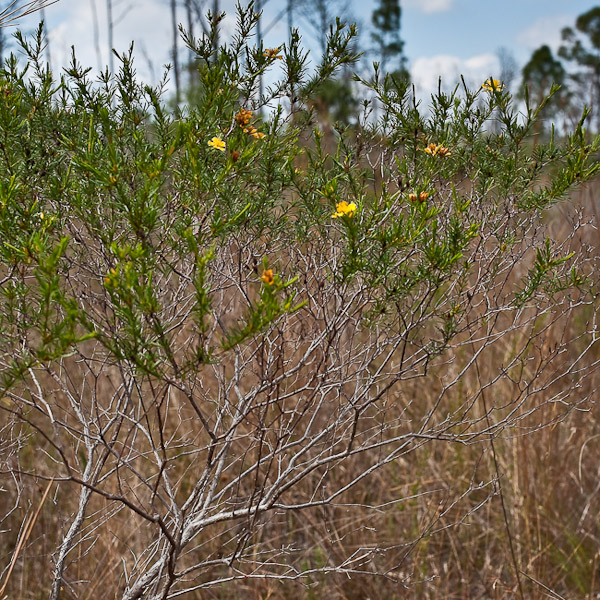
PBSJW. Today’s pictures all by John Bradford.
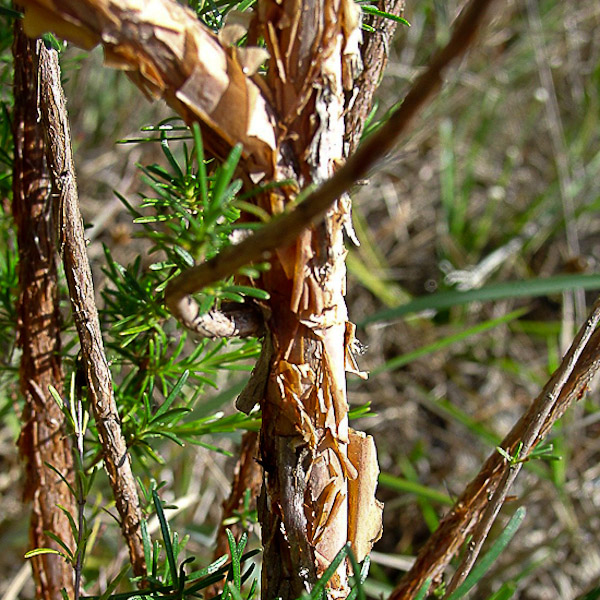
So then, first, why “peelbark”? Hypericum fasciculatum is mostly a species of seasonally inundated marshes…you might say “Hypericum marshes”…and of wet shores. It spends much of its time up to its knees in water. Seasonally flooded plants have a problem: ventilating their roots during highwater times. Want another seasonally inundated plant with similar peeling spongy bark? Bald Cypress knee bark resembles Peelbark St. Johnswort. Those porous barks no doubt aerate the above-water regions. in my opinion the exposure in Bald Cypress sustains the living phloem just under (actually part of) the bark. In the St. Johnswort the peeling bark perhaps likewise feeds the phloem, and possibly ventilates the roots which have two special adaptations of their own.
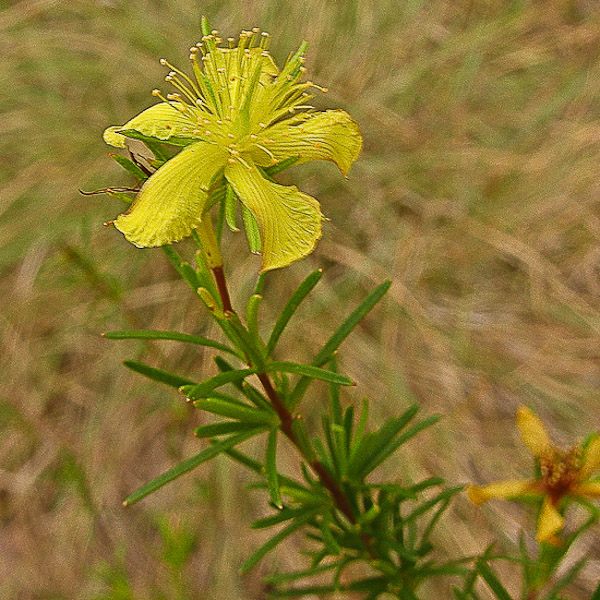
The first special adaptation is the formation of “adventitious” (on the stem) roots near the high water level. This tendency has served during the dry months as a marker of erstwhile high water limits.
The second special root adaptation is a series of air channels (aerenchyma). Botanists who have studied similar roots in similar species have found the channels to help maintain optimal levels of the airborne hormone ethylene.
Why would an aquatic plant with unlimited water have narrow needlelike leaves resembling a dryland conifer? It looks like a desert plant. So does its marshland neighbor corkwood, Stillingia aquatica. One answer is probably that semi-impaired suffocating roots are unable to service large broad leaves well, and a second reason for skinny “desert” leaves seems to be those challenging months when the shrub is high and dry.
Here is a fishy mystery to ponder. Why do Hypericum fasciculatum plants in bodies of water having fish manage a stronger seedset than those in fish-free habitats? No. the answer is not “fish manure fertilizer.” Sometimes ecological relationships are fun to unravel, as UF ecologist T.M. Knight and collaborators did in 2005. Fish eat dragonfly larvae. Dragonflies eat bees and things. Bees and things pollinate PBSJW. So no fish = many dragonflies = scarce pollinators. If fish abound, however, so do the pollinators and the seeds.
 John Bradford
 George Rogers
 George Rogers
 Dee Staley
 Treasure Coast Natives
Kathie
June 29, 2020 at 3:56 pm
I just want you to know how much I enjoy your presentations. Thank you, Kathie Benson
Sent from my iPhone
George Rogers
August 16, 2020 at 3:20 pm
Thanks Kathie! Just now found your comment…and so appreciated.
Flower Roberts
June 30, 2020 at 2:52 pm
I need you to check out my post on Passion vine blooms. I want to know why the pistils change position.
George Rogers
July 2, 2020 at 9:30 am
Passionvines are protandrous…that is male before female. They start out with the pistils out of the game, then they move in for their turn in the female phase.
Flower Roberts
July 2, 2020 at 11:36 am
Thanks for a new term and concept. I knew the you would know.