Polypremum procumbens
(Polypremum loosely translates as many-branched, and procumbens means “lies down” without rooting from the stems)
Tetrachondraceae
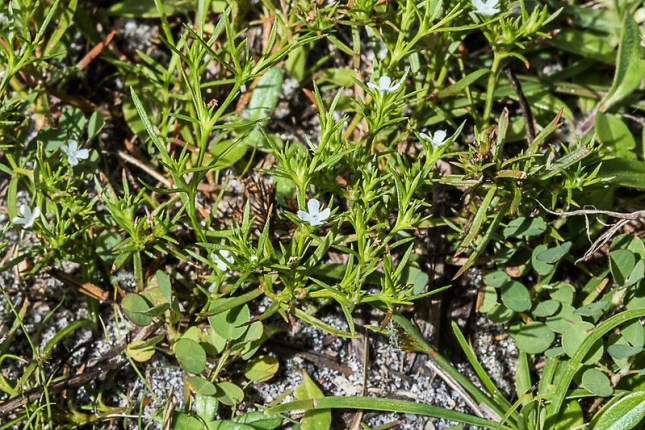
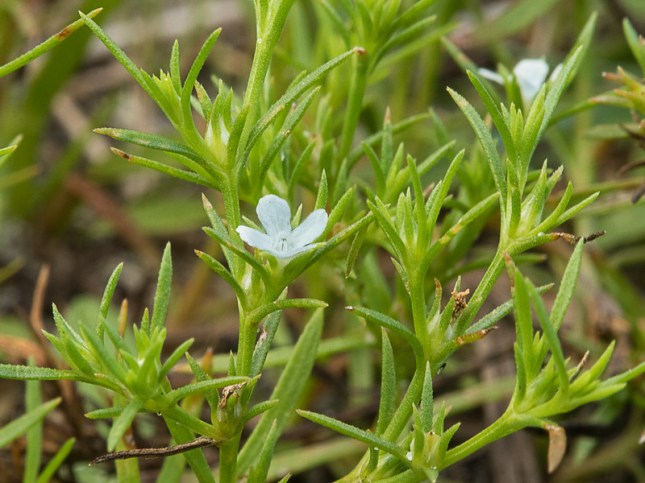
Rustweed is a curious little thing. Merely figuring out its relationships was a botanical head-scratcher for a couple centuries until DNA came along to solve all mysteries. It lives on sun-baked sandy surfaces from Florida to Mexico and to the northeastern U.S., very abundant around Palm Beach County. Branching is Y-shaped, and the paired leaves look like little sawtooth daggers.
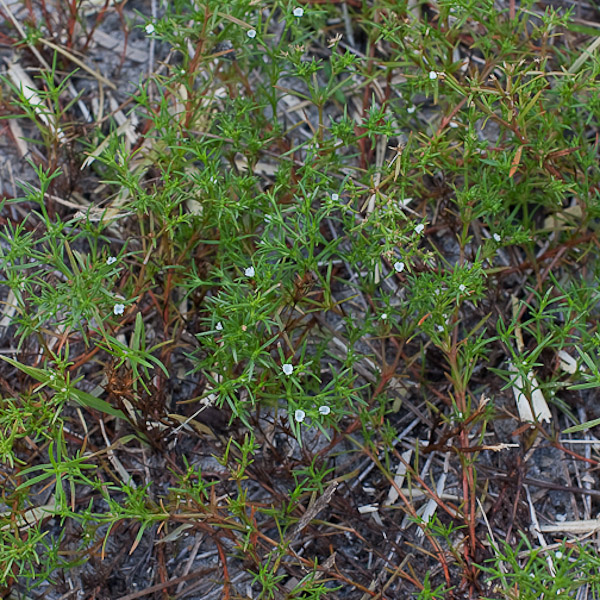
Today’s non-microscope and non-butterfly pictures by John Bradford.
The first of three Polypremum oddities is that the plants transform from leafy green to rusty orange-brown at times of extreme sun exposure or drought. They are not dying…merely getting a tan. Do they go back from rusty to light green? I don’t think so. Somebody ought to conduct a comparative study on their performances and tolerances in the two phases. Do the rusty plants thrive under stresses green ones can’t handle? Do the green ones grow faster under favorable conditions?
A second oddity is microscopic and beyond my photographic ability, so below is a drawing from a 19th Century German treatise on plant hairs.
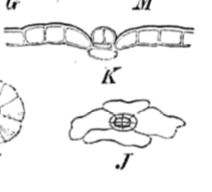
The leaves have on their undersides microscopic “glands” with a beautiful structure and recessed into the leaf surface. What do they do? I’ve been wondering that since the 80s. We often think of glands on leaves as producing nectar to favor defensive ants. Not in this case. To make a varnish to protect the leaf? Naw, wrong placement. To excrete excess salt? I doubt it, wrong habitat. Drain excess water? Water-secreting structures are common, but these have the wrong structure and placement, rejected. You know what they look like to me? The complex structures on Tillandsia leaves that function in part to take in water in a stressfully dry habitat.
Did somebody say stressfully dry habitat? You know, like Rustweed-inhabited sand in a Florida scrub. Speaking speculatively, I’m guessing those little “glands” help take in precious water from rain, mist, and dew out on those parched sands. Might be tough to test and prove without sophisticated gear, although weed scientists have shown plant hairs on other species to take up herbicides in water. Things that matter get studied. One quick test that might suggest or nix water intake would be to see if the leaves gain weight upon foliar water exposure, with no water applied to the root.
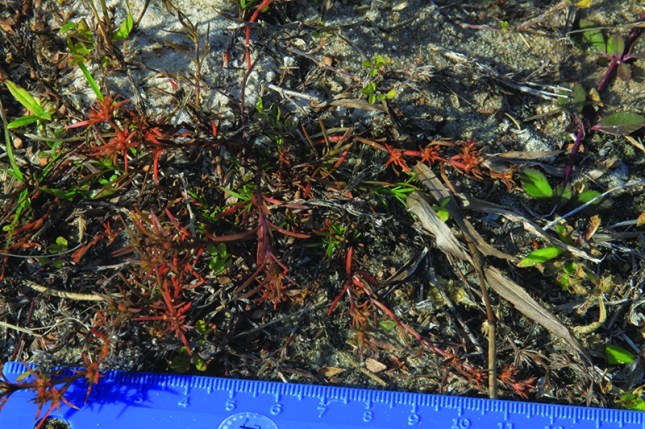
With a tan
Oddity number 3 requires a speedy pre-lesson. In a flowering plant’s sexual cycle, to make a long story short, the pollen grain sprouts a tube called the pollen tube, and the pollen tube delivers the sperm to the egg inside the future seed. The textbooks tell us the pollen grain with its seminal cargo arrives from another plant thanks to the birds and bees. Textbooks lie.
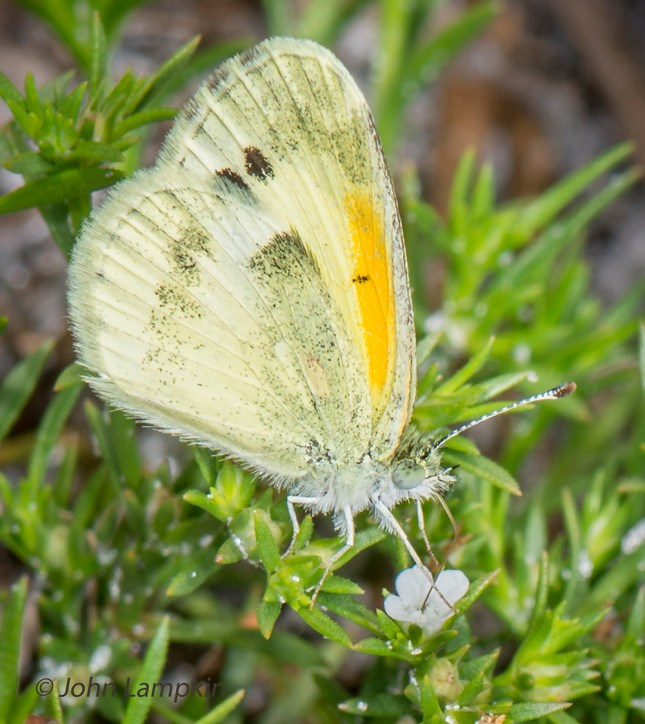
Dainty Sulfur meets Rustweed, contributed by John Lampkin
Suppose you are a lone Rustweed, bereft of that “another plant,” established by a wind-blown seed on some remote sandy patch to colonize. Rustweed has colonized Hawaii, Guam, and Palau. How can it reproduce all alone and isolated? Not a problem, as iconic botanists Asa Grapy and John Torrey noted back in 1841. They found Polypremum to germinate its pollen tubes within the flower that made them, no need for pesky birds and bees. That germinated pollen (i.e. with pollen tube) takes care of fertilization without ever leaving its home flower. As far as I can tell, nobody has re-noticed or mentioned it since, although various forms of self-pollination are not rare. That 179-year assertion by Torrey and Gray had to be checked, what if they were wrong OMG!!!, so I brought some Polypremum home today for a look. They were correct, the pollen trapped inside the flowers is still sporting pollen tubes rarin’ to go.
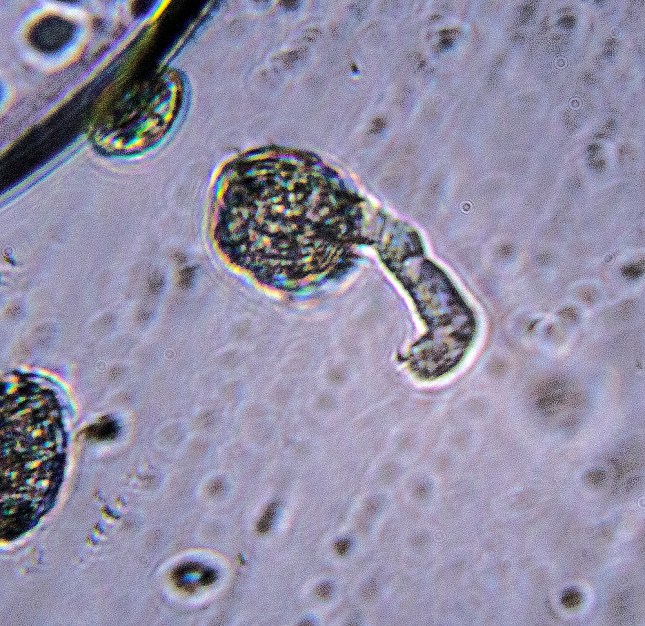
Pollen with its pollen tube hanging around today inside the flower that made it.
 John Bradford
 George Rogers
 George Rogers
 Dee Staley
 Treasure Coast Natives