Bacopa monnieri and Bacopa caroliniana
Hyssop is an ancient name, including in the Bible, applied to any of many fragrant herbs. Bacopa comes from an indigenous South American name. Louis-Guillaume Le Monnier (1717-1799) was a French scientist whose interests extended to botany.)
Plantaginaceae
Members of the genus Bacopa are easy to overlook, and in wet muddy habitats. Most passers by probably step on them. The flowers are pretty although not eye-popping. Despite their unassuming modesty, bacopas are botanical wack-a-moles popping up in disparate connections. Four species live in Florida, two native (including B. caroliniana with blue flowers), one (B. monnieri ) debatably indigenous, and one introduced.
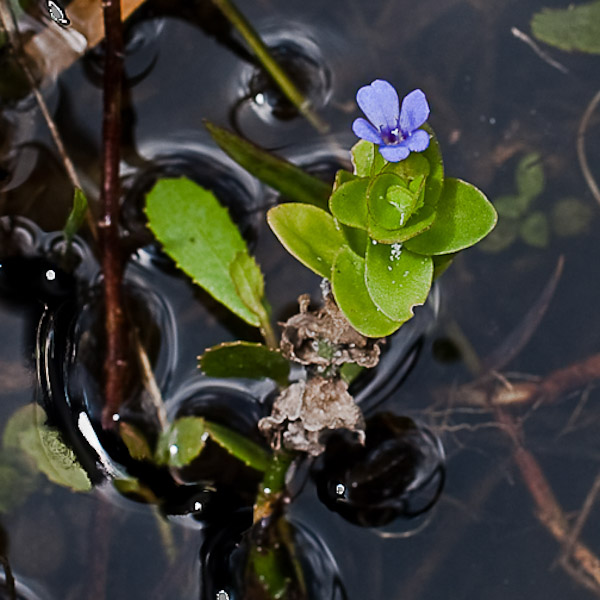
B. caroliniana by John Bradford.
Aquanauts
Bacopas are among an intriguing clique of species able to grow underwater like seaweeds yet also happy high and dry. Pretty handy for Florida habitats submerged part of the year and sun-baked mud the rest of the year. The underwater ability is why you can buy them as aquarium plants, and that in turn is in part probably why today’s species are invasive exotics in other lands. A second probable contributing factor to their global spread is via cultivation as ancient medicines. Bacopa monnieri is so widespread worldwide it is hard to know its original “nativity.” It is an invasive problem species in Hawaii, the Cayman Islands, and in eastern Asia. Bacopa caroliniana has made it to South Korea.
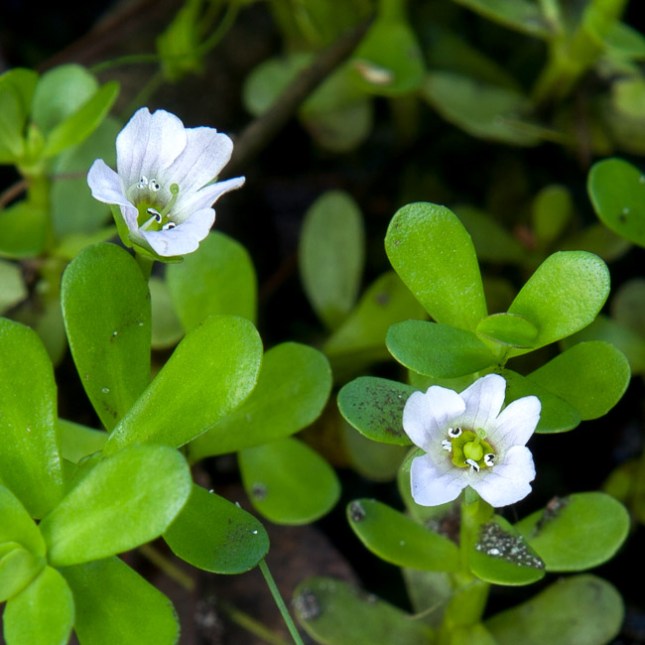
Bacopa monnieri by John Bradford.
Green Lanterns
Taiwanese researchers infused gold nanoparticles into Bacopa caroliniana, and it glowed like a botanical LED. That ability could be harnessed. Big thinkers thought, well, it that works in a sprawling water weed, onward to living street lights? You saw it here first.
Friend of the White Peacock
My wife Donna and I have spent Corona-time over-tending our backyard butterfly garden and its little villagers. Among the gorgeous visitors have suddenly appeared a profusion of White Peacock butterflies. They are broad in their floral tastes, yet picky about their larval host plants, in fact, limited mostly to species of Bacopa and Phyla (Fogfruit, aka Frogfruit). Behind our house is a broad canal, at this moment almost dry, the exposed mud with big patches of Bacopa. I’d go out now and try to photo a Peacock caterpillar but it is raining.
Lemony Fresh Nerve Poison
The name Lemon Bacopa fits Bacopa caroliniana. Empowered with that knowledge, you will never struggle to identify it…just scratch and sniff. Ahhhh, a cleansing whiff of lemon. No trip to the mudflats is complete without it. As with most plant stinkiness, we’re talking herbivore deterrence. A 2019 study showed it to have a similar mode of nerve-poison action against insects as commercial organophosphate insecticides, such as Malathion. Knowing that, no thanks on Bacopa medications. (Please don’t eat the wildflowers.) Fact is, Bacopas are green chemical factories and not everything in them is harmless.
Don’t Forget This
Want a medicinal plant? Go outside and pick a specimen, bring it in and Google it. Somebody somewhere has applied it for something. That goes double for fragrant species. So why delve into the usually boring realm of old plant uses here and now? Because Bacopas, especially B. monnieri, are monsters of medicinal applications worldwide. Always interesting when multiple separate human cultures find similar uses for a given plant. Here is just one example of B. monnieri’s fan mail from hundreds:
Most of the historical uses center on the nervous system. Neurological (and additional) effects have brought B. monnieri into the fold of modern medicinal interest. Many parties feel the herb and its extracts enhance cognition, and may even help in Alzheimers, which could be true with the caveat that the world of plant-derived medicines tends to be very very optimistic. Really, it had me with host plant for White Peacocks.
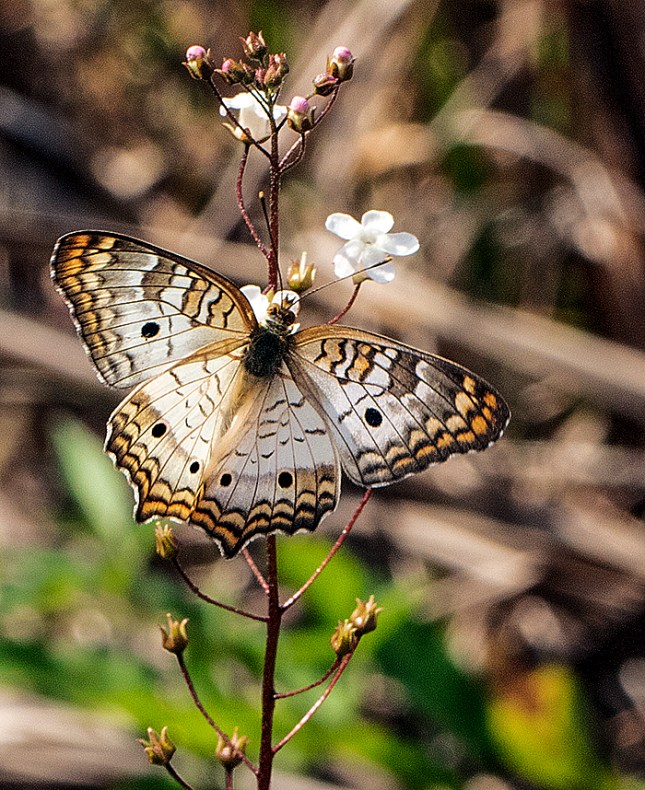
 John Bradford
 George Rogers
 George Rogers
 Dee Staley
 Treasure Coast Natives
Diane Goldberg
May 16, 2020 at 7:27 am
The Florida Plant Atlas says Bacopa innominate, Tropical Waterhyssop is also a native.
George Rogers
May 16, 2020 at 9:27 am
yuppers
Linda Cooper
May 16, 2020 at 8:01 am
I always enjoy your plant discussions and would like to post this on Facebook to my page as well as Florida Butterflies page. I don’t know how to put in a link to it. Can you give me any guidance on that please. Your photo of White Leacock is just stunning. Thanks so much. Linda Cooper
Sent from Linda’s iPad Pro
>
George Rogers
May 16, 2020 at 9:23 am
Hi Linda, Nice to hear from you. I’m not the most tech savvy individual around, but long ago I learned to post the blog to FB. At the very bottom of the post under “Johns and my blog this week” appears (at least for me) a cluster of buttons. One of them is Facebook. When you hit it, a question pops up asking if you want to post the item to FB. I hope you see the same options. If not, the post has a shareable link which is https://wp.me/p1H7HW-2Hw
Mary Starzinski
May 16, 2020 at 2:54 pm
So I guess it wasn’t a good idea for the naturalist at Grassy Waters to have us eat the leaf of B. caroliniana…or is it only the flower that acts as a nerve poison. Hope you’re doing ok. KP and I are both working the COVID Hotline at the Dept of Health. Pretty crazy. Hope I get some Peacock babies on mr Fogfruit!
George Rogers
May 17, 2020 at 8:17 am
May the babies come! Maybe I’m finicky, but I would not put anything in my mouth from Grassy Waters waters…can Giardia ride on wetland foliage? But mainly, in the Bacopa chemical array are a bunch of alkaloids (always potentially troublesome), saponins (ditto), and anti-cholinesterase activity just like oh let’s say the popular systemic insecticide Orthene (acephate). Orthene kills insects by interfering with cholinesterase, as does Bacopa (and additional plants). Interestingly, in the search for what to do about Alzheimers excess acetylcholine seems to be a suspect contributing factor (far beyond my botanical world), and using acephate OR Bacopa have been mentioned in the same publication as worth a look for slowing Alzhimers…a little insecticide might help. Otherwise…hmmmmm.
The hotline work sounds like a wonderful positive use of covid-time. Hopefully not too severe in Martin Co.,
theshrubqueen
May 17, 2020 at 4:34 pm
Wonderful, George. I have had one White Peacock and I thought it was hosting on the native Porterweed!? not that I saw the cats. Mysteries. People eat Bacopa on Florida Gardening Friends…
Diane Goldberg
May 18, 2020 at 7:33 pm
My book Florida Butterfly Caterpillars by Marc C. Minno, Jerry F. Butler, and Donald W. Hall says that Turkey Tangle Fogfruit, Phyla nodiflora, is also a host plant for the White Peacock.
George Rogers
May 22, 2020 at 9:50 pm
True enough…see the paragraph under the heading friend of the white peacock…
Diane Goldberg
May 23, 2020 at 9:01 am
Sorry I missed that. Thank you.